Electric Window Opener Market Size, Share & Demand Report By Product Type (Chain Electric Window Openers, Linear Electric Window Openers, Rack and Pinion Electric Window Openers, Folding Arm Electric Window Openers), By Application (Residential Buildings, Commercial Buildings, Industrial Facilities, Institutional Buildings), By End Use (New Construction, Retrofit and Renovation) By Region & Segment Forecasts, 2026–2034
USD 3950
Market Overview
The global Electric Window Opener Market size was valued at USD 2.48 billion in 2026 and is projected to reach USD 5.21 billion by 2034, expanding at a CAGR of 9.7% during the forecast period from 2026 to 2034. The market is witnessing steady growth due to rising investments in smart infrastructure, increasing adoption of automated ventilation systems, and growing emphasis on energy-efficient commercial buildings. Electric window openers are widely integrated into residential, commercial, and industrial structures to improve indoor air quality, reduce manual operation, and support advanced building automation systems.
The growing construction of green buildings across developed and emerging economies continues to support market expansion. Governments and private developers are increasingly focusing on automated ventilation solutions that reduce energy consumption and improve occupant comfort. Electric window openers are becoming an essential component in modern architecture due to their compatibility with smart sensors, remote monitoring systems, and fire safety technologies. The increasing use of automated windows in hospitals, educational facilities, office buildings, airports, and manufacturing units has further strengthened industry demand.
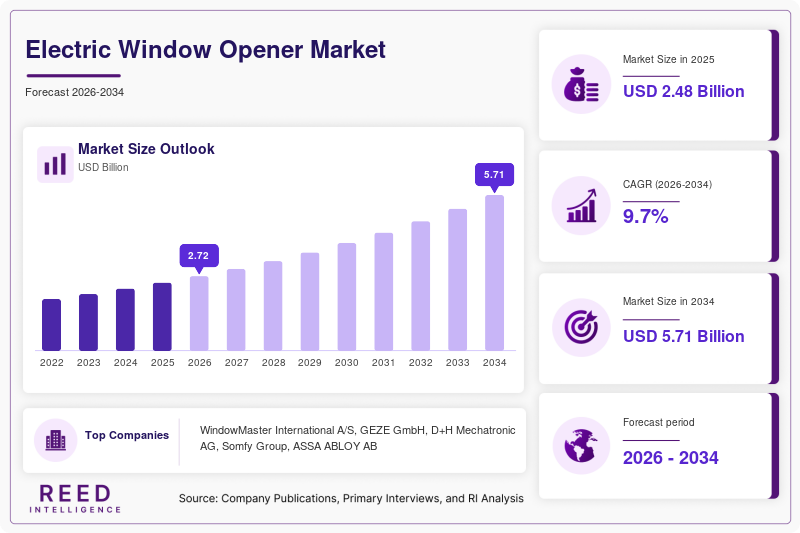
Key Highlights
- North America dominated the market with a 34.2% share in 2025
- Asia Pacific is expected to grow at the fastest CAGR of 11.2% during 2026–2034.
- By product type, chain electric window openers accounted for the largest share of 39.1%, while linear electric window openers are projected to grow at a CAGR of 11.8%.
- By application, commercial buildings led with a 44.5% share, whereas industrial facilities are expected to expand at a CAGR of 10.9%.
- The United States remained the dominant country, with market values of USD 620 million in 2024 and USD 685 million in 2025.
Market Trends
Smart Building Integration Supporting Product Demand
The increasing adoption of smart building technologies is emerging as a major trend in the Electric Window Opener Market. Modern buildings are integrating automated systems to improve energy efficiency, occupant comfort, and ventilation control. Electric window openers are increasingly connected with centralized building management systems, allowing automated operation based on temperature, humidity, air quality, and occupancy levels. This integration helps reduce energy costs while improving operational efficiency in commercial and institutional facilities.
The trend is especially visible in office buildings, hospitals, hotels, and educational institutions where ventilation management plays a critical role. Wireless electric window opener systems equipped with remote monitoring features are gaining traction among facility managers. Manufacturers are also focusing on compact and silent motor technologies that improve user experience in residential and premium commercial properties. The expansion of IoT-enabled infrastructure and demand for intelligent ventilation solutions are expected to accelerate the deployment of advanced electric window opener systems across global markets.
Growing Adoption of Automated Smoke Ventilation Systems
The increasing emphasis on fire safety and smoke ventilation systems is another significant trend shaping the market. Electric window openers are widely used in smoke extraction systems to improve emergency ventilation in commercial and industrial structures. Regulatory authorities in several countries are implementing stricter building safety regulations that require automated smoke ventilation systems in high-rise buildings, malls, airports, and manufacturing plants.
The demand for electric window openers integrated with emergency response systems is rising because these products help release smoke and heat during fire incidents. Construction companies and architects are prioritizing automated smoke ventilation in modern infrastructure projects. Additionally, retrofitting activities in aging buildings are creating demand for advanced electric actuators and window control systems. Increasing investments in public infrastructure and commercial real estate projects are expected to support the long-term growth of smoke ventilation-related applications within the Electric Window Opener Market.
Market Drivers
Rising Construction of Energy-Efficient Buildings
The growing focus on sustainable and energy-efficient buildings is driving the demand for electric window opener systems worldwide. Governments and environmental organizations are promoting green construction standards to reduce energy consumption and carbon emissions. Electric window openers contribute to natural ventilation management, reducing dependence on mechanical cooling systems in commercial and residential buildings.
Building owners are increasingly adopting automated ventilation technologies to maintain indoor air quality while lowering electricity usage. The integration of electric window openers with environmental sensors enables optimized airflow management according to external weather conditions and indoor occupancy levels. This trend is particularly strong in urban areas where sustainable construction activities are increasing rapidly. As green building certifications gain importance across the construction industry, the adoption of automated window control systems is expected to increase significantly during the forecast period.
Expansion of Commercial Infrastructure Projects
Rapid growth in commercial infrastructure development is another key factor supporting market expansion. Large-scale investments in office spaces, airports, healthcare facilities, shopping complexes, and hospitality projects are increasing the requirement for automated window systems. Electric window openers are increasingly used in commercial structures to improve convenience, ventilation control, and operational safety.
Commercial developers are adopting advanced automation systems to improve building performance and enhance occupant comfort. Electric window openers are also becoming common in industrial facilities where controlled ventilation is essential for worker safety and equipment efficiency. The growing preference for modern architectural designs featuring large windows and skylights is further supporting product demand. In addition, infrastructure modernization projects in emerging economies are creating favorable opportunities for manufacturers operating in the Electric Window Opener Market.
Market Restraint
High Installation and Maintenance Costs Limiting Adoption
The relatively high installation and maintenance costs associated with electric window opener systems remain a major restraint for market growth. Automated window systems require specialized actuators, wiring infrastructure, control panels, and sensor integration, which increases the initial investment for end users. Small residential property owners and cost-sensitive commercial developers often prefer conventional manual systems due to budget limitations.
Maintenance requirements also create operational challenges, particularly in large commercial buildings where multiple automated windows are installed. Electrical failures, actuator wear, and sensor malfunctions may increase maintenance expenses over time. In developing regions, limited technical expertise and lower awareness regarding smart ventilation systems further restrict adoption. Additionally, fluctuations in raw material prices and electronic component costs can affect product pricing and profitability for manufacturers. These factors collectively limit the widespread adoption of electric window opener systems in certain price-sensitive markets despite growing interest in building automation technologies.
Market Opportunities
Increasing Demand for Retrofitting Projects
The growing number of retrofitting and renovation projects across commercial and institutional buildings is creating significant opportunities for market participants. Aging buildings in developed economies are increasingly being upgraded with automated ventilation systems to improve energy efficiency and meet modern building standards. Electric window openers are widely adopted in retrofit projects because they enhance ventilation management without requiring complete structural modifications.
Property owners are investing in automation upgrades to reduce energy costs and improve occupant comfort. Retrofitting projects in hospitals, schools, and office complexes are particularly contributing to market growth. Manufacturers are responding by introducing compact and wireless electric window opener systems that simplify installation in existing structures. The increasing focus on sustainable building renovation programs is expected to create long-term growth opportunities for the Electric Window Opener Market during the forecast period.
Expansion of Smart Residential Construction
The rising popularity of smart homes and connected residential infrastructure presents another major growth opportunity for the market. Consumers are increasingly adopting automated home technologies that improve convenience, security, and energy management. Electric window openers integrated with smart home ecosystems allow users to control windows remotely through mobile applications and voice-controlled assistants.
Demand for intelligent ventilation systems is increasing in premium residential projects, particularly in urban regions with high adoption of home automation technologies. Manufacturers are developing aesthetically compact and energy-efficient electric window opener systems designed specifically for residential use. Growing disposable income, rising awareness regarding indoor air quality, and increasing investments in luxury housing projects are expected to support product adoption. The continuous expansion of connected home infrastructure is likely to strengthen future market opportunities for electric window opener manufacturers worldwide.
Segmental Analysis
By Product Type
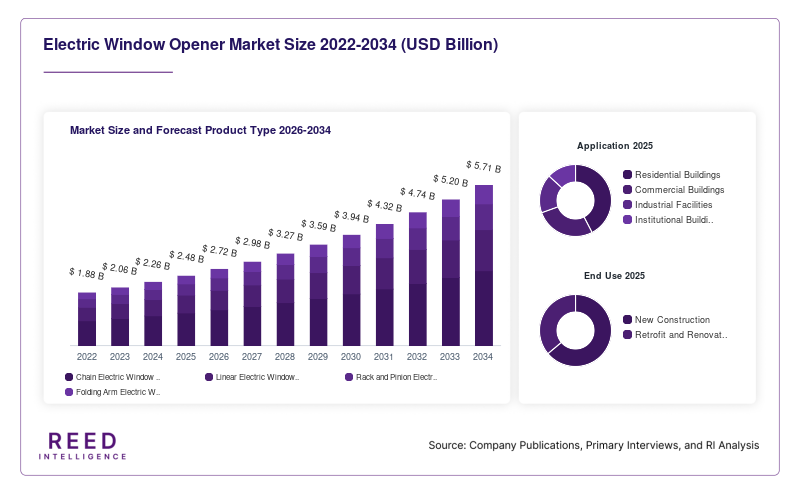
Chain electric window openers held the dominant share of 39.1% in 2024 due to their extensive application across residential and commercial buildings. These systems are widely preferred because of their compact design, easy installation process, and suitability for various window configurations. Chain openers are commonly integrated into skylights, roof windows, and side-hung windows where controlled ventilation is required. The growing adoption of smart building technologies has further increased the use of chain electric openers equipped with remote operation capabilities and automated sensor integration.
Linear electric window openers are projected to expand at the fastest CAGR of 11.8% during the forecast period. Their ability to support heavy-duty windows and large ventilation structures is driving demand across industrial and commercial facilities. Linear systems are increasingly adopted in manufacturing plants, warehouses, airports, and shopping complexes where higher opening force and durability are essential. Manufacturers are focusing on developing advanced linear actuators with lower power consumption and improved operational efficiency. The rising preference for large architectural glass structures in commercial buildings is expected to support future growth within this subsegment.
By Application
Commercial buildings accounted for the largest market share of 44.5% in 2024 due to increasing deployment of automated ventilation systems in office spaces, hospitals, hotels, airports, and educational institutions. Building operators are increasingly investing in intelligent ventilation technologies to improve indoor air quality and reduce energy consumption. Electric window openers are also integrated into smoke ventilation systems to support emergency safety measures in commercial properties. Growing smart building investments and modernization of urban infrastructure continue to strengthen demand within this segment.
Industrial facilities are expected to register the fastest CAGR of 10.9% during the forecast period due to rising demand for automated ventilation and environmental control systems. Manufacturing units, warehouses, and processing facilities require efficient airflow management to maintain operational safety and worker comfort. Electric window openers are increasingly used in industrial settings to improve heat extraction and ventilation efficiency. The expansion of industrial automation and the increasing establishment of large-scale production facilities in emerging economies are expected to support sustained growth in this segment over the coming years.
By End Use
The new construction segment dominated the Electric Window Opener Market in 2024 with a substantial share due to rapid growth in smart residential and commercial building projects worldwide. Developers are increasingly incorporating automated ventilation systems during initial construction phases to improve energy efficiency and comply with modern building standards. Electric window openers are becoming common in green building projects where natural ventilation plays an important role in reducing energy consumption. The continuous expansion of urban infrastructure and commercial real estate development remains a major contributor to segment growth.
The retrofit and renovation segment is anticipated to grow at the fastest CAGR of 10.7% during the forecast period. Existing buildings are increasingly being upgraded with automated systems to improve ventilation efficiency and reduce operational costs. Building owners are investing in retrofit projects to meet evolving environmental regulations and improve occupant comfort. Wireless electric window opener systems designed for easy integration into existing structures are gaining significant popularity. Rising government initiatives supporting energy-efficient renovation programs are expected to create long-term growth opportunities within the retrofit segment.
Regional Analysis
North America
North America accounted for 34.2% of the global Electric Window Opener Market share in 2025 and continues to maintain a strong position due to advanced construction technologies and widespread adoption of smart building systems. The region is expected to expand at a CAGR of 8.9% during the forecast period. High investments in commercial real estate, increasing demand for automated ventilation systems, and strong implementation of fire safety regulations are supporting regional growth. The adoption of intelligent building management systems across office buildings and healthcare facilities further contributes to market expansion.
The United States remains the dominant country within North America due to rising smart infrastructure investments and strong demand for energy-efficient buildings. Commercial property developers are increasingly integrating automated window systems into modern office spaces and institutional facilities. The presence of established manufacturers and rapid technological advancements in IoT-enabled ventilation systems continue to strengthen the country’s market position. Additionally, retrofitting projects across aging commercial buildings are generating consistent demand for advanced electric window opener systems.
Europe
Europe represented a significant share of the Electric Window Opener Market in 2025 and is projected to grow at a CAGR of 8.5% through 2034. The region benefits from strict environmental regulations promoting energy-efficient construction practices and sustainable building technologies. Countries across Europe are increasingly adopting automated ventilation systems to reduce energy consumption and improve indoor climate management. Growing investments in green commercial infrastructure and modernization of public buildings continue to support regional market growth.
Germany remains the leading country in the European market due to strong industrial automation capabilities and advanced construction standards. The country has witnessed increasing demand for automated smoke ventilation systems in commercial and industrial facilities. Smart city initiatives and the expansion of environmentally sustainable building projects are creating favorable conditions for product adoption. In addition, increasing integration of automated window systems in premium residential developments is contributing to the steady expansion of the German market.
Asia Pacific
Asia Pacific is anticipated to register the fastest CAGR of 11.2% during the forecast period due to rapid urbanization and expanding construction activities across emerging economies. The region is witnessing strong growth in commercial infrastructure projects, smart residential developments, and industrial facilities. Governments across Asia Pacific are investing heavily in modern transportation hubs, healthcare institutions, and educational buildings that increasingly incorporate automated ventilation technologies.
China dominates the Asia Pacific Electric Window Opener Market due to extensive urban development and large-scale investments in smart infrastructure. Rapid industrialization and growing awareness regarding energy-efficient buildings are supporting market demand across the country. The increasing adoption of automated ventilation systems in high-rise residential complexes and commercial buildings further strengthens growth opportunities. Additionally, local manufacturers are expanding production capacities and introducing cost-effective products to address rising regional demand.
Middle East & Africa
The Middle East & Africa market is experiencing moderate growth and is expected to expand at a CAGR of 8.1% during the forecast period. Increasing investments in commercial construction projects, luxury hotels, and smart city initiatives are driving regional demand for electric window opener systems. Countries in the Gulf region are increasingly focusing on sustainable building technologies that improve energy efficiency and indoor air circulation in high-temperature climates.
The United Arab Emirates remains the dominant country in the region due to rapid infrastructure modernization and large-scale commercial developments. Smart building integration is becoming increasingly common in premium residential and hospitality projects across cities such as Dubai and Abu Dhabi. The need for automated ventilation systems capable of operating efficiently in extreme climate conditions is supporting product adoption. Additionally, government initiatives promoting environmentally sustainable urban development are expected to create favorable market opportunities.
Latin America
Latin America accounted for a smaller but steadily growing share of the global market in 2025 and is projected to expand at a CAGR of 7.8% through 2034. Increasing urban infrastructure development and rising investments in commercial real estate are contributing to regional growth. The adoption of electric window opener systems is gradually increasing across office buildings, educational institutions, and healthcare facilities due to improving awareness regarding energy-efficient ventilation technologies.
Brazil dominates the Latin American market due to expanding urban construction activities and modernization of commercial infrastructure. Demand for automated window systems is increasing in large metropolitan areas where developers are adopting advanced building automation technologies. Rising investments in smart residential projects and improvements in building safety regulations are further supporting market growth. In addition, the growing hospitality sector is creating new opportunities for electric window opener installations across hotels and resort properties.

Competitive Landscape
The Electric Window Opener Market is characterized by the presence of international and regional manufacturers competing through product innovation, technological integration, and strategic partnerships. Companies are increasingly focusing on smart automation capabilities, energy-efficient actuator systems, and wireless connectivity features to strengthen market competitiveness. The industry is also witnessing increased investment in research and development activities aimed at improving product durability, silent operation, and compatibility with intelligent building management systems.
Chain actuator manufacturers and smart ventilation solution providers are expanding their product portfolios to address the growing demand from commercial infrastructure and industrial facilities. The market leader, WindowMaster International A/S, continues to strengthen its global position through advanced smoke ventilation solutions and integrated building automation systems. Recent developments include the launch of intelligent window control platforms compatible with IoT-based building management technologies.
Key Players
- WindowMaster International A/S
- GEZE GmbH
- D+H Mechatronic AG
- Ultraflex Control Systems
- Aprimatic S.p.A.
- Mingardi S.r.l.
- Nekos S.r.l.
- TOPP Srl
- Dorwin Ltd.
- AXA Fenster und Türen GmbH
- Somfy Group
- ASSA ABLOY AB
- Nitto Kohki Co., Ltd.
- SE Controls
- FAKRO Group
Recent Developments
- In 2025, GEZE GmbH introduced an advanced smart ventilation actuator system designed for integration with automated climate control platforms in commercial buildings.
- In 2024, Somfy Group expanded its smart home automation portfolio with wireless electric window opener solutions compatible with voice-controlled ecosystems.
- In 2025, D+H Mechatronic AG launched a new smoke ventilation control system focused on high-rise commercial infrastructure and industrial facilities.
Electric Window Opener Market Segments
Product Type
- Chain Electric Window Openers
- Linear Electric Window Openers
- Rack and Pinion Electric Window Openers
- Folding Arm Electric Window Openers
Application
- Residential Buildings
- Commercial Buildings
- Industrial Facilities
- Institutional Buildings
End Use
- New Construction
- Retrofit and Renovation
By Region
- North America
- Europe
- APAC
- Middle East and Africa
- LATAM