Electricity Ancillary Services Market Size, Share & Demand Report By Service Type (Frequency Regulation, Voltage Control, Spinning Reserve, Reactive Power Support, Black Start Services, Load Following Services), By End-Use (Utilities, Renewable Energy Operators, Industrial Facilities, Commercial Establishments, Independent Power Producers), By Application (Grid Balancing, Peak Load Management, Demand Response Management, Emergency Power Restoration, Renewable Energy Integration), By Region & Seg
USD 3950
Market Overview
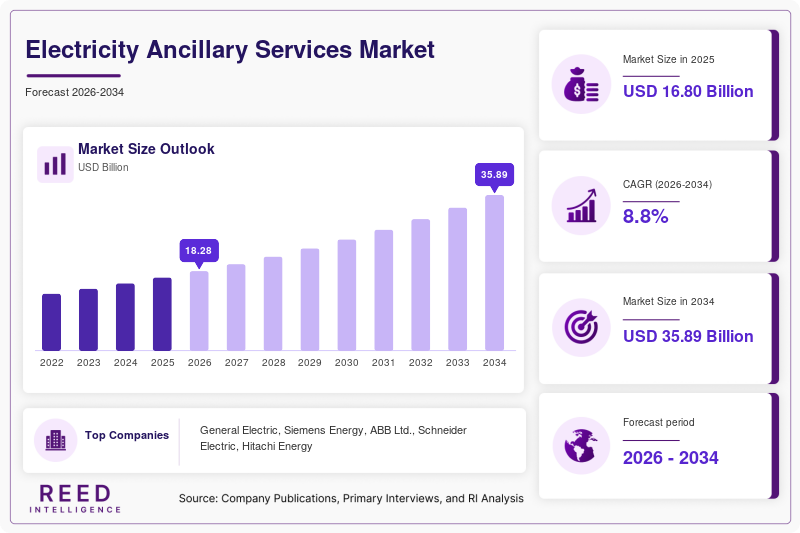
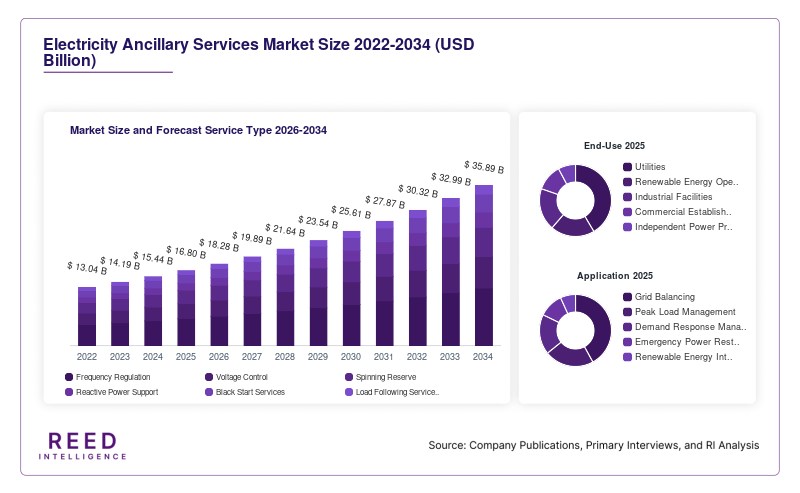
The global Electricity Ancillary Services Market size was valued at USD 16.8 billion in 2026 and is projected to reach USD 32.9 billion by 2034, expanding at a CAGR of 8.8% during the forecast period from 2026 to 2034. Electricity ancillary services include a broad range of grid-support functions such as frequency regulation, voltage control, spinning reserves, black start services, reactive power management, and load balancing solutions. These services are essential for maintaining grid reliability, stability, and operational efficiency in increasingly decentralized electricity systems. Growing deployment of renewable energy sources across developed and emerging economies has accelerated the need for flexible grid management systems, thereby supporting the expansion of the Electricity Ancillary Services Market.
One of the major global factors contributing to market growth is the rapid integration of renewable power generation into national electricity grids. Wind and solar energy systems often generate intermittent power, creating fluctuations in voltage and frequency levels. Grid operators and utilities are increasingly investing in ancillary services to stabilize electricity transmission networks and maintain uninterrupted supply. In addition, digitalization of energy infrastructure, expansion of battery energy storage systems, and implementation of smart grid technologies continue to strengthen market demand. Governments across North America, Europe, and Asia Pacific are also introducing supportive energy transition policies that encourage advanced grid balancing solutions and reserve capacity mechanisms.
Key Highlights
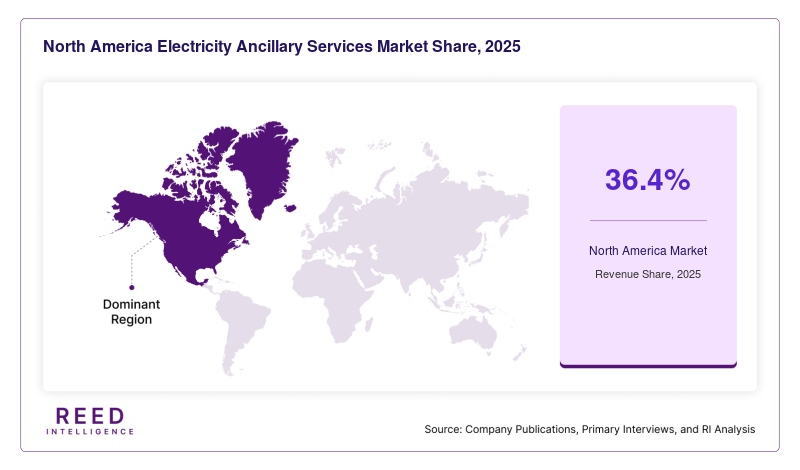
- North America dominated the market with a 36.4% share in 2025.
- Asia Pacific is expected to grow at the fastest CAGR of 10.9% during 2026–2034.
- By service type, frequency regulation accounted for the largest share of 39.1%, while black start services are projected to grow at a CAGR of 11.6%.
- By end-use, utilities led with a 47.8% share, whereas renewable energy operators are expected to expand at a CAGR of 12.3%.
- The United States remained the dominant country, with market values of USD 4.9 billion in 2024 and USD 5.4 billion in 2025.
Market Trends
Expansion of battery energy storage systems for grid balancing
Battery energy storage systems are becoming a central component in the Electricity Ancillary Services Market due to their ability to provide rapid-response frequency regulation and reserve support. Utilities and transmission operators are deploying lithium-ion and hybrid storage technologies to improve grid flexibility and reduce operational disruptions caused by renewable energy fluctuations. The increasing deployment of utility-scale battery projects across the United States, China, Germany, and Australia is reshaping ancillary service procurement models. Energy storage assets can respond within milliseconds, making them suitable for real-time balancing requirements and reducing dependence on conventional fossil-fuel-based reserve generation systems. This trend is expected to continue as grid operators seek efficient and low-emission balancing alternatives.
The integration of advanced battery analytics and artificial intelligence-based energy management systems is further improving operational performance in ancillary service applications. Energy storage operators are participating in competitive electricity balancing markets and generating additional revenue streams through demand response and reserve capacity programs. Falling battery prices and supportive government incentives are also improving project economics. Many utilities are now entering long-term contracts with storage providers to strengthen grid resilience. As renewable energy penetration increases globally, battery-backed ancillary services are expected to become a key component of future electricity infrastructure modernization strategies.
Increasing adoption of digital grid monitoring platforms
Digitalization is emerging as a major trend in the Electricity Ancillary Services Market as utilities and grid operators adopt intelligent monitoring systems to improve operational visibility and control. Smart sensors, predictive analytics, and automated grid management software are enabling real-time assessment of voltage fluctuations, load patterns, and reserve requirements. These technologies support efficient allocation of ancillary resources and reduce response time during grid disturbances. Utilities are increasingly investing in cloud-based control systems and automated substations to improve power quality and network stability. The transition toward digital grids is particularly strong in developed economies where aging infrastructure requires modernization.
Artificial intelligence and machine learning tools are also being used to forecast electricity demand and optimize ancillary service dispatch strategies. These solutions help utilities minimize operational costs while improving reliability standards. Digital platforms can process large volumes of grid performance data and identify potential disruptions before outages occur. In addition, cybersecurity investments are increasing as grid systems become more interconnected and digitally managed. The adoption of digital monitoring technologies is expected to create long-term opportunities for software providers, automation companies, and energy technology firms operating in the Electricity Ancillary Services Market.
Market Drivers
Rising renewable energy integration across power grids
The rapid growth of renewable energy installations is one of the primary drivers supporting the Electricity Ancillary Services Market. Wind and solar power generation are inherently variable, creating challenges related to voltage stability, frequency control, and reserve balancing. Grid operators require ancillary services to manage fluctuations and maintain uninterrupted electricity transmission. Countries including the United States, China, India, and Germany are significantly increasing renewable energy capacity to meet carbon reduction goals, resulting in stronger demand for flexible grid stabilization services. Utilities are also investing in reserve generation systems and energy storage technologies to support renewable integration without compromising grid reliability.
Renewable energy policies introduced by governments and regional energy authorities are further accelerating market growth. Feed-in tariffs, renewable portfolio standards, and clean energy transition targets are encouraging higher deployment of intermittent power generation sources. This transition has increased the need for real-time balancing mechanisms and fast-response ancillary solutions. Independent power producers and renewable energy operators are also participating in balancing markets to improve revenue generation. As global renewable electricity production continues to rise, the need for advanced ancillary services is expected to expand steadily during the forecast period.
Modernization of aging electricity transmission infrastructure
Aging electricity transmission and distribution networks are increasing the need for advanced ancillary service solutions worldwide. Many developed countries continue to operate legacy grid infrastructure that was originally designed for centralized fossil-fuel-based power generation. However, modern electricity systems now require greater flexibility to support distributed generation, electric vehicle charging networks, and decentralized renewable assets. Utilities are investing in grid modernization projects that include digital substations, smart meters, and automated voltage control technologies. These upgrades require efficient ancillary service management to ensure network reliability and reduce transmission disruptions.
Governments and regulatory authorities are supporting modernization initiatives through infrastructure investment programs and grid resilience policies. The deployment of smart grids is improving electricity flow management and enabling better integration of decentralized energy systems. Transmission operators are increasingly using advanced forecasting tools and automated balancing systems to manage peak demand periods. In addition, increasing electricity consumption from industrial and commercial sectors is placing greater pressure on grid infrastructure. These factors are collectively driving sustained demand for ancillary service technologies and operational support systems across global electricity markets.
Market Restraint
High operational costs associated with ancillary service deployment
High infrastructure and operational costs remain a significant restraint affecting the growth of the Electricity Ancillary Services Market. Establishing advanced balancing systems, reserve generation capacity, and automated voltage control infrastructure requires substantial capital investment. Utilities and transmission operators often face budget constraints when implementing modern ancillary service solutions, particularly in developing economies with limited energy infrastructure funding. Battery storage systems, digital grid platforms, and reactive power compensation technologies involve ongoing maintenance and integration expenses that can increase total operational costs over time.
Smaller utilities and regional grid operators may experience difficulties in deploying advanced ancillary service technologies due to limited technical expertise and financial resources. In some markets, outdated regulatory structures also limit private investment participation in ancillary service procurement. Inconsistent pricing mechanisms for reserve and balancing services can create uncertainty for service providers and investors. For example, emerging economies in parts of Africa and Latin America continue to face delays in grid modernization projects because of funding limitations and insufficient transmission infrastructure. These cost-related challenges may slow the adoption of advanced ancillary services despite rising electricity demand and renewable energy integration.
Market Opportunities
Growth of electric vehicle charging infrastructure
The expansion of electric vehicle charging infrastructure is creating significant opportunities for the Electricity Ancillary Services Market. Increasing adoption of electric vehicles is expected to place additional pressure on electricity grids, particularly during peak charging periods. Utilities and transmission operators are investing in demand response systems and load-balancing technologies to manage rising electricity consumption from public and residential charging stations. Vehicle-to-grid integration is also emerging as a promising solution that enables electric vehicle batteries to provide frequency regulation and reserve support services during periods of high grid demand.
Governments across Europe, Asia Pacific, and North America are implementing policies to accelerate electric vehicle adoption and charging network expansion. These developments are increasing the need for intelligent grid management systems capable of handling variable charging loads efficiently. Energy companies are collaborating with automotive manufacturers and charging infrastructure providers to develop integrated ancillary service solutions. Advanced charging platforms equipped with real-time monitoring capabilities are expected to improve grid flexibility and create additional revenue opportunities for energy storage operators participating in balancing markets.
Expansion of decentralized and microgrid energy systems
The growing adoption of decentralized energy systems and microgrids is creating new growth opportunities in the Electricity Ancillary Services Market. Commercial facilities, industrial plants, hospitals, and remote communities are increasingly deploying localized power systems to improve energy reliability and reduce dependence on centralized grids. These systems require advanced ancillary support functions such as voltage regulation, load balancing, and black start capabilities to ensure uninterrupted power supply during outages or grid instability. Microgrids powered by renewable energy and battery storage technologies are becoming more common in both developed and developing economies.
Utilities and technology providers are investing in intelligent energy management platforms that enable decentralized systems to participate in ancillary service markets. Industrial operators are also exploring onsite reserve generation solutions to improve operational resilience and reduce energy costs. The increasing frequency of extreme weather events and grid disruptions is encouraging businesses to adopt self-sustaining power infrastructure supported by advanced balancing services. As decentralized energy networks continue to expand globally, ancillary service providers are expected to benefit from rising demand for flexible and localized grid stabilization solutions.
Segmental Analysis
By Service Type
Frequency regulation emerged as the dominant subsegment within the service type category and accounted for 39.1% of the market share in 2024. This segment plays a critical role in maintaining balance between electricity generation and consumption across transmission networks. Utilities and grid operators rely heavily on frequency regulation services to stabilize grid performance and prevent power outages caused by sudden fluctuations in electricity demand. Growing integration of renewable energy systems has increased the importance of fast-response balancing services capable of managing intermittent power generation. Transmission operators across North America and Europe continue to invest in advanced frequency control infrastructure supported by energy storage technologies and automated grid management platforms.
Black start services are expected to register the fastest CAGR of 11.6% during the forecast period due to rising focus on grid resilience and disaster recovery capabilities. Black start systems enable power restoration following large-scale grid failures without requiring external electricity supply. Increasing frequency of extreme weather events and cyber-related grid security concerns are encouraging utilities to strengthen restoration infrastructure. Governments and energy regulators are also introducing stricter reliability standards for electricity networks, driving investment in reserve generation assets and emergency response systems. The growing adoption of decentralized power systems and microgrids is further supporting demand for advanced black start service capabilities.
By End-Use
Utilities accounted for the largest share of 47.8% in the end-use segment during 2024 due to their extensive involvement in electricity transmission and grid reliability management. Public and private utility operators are the primary purchasers of ancillary services such as voltage support, reserve balancing, and reactive power management. Increasing electricity demand from residential, commercial, and industrial sectors is encouraging utilities to modernize transmission systems and improve operational flexibility. Many utility companies are deploying artificial intelligence-driven grid monitoring platforms and battery storage systems to enhance balancing efficiency. Regulatory requirements for electricity reliability and renewable integration continue to support strong ancillary service adoption among utility operators worldwide.
Renewable energy operators are projected to expand at the fastest CAGR of 12.3% during the forecast period. Wind farms and solar power producers increasingly depend on ancillary services to manage intermittent electricity generation and comply with grid stability standards. Energy storage integration and predictive forecasting tools are helping renewable operators improve operational performance while participating in balancing markets. Governments are also encouraging renewable producers to contribute to ancillary service provision through supportive policy frameworks and incentive programs. As renewable energy capacity continues to expand globally, renewable power operators are expected to become increasingly important participants in ancillary service ecosystems.
By Application
Grid balancing represented the leading application segment and captured 43.5% of the market share in 2024. The increasing complexity of modern electricity networks has strengthened the need for balancing services capable of maintaining stable power flow and minimizing transmission disruptions. Utilities and system operators are using advanced balancing mechanisms to manage fluctuations caused by renewable energy generation, industrial electricity demand, and peak load conditions. Grid balancing solutions are also essential for supporting cross-border electricity transmission and ensuring consistent voltage stability. The expansion of smart grid infrastructure and automated energy management systems is contributing significantly to the growth of this application segment.
Demand response management is expected to witness the fastest CAGR of 11.8% during the forecast period due to increasing focus on electricity consumption optimization and peak load reduction strategies. Demand response systems enable utilities to adjust electricity usage patterns based on real-time grid conditions, thereby improving operational efficiency and reducing balancing costs. Industrial facilities, commercial buildings, and residential consumers are increasingly participating in demand response programs through smart metering and digital energy platforms. The growth of electric vehicle charging infrastructure and distributed energy resources is also increasing the need for flexible demand-side management solutions across global electricity markets.
Regional Analysis
North America
North America accounted for 36.4% of the global Electricity Ancillary Services Market share in 2025 and continues to maintain a leading position due to strong investment in smart grid infrastructure and battery energy storage deployment. The region is projected to grow at a CAGR of 8.1% during the forecast period. Increasing penetration of renewable energy across the United States and Canada has accelerated demand for frequency regulation and reserve balancing services. Utilities are actively modernizing transmission systems to support decentralized electricity generation and improve operational reliability.
The United States remains the dominant country in North America due to large-scale renewable energy integration and advanced electricity market structures. Regional transmission organizations are implementing competitive ancillary service procurement frameworks that encourage participation from independent power producers and energy storage operators. Growing deployment of electric vehicle charging infrastructure and utility-scale battery projects is further strengthening market demand. Investments in artificial intelligence-driven grid management platforms also contribute to regional market expansion.
Europe
Europe represented 27.1% of the global Electricity Ancillary Services Market in 2025 and is expected to expand at a CAGR of 8.5% through 2034. The region benefits from ambitious decarbonization goals and high renewable electricity generation capacity. Countries across the European Union are increasing investment in cross-border transmission systems and grid balancing mechanisms to maintain electricity reliability. Rising offshore wind installations and distributed solar generation continue to support demand for ancillary service solutions, particularly in frequency regulation and voltage management applications.
Germany remains the dominant country within the European market due to its extensive renewable energy infrastructure and advanced grid modernization initiatives. The country is investing heavily in battery storage systems and flexible reserve generation assets to stabilize electricity supply. In addition, regulatory support for decentralized energy participation in balancing markets is encouraging innovation among energy technology providers. Increasing adoption of digital substations and automated grid monitoring systems is also supporting long-term market development.
Asia Pacific
Asia Pacific held 22.6% of the global Electricity Ancillary Services Market share in 2025 and is projected to witness the fastest CAGR of 10.9% during the forecast period. Rapid urbanization, rising electricity demand, and large-scale renewable energy deployment are driving regional market expansion. Countries such as China, India, Japan, and Australia are investing in smart grid projects and utility-scale battery storage facilities to strengthen electricity reliability. Growing industrialization is also increasing the need for advanced reserve and balancing services across regional power networks.
China dominates the Asia Pacific market due to extensive renewable energy capacity additions and large transmission infrastructure investments. The country continues to expand ultra-high-voltage transmission networks and energy storage projects to manage electricity demand fluctuations effectively. Government initiatives supporting clean energy integration and grid digitalization are contributing to rising ancillary service demand. India is also emerging as a high-growth market due to increasing solar and wind energy installations combined with ongoing electricity sector modernization efforts.
Middle East & Africa
The Middle East & Africa region accounted for 7.4% of the global Electricity Ancillary Services Market in 2025 and is expected to grow at a CAGR of 7.7% during the forecast period. Increasing investment in renewable energy projects and electricity infrastructure development is supporting regional demand for ancillary services. Countries in the Gulf Cooperation Council are modernizing power transmission systems to improve operational efficiency and reduce dependence on fossil-fuel-based electricity generation. Grid stabilization services are becoming increasingly important as renewable penetration rises across regional electricity networks.
Saudi Arabia remains the dominant country in the region due to ongoing energy diversification programs and large-scale renewable energy investments. The country is implementing smart grid initiatives and advanced power management systems to improve electricity reliability and operational flexibility. Expansion of industrial zones and urban infrastructure projects is increasing electricity demand, thereby supporting ancillary service deployment. South Africa is also investing in grid modernization and reserve balancing systems to address power supply reliability concerns.
Latin America
Latin America captured 6.5% of the global Electricity Ancillary Services Market share in 2025 and is projected to expand at a CAGR of 7.9% through 2034. Rising electricity demand and increasing renewable energy investments are supporting regional market growth. Countries across the region are developing flexible grid systems to integrate hydroelectric, wind, and solar power generation efficiently. Utilities are investing in voltage control systems, reserve capacity solutions, and digital monitoring platforms to improve transmission reliability and reduce power disruptions.
Brazil remains the leading country in the Latin American market due to its extensive electricity generation infrastructure and growing renewable energy sector. The country is increasing investment in smart transmission networks and balancing technologies to support hydropower variability and renewable integration. Expansion of industrial activities and urban electricity consumption is creating additional demand for ancillary services. Mexico is also strengthening electricity infrastructure modernization efforts to improve grid efficiency and support long-term energy transition goals.
Competitive Landscape
The Electricity Ancillary Services Market is moderately consolidated, with major energy companies, grid operators, and technology providers competing through infrastructure modernization, digital grid integration, and renewable energy partnerships. Companies are increasingly investing in battery energy storage systems, artificial intelligence-based grid analytics, and automated reserve balancing platforms to strengthen market position. Strategic collaborations between utilities and technology firms are becoming common as grid operators seek advanced balancing capabilities and operational flexibility.
General Electric emerged as one of the leading participants in the market due to its broad portfolio of smart grid technologies, grid automation systems, and energy management solutions. In 2025, the company expanded its digital grid operations platform to improve real-time ancillary service optimization for renewable-heavy electricity networks. Siemens Energy, ABB, Schneider Electric, and Hitachi Energy also maintain strong market presence through investments in transmission automation and battery-integrated balancing systems. Market participants are focusing on long-term utility contracts, software innovation, and regional expansion strategies to strengthen competitive positioning across developed and emerging electricity markets.
Key Players
- General Electric
- Siemens Energy
- ABB Ltd.
- Schneider Electric
- Hitachi Energy
- Mitsubishi Electric Corporation
- Eaton Corporation
- Toshiba Energy Systems & Solutions Corporation
- Honeywell International Inc.
- NextEra Energy Resources
- Enel Green Power
- Duke Energy Corporation
- National Grid plc
- Wärtsilä Corporation
- Fluence Energy
Recent Developments
- In March 2026, Siemens Energy introduced an advanced grid balancing platform integrated with battery storage analytics to improve frequency regulation efficiency for renewable-heavy power systems.
- In October 2025, Hitachi Energy partnered with a regional transmission operator in North America to deploy digital substations and automated reserve balancing infrastructure across multiple electricity networks.
- In January 2026, Fluence Energy expanded its utility-scale battery storage operations in Asia Pacific to support ancillary service demand associated with rising renewable electricity generation.
- In August 2025, ABB Ltd. launched a cloud-based voltage control solution designed to improve real-time grid stability and transmission monitoring capabilities for utility operators.
- In February 2026, Schneider Electric announced the deployment of an artificial intelligence-driven energy management platform focused on optimizing ancillary service dispatch and reducing grid balancing costs.
Electricity Ancillary Services Market Segments
Service Type
- Frequency Regulation
- Voltage Control
- Spinning Reserve
- Reactive Power Support
- Black Start Services
- Load Following Services
End-Use
- Utilities
- Renewable Energy Operators
- Industrial Facilities
- Commercial Establishments
- Independent Power Producers
Application
- Grid Balancing
- Peak Load Management
- Demand Response Management
- Emergency Power Restoration
- Renewable Energy Integration
By Region
- North America
- Europe
- APAC
- Middle East and Africa
- LATAM