Electrodynamic Shaker System Market Size, Share, Growth & Industry Demand Report By Type (Electrodynamic Shaker Equipment, Vibration Sensors, Control & Simulation Software), By Application (Structural Testing, Fatigue Testing, Functional Testing, Durability & Reliability Testing), By End-Use Industry (Aerospace & Defense, Automotive & Electric Vehicles, Electronics & Semiconductor, Industrial Manufacturing, Research & Academic Institutes), By Region & Segment Forecasts, 2026–2034
USD 3950
Market Overview
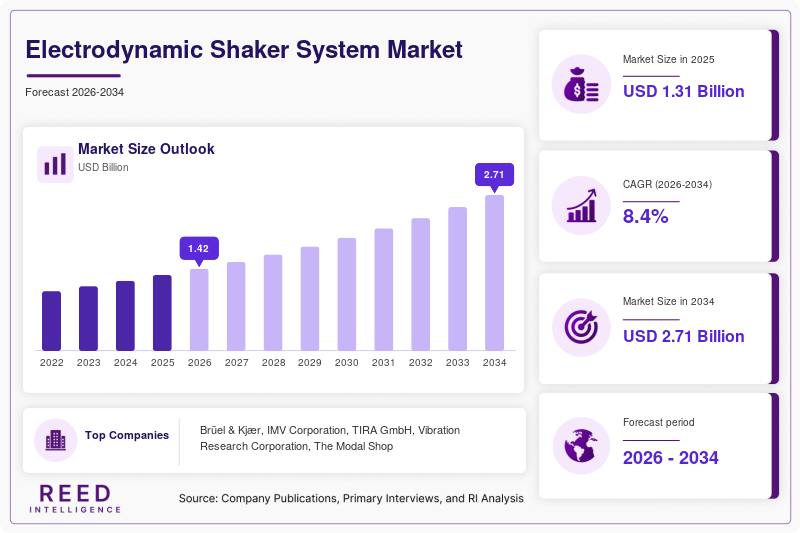
The Electrodynamic Shaker System Market is projected to reach USD 1.42 billion in 2026 and is expected to attain USD 2.71 billion by 2034, registering a CAGR of 8.4% during 2026–2034. The market is witnessing steady expansion due to rising demand for precision testing equipment used in aerospace, automotive, defense, and electronics industries. These systems are widely used for vibration testing, product validation, and durability assessment under simulated real-world conditions.
A major global factor supporting market growth is the increasing focus on product reliability and regulatory compliance across high-performance industries. Manufacturers are investing in advanced testing systems to ensure structural integrity and reduce product failure risks. Additionally, the rapid expansion of electric vehicles and aerospace modernization programs has strengthened demand for vibration testing equipment, including electrodynamic shaker systems.
Key Highlights
- North America dominated the market with a 34.2% share in 2025.
- Asia Pacific is expected to grow at the fastest CAGR of 11.2% during 2026–2034.
- By equipment type, sensors accounted for the largest share of 38.5%.
- while software solutions are projected to grow at a CAGR of 12.4%.
- By application, structural testing led with a 41.7% share, whereas fatigue testing is expected to expand at a CAGR of 11.8%.
- The United States remained the dominant country, with market values of USD 510 million in 2024 and USD 560 million in 2025.
Market Trends
Integration of Digital Control and Smart Testing Systems
The Electrodynamic Shaker System Market is experiencing a shift toward digitally controlled and software-integrated testing platforms. Modern shaker systems are increasingly equipped with real-time monitoring capabilities, AI-based vibration analysis, and remote operation features. These advancements allow engineers to conduct precise simulation tests with minimal manual intervention. The integration of cloud-based platforms also enables centralized data management, improving traceability and test accuracy. Industries such as aerospace and automotive are adopting these systems to enhance product validation efficiency and reduce testing time cycles. Furthermore, digital control systems allow customization of vibration profiles, enabling highly specific testing scenarios aligned with industry standards. This trend is expected to accelerate as manufacturers prioritize automation and data-driven testing environments.
Rising Adoption in Electric Vehicle and Aerospace Testing
Another significant trend shaping the market is the growing use of electrodynamic shaker systems in electric vehicle (EV) and aerospace testing applications. With increasing EV production globally, manufacturers are focusing on battery durability, motor vibration resistance, and structural reliability testing. Similarly, aerospace companies are adopting advanced shaker systems to test components under extreme vibration conditions encountered during flight operations. The demand for lightweight materials and advanced composites has further necessitated precise vibration testing solutions. These systems ensure compliance with stringent safety and performance standards, thereby supporting their widespread adoption. The trend is expected to strengthen as global mobility and space exploration initiatives expand.
Market Drivers
Growing Demand for Product Reliability and Quality Assurance
One of the primary drivers of the Electrodynamic Shaker System Market is the increasing emphasis on product reliability and quality assurance across industries. Manufacturers are under pressure to deliver durable and high-performance products, especially in sectors such as automotive, aerospace, and defense. Electrodynamic shaker systems enable precise vibration simulation, helping identify structural weaknesses during product development stages. This reduces the risk of failure in real-world conditions and enhances brand reliability. Additionally, regulatory bodies are enforcing strict testing standards, further encouraging companies to adopt advanced vibration testing systems. The growing complexity of engineered products has also made traditional testing methods insufficient, boosting demand for high-precision electrodynamic systems.
Expansion of Aerospace, Defense, and Automotive Industries
The expansion of aerospace, defense, and automotive industries is significantly driving market growth. These sectors require rigorous testing of components exposed to high vibration environments. For example, aerospace components must withstand extreme launch and flight conditions, while automotive parts need durability validation under continuous vibration stress. The rise in defense modernization programs across various countries has also increased demand for advanced testing systems. Furthermore, the growth of electric vehicles has introduced new testing requirements for battery packs and powertrain systems. As these industries continue to expand globally, the need for electrodynamic shaker systems is expected to rise steadily.
Market Restraint
High Initial Investment and Maintenance Costs
A major restraint in the Electrodynamic Shaker System Market is the high initial investment and maintenance costs associated with these systems. Electrodynamic shaker systems require advanced components such as power amplifiers, cooling systems, and precision control units, which significantly increase overall costs. Small and medium-sized enterprises often face budget constraints, limiting their adoption of high-end testing systems. Additionally, maintenance and calibration requirements add to long-term operational expenses. Regular servicing is essential to maintain accuracy and system reliability, further increasing total cost of ownership. In developing regions, limited access to technical expertise and service infrastructure also restricts market penetration. These financial barriers can slow adoption rates, particularly among smaller testing laboratories and research institutions. Despite technological advancements, cost remains a key challenge affecting widespread implementation of electrodynamic shaker systems.
Market Opportunities
Expansion in Emerging Economies and Industrialization
Emerging economies present significant growth opportunities for the Electrodynamic Shaker System Market. Rapid industrialization in countries across Asia Pacific, Latin America, and the Middle East is increasing demand for advanced testing infrastructure. Governments are investing in aerospace, automotive, and electronics manufacturing sectors, which require reliable vibration testing systems. Additionally, the establishment of new research and development centers in these regions is driving demand for precision testing equipment. Local manufacturers are also increasingly adopting global quality standards, further boosting market penetration. The availability of cost-effective manufacturing facilities and supportive industrial policies enhances the attractiveness of these regions for market players. As industrial output continues to grow, the need for electrodynamic shaker systems is expected to rise significantly.
Technological Advancements in Simulation and Automation
Technological advancements in simulation and automation are creating new opportunities in the market. The integration of artificial intelligence, machine learning, and advanced control algorithms is improving the efficiency and accuracy of vibration testing systems. Automated shaker systems can now perform complex test sequences with minimal human intervention, reducing operational time and improving consistency. Additionally, simulation software integration allows engineers to replicate real-world conditions more accurately, enhancing product development processes. These innovations are particularly valuable in industries requiring high precision and compliance with stringent regulations. As digital transformation accelerates across industrial sectors, demand for intelligent and automated electrodynamic shaker systems is expected to grow.
Segmental Analysis
By Type
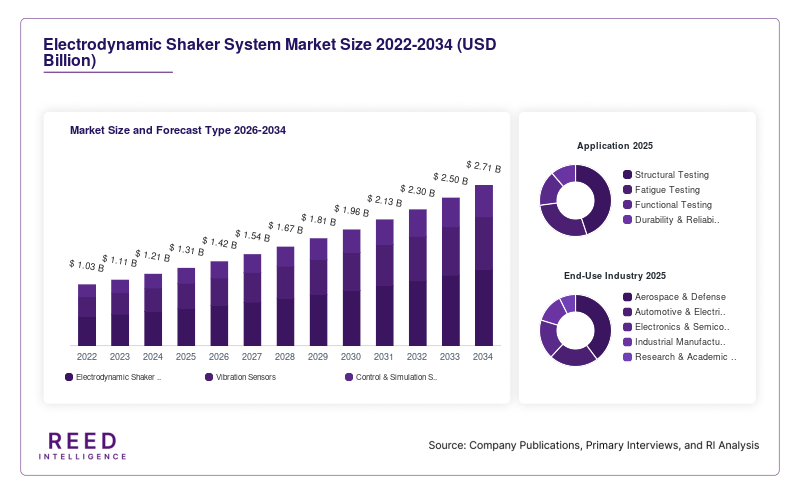
The equipment segment dominated the Electrodynamic Shaker System Market with a 2024 share of 46.3%, driven by widespread use in industrial vibration testing applications. Equipment includes shaker tables, amplifiers, and control units that form the core of testing systems. These components are essential for ensuring accurate simulation of real-world vibration environments across multiple industries. The high demand from aerospace and automotive sectors continues to support this dominance, as manufacturers rely heavily on physical testing infrastructure for validation purposes.
The software segment is the fastest-growing, expected to register a CAGR of 12.4%, driven by increasing adoption of digital simulation and automation technologies. Software solutions enable advanced data analysis, real-time monitoring, and test customization, improving overall system efficiency. The growing integration of AI-based predictive modeling and cloud connectivity is further enhancing the capabilities of software platforms in vibration testing environments.
By Application
Structural testing held the dominant share of 41.7% in 2024, as it is widely used for evaluating material strength and durability under vibration conditions. This application is critical in aerospace, automotive, and construction industries where structural integrity is essential. The demand for reliable testing systems ensures continued dominance of this segment.
Fatigue testing is expected to grow at a CAGR of 11.8%, driven by increasing focus on long-term durability assessment of components. Industries are increasingly using fatigue testing to predict product lifespan and prevent premature failures. The rising complexity of engineered materials further supports demand for advanced fatigue testing solutions.
By End-Use
The aerospace sector accounted for a 2024 share of 39.5%, making it the leading end-use segment. High reliance on vibration testing for aircraft components and space systems supports this dominance. Stringent regulatory requirements further reinforce adoption across aerospace manufacturers.
The automotive sector is expected to register the fastest CAGR of 10.9%, driven by electric vehicle expansion and increasing need for battery and drivetrain testing. The shift toward EV technology has significantly increased demand for advanced vibration simulation systems.
Regional Analysis
North America
North America accounted for approximately 34.2% market share in 2025, with a projected CAGR of 7.9% from 2026 to 2034. The region remains a key hub for advanced testing technologies due to strong industrial infrastructure and high R&D investments.
The United States is the dominant country in this region, driven by strong aerospace, defense, and automotive manufacturing sectors. The presence of established testing laboratories and regulatory frameworks requiring strict product validation standards supports continuous demand for electrodynamic shaker systems.
Europe
Europe accounted for approximately 27% of the market share in 2025 and continues to be a significant contributor to global demand. The region is characterized by a strong automotive manufacturing base and engineering excellence, particularly in countries such as Germany, France, and the UK.
The transition toward electric vehicles and emphasis on product safety and compliance are key growth drivers. Additionally, government regulations focused on quality assurance and sustainability are increasing the adoption of advanced vibration testing systems.
Asia Pacific
Asia Pacific is the fastest-growing region in the Electrodynamic Shaker System Market, with a projected CAGR exceeding 11% during 2026–2034. The region is witnessing rapid industrialization and expansion in manufacturing sectors, especially in China, Japan, South Korea, and India.
Increasing investments in aerospace, electronics, and automotive industries are boosting demand for testing equipment. Furthermore, the presence of cost-effective manufacturing facilities and rising R&D activities contribute to the region’s strong growth trajectory.
Middle East & Africa
The Middle East & Africa region is gradually emerging as a promising market, supported by infrastructure development and industrial diversification initiatives. Countries such as Saudi Arabia and the UAE are investing in advanced technologies and manufacturing capabilities.
The growing focus on aerospace and defense sectors, along with increasing demand for industrial testing solutions, is driving market growth. However, limited technical expertise in some areas may slightly restrain adoption rates.
Latin America
Latin America represents a smaller but steadily growing market, driven by expanding automotive and manufacturing industries. Brazil and Mexico are the key contributors to regional growth, supported by increasing industrial investments and modernization of testing facilities.
The demand for reliable product testing solutions is rising as manufacturers aim to meet global quality standards. Government initiatives to support industrial development are expected to further enhance market growth in the region.

Competitive Landscape
The Electrodynamic Shaker System Market is moderately consolidated, with leading players focusing on innovation, system integration, and global expansion strategies. Key companies include Vibration Research Corporation, Brüel & Kjær, The Modal Shop, IMV Corporation, and TIRA GmbH. These companies compete based on product accuracy, durability, and digital integration capabilities.
Among these, Brüel & Kjær holds a strong leadership position due to its advanced measurement and testing solutions portfolio. The company has recently introduced upgraded vibration control software with enhanced real-time analytics capabilities, improving testing precision and efficiency. Market players are increasingly investing in AI-enabled testing systems and modular shaker designs to improve operational flexibility and reduce system downtime.
Key Players List
- Brüel & Kjær
- IMV Corporation
- TIRA GmbH
- Vibration Research Corporation
- The Modal Shop
- Data Physics Corporation
- LDS Test and Measurement
- Sentek Dynamics
- Unholtz-Dickie Corp.
- EMIC Corporation
- TEAM Corporation
- Sauber Technologies
- Dongling Technologies
- Labworks Inc.
- APS Dynamics
Recent Developments
- In 2025, IMV Corporation launched a next-generation electrodynamic shaker system integrated with AI-based vibration control algorithms for precision testing applications.
- Brüel & Kjær expanded its software portfolio by introducing cloud-enabled vibration analysis tools designed for remote monitoring and predictive maintenance applications.
- TIRA GmbH announced the expansion of its manufacturing facility in Europe to increase production capacity for high-force shaker systems used in aerospace testing applications.
Electrodynamic Shaker System Market Segments
Type
- Electrodynamic Shaker Equipment
- Vibration Sensors
- Control & Simulation Software
Application
- Structural Testing
- Fatigue Testing
- Functional Testing
- Durability & Reliability Testing
End-Use Industry
- Aerospace & Defense
- Automotive & Electric Vehicles
- Electronics & Semiconductor
- Industrial Manufacturing
- Research & Academic Institutes
By Region
- North America
- Europe
- APAC
- Middle East and Africa
- LATAM