Electrolyzer Test System Market Size, Share & Demand Report By Equipment Type (Performance Testing Systems, Durability Testing Systems, Safety Testing Systems), By Application (Hydrogen Production Validation, Research & Development Testing, Quality Assurance), By End-Use (Energy & Utilities, Industrial, Research Institutions), By Region & Segment Forecasts, 2026–2034
USD 3950
Market Overview
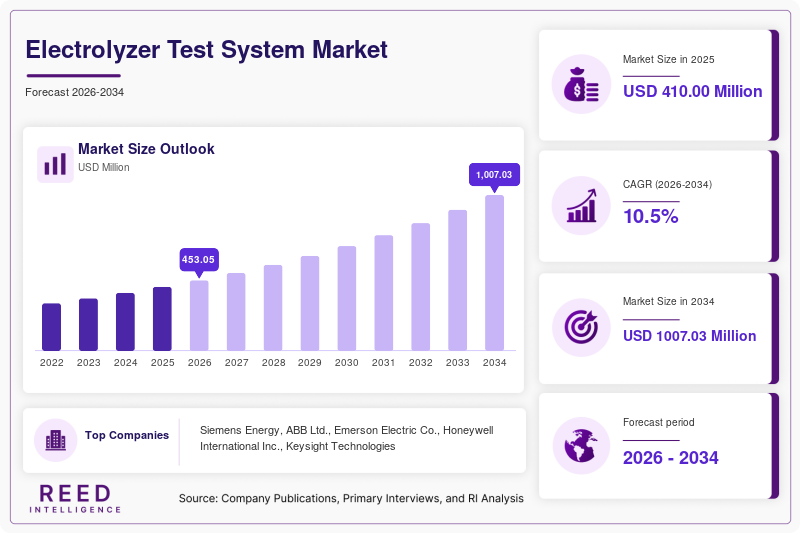
The Electrolyzer Test System Market was valued at approximately USD 410 million in 2026 and is projected to reach around USD 910 million by 2034, expanding at a CAGR of 10.5% during the forecast period (2026–2034). The market growth is primarily supported by the increasing global emphasis on hydrogen as a clean energy carrier. Governments and private organizations are investing in hydrogen production technologies, particularly water electrolysis, to decarbonize industrial operations and transportation sectors. This has led to a rising demand for advanced test systems that ensure performance validation, durability assessment, and efficiency optimization of electrolyzers.
Electrolyzer test systems are gaining traction as manufacturers strive to meet evolving performance standards and safety regulations. These systems provide precise monitoring of parameters such as voltage, current density, temperature, and gas purity. The expansion of green hydrogen projects, coupled with technological advancements in proton exchange membrane (PEM) and alkaline electrolyzers, has further accelerated the adoption of testing solutions. Additionally, the growing deployment of pilot hydrogen plants and research facilities continues to create a steady demand for sophisticated testing infrastructure.
Key Highlights
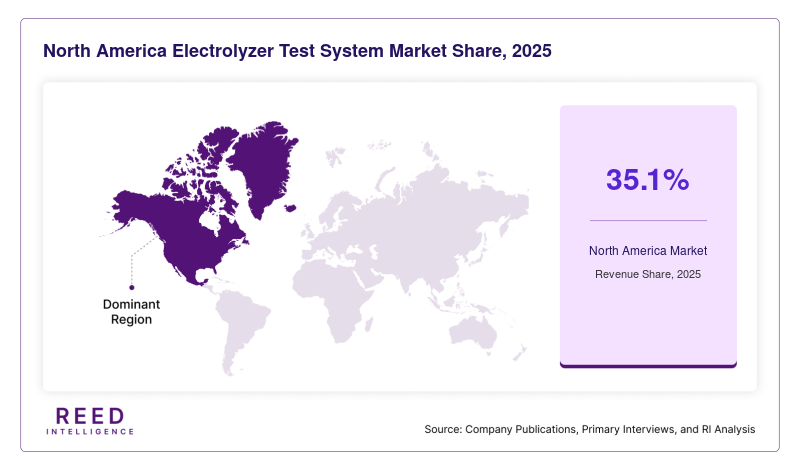
- North America dominated the market with a 35.1% share in 2025.
- Asia Pacific is expected to grow at the fastest CAGR of 11.6% during 2026–2034.
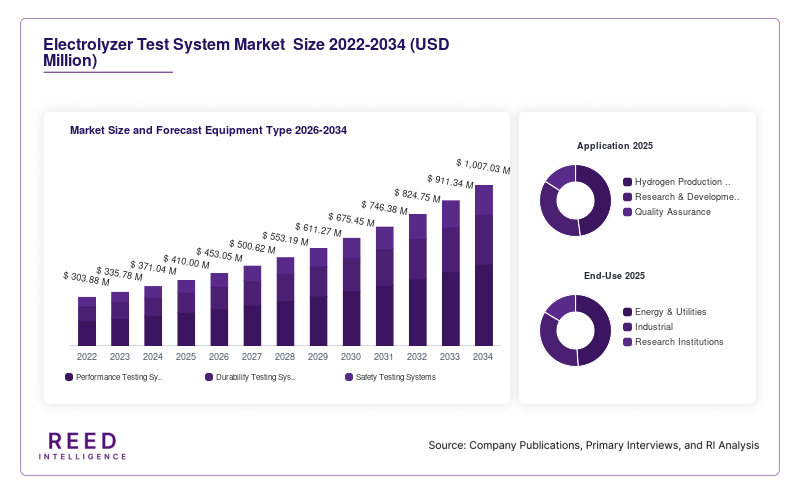
- By equipment type, performance testing systems accounted for the largest share of 39.4%.
- while durability testing systems are projected to grow at a CAGR of 12.1%.
- By application, hydrogen production validation led with a 43.2% share, whereas R&D testing is expected to expand at a CAGR of 11.9%.
- The United States remained the dominant country, with market values of USD 150 million in 2024 and USD 168 million in 2025.
Market Trends
Increasing integration of digital monitoring and automation
A notable trend shaping the Electrolyzer Test System Market is the integration of digital monitoring tools and automation technologies into testing frameworks. Modern test systems are increasingly equipped with real-time data acquisition, cloud-based analytics, and AI-driven diagnostics. These capabilities allow manufacturers to detect anomalies early, optimize testing cycles, and improve overall system efficiency. Automation reduces human intervention, minimizes errors, and accelerates the testing process, which is essential for scaling hydrogen production technologies.
The shift toward digitalization is also enabling predictive maintenance and lifecycle analysis of electrolyzers. Testing systems now incorporate advanced software platforms that provide actionable insights into component degradation and performance variability. This trend aligns with broader Industry 4.0 adoption across manufacturing sectors. As electrolyzer deployment increases globally, the demand for intelligent and automated test systems is expected to grow steadily, contributing to improved reliability and cost efficiency in hydrogen production systems.
Expansion of green hydrogen pilot and demonstration projects
Another significant trend is the expansion of green hydrogen pilot and demonstration projects across various regions. Governments and energy companies are investing in pilot plants to evaluate the feasibility of large-scale hydrogen production using renewable energy sources. These projects require extensive testing and validation of electrolyzer systems under different operating conditions, thereby driving demand for advanced test systems.
Pilot projects often involve collaboration between research institutions, technology providers, and industrial stakeholders. This collaborative environment fosters innovation in testing methodologies and equipment design. Electrolyzer test systems are being tailored to meet the specific requirements of pilot-scale operations, including modularity and scalability. As more demonstration projects transition into commercial deployments, the need for robust testing infrastructure will continue to rise, reinforcing the importance of this trend in shaping the market landscape.
Market Drivers
Rising investments in hydrogen infrastructure development
The growth of the Electrolyzer Test System Market is strongly driven by increasing investments in hydrogen infrastructure development. Governments worldwide are allocating substantial funding to support hydrogen production, storage, and distribution networks. These investments are part of broader decarbonization strategies aimed at reducing greenhouse gas emissions and achieving energy transition goals. As electrolyzers form the core of hydrogen production systems, their performance and reliability must be rigorously tested, thereby boosting demand for test systems.
Private sector participation is also contributing to infrastructure expansion. Energy companies, automotive manufacturers, and industrial players are investing in hydrogen projects to diversify their energy portfolios. This surge in investment is leading to the establishment of new manufacturing facilities and testing laboratories. Consequently, the need for advanced electrolyzer test systems is increasing, as stakeholders seek to ensure compliance with performance standards and optimize system efficiency.
Technological advancements in electrolyzer design
Technological advancements in electrolyzer design are another key driver of market growth. Innovations in materials, cell architecture, and system integration are enhancing the efficiency and durability of electrolyzers. However, these advancements also necessitate sophisticated testing solutions capable of evaluating complex performance parameters. Electrolyzer test systems are evolving to accommodate new technologies, including high-pressure operation and dynamic load conditions.
The development of next-generation electrolyzers, such as solid oxide and anion exchange membrane systems, is further driving demand for specialized testing equipment. These technologies require precise validation to ensure operational stability and scalability. Test system manufacturers are investing in research and development to create solutions that can accurately assess emerging electrolyzer technologies. This continuous innovation cycle is expected to sustain market growth over the forecast period.
Market Restraint
High capital investment and operational complexity
A major restraint affecting the Electrolyzer Test System Market is the high capital investment required for setting up advanced testing infrastructure. Test systems involve sophisticated instrumentation, control systems, and safety mechanisms, which contribute to significant upfront costs. Small and medium-sized enterprises often face challenges in adopting these systems due to budget constraints. This limits market penetration, particularly in emerging economies where funding availability may be restricted.
In addition to high costs, operational complexity poses another challenge. Electrolyzer test systems require skilled personnel for installation, calibration, and maintenance. The lack of standardized testing protocols across regions further complicates system deployment. For instance, varying regulatory requirements and performance benchmarks can lead to inconsistencies in testing procedures. These factors can delay project timelines and increase operational expenses, thereby restraining market growth. Addressing these challenges will require collaborative efforts to standardize testing practices and reduce system costs through technological innovation.
Market Opportunities
Growing demand for decentralized hydrogen production systems
The increasing interest in decentralized hydrogen production systems presents a significant opportunity for the Electrolyzer Test System Market. Decentralized systems enable on-site hydrogen generation, reducing the need for extensive transportation and storage infrastructure. This approach is particularly beneficial for remote locations and industrial facilities seeking energy independence. As decentralized systems gain traction, the demand for compact and modular test systems is expected to rise.
Manufacturers are focusing on developing portable and scalable testing solutions tailored to decentralized applications. These systems allow for quick deployment and efficient performance evaluation in diverse environments. The growing adoption of renewable energy sources, such as solar and wind, further supports decentralized hydrogen production. As a result, the need for reliable testing infrastructure will continue to expand, creating new growth avenues for market players.
Increasing focus on research and development activities
Another promising opportunity lies in the increasing focus on research and development activities related to hydrogen technologies. Academic institutions, research organizations, and industry players are investing in R&D to improve electrolyzer efficiency and reduce production costs. These activities require advanced testing systems capable of providing accurate and repeatable results under controlled conditions.
The establishment of dedicated hydrogen research centers and innovation hubs is driving demand for specialized test equipment. These facilities often collaborate with technology providers to develop customized testing solutions. Additionally, government funding for hydrogen research is encouraging innovation in testing methodologies. As R&D activities continue to expand, the Electrolyzer Test System Market is expected to benefit from sustained demand for high-performance testing solutions.
Segmental Analysis
By Equipment Type
Performance testing systems dominated the Electrolyzer Test System Market, accounting for a 39.4% share in 2024. These systems are widely used to evaluate the efficiency, output, and operational stability of electrolyzers under various conditions. Their ability to provide accurate and real-time data makes them essential for both manufacturing and research applications. The increasing complexity of electrolyzer technologies has further emphasized the importance of performance testing systems, as manufacturers seek to ensure compliance with industry standards and optimize system performance.
Durability testing systems are emerging as the fastest-growing subsegment, projected to expand at a CAGR of 12.1% during the forecast period. The growing emphasis on long-term reliability and lifecycle assessment of electrolyzers is driving demand for these systems. Durability testing helps identify potential degradation issues and ensures consistent performance over extended periods. As hydrogen production systems are expected to operate continuously, the need for robust durability testing solutions is becoming increasingly critical.
By Application
Hydrogen production validation held the largest share of 43.2% in 2024, driven by the increasing deployment of electrolyzers in industrial and energy applications. This segment focuses on verifying the efficiency and output of hydrogen production systems, ensuring that they meet required performance standards. The growing adoption of green hydrogen projects has further increased the demand for validation testing, as stakeholders seek to optimize production processes and reduce operational costs.
Research and development testing is the fastest-growing subsegment, with a projected CAGR of 11.9%. The expansion of R&D activities in hydrogen technologies is driving demand for advanced testing systems. These systems enable researchers to experiment with new materials, designs, and operating conditions. The increasing collaboration between academic institutions and industry players is further supporting the growth of this segment, as innovation becomes a key focus area.
By End-Use
Energy and utilities dominated the market with a 46.5% share in 2024, driven by the growing adoption of hydrogen as an alternative energy source. This sector relies heavily on electrolyzer test systems to ensure efficient and reliable hydrogen production. The integration of renewable energy sources with hydrogen systems has further increased the need for advanced testing solutions, as utilities seek to optimize energy conversion processes.
The industrial sector is expected to be the fastest-growing subsegment, with a CAGR of 11.3% during the forecast period. Industries such as chemicals, refining, and steel are increasingly adopting hydrogen to reduce carbon emissions. This shift is driving demand for electrolyzer test systems to validate performance and ensure compliance with environmental regulations. The growing focus on sustainable manufacturing practices is expected to further accelerate the adoption of testing solutions in this segment.
Regional Analysis
North America
North America accounted for a significant share of the Electrolyzer Test System Market, representing 35.1% in 2025, and is expected to maintain steady growth with a CAGR of 9.8% during the forecast period. The region’s strong market position is supported by well-established hydrogen infrastructure initiatives and increasing investments in clean energy technologies. The presence of leading technology providers and research institutions further strengthens the market landscape.
The United States dominates the regional market, driven by government policies promoting hydrogen adoption and decarbonization. A key growth factor is the expansion of large-scale hydrogen projects supported by federal funding programs. These initiatives are encouraging the deployment of advanced electrolyzer systems, thereby increasing the demand for comprehensive testing solutions across the country.
Europe
Europe held a substantial share of the market in 2025 and is projected to grow at a CAGR of 10.2% during the forecast period. The region’s commitment to achieving carbon neutrality has led to significant investments in hydrogen production and related technologies. The European Union’s strategic initiatives are fostering the development of hydrogen value chains, which in turn drives demand for testing systems.
Germany emerges as the dominant country in the region, supported by strong industrial capabilities and government-backed hydrogen strategies. A unique growth factor is the integration of renewable energy sources with hydrogen production systems. This integration requires advanced testing to ensure system efficiency and stability, thereby boosting market demand.
Asia Pacific
Asia Pacific is expected to witness the fastest growth, with a CAGR of 11.6% during 2026–2034, driven by rapid industrialization and increasing energy demand. The region’s expanding renewable energy capacity and supportive government policies are contributing to the growth of hydrogen projects. This creates a favorable environment for the adoption of electrolyzer test systems.
China leads the regional market, supported by large-scale investments in hydrogen infrastructure. A key growth factor is the country’s focus on scaling up domestic electrolyzer manufacturing capabilities. This requires extensive testing and validation processes, thereby driving demand for advanced test systems across the region.
Middle East & Africa
The Middle East & Africa region is experiencing moderate growth, with a CAGR of 9.1% during the forecast period. The region’s abundant renewable energy resources, particularly solar energy, are supporting the development of green hydrogen projects. Governments are increasingly recognizing the potential of hydrogen as a future energy source.
Saudi Arabia dominates the regional market, driven by large-scale hydrogen production initiatives. A unique growth factor is the development of mega projects aimed at exporting green hydrogen. These projects require robust testing infrastructure to ensure compliance with international standards, thereby boosting demand for electrolyzer test systems.
Latin America
Latin America is projected to grow steadily, with a CAGR of 9.4% during the forecast period. The region’s increasing focus on renewable energy and sustainable development is driving interest in hydrogen technologies. Governments are implementing policies to promote clean energy adoption, which supports market growth.
Brazil leads the regional market, supported by its strong renewable energy base. A key growth factor is the integration of hydropower with hydrogen production systems. This integration requires efficient testing solutions to optimize performance and ensure reliability, thereby driving demand for electrolyzer test systems.
Competitive Landscape
The Electrolyzer Test System Market is characterized by the presence of several established players and emerging companies focusing on technological innovation and strategic collaborations. The market is moderately consolidated, with leading companies investing in research and development to enhance their product offerings. These players are also expanding their global presence through partnerships and acquisitions.
A leading company in the market is Siemens Energy, which has developed advanced testing solutions tailored for large-scale hydrogen projects. A recent development includes the launch of integrated testing platforms designed to support next-generation electrolyzer technologies. Other companies are focusing on modular and scalable solutions to cater to diverse customer requirements. The competitive landscape is expected to evolve further as new entrants introduce innovative products and existing players expand their capabilities.
Key Players List
- Siemens Energy
- ABB Ltd.
- Emerson Electric Co.
- Honeywell International Inc.
- Keysight Technologies
- National Instruments Corporation
- Horiba Ltd.
- Yokogawa Electric Corporation
- AMETEK Inc.
- Systec Controls
- FuelCon AG
- Greenlight Innovation Corp.
- AVL List GmbH
- Bosch Rexroth AG
- Thermo Fisher Scientific Inc.
Recent Developments
- Siemens Energy introduced a new modular electrolyzer test platform in 2025 to support large-scale hydrogen production projects.
- ABB Ltd. expanded its testing solutions portfolio with enhanced digital monitoring capabilities in 2024.
- Honeywell International Inc. launched an advanced analytics-enabled test system aimed at improving electrolyzer efficiency in 2025
Electrolyzer Test System Market Segments
Equipment Type
- Performance Testing Systems
- Durability Testing Systems
- Safety Testing Systems
Application
- Hydrogen Production Validation
- Research & Development Testing
- Quality Assurance
End-Use
- Energy & Utilities
- Industrial
- Research Institutions
By Region
- North America
- Europe
- APAC
- Middle East and Africa
- LATAM