Electromagnetic Field Meter Market Size, Share & Demand Report By Type (Portable Electromagnetic Field Meters, Wearable Electromagnetic Field Meters, Benchtop Electromagnetic Field Meters), By Frequency Range (Broadband Electromagnetic Field Meters, Narrowband Electromagnetic Field Meters), By Application (Telecommunications Monitoring, Environmental Radiation Assessment, Industrial Equipment Monitoring, Research & Laboratory Testing), By End-Use Industry (Testing Laboratories, Telecommunication
USD 3950
Market Overview
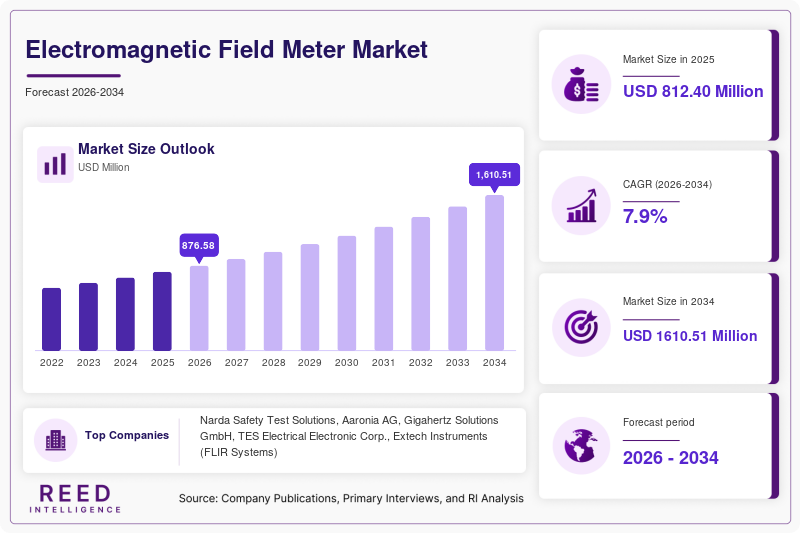
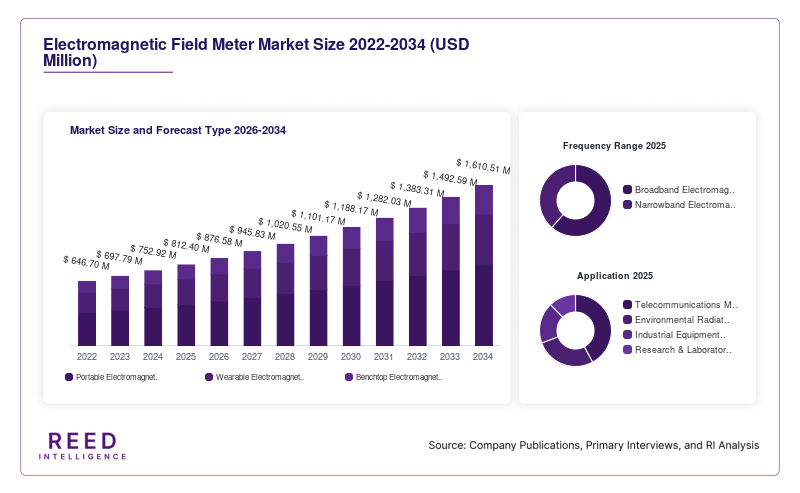
The Electromagnetic Field Meter Market size was valued at USD 812.4 million in 2025 and is projected to reach USD 1.62 billion by 2034, expanding at a compound annual growth rate (CAGR) of 7.9% from 2025 to 2034. Increasing global awareness regarding electromagnetic radiation exposure from communication infrastructure, electronic devices, and industrial equipment has contributed to sustained demand for monitoring solutions. Electromagnetic field meters are widely used to detect and measure radiation levels generated by power lines, wireless networks, medical equipment, and industrial machinery.
Growing deployment of 5G infrastructure has been a notable global factor supporting the growth of the Electromagnetic Field Meter Market. Telecommunications providers are rapidly expanding base station networks, resulting in increased regulatory monitoring and safety compliance requirements. Governments and regulatory agencies across developed and developing economies are encouraging periodic measurement of electromagnetic radiation levels, particularly in urban areas where wireless communication infrastructure is dense. These regulatory initiatives have stimulated the adoption of portable and high-precision electromagnetic field monitoring equipment.
<
Key Highlights
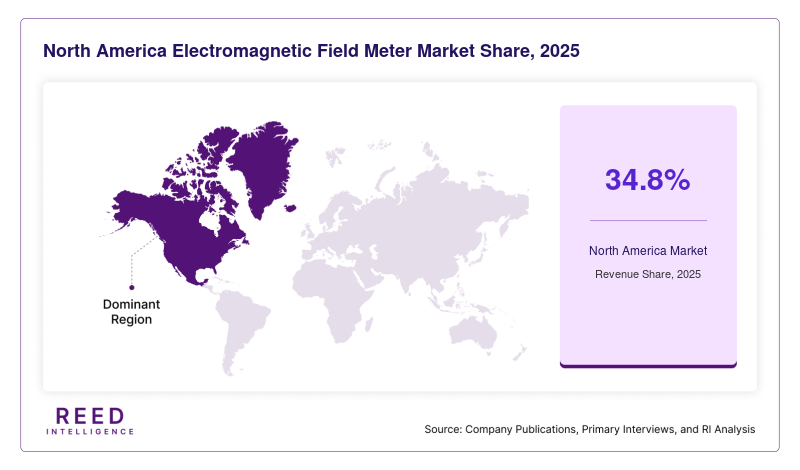
- North America accounted for 34.8% of the Electromagnetic Field Meter Market share in 2025, while Asia Pacific is projected to grow at a CAGR of 9.2% during the forecast period.
- By type, portable electromagnetic field meters held the leading share of 58.6% in 2025, while wearable EMF meters are projected to grow at a CAGR of 9.8%.
- By application, telecommunications monitoring dominated with 32.4% share, whereas environmental radiation assessment is expected to grow at a CAGR of 9.5%.
- The United States represented the dominant country with a market value of USD 219.7 million in 2025 and is estimated to reach USD 236.5 million in 2026.
Market Trends
Expansion of 5G and Wireless Infrastructure Monitoring
One of the key trends shaping the Electromagnetic Field Meter Market is the increasing monitoring of electromagnetic radiation associated with the expansion of 5G networks. Telecommunications operators worldwide are installing thousands of small cells and base stations to support high-speed connectivity. These installations have increased the need for periodic electromagnetic radiation measurements to ensure compliance with exposure guidelines set by regulatory authorities. Field engineers and environmental consultants are increasingly using advanced electromagnetic field meters equipped with broadband sensors to monitor radiation levels around telecommunications towers and network equipment. As wireless infrastructure continues to expand, the demand for precise electromagnetic monitoring instruments is expected to rise steadily.
Integration of Digital Data Logging and Connectivity Features
Another emerging trend in the Electromagnetic Field Meter Market involves the integration of digital data logging and wireless connectivity features. Modern electromagnetic field meters are being designed with built-in Bluetooth, Wi-Fi connectivity, and cloud data integration capabilities. These features allow professionals to record real-time radiation levels and transmit measurement data to remote monitoring platforms. Laboratories, research institutions, and environmental monitoring agencies increasingly prefer devices that support automated reporting and digital record management. This technological shift is contributing to the growing adoption of smart electromagnetic monitoring solutions across industrial and research environments.
Market Drivers
Increasing Safety Regulations on Electromagnetic Radiation
The growing emphasis on radiation safety standards has supported expansion of the Electromagnetic Field Meter Market. Governments and international health organizations have established strict guidelines governing acceptable electromagnetic exposure levels in workplaces and residential environments. Regulatory bodies often require regular monitoring of electromagnetic radiation near power lines, telecommunication infrastructure, and electronic manufacturing facilities. Compliance with these regulations has increased the demand for reliable electromagnetic measurement equipment across environmental monitoring agencies, industrial facilities, and occupational safety organizations.
Growing Use of Electronic and Wireless Devices
The rapid proliferation of electronic devices and wireless technologies has also contributed to the growth of the Electromagnetic Field Meter Market. Consumer electronics such as smartphones, laptops, routers, and wearable devices generate electromagnetic radiation during operation. As public awareness regarding electromagnetic exposure increases, testing laboratories and certification agencies are conducting more frequent measurements of device emissions. This trend has encouraged manufacturers to adopt electromagnetic field meters during product testing and quality control processes. The expanding use of electronic devices in residential, commercial, and industrial environments continues to create demand for accurate electromagnetic monitoring solutions.
Market Restraint
Limited Awareness in Emerging Economies
A major restraint affecting the Electromagnetic Field Meter Market is the limited awareness regarding electromagnetic radiation monitoring in several emerging economies. While developed countries have established comprehensive guidelines for electromagnetic exposure measurement, awareness levels remain comparatively low in many developing regions. Small industrial facilities and local businesses often lack dedicated environmental monitoring programs or radiation safety compliance procedures.
Additionally, the perceived cost of professional electromagnetic field meters may discourage small organizations from investing in monitoring equipment. In regions where regulatory enforcement is limited, companies may rely on occasional external testing rather than maintaining dedicated measurement tools. This reduces consistent demand for electromagnetic monitoring devices.
Another factor contributing to slower adoption is the lack of trained professionals capable of interpreting electromagnetic measurement results. Specialized knowledge is required to evaluate radiation exposure levels and apply regulatory guidelines. Without adequate training programs and awareness campaigns, the adoption of electromagnetic monitoring solutions may progress gradually in some markets.
Although regulatory expansion and technological innovation are gradually improving awareness, these challenges currently limit the growth potential of the Electromagnetic Field Meter Market in certain developing regions.
Market Opportunities
Increasing Environmental Monitoring Programs
The expansion of environmental radiation monitoring programs presents a significant opportunity for the Electromagnetic Field Meter Market. Governments and environmental agencies are increasingly conducting assessments to evaluate electromagnetic radiation exposure in urban environments. Monitoring initiatives are often implemented near communication towers, power transmission lines, and densely populated residential areas. These programs require portable electromagnetic field meters capable of measuring radiation across multiple frequency ranges. As environmental monitoring becomes more structured and data-driven, the demand for accurate electromagnetic measurement instruments is expected to grow.
Development of Wearable Radiation Monitoring Devices
Another emerging opportunity within the Electromagnetic Field Meter Market involves the development of wearable radiation monitoring devices. Wearable electromagnetic field sensors can be used by technicians, engineers, and research professionals working in environments with potential radiation exposure. These devices provide continuous monitoring and alert users when exposure levels exceed recommended thresholds. Advancements in miniaturized sensors and low-power electronics are enabling manufacturers to design compact wearable EMF monitoring devices. As occupational safety standards evolve and industrial workplaces adopt continuous monitoring practices, wearable electromagnetic field meters are expected to gain increased adoption.
Segmental Analysis
By Type
Portable electromagnetic field meters dominated the Electromagnetic Field Meter Market with a 58.6% share in 2025. These devices are widely used by technicians and environmental monitoring professionals because of their portability and ease of use in field environments. Portable meters are commonly used during radiation inspections around communication towers, industrial facilities, and power transmission infrastructure. Their compact design and real-time measurement capabilities have supported their widespread adoption across multiple industries.
Wearable electromagnetic field meters are projected to grow at a CAGR of 9.8% during the forecast period. The growth of this subsegment will be driven by increasing adoption of continuous radiation monitoring practices in occupational safety programs. Wearable devices allow technicians working near electromagnetic sources to track radiation exposure levels throughout their work shifts. Advancements in miniaturized sensors and low-power electronics will support the development of compact wearable monitoring solutions designed for industrial safety applications.
By Frequency Range
Broadband electromagnetic field meters accounted for 52.3% of the Electromagnetic Field Meter Market share in 2025. These devices are capable of measuring radiation across a wide frequency spectrum, allowing technicians to monitor multiple electromagnetic sources simultaneously. Broadband meters are commonly used in environmental monitoring applications where various wireless communication signals may be present. Their versatility and wide measurement range contribute to their strong adoption across telecommunications and research applications.
Narrowband electromagnetic field meters are expected to grow at a CAGR of 8.7% during the forecast period. These devices are specifically designed to measure radiation at precise frequency bands, enabling detailed analysis of specific electromagnetic sources. Telecommunications testing laboratories often use narrowband meters when analyzing emissions generated by communication equipment operating at defined frequency ranges. The increasing need for detailed electromagnetic spectrum analysis will support growth in this segment.
By Application
Telecommunications monitoring represented 32.4% of the Electromagnetic Field Meter Market share in 2025. Telecommunications providers frequently conduct electromagnetic radiation measurements around communication towers, base stations, and wireless transmission equipment. These measurements help ensure compliance with radiation exposure guidelines and maintain operational safety within telecommunications infrastructure environments.
Environmental radiation assessment is projected to grow at a CAGR of 9.5% during the forecast period. Governments and environmental agencies are conducting more frequent monitoring of electromagnetic radiation in urban areas and near infrastructure installations. Environmental testing organizations use electromagnetic field meters to evaluate radiation exposure levels in residential zones and public spaces. Increasing public awareness regarding electromagnetic radiation exposure will support growth in this segment.
By End-Use Industry
Testing laboratories held 35.1% of the Electromagnetic Field Meter Market share in 2025. Laboratories conduct electromagnetic compatibility testing and radiation measurement as part of product certification and regulatory compliance processes. Manufacturers of electronic devices frequently rely on testing laboratories to evaluate electromagnetic emissions generated by their products.
Industrial facilities are expected to grow at a CAGR of 8.9% during the forecast period. Industrial environments often contain machinery, electrical equipment, and automated production systems that generate electromagnetic radiation. Occupational safety programs within manufacturing facilities are increasingly incorporating electromagnetic exposure monitoring practices. As industrial automation expands, monitoring radiation levels around equipment will become an important component of workplace safety management.
Regional Analysis
North America
North America accounted for 34.8% of the Electromagnetic Field Meter Market share in 2025 and will grow at a CAGR of 7.5% from 2025 to 2034. The region has a well-established regulatory environment governing electromagnetic radiation exposure and environmental monitoring. Telecommunications infrastructure expansion, coupled with strong industrial safety regulations, supports steady demand for electromagnetic measurement equipment. Research institutions, environmental monitoring agencies, and telecommunications companies across the region regularly conduct radiation assessments using portable electromagnetic field meters.
The United States represented the dominant country within the regional Electromagnetic Field Meter Market. One of the primary growth factors in the country is the strong presence of testing laboratories and certification organizations that evaluate electronic product compliance with electromagnetic emission standards. These laboratories use electromagnetic field meters during device testing and environmental radiation analysis. Increasing adoption of electromagnetic monitoring equipment across research institutions and occupational safety programs is expected to maintain steady market expansion in the country.
Europe
Europe held 27.1% of the Electromagnetic Field Meter Market share in 2025 and will expand at a CAGR of 7.2% during the forecast period. The region has established regulatory frameworks governing electromagnetic exposure across industrial workplaces and residential environments. European environmental monitoring agencies conduct routine electromagnetic radiation assessments around telecommunications infrastructure and high-voltage power transmission lines. These monitoring programs contribute to the stable demand for electromagnetic measurement equipment across the region.
Germany emerged as the dominant country within the European Electromagnetic Field Meter Market. The country’s strong industrial manufacturing base and focus on occupational safety have increased the adoption of electromagnetic radiation monitoring equipment. Industrial facilities often measure electromagnetic emissions generated by automated production systems and electrical equipment to ensure compliance with workplace safety guidelines. Continued industrial modernization and regulatory oversight are expected to support steady growth in the German market.
Asia Pacific
Asia Pacific represented 23.5% of the Electromagnetic Field Meter Market share in 2025 and will grow at the fastest CAGR of 9.2% between 2025 and 2034. Rapid telecommunications network expansion, urban infrastructure development, and increasing electronic device manufacturing activities are contributing to the demand for electromagnetic monitoring solutions in the region. Environmental monitoring initiatives in densely populated urban areas are also encouraging the use of electromagnetic field meters.
China dominated the regional Electromagnetic Field Meter Market due to its large telecommunications infrastructure deployment and electronics manufacturing ecosystem. Telecommunications providers in the country are expanding 5G networks across major metropolitan areas, which has increased the need for radiation monitoring equipment. In addition, electronics manufacturers frequently conduct electromagnetic emission testing during product development and quality assurance processes. These factors are expected to support continued market growth in the Chinese market.
Middle East & Africa
The Middle East & Africa accounted for 8.1% of the Electromagnetic Field Meter Market share in 2025 and will expand at a CAGR of 6.8% during the forecast period. Growth in the region is supported by infrastructure modernization and increasing investments in telecommunications networks. Several countries in the Middle East are expanding high-speed wireless connectivity and deploying additional communication towers to support digital transformation initiatives.
The United Arab Emirates represented the dominant country within the regional Electromagnetic Field Meter Market. The country’s advanced telecommunications infrastructure and focus on technology adoption have encouraged the implementation of electromagnetic radiation monitoring programs. Regulatory authorities frequently conduct environmental radiation assessments around telecommunications facilities and urban infrastructure. These monitoring programs are expected to contribute to steady demand for electromagnetic measurement instruments in the country.
Latin America
Latin America held 6.5% of the Electromagnetic Field Meter Market share in 2025 and will grow at a CAGR of 6.9% between 2025 and 2034. Telecommunications infrastructure development and increased urbanization are gradually increasing the need for electromagnetic radiation monitoring across the region. Environmental testing organizations and telecommunications providers are the primary users of electromagnetic field meters in Latin America.
Brazil dominated the regional Electromagnetic Field Meter Market due to its expanding telecommunications sector and urban infrastructure development. Telecommunications companies operating in the country are installing additional wireless communication towers to improve connectivity across metropolitan and suburban regions. These installations often require periodic radiation monitoring and environmental compliance testing, which supports demand for electromagnetic field measurement devices.
Competitive Landscape
The Electromagnetic Field Meter Market is characterized by the presence of several measurement technology manufacturers and electronic instrumentation companies. These companies focus on improving measurement accuracy, portability, and data integration capabilities in electromagnetic monitoring devices.
One of the leading participants in the Electromagnetic Field Meter Market is Narda Safety Test Solutions, which offers a broad portfolio of electromagnetic radiation measurement instruments designed for telecommunications, industrial safety, and environmental monitoring applications. The company continues to expand its product offerings with advanced broadband electromagnetic field meters that support digital data logging and wireless connectivity.
Other market participants are focusing on product innovation and expanding distribution networks across emerging economies. Strategic collaborations with environmental monitoring agencies and research institutions are also contributing to increased product adoption across global markets.
Key Players
- Narda Safety Test Solutions
- Aaronia AG
- Gigahertz Solutions GmbH
- TES Electrical Electronic Corp.
- Extech Instruments
- PCE Instruments
- Tenmars Electronics Co. Ltd.
- Trifield
- Sper Scientific
- Omega Engineering
- Chauvin Arnoux
- Rohde & Schwarz
- Wavecontrol
- Keysight Technologies
- Holaday Industries
- Fluke Corporation
Recent Developments
- 2025: Narda Safety Test Solutions introduced a new portable electromagnetic field meter with integrated cloud-based data logging capabilities designed for environmental radiation monitoring.
- 2024: Aaronia AG expanded its electromagnetic spectrum analysis product line with enhanced broadband EMF meters for telecommunications testing applications.
- 2024: Gigahertz Solutions GmbH launched an upgraded handheld EMF meter with improved frequency detection accuracy for industrial safety monitoring.
- 2023: Wavecontrol introduced advanced electromagnetic exposure monitoring equipment designed for continuous radiation measurement near telecommunications installations.
- 2023: Keysight Technologies expanded its electromagnetic testing solutions portfolio for research laboratories focusing on wireless device emission testing.
Electromagnetic Field Meter Market Segments
Type
- Portable Electromagnetic Field Meters
- Wearable Electromagnetic Field Meters
- Benchtop Electromagnetic Field Meters
Frequency Range
- Broadband Electromagnetic Field Meters
- Narrowband Electromagnetic Field Meters
Application
- Telecommunications Monitoring
- Environmental Radiation Assessment
- Industrial Equipment Monitoring
- Research & Laboratory Testing
End-Use Industry
- Testing Laboratories
- Telecommunications Providers
- Industrial Manufacturing Facilities
- Environmental Monitoring Agencies
- Research Institutions
Distribution Channel
- Online Sales
- Industrial Equipment Distributors
- Direct Sales
- Specialty Instrumentation Stores
By Region
- North America
- Europe
- APAC
- Middle East and Africa
- LATAM