Electromagnetic Radio Frequency Interference Coating For Electric Vehicle Market Size, Share Demand Report By Type (Conductive Coatings, Nano-Coatings, Hybrid Coatings), By Application (Battery Systems, Infotainment Systems, Power Electronics, ADAS Systems), By End-Use (Passenger Vehicles, Commercial Vehicles) By Region & Segment Forecasts, 2026–2034
USD 3950
Market Overview
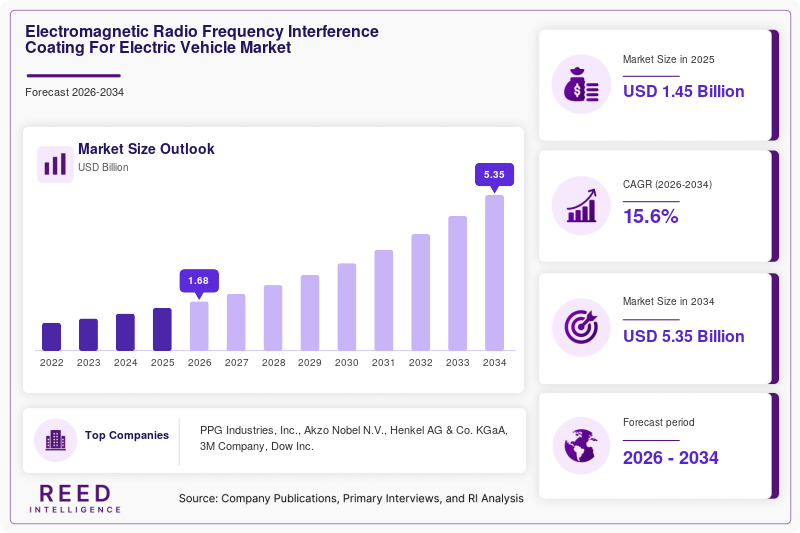
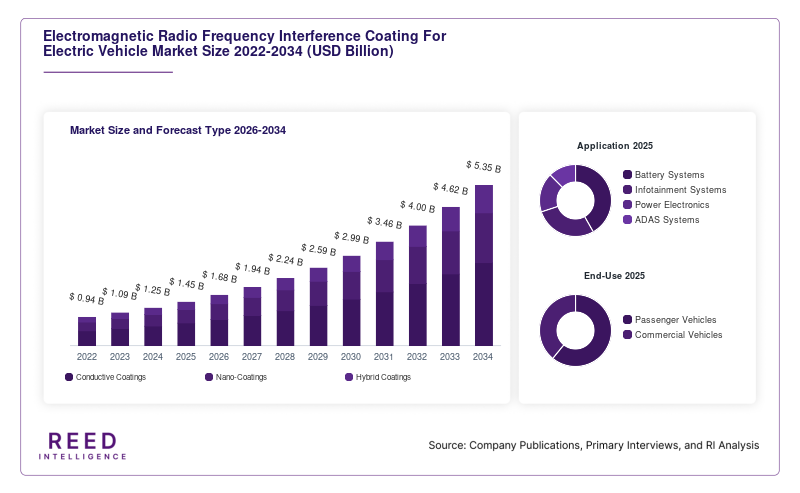
The global Electromagnetic Radio Frequency Interference Coating For Electric Vehicle Market size was valued at approximately USD 1.45 billion in 2026 and is projected to reach USD 4.62 billion by 2034, expanding at a compound annual growth rate (CAGR) of 15.6% from 2026 to 2034. The market is gaining traction due to the rapid electrification of transportation and the growing complexity of electronic systems in electric vehicles (EVs), which require effective electromagnetic interference (EMI) shielding solutions to ensure operational reliability and safety.
A key global factor supporting market growth is the increasing integration of advanced driver-assistance systems (ADAS), infotainment systems, and battery management systems in EVs. These components generate high levels of electromagnetic radiation, which can disrupt signal integrity and vehicle performance. As a result, automotive manufacturers are increasingly adopting EMI/RFI coatings to minimize interference and maintain system efficiency.
Key Highlights
- Asia Pacific dominated the market with a 42% share in 2025, while it is also the fastest-growing region with a CAGR of 16.8%.
- Conductive coatings emerged as the leading subsegment under type, holding a 48% share, while nano-coatings are projected to grow at a CAGR of 17.5%.
- Battery systems accounted for the largest application segment with a 36% share, whereas infotainment systems are the fastest-growing at a CAGR of 16.9%.
- China remained the dominant country, with market values of USD 410 million in 2024 and USD 475 million in 2025.
Market Trends
Increasing Adoption of Lightweight EMI Shielding Materials
The shift toward lightweight materials in electric vehicles is influencing the development of advanced electromagnetic radio frequency interference coatings. Automakers are prioritizing weight reduction to improve battery efficiency and vehicle range, which has led to a growing preference for thin-film conductive coatings over traditional shielding methods such as metal enclosures. These coatings provide effective EMI shielding while adding minimal weight, making them suitable for compact EV architectures. Additionally, the use of polymer-based conductive coatings infused with carbon nanotubes or graphene is gaining traction due to their superior conductivity and flexibility. This trend is particularly relevant in next-generation EV platforms, where space optimization and efficiency are critical. As OEMs aim to meet stringent emission and efficiency standards, lightweight EMI coatings are expected to see sustained adoption across multiple vehicle components.
Integration of Smart Coatings with Multifunctional Capabilities
Another notable trend is the emergence of multifunctional coatings that combine EMI shielding with additional properties such as thermal management, corrosion resistance, and self-healing capabilities. These smart coatings are being developed to address multiple challenges within EV systems, including heat dissipation from batteries and protection against environmental degradation. The integration of such features reduces the need for multiple layers or components, simplifying manufacturing processes and lowering overall costs. Furthermore, advancements in nanotechnology have enabled the creation of coatings with enhanced durability and performance under extreme conditions. This trend aligns with the automotive industry's push toward high-performance and long-lasting materials, particularly in premium EV models where reliability and efficiency are critical selling points.
Market Drivers
Rising Demand for Electric Vehicles Globally
The rapid growth in electric vehicle adoption is a major driver for the electromagnetic radio frequency interference coating market. Governments worldwide are implementing stringent emission regulations and offering incentives to accelerate the transition from internal combustion engine vehicles to EVs. As EV production scales up, the demand for advanced electronic systems increases, creating a greater need for EMI/RFI shielding solutions. Electric vehicles rely heavily on electronic components such as inverters, onboard chargers, and battery management systems, all of which generate electromagnetic interference. Without proper shielding, this interference can lead to system malfunctions and safety risks. Therefore, automotive manufacturers are investing in high-performance coatings to ensure compliance with electromagnetic compatibility standards and enhance vehicle reliability.
Growth of Advanced Automotive Electronics and Connectivity
The increasing complexity of automotive electronics is another key factor driving market growth. Modern EVs are equipped with features such as autonomous driving systems, vehicle-to-everything (V2X) communication, and high-speed data networks. These technologies require stable and interference-free signal transmission to function effectively. Electromagnetic interference can disrupt communication between electronic components, leading to performance issues. As a result, manufacturers are adopting EMI coatings to protect sensitive circuits and maintain signal integrity. Additionally, the rise of connected vehicles and the integration of 5G technology are further amplifying the need for advanced shielding solutions. This trend is expected to drive consistent demand for EMI/RFI coatings in the automotive sector.
Market Restraint
High Cost of Advanced Coating Technologies
One of the primary challenges in the electromagnetic radio frequency interference coating market is the high cost associated with advanced coating technologies. The development and application of high-performance coatings, particularly those incorporating nanomaterials such as graphene and silver nanoparticles, require significant investment in research, raw materials, and manufacturing processes. These costs are often passed on to automotive manufacturers, making it difficult for smaller OEMs and suppliers to adopt such solutions at scale. Additionally, the application process for these coatings may involve specialized equipment and skilled labor, further increasing production expenses.
The high cost factor can limit market penetration, especially in price-sensitive regions where cost efficiency is a critical consideration. For example, entry-level electric vehicles may prioritize cost reduction over advanced EMI shielding solutions, leading to the use of less effective alternatives. This can impact overall market growth and slow the adoption of innovative coating technologies. Furthermore, fluctuations in the prices of raw materials such as metals and conductive polymers can add to cost uncertainties, making it challenging for manufacturers to maintain consistent pricing strategies.
Market Opportunities
Expansion of EV Charging Infrastructure
The rapid expansion of electric vehicle charging infrastructure presents a significant opportunity for the EMI/RFI coating market. Charging stations, especially fast-charging systems, generate high levels of electromagnetic interference due to the large amount of power being transmitted. This creates a need for effective shielding solutions to ensure safe and efficient operation. Coatings can be applied to various components within charging systems, including cables, connectors, and enclosures, to minimize interference and improve performance. As governments and private companies invest heavily in building EV charging networks, the demand for EMI coatings is expected to increase. This trend is particularly prominent in urban areas and along highways, where high-speed charging stations are being deployed.
Advancements in Nanotechnology and Material Science
Technological advancements in nanotechnology and material science are opening new avenues for the development of high-performance EMI coatings. Researchers are exploring the use of nanomaterials such as graphene, carbon nanotubes, and metal nanoparticles to create coatings with superior conductivity and durability. These materials offer enhanced shielding effectiveness while maintaining flexibility and lightweight properties. Additionally, innovations in coating application techniques, such as spray coating and electroplating, are improving efficiency and reducing costs. These advancements are expected to drive the adoption of next-generation EMI coatings across various EV components, creating new growth opportunities for market players.
Segmental Analysis
By Type
Conductive coatings dominated the market in 2024, accounting for approximately 48% of the total share. These coatings are widely used due to their high efficiency in blocking electromagnetic interference and their compatibility with various substrates. Conductive coatings typically contain materials such as silver, copper, or nickel, which provide excellent electrical conductivity. They are commonly applied to enclosures, connectors, and electronic components in electric vehicles. The demand for conductive coatings is driven by their ability to provide reliable shielding while maintaining durability and resistance to environmental factors. Additionally, advancements in material science have improved the performance and cost-effectiveness of these coatings, further supporting their widespread adoption.
Nano-coatings are expected to be the fastest-growing subsegment, with a projected CAGR of 17.5%. These coatings leverage nanotechnology to achieve superior performance characteristics, including enhanced conductivity, flexibility, and lightweight properties. The growth of nano-coatings is driven by the increasing demand for advanced materials that can meet the evolving requirements of electric vehicle systems. For example, nano-coatings can be applied to complex geometries and thin surfaces, making them ideal for modern EV designs. Furthermore, ongoing research and development efforts are expected to reduce production costs and improve scalability, enabling wider adoption across the automotive industry.
By Application
Battery systems accounted for the largest share of the market in 2024, representing approximately 36% of the total share. The high concentration of electronic components within battery systems makes them particularly susceptible to electromagnetic interference. EMI coatings are used to protect battery management systems and ensure stable operation. The growing demand for high-capacity batteries and the increasing complexity of battery designs are driving the adoption of EMI coatings in this segment. Additionally, the need for thermal management and safety in battery systems is further supporting the use of advanced coatings that offer multiple functionalities.
Infotainment systems are the fastest-growing application segment, with a projected CAGR of 16.9%. The increasing integration of advanced infotainment features, such as touchscreen displays, connectivity solutions, and multimedia systems, is driving the demand for EMI shielding. These systems require stable signal transmission to deliver seamless user experiences. As electric vehicles become more connected and feature-rich, the need for effective EMI coatings in infotainment systems is expected to grow significantly. Furthermore, the rise of 5G technology and vehicle-to-everything communication is amplifying the importance of shielding solutions in this segment.
By End-Use
Passenger vehicles dominated the market in 2024, accounting for approximately 68% of the total share. The high volume of passenger vehicle production and the increasing adoption of electric cars are key factors driving this segment. Passenger EVs are equipped with a wide range of electronic systems, including advanced safety features, infotainment systems, and battery management systems, all of which require effective EMI shielding. The growing consumer demand for electric cars, supported by government incentives and environmental awareness, is expected to sustain the dominance of this segment.
Commercial vehicles are projected to be the fastest-growing subsegment, with a CAGR of 15.9%. The growth of this segment is driven by the increasing adoption of electric buses, trucks, and delivery vehicles. These vehicles often operate in demanding environments and require robust EMI shielding solutions to ensure reliable performance. Additionally, the expansion of e-commerce and logistics industries is driving the demand for electric commercial vehicles, further supporting the growth of this segment. As fleet operators prioritize efficiency and sustainability, the adoption of EMI coatings in commercial vehicles is expected to increase.
Regional Analysis
North America
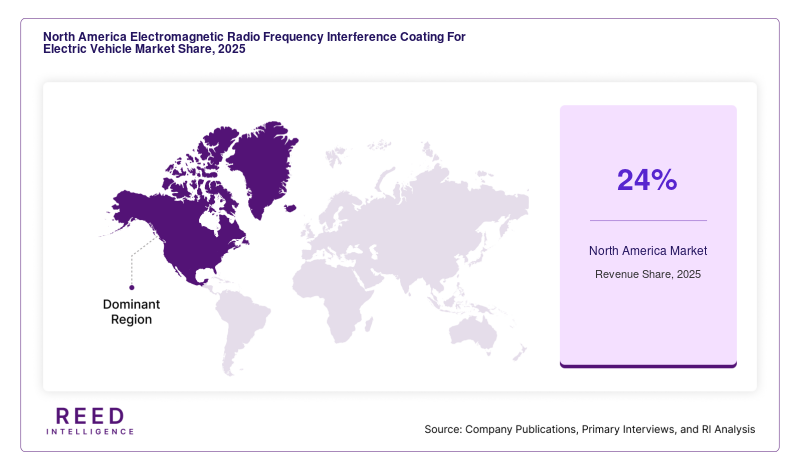
North America accounted for approximately 24% of the global market share in 2025, with a projected CAGR of 14.8% during the forecast period. The region’s growth is driven by the increasing adoption of electric vehicles and the presence of established automotive manufacturers investing in advanced technologies. Government policies promoting clean energy and emission reduction are also contributing to market expansion.
The United States dominates the North American market due to its strong focus on technological innovation and the presence of leading EV manufacturers. A unique growth factor in this region is the rapid development of autonomous driving technologies, which require robust EMI shielding solutions to ensure reliable performance and safety.
Europe
Europe held a 22% market share in 2025 and is expected to grow at a CAGR of 15.2%. The region’s strict environmental regulations and ambitious targets for carbon neutrality are driving the adoption of electric vehicles and, consequently, EMI coatings.
Germany is the dominant country in Europe, supported by its strong automotive industry and focus on research and development. A unique growth factor in this region is the increasing collaboration between automotive manufacturers and material science companies to develop advanced coating solutions tailored for EV applications.
Asia Pacific
Asia Pacific led the market with a 42% share in 2025 and is projected to grow at the fastest CAGR of 16.8%. The region’s dominance is attributed to the high production and sales of electric vehicles, particularly in countries such as China, Japan, and South Korea.
China is the leading country in this region, driven by government incentives and large-scale EV manufacturing. A unique growth factor is the strong domestic supply chain for raw materials and components, which supports cost-effective production of EMI coatings.
Middle East & Africa
The Middle East & Africa region accounted for 6% of the market share in 2025 and is expected to grow at a CAGR of 13.5%. The market is in its early stages but is gaining momentum due to increasing investments in sustainable transportation.
The United Arab Emirates is a key country in this region, with a growing focus on electric mobility. A unique growth factor is the government’s initiative to diversify the economy and reduce dependence on fossil fuels, which is encouraging the adoption of EV technologies.
Latin America
Latin America held a 6% market share in 2025 and is projected to grow at a CAGR of 14.1%. The region is witnessing gradual growth in electric vehicle adoption, supported by government incentives and infrastructure development.
Brazil is the dominant country in Latin America, driven by its expanding automotive industry. A unique growth factor is the increasing investment in local EV manufacturing, which is expected to boost demand for EMI/RFI coatings in the coming years.
Competitive Landscape
The electromagnetic radio frequency interference coating for electric vehicle market is moderately fragmented, with several global and regional players competing based on product innovation, pricing, and strategic partnerships. Leading companies are focusing on developing advanced coating technologies that offer improved performance and cost efficiency. They are also investing in research and development to create next-generation solutions tailored for electric vehicle applications.
PPG Industries, Inc. is considered a leading player in the market, known for its extensive portfolio of coating solutions and strong presence in the automotive sector. The company recently introduced a new range of lightweight conductive coatings designed specifically for electric vehicle components, enhancing shielding performance while reducing overall weight.
Other major players are adopting strategies such as mergers and acquisitions, collaborations with automotive manufacturers, and expansion into emerging markets. These initiatives are aimed at strengthening their market position and capturing a larger share of the growing EV market. Additionally, companies are focusing on sustainability by developing eco-friendly coatings with reduced environmental impact.
Key Players
- PPG Industries, Inc.
- Akzo Nobel N.V.
- Henkel AG & Co. KGaA
- 3M Company
- Dow Inc.
- Parker Hannifin Corporation
- Laird Performance Materials
- MG Chemicals
- Electrolube
- Tatsuta Electric Wire & Cable Co., Ltd.
- Chomerics (Parker Hannifin)
- Master Bond Inc.
- Shieldex Trading Inc.
- Aremco Products Inc.
- Lord Corporation
Recent Developments
- In 2025, a leading coatings manufacturer launched a graphene-based EMI coating designed for high-performance EV battery systems, improving conductivity and thermal resistance.
- In 2024, a major automotive supplier partnered with a materials company to develop multifunctional coatings combining EMI shielding and thermal management.
- In 2025, a global player expanded its production capacity in Asia Pacific to meet rising demand for EMI coatings in electric vehicle manufacturing.
Electromagnetic Radio Frequency Interference Coating For Electric Vehicle Market Segments
Type
- Conductive Coatings
- Nano-Coatings
- Hybrid Coatings
Application
- Battery Systems
- Infotainment Systems
- Power Electronics
- ADAS Systems
End-Use
- Passenger Vehicles
- Commercial Vehicles
By Region
- North America
- Europe
- APAC
- Middle East and Africa
- LATAM