Electromyography Devices Market Size, Share, Demand Report By Product Type (Hardware Systems, Sensors & Electrodes, Software & Analytics Platforms, Wireless & Portable EMG Systems), By Application By End-Use (Hospitals & Diagnostic Centers, Rehabilitation Centers, Sports Medicine Facilities, Research Institutes, Home Healthcare Settings), By Region & Segment Forecasts, 2026–2034
USD 3950
Market Overview
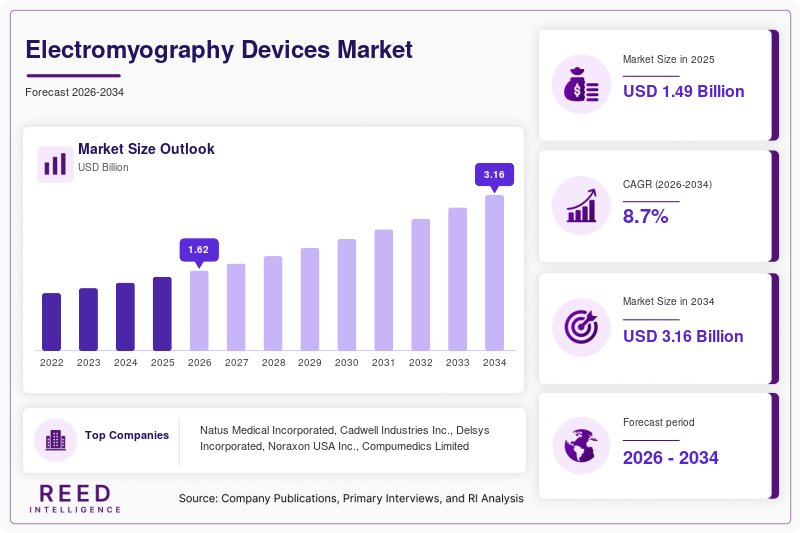
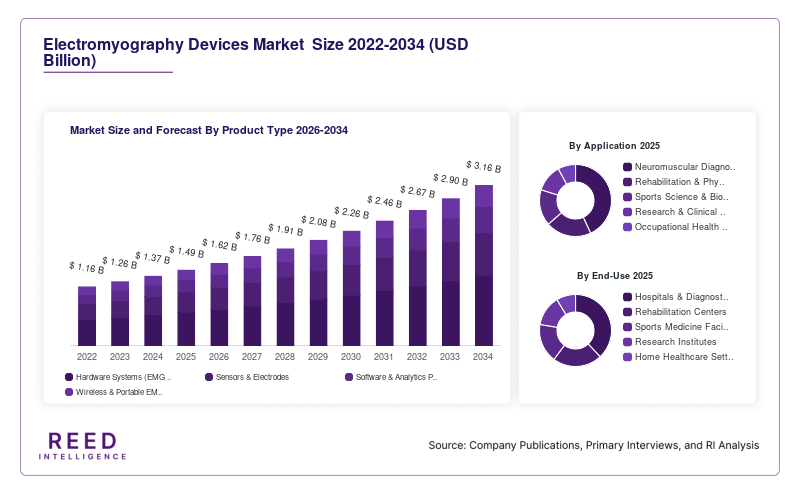
The Electromyography Devices Market is projected to reach USD 1.62 billion in 2026 and is expected to expand to approximately USD 3.18 billion by 2034, registering a CAGR of 8.7% during 2026–2034. Growth in the market is primarily driven by the increasing prevalence of neuromuscular disorders, rising demand for advanced diagnostic neurophysiology tools, and continuous advancements in biomedical signal processing technologies. Electromyography (EMG) devices are increasingly being integrated into clinical neurology, rehabilitation therapy, and sports medicine due to their ability to measure and analyze electrical activity produced by skeletal muscles.
A major global factor supporting market growth is the rising aging population, which is more susceptible to conditions such as peripheral neuropathy, amyotrophic lateral sclerosis, and muscular dystrophy. This demographic shift has significantly increased diagnostic testing volumes across hospitals and specialty clinics. Additionally, technological improvements such as wireless EMG systems and AI-assisted signal interpretation have improved diagnostic accuracy and workflow efficiency, further strengthening adoption across healthcare systems worldwide.
Key Highlights
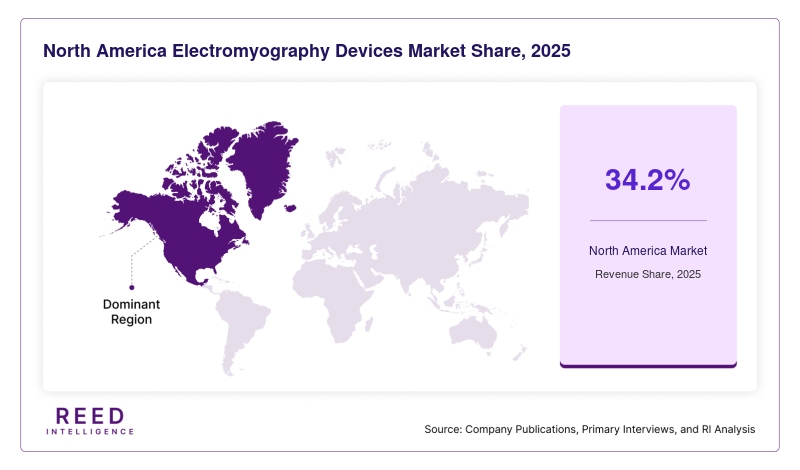
- North America dominated the market with a 34.2% share in 2025.
- Asia Pacific is expected to grow at the fastest CAGR of 11.2% during 2026–2034.
- By equipment type, sensors accounted for the largest share of 38.5%.
- while software solutions are projected to grow at a CAGR of 12.4%.
- By application, structural health monitoring led with a 41.7% share, whereas corrosion detection is expected to expand at a CAGR of 11.8%.
- The United States remained the dominant country, with market values of USD 510 million in 2024 and USD 560 million in 2025.
Market Trends
Integration of Wireless and Wearable EMG Systems
The adoption of wireless and wearable electromyography devices is emerging as a major trend in the Electromyography Devices Market. Traditional wired EMG systems are increasingly being replaced by portable and compact devices that allow real-time muscle activity monitoring outside clinical environments. These systems are particularly valuable in sports science, rehabilitation centers, and remote patient monitoring applications. Wireless EMG devices offer improved patient comfort, reduced setup time, and greater mobility during diagnostic procedures. Furthermore, the integration of cloud-based data storage and Bluetooth-enabled sensors enables seamless data transmission for remote analysis by healthcare professionals. This trend is further supported by increasing investments in digital health technologies and the growing demand for home-based diagnostic solutions, particularly among elderly patients requiring long-term neuromuscular monitoring.
AI-Driven Signal Processing and Data Analytics
Another significant trend shaping the Electromyography Devices Market is the incorporation of artificial intelligence (AI) and machine learning algorithms for signal interpretation and predictive diagnostics. EMG signals are often complex and require advanced filtering and analysis techniques to derive clinically meaningful insights. AI-powered platforms help in identifying abnormal neuromuscular patterns with higher precision, reducing diagnostic errors and improving clinical decision-making. Hospitals and research institutions are increasingly deploying AI-integrated EMG systems to enhance workflow efficiency and reduce interpretation time. Additionally, predictive analytics is being used to assess disease progression in neuromuscular disorders, enabling early intervention strategies. This technological shift is also supporting the development of personalized rehabilitation programs based on muscle activity data.
Market Drivers
Rising Prevalence of Neuromuscular Disorders
One of the primary drivers of the Electromyography Devices Market is the increasing prevalence of neuromuscular disorders worldwide. Conditions such as muscular dystrophy, myasthenia gravis, peripheral neuropathy, and amyotrophic lateral sclerosis are becoming more commonly diagnosed due to improved awareness and advanced diagnostic capabilities. EMG devices play a crucial role in detecting abnormalities in muscle response and nerve conduction, making them essential tools in neurological diagnostics. The growing patient population requiring long-term monitoring and early-stage diagnosis is significantly increasing demand for EMG-based testing. Hospitals and diagnostic centers are expanding their neurophysiology departments to accommodate rising test volumes, thereby accelerating market adoption.
Technological Advancements in Neurodiagnostic Equipment
Technological innovation in electromyography devices is another key driver fueling market expansion. Modern EMG systems now feature high-resolution signal acquisition, multi-channel recording capabilities, and integration with imaging modalities such as ultrasound. These advancements enhance diagnostic accuracy and enable comprehensive neuromuscular assessments. Additionally, improvements in electrode design, including dry electrodes and minimally invasive sensors, have enhanced patient comfort and reduced procedural complexity. The incorporation of digital interfaces and software-based analysis tools has streamlined data interpretation, making EMG testing more accessible to a broader range of healthcare providers, including outpatient clinics and rehabilitation centers.
Market Restraint
High Cost and Limited Accessibility of Advanced EMG Systems
A significant restraint affecting the Electromyography Devices Market is the high cost associated with advanced EMG systems and their maintenance. High-end devices equipped with multi-channel recording, AI-based analysis, and wireless connectivity require substantial capital investment, making them less accessible to small healthcare facilities and clinics in developing regions. Additionally, the cost of skilled professionals required to operate and interpret EMG results adds to the overall operational expenses. In many low- and middle-income countries, limited healthcare budgets restrict the widespread adoption of advanced neurodiagnostic tools, leading to uneven market penetration. For example, rural hospitals often rely on basic diagnostic alternatives instead of sophisticated EMG systems due to affordability constraints. This cost barrier continues to limit the expansion potential of the market despite growing clinical demand.
Market Opportunities
Expansion of Home-Based and Remote Monitoring Solutions
The increasing adoption of home healthcare services presents a significant opportunity for the Electromyography Devices Market. Portable EMG devices designed for remote monitoring are gaining traction, particularly among elderly patients and individuals undergoing long-term rehabilitation therapy. These systems enable continuous muscle activity tracking without requiring frequent hospital visits, thereby improving patient convenience and reducing healthcare costs. The integration of telemedicine platforms with EMG devices further enhances remote diagnostic capabilities. Healthcare providers can monitor patient progress in real time and adjust treatment plans accordingly, making home-based EMG solutions a rapidly growing segment in the market.
Growth in Sports Science and Rehabilitation Applications
Another major opportunity lies in the expanding use of EMG devices in sports science, biomechanics research, and physical rehabilitation. Athletes and trainers increasingly rely on EMG systems to analyze muscle performance, optimize training techniques, and prevent injuries. Rehabilitation centers also utilize EMG data to design personalized recovery programs for patients recovering from orthopedic surgeries or neurological conditions. The rising focus on performance optimization and injury prevention in professional sports is expected to drive demand for advanced EMG technologies. Additionally, collaborations between medical device manufacturers and sports organizations are creating new avenues for product innovation and commercialization.
Segmental Analysis
Type Segment
The sensors segment dominated the Electromyography Devices Market with a 38.5% share in 2024, driven by their critical role in signal acquisition and accuracy in neuromuscular diagnostics. These sensors are widely used in both clinical and research applications due to their reliability and compatibility with modern EMG systems. Hospitals and rehabilitation centers prefer high-precision sensors to ensure accurate diagnostic outputs, which supports their strong market position.
The software solutions segment is expected to register the fastest growth with a CAGR of 12.4%, driven by increasing demand for AI-enabled analysis and cloud-based data management. Advanced software platforms allow real-time signal processing, automated interpretation, and integration with hospital information systems, significantly improving diagnostic efficiency and workflow automation.
Application Segment
Structural health monitoring held the largest share of 41.7% in 2024, as EMG technology is widely used to analyze muscle fatigue, strain, and biomechanical performance in industrial and healthcare settings. Its application in rehabilitation therapy and occupational health assessments further strengthens its dominance.
Corrosion detection and related applications are projected to grow at a CAGR of 11.8%, supported by increasing use of EMG-based systems in advanced industrial diagnostics and material testing environments. The rising demand for predictive maintenance solutions contributes to this segment’s expansion.
End-Use Segment
Hospitals and diagnostic centers accounted for 44.3% share in 2024, driven by high patient inflow and availability of specialized neurodiagnostic departments. These facilities are primary users of advanced EMG systems for neurological evaluations.
Rehabilitation centers are expected to grow at the fastest CAGR of 10.9%, due to increasing focus on personalized recovery programs and physical therapy solutions supported by EMG data analytics.
Regional Analysis
North America
North America accounted for approximately 34.2% market share in 2025, and the region is projected to grow at a CAGR of 8.1% during 2026–2034. The region benefits from advanced healthcare infrastructure, high adoption of neurodiagnostic technologies, and strong presence of leading medical device manufacturers. Increasing investment in neurological research further supports regional growth.
The United States dominates the North American market, driven by widespread clinical use of EMG devices in hospitals and research institutions. A key growth factor is the rising incidence of neuromuscular diseases and strong reimbursement frameworks supporting diagnostic procedures.
Europe
Europe accounted for approximately 27–28% of the Electromyography Devices Market share in 2025, with an expected CAGR of 7.5% during the forecast period. Growth in the region is supported by increasing prevalence of neurological disorders and a rapidly aging population requiring early diagnostic interventions. Public healthcare systems across countries such as Germany, France, and the UK play a crucial role in supporting access to EMG diagnostics. Additionally, technological integration in hospitals and research institutions continues to drive demand for advanced neurophysiology equipment.
Germany leads the European market, supported by its advanced medical device manufacturing ecosystem and strong emphasis on clinical research. A unique growth factor in the region is the increasing focus on rehabilitation and physiotherapy programs, where EMG devices are widely used for muscle activity monitoring and therapy planning. Moreover, collaboration between research institutions and healthcare providers is facilitating innovation in EMG-based diagnostics and treatment approaches.
Asia Pacific
Asia Pacific captured around 23–24% of the market share in 2025 and is expected to register the fastest CAGR of 10–11% during 2026–2034. The region’s growth is driven by improving healthcare infrastructure, rising awareness of neuromuscular disorders, and increasing investment in diagnostic technologies. Countries such as China, Japan, and India are expanding their healthcare systems to accommodate growing patient populations, which is significantly boosting demand for EMG devices.
China dominates the Asia Pacific market due to large-scale healthcare modernization programs and increasing government investments in hospital infrastructure. A key growth factor is the expansion of public healthcare initiatives aimed at improving diagnostic accessibility in both urban and rural areas. Additionally, the rising adoption of portable and cost-effective EMG systems in outpatient settings is contributing to rapid market growth across the region.
Middle East & Africa
The Middle East & Africa region accounted for approximately 10–11% of the global market share in 2025, with a projected CAGR of 7.5–8.0% over the forecast period. Although the market is relatively smaller compared to developed regions, it is gradually expanding due to increasing investments in healthcare infrastructure and diagnostic capabilities. Governments in the region are focusing on upgrading hospital facilities and introducing advanced medical technologies to improve patient care outcomes.
Saudi Arabia is the leading country in this region, driven by ongoing healthcare reforms and diversification initiatives. A unique growth factor is the implementation of national healthcare transformation programs that emphasize early disease diagnosis and advanced medical technologies. Additionally, increasing awareness of neurological conditions and growing private healthcare investments are supporting the adoption of EMG devices across hospitals and specialty clinics.
Latin America
Latin America held approximately 8–9% share of the Electromyography Devices Market in 2025, with an expected CAGR of around 8.0–8.5% during 2026–2034. Market growth in this region is supported by improving healthcare infrastructure, rising healthcare expenditure, and increasing adoption of diagnostic technologies in urban centers. The expansion of private healthcare facilities and diagnostic laboratories is further contributing to market development.
Brazil dominates the Latin American market, driven by its large healthcare system and growing demand for neurological diagnostics. A key growth factor is the expansion of private healthcare networks and increasing investment in specialized diagnostic centers. Additionally, government initiatives aimed at improving access to healthcare services are enhancing the adoption of EMG devices across the country, particularly in metropolitan areas where advanced medical technologies are more readily available.
Competitive Landscape
The Electromyography Devices Market is moderately consolidated, with key players focusing on technological innovation, product expansion, and strategic collaborations. Leading companies include Natus Medical Incorporated, Cadwell Industries, Delsys Incorporated, Noraxon USA Inc., and Compumedics Limited. These companies are investing in wireless EMG systems, AI-based diagnostic tools, and portable monitoring devices to strengthen their market positions.
Natus Medical Incorporated is considered a leading player due to its broad portfolio of neurodiagnostic solutions and strong global distribution network. Recently, the company introduced an upgraded EMG platform with enhanced signal processing capabilities and integrated cloud analytics to improve clinical workflow efficiency.
Key Players List
- Natus Medical Incorporated
- Cadwell Industries Inc.
- Delsys Incorporated
- Noraxon USA Inc.
- Compumedics Limited
- Nihon Kohden Corporation
- Thought Technology Ltd.
- OT Bioelettronica
- Alpine Biomed
- Biometrics Ltd.
- Mitsar Co. Ltd.
- Electrical Geodesics Inc.
- Neurosoft
- Medtronic plc
- Biopac Systems Inc.
Recent Developments
- In 2025, Natus Medical Incorporated launched a next-generation wireless EMG system featuring AI-assisted signal interpretation and cloud integration for remote diagnostics.
- Cadwell Industries introduced a portable EMG device designed for outpatient and home-care applications, improving accessibility in remote monitoring.
- Delsys Incorporated expanded its product portfolio with high-density EMG sensor arrays aimed at advanced biomechanics and sports performance analysis.
Electromyography Devices Market Segments
By Product Type
- Hardware Systems (EMG Devices)
- Sensors & Electrodes
- Software & Analytics Platforms
- Wireless & Portable EMG Systems
By Application
- Neuromuscular Diagnostics
- Rehabilitation & Physiotherapy
- Sports Science & Biomechanics
- Research & Clinical Studies
- Occupational Health & Muscle Analysis
By End-Use
- Hospitals & Diagnostic Centers
- Rehabilitation Centers
- Sports Medicine Facilities
- Research Institutes
- Home Healthcare Settings
By Region
- North America
- Europe
- APAC
- Middle East and Africa
- LATAM