Electronic Cigarette Lithium Battery Market Size, Share & Demand Report By Battery Type (Lithium-Ion Batteries, Lithium Polymer Batteries), By Capacity (Below 500 mAh, 500–1000 mAh, Above 1000 mAh), By Application (Disposable Electronic Cigarettes), By Distribution Channel (Original Equipment Manufacturers (OEMs), Battery Distributors), By Region & Segment Forecasts, 2026–2034
USD 3950
Market Overview
The Electronic Cigarette Lithium Battery Market size was valued at USD 3.42 billion in 2026 and is projected to reach USD 6.87 billion by 2034, expanding at a CAGR of 9.1% during 2026–2034. The market growth is being supported by the increasing adoption of rechargeable power solutions in electronic nicotine delivery systems and the ongoing shift toward compact, high-energy-density battery technologies. Improvements in lithium-ion chemistry, battery management systems, and charging efficiency have contributed to wider deployment across disposable, rechargeable, and pod-based electronic cigarette products.
A significant global factor supporting market expansion has been the advancement of lithium battery manufacturing capacity. Investments in battery production facilities, automation technologies, and energy storage innovation have improved cell performance, reduced manufacturing costs, and enhanced product reliability. These developments have enabled battery suppliers to meet rising demand from electronic cigarette device manufacturers while maintaining performance and safety standards.
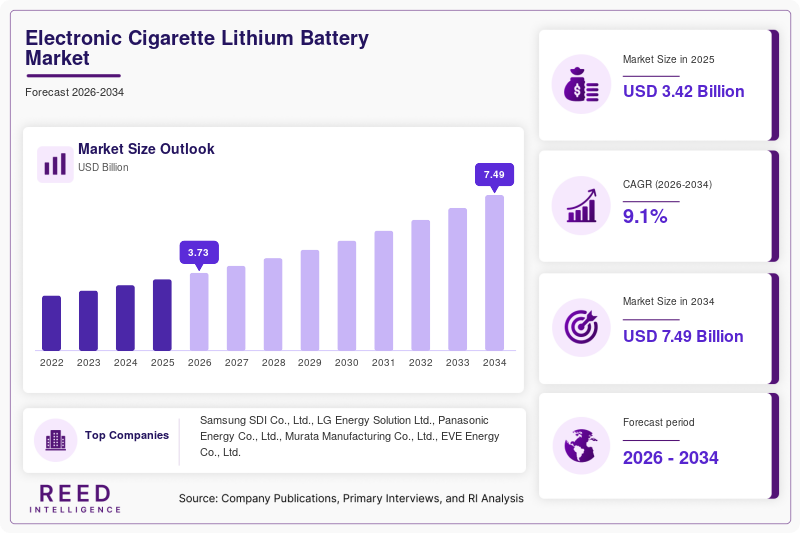
Key Highlights
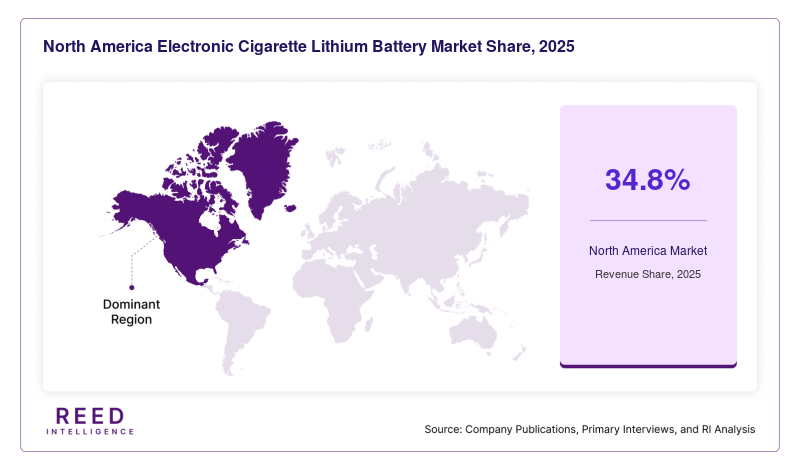
- North America accounted for 34.8% of the global Electronic Cigarette Lithium Battery Market share in 2025, while Asia Pacific is projected to register the fastest CAGR of 10.4% during 2026–2034.
- By battery type, Lithium-Ion Batteries held the leading market share of 62.7% in 2025, whereas Lithium Polymer Batteries are anticipated to grow at a CAGR of 10.8% through 2034.
- By capacity, 500–1000 mAh Batteries represented 38.6% of market revenue in 2025. The Above 1000 mAh Segment is forecast to expand at a CAGR of 10.6%.
- By application, Rechargeable Electronic Cigarettes captured 68.2% of total market demand in 2025, while Advanced Pod Systems are expected to record a CAGR of 10.9%.
- The United States remained the dominant national market, valued at USD 0.92 billion in 2024 and USD 0.98 billion in 2025.
Market Trends
AI-Enabled Battery Monitoring and Safety Integration
Manufacturers are increasingly integrating intelligent battery monitoring technologies into electronic cigarette devices. Smart battery management systems provide real-time information regarding charge cycles, temperature fluctuations, power consumption, and remaining battery life. These features improve user experience while supporting safer device operation. As electronic cigarette products become more technologically sophisticated, battery suppliers are collaborating with device manufacturers to incorporate advanced monitoring capabilities into compact battery systems.
Shift Toward High-Capacity Fast-Charging Batteries
Consumer demand for extended device usage and shorter charging times is influencing product development strategies. Battery manufacturers are focusing on high-capacity lithium-ion and lithium-polymer solutions that support rapid charging while maintaining thermal stability. New electrode materials, improved electrolyte formulations, and optimized cell architecture are enabling manufacturers to deliver enhanced performance without significantly increasing battery size. This trend is expected to remain a key contributor to market expansion throughout the forecast period.
Market Drivers
Growing Demand for Rechargeable Vaping Devices
The increasing preference for rechargeable electronic cigarette devices is creating sustained demand for lithium battery solutions. Consumers seek products that offer extended usage cycles, cost efficiency, and convenient charging capabilities. Rechargeable devices require durable and efficient battery systems, encouraging manufacturers to invest in advanced lithium battery technologies. The transition from traditional disposable systems toward rechargeable alternatives continues to strengthen demand across multiple regions.
Continuous Advancements in Battery Energy Density
Technological progress in lithium battery chemistry has improved energy density, enabling smaller batteries to deliver greater performance. Enhanced energy storage capacity allows device manufacturers to produce compact electronic cigarette products without compromising operational duration. The availability of high-performance cells supports product innovation and contributes to broader adoption among consumers seeking portable and reliable vaping devices.
Market Restraint
Regulatory Uncertainty Across Multiple Markets
Regulatory changes affecting electronic cigarette products continue to create uncertainty for battery manufacturers and device producers. Variations in product approval requirements, safety standards, transportation regulations, and import restrictions can affect supply chains and market accessibility. Compliance costs and evolving regulatory frameworks may limit expansion opportunities in certain regions.
Market Opportunities
Development of Sustainable Battery Technologies
Growing attention toward environmental sustainability is creating opportunities for recyclable and environmentally responsible battery solutions. Manufacturers investing in recyclable materials, improved recovery systems, and eco-friendly production processes are expected to benefit from changing industry expectations and sustainability initiatives. Such developments could enhance market competitiveness while supporting long-term growth.
Expansion of Premium High-Performance Device Segments
The emergence of premium electronic cigarette products is generating demand for specialized battery systems with advanced performance characteristics. High-capacity batteries, intelligent charging systems, and enhanced safety mechanisms are becoming important differentiators in premium devices. Battery suppliers capable of delivering customized solutions are expected to capitalize on this growing market opportunity.
Segmental Analysis
By Battery Type
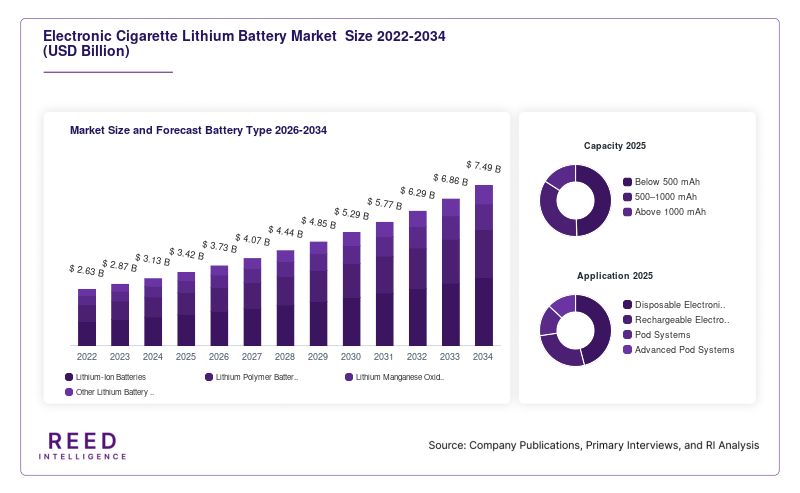
The market is segmented into Lithium-Ion Batteries, Lithium Polymer Batteries, Lithium Manganese Oxide Batteries, and Others.
Lithium-Ion Batteries accounted for 62.7% of market revenue in 2025. Their dominance was attributed to high energy density, cost efficiency, long cycle life, and compatibility with a broad range of electronic cigarette devices. Manufacturers widely adopted lithium-ion batteries because they provide reliable performance while maintaining compact dimensions.
Lithium Polymer Batteries are projected to register the fastest CAGR of 10.8% during the forecast period. Their lightweight construction and flexible design configurations will support adoption in next-generation compact vaping devices. Increasing demand for slim and portable products will encourage greater deployment of lithium-polymer technologies.
By Capacity
The capacity segment includes Below 500 mAh, 500–1000 mAh, and Above 1000 mAh batteries.
The 500–1000 mAh Segment held 38.6% market share in 2025. This capacity range balanced portability and performance, making it suitable for mainstream electronic cigarette devices used by a broad consumer base.
The Above 1000 mAh Segment is expected to expand at a CAGR of 10.6% through 2034. Growth will be supported by demand for extended battery life in high-performance devices. Consumers seeking longer operational duration between charging cycles will increasingly favor higher-capacity battery solutions.
By Application
The application segment consists of Disposable Electronic Cigarettes, Rechargeable Electronic Cigarettes, Pod Systems, and Advanced Pod Systems.
Rechargeable Electronic Cigarettes represented 68.2% of total revenue in 2025. Their popularity stemmed from long-term cost efficiency, reusable designs, and compatibility with high-capacity battery systems.
Advanced Pod Systems are forecast to record the highest CAGR of 10.9% during the assessment period. These devices will increasingly utilize intelligent power management features and optimized battery configurations that improve overall device performance.
By Distribution Channel
The market is divided into Original Equipment Manufacturers (OEMs), Battery Distributors, and Online Supply Platforms.
Original Equipment Manufacturers (OEMs) captured 54.1% of market demand in 2025. Direct integration of battery solutions into electronic cigarette manufacturing operations supported segment leadership and ensured product compatibility.
Online Supply Platforms are anticipated to grow at a CAGR of 10.2% during 2026–2034. Expanded digital procurement capabilities and streamlined supply chain management solutions will encourage greater adoption of online sourcing channels.
Regional Analysis
North America
North America held 34.8% of the global Electronic Cigarette Lithium Battery Market share in 2025. The region benefited from established electronic cigarette distribution networks, strong consumer awareness, and widespread adoption of rechargeable devices. The market is projected to expand at a CAGR of 8.7% during 2026–2034.
The United States remained the dominant country within the region. Growth is supported by increasing demand for technologically advanced vaping devices featuring enhanced battery performance and longer operating life. Domestic innovation in battery management technologies continues to contribute to market development.
Europe
Europe accounted for 27.1% of global revenue in 2025. The market is expected to grow at a CAGR of 8.5% throughout the forecast period. Product quality standards and consumer demand for reliable rechargeable systems supported regional market performance.
Germany represented the largest country-level market in Europe. The country's strength in precision manufacturing and electronics engineering has encouraged the development of high-quality battery solutions suitable for advanced electronic cigarette devices.
Asia Pacific
Asia Pacific represented 24.3% of the global market in 2025 and is forecast to register the fastest CAGR of 10.4% between 2026 and 2034. Expanding manufacturing infrastructure, increasing consumer demand, and growing production capacity have contributed to regional growth prospects.
China dominated the regional market due to its extensive battery manufacturing ecosystem and established position within the electronic cigarette supply chain. Strong manufacturing capabilities and ongoing investments in battery technology continue to support market expansion.
Middle East & Africa
The Middle East & Africa accounted for 7.2% of the market share in 2025 and are projected to expand at a CAGR of 8.2% during the forecast period. Market growth is supported by increasing product availability and gradual adoption of rechargeable electronic cigarette devices.
The United Arab Emirates emerged as the leading country market. The country's retail infrastructure and growing consumer demand for premium electronic products have contributed to increased adoption of advanced battery-powered vaping devices.
Latin America
Latin America captured 6.6% of global market revenue in 2025 and is anticipated to grow at a CAGR of 8.4% through 2034. Increasing urbanization and expanding consumer electronics distribution channels are supporting market development.
Brazil remained the dominant country within the region. Growth is influenced by rising demand for rechargeable consumer devices and gradual expansion of battery-powered electronic product categories across major metropolitan areas.
Competitive Landscape
The Electronic Cigarette Lithium Battery Market remains moderately consolidated, with leading participants competing through product innovation, manufacturing efficiency, battery safety improvements, and strategic partnerships. Market participants are investing in research and development activities aimed at increasing battery capacity, improving charging performance, and enhancing thermal management capabilities.
Samsung SDI Co., Ltd. remains a prominent market leader due to its advanced lithium battery portfolio and extensive manufacturing capabilities. The company recently expanded development efforts focused on next-generation high-density battery technologies designed to improve performance across compact electronic devices.
LG Energy Solution Ltd. continues to strengthen its position through advanced cell technologies and investments in battery production capacity.
Murata Manufacturing Co., Ltd. focuses on high-performance lithium battery solutions emphasizing reliability and compact form factors.
Panasonic Energy Co., Ltd. maintains a significant market presence through continuous battery innovation and strong global distribution capabilities.
EVE Energy Co., Ltd. has expanded production capacity to support increasing demand from consumer electronics and specialized battery applications.
Key Players List
- Samsung SDI Co., Ltd.
- LG Energy Solution Ltd.
- Panasonic Energy Co., Ltd.
- Murata Manufacturing Co., Ltd.
- EVE Energy Co., Ltd.
- Sony Energy Devices Corporation
- BYD Company Limited
- BAK Battery Co., Ltd.
- Tianjin Lishen Battery Joint-Stock Co., Ltd.
- ATL (Amperex Technology Limited)
- Sunwoda Electronic Co., Ltd.
- Shenzhen Grepow Battery Co., Ltd.
- VDL Power Co., Ltd.
- HGB Battery Co., Ltd.
- Jiangsu Highstar Battery Manufacturing Co., Ltd.
Electronic Cigarette Lithium Battery Market Segments
Battery Type
- Lithium-Ion Batteries
- Lithium Polymer Batteries
- Lithium Manganese Oxide Batteries
- Other Lithium Battery Types
Capacity
- Below 500 mAh
- 500–1000 mAh
- Above 1000 mAh
Application
- Disposable Electronic Cigarettes
- Rechargeable Electronic Cigarettes
- Pod Systems
- Advanced Pod Systems
Distribution Channel
- Original Equipment Manufacturers (OEMs)
- Battery Distributors
- Online Supply Platforms
By Region
- North America
- Europe
- APAC
- Middle East and Africa
- LATAM