Electronic Keyboards Market Size, Share, Demand Report By Product Type (Portable Keyboards, Digital Pianos, Workstation Keyboards, MIDI Controller Keyboards, Arranger Keyboards), By Application (Music Education and Learning, Professional Performance, Digital Music Production, Home Entertainment, Religious and Community Events), By Distribution Channel (Offline Retail Stores, Online Retail), By Region & Segment Forecasts, 2026–2034
USD 3950
Market Overview
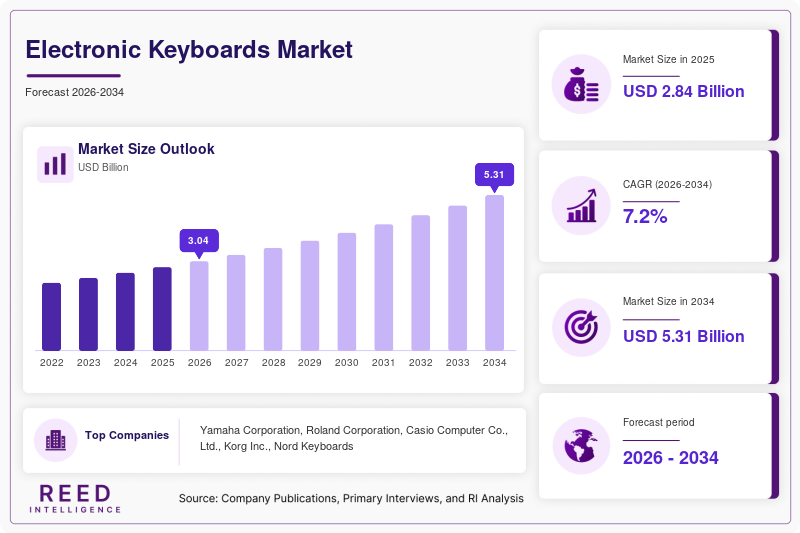
The global Electronic Keyboards Market size was valued at USD 2.84 billion in 2026 and is projected to reach USD 4.97 billion by 2034, expanding at a CAGR of 7.2% during 2026–2034. The market continues to evolve as digital music creation, music education, home entertainment, and professional performance applications gain wider adoption across developed and emerging economies. Electronic keyboards have become increasingly accessible due to improvements in sound synthesis technology, connectivity features, and compact product designs that appeal to both beginners and professional musicians.
The growing integration of music education programs across schools, universities, and private institutions has played an important role in supporting demand for electronic keyboards worldwide. Educational institutions increasingly prefer electronic instruments because they require less maintenance than traditional pianos while offering diverse sound libraries and learning functionalities. Additionally, the expansion of online music learning platforms has encouraged consumers to invest in entry-level and intermediate keyboards for skill development.
Key Highlights
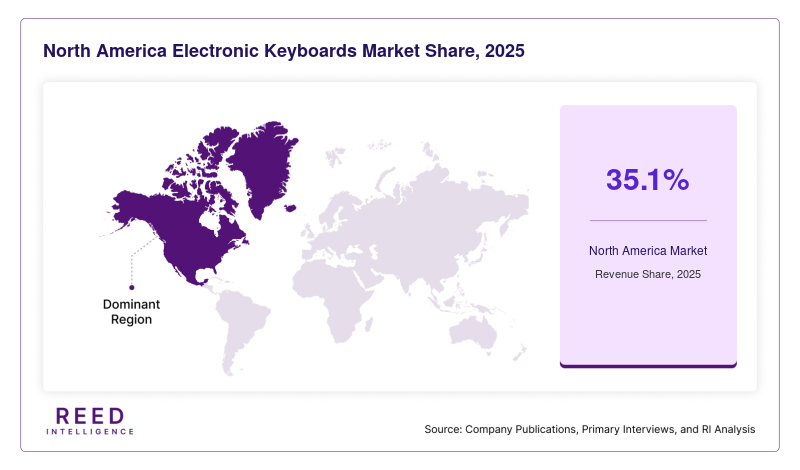
- North America dominated the market with a 35.1% share in 2025.
- while Asia Pacific is expected to grow at the fastest CAGR of 9.4% during 2026–2034.
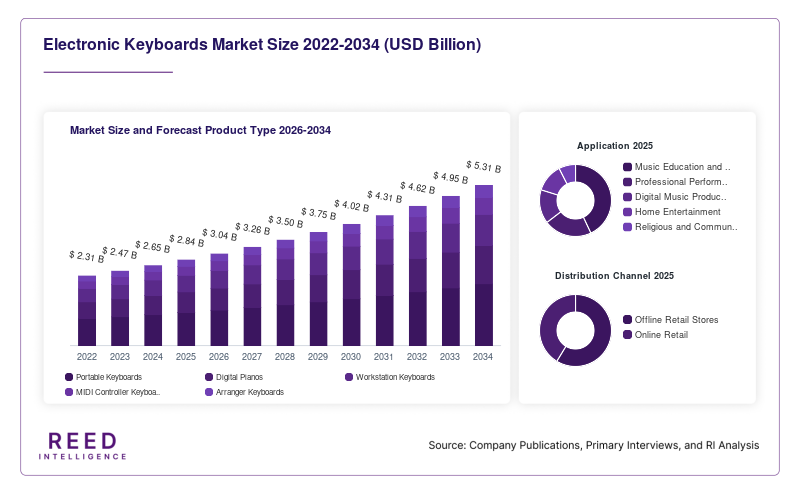
- By product type, portable keyboards accounted for the largest share of 39.4%.
- while MIDI controller keyboards are projected to grow at a CAGR of 9.8%.
- By application, music education and learning led with a 42.8% share.
- whereas digital music production is expected to expand at a CAGR of 9.6%.
- By distribution channel, offline retail stores held the largest share of 63.5%.
- while online retail is anticipated to grow at a CAGR of 10.2%.
- The United States remained the dominant country, with market values of USD 712 million in 2024 and USD 758 million in 2025.
Market Trends
Integration of Smart Connectivity and Mobile Applications
The electronic keyboards industry is experiencing significant transformation through the integration of smart connectivity features. Manufacturers are increasingly incorporating Bluetooth audio, wireless MIDI transmission, cloud-based sound libraries, and smartphone application compatibility into new product launches. These features allow users to access tutorials, record performances, customize sounds, and connect seamlessly with digital audio workstations. The growing preference for connected music ecosystems is encouraging producers to develop keyboards that function as complete music creation hubs rather than standalone instruments. As digital lifestyles become more prevalent among younger consumers, smart connectivity capabilities are becoming important purchase considerations across both entry-level and professional product categories.
Rising Popularity of Home-Based Music Creation
Home-based music production and recreational music learning have emerged as influential trends shaping market development. The expansion of content creation platforms, online music lessons, and independent music production has increased demand for versatile electronic keyboards. Consumers are investing in compact instruments that offer professional-grade sounds while fitting into home environments. Advanced sampling technologies and affordable recording software have reduced barriers to music production, allowing individuals to create studio-quality content from personal spaces. This trend is generating sustained demand for portable keyboards and MIDI controllers, particularly among younger demographics seeking creative outlets and supplemental income opportunities through digital content creation.
Market Drivers
Expansion of Global Music Education Programs
Growing investment in music education programs across schools, universities, and private academies is a major driver of the Electronic Keyboards Market. Educational institutions increasingly recognize the role of music in cognitive development, creativity enhancement, and emotional well-being. Electronic keyboards provide cost-effective solutions for music instruction due to their versatility, portability, and reduced maintenance requirements. Many educational organizations are replacing traditional instruments with digital alternatives that support interactive learning experiences. Features such as built-in lesson modes, recording functions, and multiple instrument voices help students develop skills more efficiently. As governments and educational stakeholders continue promoting arts education, demand for electronic keyboards is expected to remain strong throughout the forecast period.
Growth of Digital Entertainment and Content Creation
The rapid expansion of digital entertainment platforms has significantly increased demand for electronic musical instruments. Independent artists, content creators, streamers, and music producers require flexible tools for composing and recording music. Electronic keyboards serve as essential instruments within modern digital production workflows. The increasing popularity of video-sharing platforms and music streaming services has encouraged individuals to create original content, driving purchases of both beginner and professional keyboard models. Manufacturers are responding by introducing products that integrate directly with production software and recording systems. This convergence between music technology and digital media creation continues to generate new growth avenues for industry participants worldwide.
Market Restraint
Competition from Software-Based Virtual Instruments
One of the major challenges facing the Electronic Keyboards Market is the increasing availability of software-based virtual instruments and digital music applications. Many aspiring musicians and hobbyists can now access high-quality piano sounds, synthesizers, and production tools through computers, tablets, and smartphones at relatively low costs. These software solutions often provide extensive customization options without requiring dedicated hardware investments. As a result, some consumers may postpone or avoid purchasing physical keyboards altogether. The trend is particularly noticeable among entry-level users exploring music production for the first time. While professional musicians continue to value hardware instruments for performance reliability and tactile control, growing software adoption creates competitive pressure on manufacturers. Companies must continuously invest in innovation, enhanced user experiences, and integrated ecosystems to maintain product differentiation and sustain market growth amid evolving consumer preferences.
Market Opportunities
Increasing Demand Across Emerging Economies
Emerging economies present substantial opportunities for electronic keyboard manufacturers. Rising urbanization, expanding middle-class populations, and increasing disposable incomes are enabling greater consumer spending on recreational and educational products. Countries across Asia Pacific, Latin America, and parts of the Middle East are witnessing growing interest in music education and performance activities. Retail expansion and e-commerce penetration are making electronic keyboards more accessible to first-time buyers. Manufacturers that introduce affordable models tailored to local purchasing power can capture significant market share. Strategic partnerships with educational institutions and music academies further strengthen market penetration opportunities in these rapidly developing regions.
Development of Professional Hybrid Performance Systems
The growing demand for hybrid performance solutions offers another attractive opportunity for industry participants. Professional musicians increasingly seek instruments that combine traditional keyboard functionality with advanced production capabilities. Products featuring workstation technology, real-time sound manipulation, AI-assisted composition tools, and seamless software integration are gaining popularity. These innovations support live performances, studio production, and remote collaboration simultaneously. Manufacturers investing in advanced processing power and customizable interfaces can address evolving professional requirements. As live entertainment, digital performances, and virtual concerts continue expanding globally, demand for multifunctional electronic keyboards is expected to create new revenue streams across premium product categories.
Segmental Analysis
By Product Type
Portable keyboards held the largest share of the market, accounting for approximately 39.4% of global revenue in 2024. Their dominance can be attributed to affordability, convenience, and broad appeal among beginners, students, and casual musicians. These instruments provide multiple sound options, learning functions, and lightweight designs suitable for home use and educational environments. Manufacturers continue introducing upgraded portable keyboards featuring improved audio quality, wireless connectivity, and integrated learning applications. Demand remains particularly strong in emerging markets where consumers seek cost-effective alternatives to traditional pianos. Educational institutions also favor portable models because they offer practical solutions for classroom-based instruction while requiring minimal maintenance and operational costs.
MIDI controller keyboards are expected to register the fastest CAGR of 9.8% through 2034. Growth is being fueled by increasing adoption of digital audio workstations and home recording systems among content creators and independent musicians. These keyboards provide seamless integration with music production software, enabling users to create, edit, and perform digital compositions efficiently. Advancements in controller sensitivity, customizable interfaces, and software compatibility are enhancing their appeal. The rapid growth of online music distribution platforms and independent production environments continues to support adoption. As more creators establish personal studios and pursue professional-quality recording capabilities, demand for MIDI controller keyboards is projected to expand substantially.
By Application
Music education and learning represented the largest application segment, accounting for approximately 42.8% of market revenue in 2024. Educational institutions, private academies, and home learners increasingly utilize electronic keyboards because they provide versatile instructional features. Built-in lesson modes, recording capabilities, metronomes, and interactive learning functions enhance educational outcomes while reducing barriers to entry. Parents and schools often prefer electronic keyboards over traditional instruments due to affordability and flexibility. The continued integration of music programs into academic curricula across developed and emerging economies supports sustained segment growth. Additionally, online learning platforms have encouraged more individuals to purchase keyboards for structured and self-directed musical education.
Digital music production is anticipated to be the fastest-growing application segment, expanding at a CAGR of 9.6% during the forecast period. The increasing popularity of independent music creation, podcast production, streaming content, and multimedia development is driving demand for advanced electronic keyboards. Producers require instruments capable of integrating with software ecosystems while offering extensive sound customization options. Technological developments in synthesis, sampling, and workstation functionality are strengthening product adoption. Growth in creator economies and digital entertainment platforms is generating new opportunities for musicians seeking professional production capabilities. These evolving requirements are expected to accelerate investment in electronic keyboards tailored for music production workflows.
By Distribution Channel
Offline retail stores accounted for the largest market share in 2024, representing approximately 63.5% of total revenue. Consumers frequently prefer physical stores because they can test keyboard functionality, evaluate sound quality, and compare features before making purchasing decisions. Specialty music retailers, electronics stores, and branded showrooms continue to play important roles in product distribution. Professional musicians and educational institutions often rely on in-person demonstrations and expert guidance during procurement processes. The availability of after-sales support, maintenance services, and financing options further strengthens offline channel performance. Despite increasing digital commerce activity, traditional retail networks remain influential across numerous regional markets.
Online retail is projected to achieve the fastest CAGR of 10.2% through 2034. E-commerce platforms offer consumers broader product selection, competitive pricing, and convenient purchasing experiences. Manufacturers are increasingly investing in direct-to-consumer channels and digital marketing strategies to reach wider audiences. Product demonstrations, virtual consultations, and customer reviews help buyers make informed decisions without visiting physical stores. Expanding internet penetration and smartphone adoption are further accelerating online sales growth. The channel is particularly attractive in emerging markets where retail infrastructure may be less developed. As digital purchasing behavior continues to evolve, online retail is expected to capture an increasingly significant portion of market revenue.
Regional Analysis
North America
North America accounted for approximately 35.1% of the global Electronic Keyboards Market in 2025, making it the largest regional market. The region benefits from a mature music industry, strong consumer purchasing power, and widespread adoption of advanced musical technologies. Growth remains supported by increasing demand from educational institutions, professional musicians, and home-based content creators. The regional market is projected to expand at a CAGR of 6.4% during the forecast period as manufacturers continue introducing innovative products with enhanced digital capabilities.
The United States remains the dominant contributor to regional revenue generation. A unique growth factor supporting market expansion is the strong presence of independent music producers and digital content creators. The country’s extensive ecosystem of recording studios, online learning platforms, and music technology companies creates favorable conditions for keyboard adoption. Increasing investments in school music programs and growing participation in recreational music activities further strengthen long-term market prospects across the nation.
Europe
Europe represented approximately 27.4% of the global market in 2025 and continues to demonstrate stable growth. The region benefits from a long-standing musical heritage, extensive music education infrastructure, and a strong base of professional performers. Consumers increasingly prefer electronic instruments that offer convenience, portability, and advanced sound customization features. Market participants are focusing on product innovations designed to meet the needs of both amateur learners and experienced musicians. Europe is expected to register a CAGR of 6.7% through 2034.
Germany remains the leading country within the European market. A unique growth factor is the country's strong manufacturing and engineering expertise in musical instruments and audio technologies. Continuous innovation from domestic and international brands operating in Germany supports market expansion. The presence of music festivals, performance venues, and specialized educational institutions further contributes to sustained demand for electronic keyboards across diverse consumer segments.
Asia Pacific
Asia Pacific held nearly 23.8% of the global Electronic Keyboards Market in 2025 and is projected to record the fastest CAGR of 9.4% during the forecast period. Rapid urbanization, rising disposable income levels, and expanding access to music education are creating favorable growth conditions. Consumers across major economies increasingly view music learning as an important extracurricular activity. Manufacturers are actively expanding distribution networks and introducing affordable products to capture growing demand among first-time buyers and students.
China dominates the Asia Pacific market due to its large population and expanding consumer electronics ecosystem. A unique growth factor is the rapid adoption of online music education platforms that encourage instrument purchases. The growing popularity of digital entertainment and social media content creation is also driving demand for electronic keyboards among younger demographics. These factors collectively position the country as a key growth engine for regional market development.
Middle East & Africa
The Middle East & Africa region accounted for approximately 6.4% of the global market in 2025. Although relatively smaller than other regions, demand is steadily increasing due to growing interest in music education and cultural entertainment activities. Urban centers are witnessing increased establishment of music schools, academies, and performance venues. Manufacturers are also leveraging e-commerce platforms to improve product accessibility across diverse markets. The regional market is expected to grow at a CAGR of 7.1% through 2034.
Saudi Arabia represents the dominant country within the region. A unique growth factor is the increasing investment in entertainment infrastructure and cultural development initiatives. Government-led programs supporting creative industries and live performances are encouraging greater participation in musical activities. The expansion of educational opportunities related to music and performing arts is further supporting demand for electronic keyboards among students and aspiring musicians.
Latin America
Latin America captured around 7.3% of the global Electronic Keyboards Market in 2025 and is expected to maintain steady growth throughout the forecast period. Rising interest in music production, expanding access to digital learning resources, and increasing consumer spending on recreational products are contributing to market development. Manufacturers are focusing on affordable product offerings and regional distribution partnerships to strengthen their presence. The market is forecast to grow at a CAGR of 7.5% during 2026–2034.
Brazil remains the dominant country in the region. A unique growth factor is the country's vibrant music culture, which encourages participation in performance, composition, and music education activities. Growing adoption of digital recording technologies and independent music production tools is increasing demand for versatile electronic keyboards. Additionally, expanding retail availability and online purchasing channels are improving consumer access to a wider range of products.
Competitive Landscape
The Electronic Keyboards Market is characterized by the presence of established musical instrument manufacturers competing through product innovation, technology integration, pricing strategies, and distribution expansion. Leading companies continue investing in advanced sound engines, wireless connectivity features, and software ecosystem compatibility to strengthen their market positions.
Yamaha Corporation remains a leading participant due to its extensive product portfolio, strong global brand recognition, and broad distribution network. The company continues to introduce electronic keyboards targeting beginners, intermediate learners, and professional musicians. Roland Corporation maintains a strong presence through innovations in digital sound technologies and performance-oriented instruments. Casio Computer Co., Ltd. focuses on affordability and educational applications, helping the company attract a broad consumer base. Korg Inc. emphasizes professional music production and performance solutions, while Nord Keyboards continues to gain traction among premium users seeking advanced stage performance capabilities.
A notable recent industry development involves manufacturers increasingly integrating artificial intelligence-assisted learning features and cloud-based content ecosystems into keyboard platforms. These advancements aim to improve user engagement, personalize learning experiences, and enhance long-term product value across consumer segments.
Key Players
- Yamaha Corporation
- Roland Corporation
- Casio Computer Co., Ltd.
- Korg Inc.
- Nord Keyboards
- Kurzweil Music Systems
- Kawai Musical Instruments Manufacturing Co., Ltd.
- Dexibell
- Medeli Electronics
- Donner Music
- Alesis
- Arturia
- Akai Professional
- Nektar Technology
- M-Audio
Recent Developments
- Yamaha Corporation introduced a new series of connected electronic keyboards featuring enhanced mobile application integration and cloud-based learning functionality in 2025.
- Roland Corporation expanded its digital workstation lineup with upgraded sound processing technology and improved wireless MIDI capabilities in 2025.
- Casio Computer Co., Ltd. launched entry-level educational keyboards incorporating AI-supported lesson features designed for beginner musicians in 2026.
- Korg Inc. released advanced production-focused keyboards featuring expanded software compatibility and customizable control interfaces in 2026.
- Nord Keyboards introduced enhanced stage performance instruments with improved sound libraries and real-time performance controls in 2025.
Electronic Keyboards Market Segments
Product Type
- Portable Keyboards
- Digital Pianos
- Workstation Keyboards
- MIDI Controller Keyboards
- Arranger Keyboards
Application
- Music Education and Learning
- Professional Performance
- Digital Music Production
- Home Entertainment
- Religious and Community Events
Distribution Channel
- Offline Retail Stores
- Online Retail
By Region
- North America
- Europe
- APAC
- Middle East and Africa
- LATAM