Electronic Tongue Market Size, Share & Industry Demand Report By Type (Potentiometric, Voltammetric, Optical), By Component (Sensor Arrays, Sampling Systems, Analytical Software), By Application (Food & Beverage Testing, Pharmaceutical Research, Environmental Monitoring, Academic Research), By End Use (Quality Control Laboratories, Research Institutes, Manufacturing Facilities) By Region & Segment Forecasts, 2025–2034
USD 3950
Market Overview
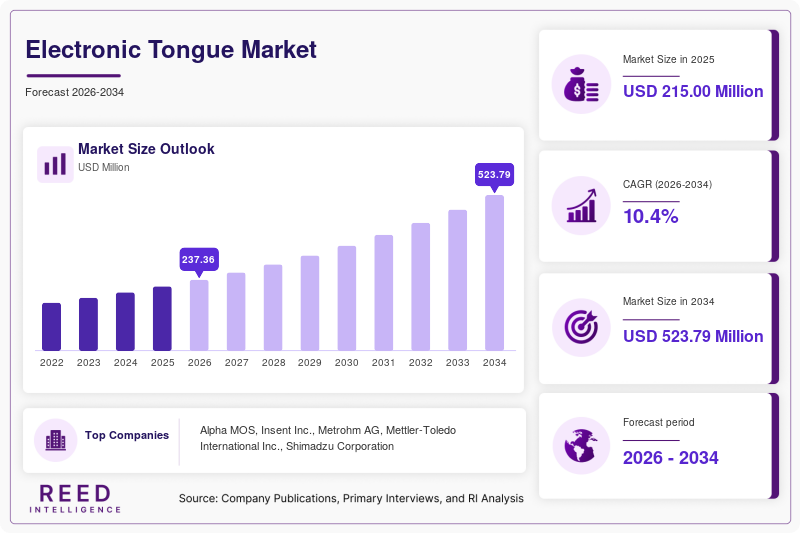
The Electronic Tongue Market size was valued at approximately USD 215 million in 2025 and is projected to reach USD 520 million by 2034, expanding at a compound annual growth rate (CAGR) of 10.4% during 2025–2034. Electronic tongue systems are advanced analytical instruments designed to replicate human taste perception using sensor arrays and pattern recognition algorithms. These systems are increasingly used in food quality testing, pharmaceutical formulation analysis, and environmental monitoring applications.
A major global factor supporting the expansion of the Electronic Tongue Market is the growing emphasis on quality assurance and product standardization across industries. Food manufacturers, pharmaceutical companies, and research laboratories increasingly rely on automated sensory analysis tools to ensure product consistency and regulatory compliance. Electronic tongue systems provide rapid, repeatable, and objective taste analysis compared with traditional human sensory panels, which has strengthened their adoption in quality control and research environments.
Key Highlights
- Asia Pacific dominated the Electronic Tongue Market with 36% share in 2025, while North America will grow fastest at a CAGR of 11.3% through 2034.
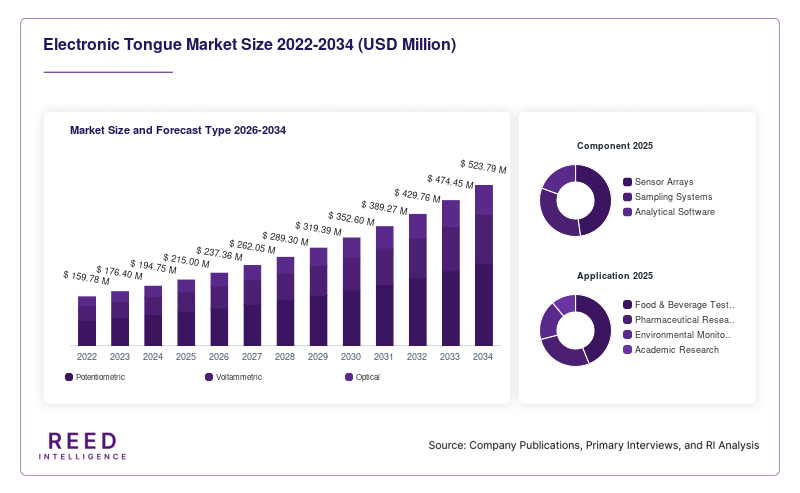
- Potentiometric electronic tongues led the Type segment with 48% share, while optical sensor-based systems will grow fastest at 12.1% CAGR.
- Food & Beverage represented the leading Application segment with 42% share, while pharmaceutical testing will expand fastest at 11.8% CAGR.
- The United States recorded a market size of USD 62 million in 2024, increasing to USD 68 million in 2025.
Market Trends
Integration of Artificial Intelligence in Taste Analysis
Artificial intelligence and machine learning algorithms are increasingly integrated into electronic tongue systems to enhance data interpretation and predictive capabilities. Traditional sensor arrays generate complex multidimensional data, which previously required extensive manual processing. AI-enabled software platforms now automate pattern recognition, enabling faster identification of taste profiles and chemical signatures.
In the Electronic Tongue Market, this trend is improving analytical efficiency and enabling predictive quality control. Food manufacturers use AI-powered systems to forecast flavor deviations during production, while pharmaceutical companies utilize advanced algorithms to evaluate bitterness suppression in drug formulations. The integration of AI also supports cloud-based analytics, allowing organizations to monitor product quality across multiple manufacturing facilities.
Expansion of Multi-Sensor Platforms
Another significant trend shaping the Electronic Tongue Market is the development of multi-sensor platforms that combine taste, smell, and chemical detection capabilities. Companies are increasingly integrating electronic tongue technology with electronic nose and spectroscopy tools to provide comprehensive sensory analysis.
This development allows manufacturers to assess both taste and aroma simultaneously, improving product development processes in industries such as beverages, dairy products, and functional foods. Multi-sensor platforms also improve environmental monitoring by enabling simultaneous detection of chemical contaminants and taste-related compounds in water samples. As sensor miniaturization progresses, these integrated analytical systems are expected to gain wider adoption across research laboratories and industrial testing environments.
Market Drivers
Rising Demand for Automated Sensory Testing in Food Manufacturing
The increasing complexity of food production and the need for standardized quality control processes are driving demand in the Electronic Tongue Market. Food manufacturers must maintain consistent flavor profiles across large production volumes and diverse geographic markets. Human sensory panels often introduce variability and require significant training and logistical coordination.
Electronic tongue systems provide a consistent and objective method for analyzing taste attributes such as bitterness, saltiness, sweetness, and acidity. These systems can evaluate product batches quickly, enabling manufacturers to detect deviations early in the production process. As global food brands expand their product portfolios and introduce new formulations, automated taste analysis technologies are becoming a critical component of quality management systems.
Growth in Pharmaceutical Taste-Masking Research
The pharmaceutical industry increasingly relies on electronic tongue systems to evaluate the taste characteristics of oral drug formulations. Many active pharmaceutical ingredients possess inherently bitter or unpleasant taste profiles, which can affect patient compliance, particularly in pediatric and geriatric populations.
Electronic tongue instruments enable pharmaceutical researchers to quantify taste intensity and assess the effectiveness of taste-masking techniques during drug development. By reducing reliance on human testing panels, these systems accelerate formulation development and support regulatory approval processes. As pharmaceutical innovation expands and oral drug formulations remain a dominant delivery method, demand for electronic tongue technologies in research laboratories will continue to grow.
Market Restraints
High Initial Investment and Technical Complexity
One major challenge affecting the Electronic Tongue Market is the high initial investment required for advanced sensor systems and analytical software platforms. Electronic tongue instruments incorporate specialized sensor arrays, signal processing units, and calibration tools that can significantly increase system costs. Smaller laboratories and research institutions may find it difficult to justify the capital expenditure associated with these instruments.
In addition to equipment costs, electronic tongue systems require specialized technical expertise for calibration, maintenance, and data interpretation. Sensor drift and degradation over time can also affect measurement accuracy, requiring regular system recalibration and sensor replacement. These operational requirements increase the total cost of ownership and may slow adoption among organizations with limited analytical infrastructure.
Another limitation involves the need for application-specific sensor arrays. Electronic tongue systems must often be customized for different sample matrices such as beverages, pharmaceuticals, or environmental samples. This customization process can extend deployment timelines and add additional development costs for manufacturers and end users. Consequently, despite growing awareness of automated sensory analysis technologies, cost and technical barriers remain a key restraint in the broader adoption of electronic tongue systems.
Market Opportunities
Expanding Applications in Environmental Monitoring
An emerging opportunity in the Electronic Tongue Market lies in environmental monitoring and water quality testing. Governments and regulatory agencies worldwide are increasing efforts to detect chemical contaminants and maintain water safety standards. Electronic tongue systems can detect taste-related compounds and dissolved chemical substances in water samples, providing an additional analytical method for water quality assessment.
These systems offer rapid analysis compared with conventional laboratory testing methods. As urbanization and industrial activity increase environmental monitoring requirements, electronic tongue technologies could become an important tool for water utilities, environmental agencies, and research organizations.
Adoption in Personalized Nutrition and Functional Foods
The rise of personalized nutrition and functional food development presents another growth opportunity for the Electronic Tongue Market. Food companies are increasingly designing products tailored to specific dietary needs and consumer taste preferences. Electronic tongue systems enable precise analysis of flavor interactions between ingredients, allowing manufacturers to optimize taste profiles in functional beverages, nutritional supplements, and plant-based foods.
With consumer demand shifting toward healthier food options, manufacturers must balance nutritional value with palatable flavor characteristics. Electronic tongue technology can accelerate product development cycles and support the formulation of new food products that meet both nutritional and sensory expectations. As personalized nutrition trends continue to evolve, demand for advanced taste analysis technologies is expected to increase.
Segmental Analysis
By Type
Potentiometric electronic tongue systems dominated the Electronic Tongue Market in 2024 with a 48% share. These systems utilize ion-selective electrodes to measure chemical interactions within liquid samples, providing reliable detection of taste-related compounds. Their widespread adoption across food testing laboratories and pharmaceutical research facilities contributed to their leading position in the market.
Optical sensor-based electronic tongue systems will grow at the fastest CAGR of 12.1% during the forecast period. Optical sensors use spectroscopic techniques to detect chemical compounds based on light absorption or emission patterns. These systems offer high sensitivity and can detect a broader range of compounds compared with traditional sensor arrays. As sensor miniaturization and optical technologies continue to improve, demand for optical electronic tongue systems will expand across research laboratories and industrial testing environments.
By Component
Sensor arrays represented the dominant component segment in 2024 with a 44% share of the Electronic Tongue Market. Sensor arrays form the core of electronic tongue systems by detecting taste-related chemical compounds and converting them into electrical signals for analysis. Continuous advancements in electrode materials and sensor coatings have improved detection accuracy and durability, contributing to their market leadership.
Analytical software platforms will grow at the fastest CAGR of 11.6% during the forecast period. These software tools process complex sensor data and apply advanced algorithms to identify taste patterns and chemical signatures. With increasing integration of artificial intelligence and machine learning, software platforms will play a critical role in enhancing analytical accuracy and enabling predictive taste analysis.
By Application
The Food & Beverage segment held the largest share of the Electronic Tongue Market in 2024 at 42%. Food manufacturers use electronic tongue systems to analyze flavor profiles, detect product inconsistencies, and optimize formulations. These instruments allow producers to maintain consistent taste across large production batches, which is essential for brand reputation and consumer satisfaction.
The Pharmaceutical application segment will grow at the fastest CAGR of 11.8% through 2034. Pharmaceutical companies increasingly use electronic tongue systems during drug formulation to evaluate taste properties and optimize taste-masking techniques. As oral drug formulations remain widely used, analytical technologies that improve patient compliance will gain greater importance in pharmaceutical research.
By End Use
Quality control laboratories accounted for the dominant share of the Electronic Tongue Market in 2024 at 46%. These laboratories conduct routine testing to verify product consistency and regulatory compliance. Electronic tongue systems provide rapid and reproducible analysis, which supports efficient quality control processes in food manufacturing and pharmaceutical production.
Research institutes will expand at the fastest CAGR of 11.2% during the forecast period. Universities and scientific research organizations are increasingly exploring taste perception, chemical sensing technologies, and food science innovations. Electronic tongue systems are becoming essential research tools for studying complex flavor interactions and developing new analytical methodologies.
Regional Analysis
North America
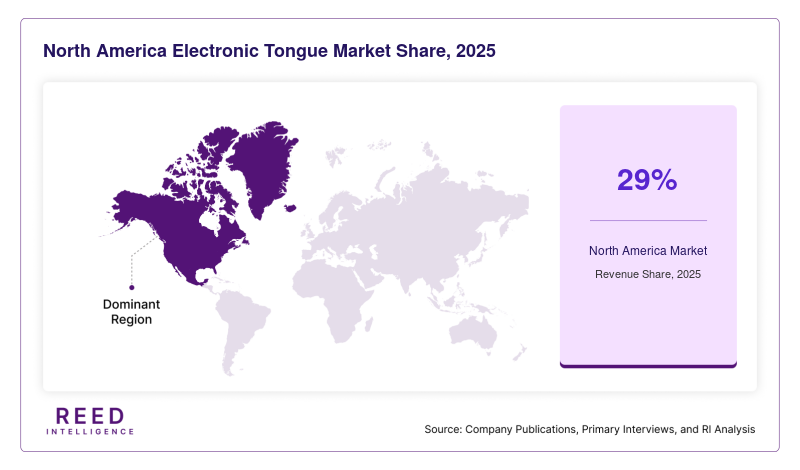
North America accounted for 29% of the Electronic Tongue Market share in 2025. The region’s market growth will expand at an estimated CAGR of 11.3% from 2025 to 2034. The region has a strong presence of pharmaceutical research facilities, food innovation laboratories, and biotechnology companies that require advanced analytical tools. The adoption of automated sensory analysis systems has grown steadily due to increasing product quality standards and the need for reproducible testing methods.
The United States dominated the North American market due to the presence of large food processing companies and pharmaceutical research organizations. The country also benefits from well-established regulatory frameworks that emphasize product quality and safety. Research institutions and biotechnology startups increasingly use electronic tongue systems to analyze taste interactions in drug formulations and nutritional products, which continues to support regional market expansion.
Europe
Europe represented 24% of the Electronic Tongue Market in 2025, and the region will grow at a CAGR of 9.8% through 2034. The market expansion is supported by the region’s strong food and beverage industry and extensive research infrastructure. European companies are actively investing in analytical technologies that enhance food safety and flavor standardization.
Germany emerged as the dominant country in Europe due to its advanced industrial manufacturing capabilities and strong presence of analytical instrument manufacturers. German food processing companies and research laboratories are increasingly integrating automated sensory analysis tools into product development workflows. The emphasis on technological innovation in industrial testing equipment continues to support market development across the region.
Asia Pacific
Asia Pacific held the largest share of the Electronic Tongue Market at 36% in 2025 and will grow at a CAGR of 10.9% through 2034. Rapid industrialization, growing food processing sectors, and increasing research investments are supporting the adoption of electronic tongue systems across the region.
China dominated the Asia Pacific market, driven by the rapid expansion of food manufacturing and pharmaceutical research activities. The country’s growing middle-class population has increased demand for high-quality packaged foods and beverages, prompting manufacturers to implement advanced quality control technologies. Research universities and biotechnology companies are also expanding analytical capabilities, which supports the increasing use of electronic tongue systems.
Middle East & Africa
The Middle East & Africa accounted for 6% of the Electronic Tongue Market in 2025. The regional market will expand at a CAGR of 8.7% through 2034. The market remains relatively smaller compared with other regions but is gradually gaining traction as food safety regulations and research infrastructure continue to develop.
The United Arab Emirates emerged as the leading country in the region due to increasing investments in food processing and biotechnology research. Government initiatives aimed at strengthening food security have encouraged the adoption of advanced analytical tools for quality testing. As food production capacity expands, demand for automated taste analysis technologies will gradually increase.
Latin America
Latin America captured 5% of the Electronic Tongue Market share in 2025, and the market will grow at a CAGR of 9.1% through 2034. The region’s expanding food and beverage sector is driving demand for quality testing technologies that ensure product consistency and compliance with international standards.
Brazil dominated the Latin American market due to its large food processing industry and expanding agricultural exports. Food manufacturers increasingly rely on analytical instruments to maintain flavor consistency across production batches and export markets. As regulatory requirements and consumer expectations evolve, the adoption of electronic tongue systems will continue to increase across the region.
Competitive Landscape
The Electronic Tongue Market is moderately consolidated, with several analytical instrument manufacturers and sensor technology companies competing in the industry. Companies focus on developing advanced sensor arrays, improving analytical software capabilities, and expanding application areas across food testing, pharmaceutical research, and environmental monitoring.
Alpha MOS is considered a leading participant in the Electronic Tongue Market due to its extensive portfolio of sensory analysis instruments and global distribution network. The company recently introduced an upgraded electronic tongue platform with enhanced sensor stability and cloud-based data analytics capabilities, improving analytical efficiency for research laboratories and food manufacturers.
Other companies in the market focus on expanding research partnerships and integrating artificial intelligence technologies into electronic tongue systems. Continuous innovation in sensor materials, signal processing technologies, and data analytics platforms remains a key competitive strategy for industry participants.
Key Players
- Alpha MOS
- Insent Inc.
- Metrohm AG
- Biolytics Co. Ltd.
- Astree Analytical Systems
- Intelligent Sensor Technology Inc.
- Sensigent LLC
- The eTongue Company
- SynapSense Corporation
- Tokyo Instruments Inc.
Recent Developments
- Alpha MOS introduced a next-generation electronic tongue platform with improved sensor stability and cloud-based analytics features.
- Insent Inc. expanded its research collaborations with pharmaceutical laboratories to develop advanced bitterness detection systems.
- Metrohm AG enhanced its electrochemical sensor technologies to improve detection sensitivity in liquid analysis applications.
- Shimadzu Corporation invested in sensor miniaturization technologies aimed at improving portability of electronic tongue systems.
- Thermo Fisher Scientific expanded its analytical instrumentation portfolio with integrated chemical sensing solutions for laboratory research.
Electronic Tongue Market Segments
Type
- Potentiometric
- Voltammetric
- Optical
Component
- Sensor Arrays
- Sampling Systems
- Analytical Software
Application
- Food & Beverage Testing
- Pharmaceutical Research
- Environmental Monitoring
- Academic Research
End Use
- Quality Control Laboratories
- Research Institutes
- Manufacturing Facilities
By Region
- North America
- Europe
- APAC
- Middle East and Africa
- LATAM