Electroretinography Market Size, Share & Demand Report By Type (Full-field ERG, Multifocal ERG, Pattern ERG, Portable ERG), By Product Type (Equipment, Electrodes, Accessories), By Application (Clinical Diagnostics, Research), By End-Use (Hospitals, Specialty Clinics, Research Institutes) & Segment Forecasts, 2026–2034
USD 3950
Market Overview
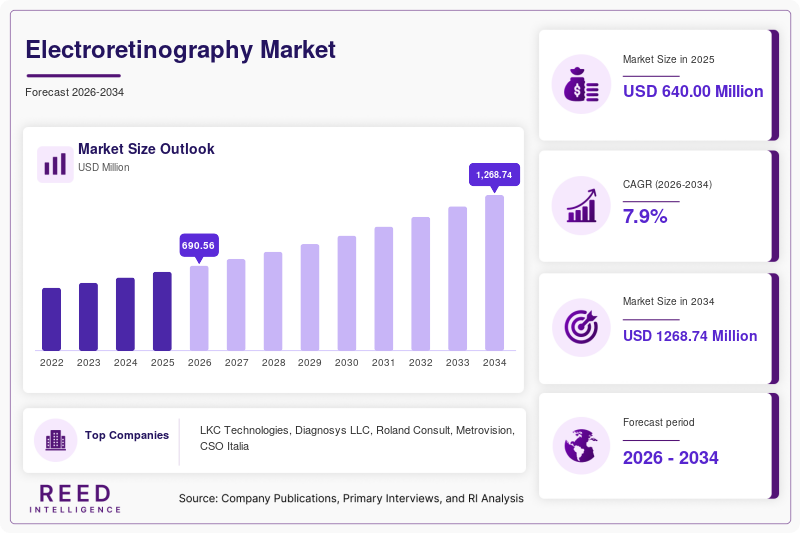
The Electroretinography Market size was valued at approximately USD 640 million in 2026 and is projected to reach USD 1.18 billion by 2034, expanding at a CAGR of 7.9% during the forecast period (2026–2034). Electroretinography (ERG) is a diagnostic technique used to measure electrical responses of various cell types within the retina, including photoreceptors, inner retinal cells, and ganglion cells. The market has been gaining steady traction due to its growing application in diagnosing retinal disorders such as retinitis pigmentosa, diabetic retinopathy, and age-related macular degeneration.
A major global factor supporting the growth of the Electroretinography Market is the rising prevalence of vision-related disorders linked to aging populations and chronic diseases. As healthcare systems increasingly prioritize early detection and preventive ophthalmology, ERG technologies have become essential tools in clinical diagnostics and research settings.
Key Highlights:
- North America dominated the market with a 38.6% share in 2025, while Asia Pacific is projected to be the fastest-growing region with a CAGR of 9.3%.
- In segmentation, full-field ERG systems led the type segment, while portable ERG devices are expected to grow at the fastest CAGR of 10.1%.
- The clinical diagnostics application segment held the largest share, whereas research applications are anticipated to expand rapidly at a CAGR of 8.8%.
- The United States remained the dominant country, with market values of USD 215 million in 2024 and USD 232 million in 2025.
Market Trends
Increasing Adoption of Portable and Handheld ERG Devices
The Electroretinography Market is witnessing a shift toward compact and portable ERG devices. Traditional ERG systems were bulky and confined to hospital settings, limiting accessibility. However, advancements in miniaturization and wireless technologies have enabled the development of handheld ERG systems that can be used in outpatient clinics and remote locations. This trend is improving diagnostic reach, particularly in underserved and rural areas. Portable systems also reduce setup time and enhance patient comfort, which is contributing to their growing adoption among ophthalmologists and optometrists.
Integration of Artificial Intelligence in Retinal Diagnostics
Another key trend shaping the Electroretinography Market is the integration of artificial intelligence (AI) and machine learning algorithms into ERG systems. AI-driven analytics can enhance the interpretation of retinal signals by identifying subtle abnormalities that may not be easily detected through manual analysis. This improves diagnostic accuracy and reduces the risk of misinterpretation. Additionally, AI integration supports automated reporting and workflow optimization, making ERG systems more efficient in clinical environments. As digital healthcare continues to evolve, AI-enabled ERG solutions are expected to play a significant role in advancing retinal diagnostics.
Market Drivers
Rising Incidence of Retinal Disorders
The increasing prevalence of retinal diseases is a primary driver of the Electroretinography Market. Conditions such as diabetic retinopathy, glaucoma, and inherited retinal disorders are becoming more common due to aging populations and lifestyle-related health issues. Early detection is critical in preventing vision loss, and ERG provides a reliable method for assessing retinal function. As awareness about eye health increases, healthcare providers are incorporating ERG testing into routine diagnostic protocols, thereby driving market demand.
Technological Advancements in Ophthalmic Diagnostics
Continuous innovation in ophthalmic diagnostic technologies is another key driver of the Electroretinography Market. Modern ERG systems offer enhanced sensitivity, faster data acquisition, and improved patient comfort. Features such as non-invasive electrodes, automated calibration, and digital data storage are improving usability and efficiency. These advancements are encouraging healthcare facilities to upgrade their diagnostic infrastructure, leading to increased adoption of ERG systems. Furthermore, integration with other imaging modalities is expanding the scope of ERG in comprehensive eye examinations.
Market Restraint
High Cost of Advanced ERG Systems
One of the primary challenges facing the Electroretinography Market is the high cost associated with advanced ERG systems. Sophisticated devices equipped with digital interfaces, AI capabilities, and enhanced imaging features require significant capital investment. This can be a barrier for small clinics and healthcare providers in developing regions. Additionally, maintenance costs and the need for skilled professionals to operate these systems further add to the overall expense. As a result, adoption rates may be limited in cost-sensitive markets, potentially slowing the overall growth of the Electroretinography Market.
Market Opportunities
Expansion in Emerging Markets
Emerging economies present significant growth opportunities for the Electroretinography Market. Increasing healthcare investments, improving infrastructure, and rising awareness about eye health are creating favorable conditions for market expansion. Governments and private organizations are focusing on enhancing ophthalmic care services, which is driving demand for diagnostic tools such as ERG systems. Additionally, the growing middle-class population in these regions is contributing to higher healthcare spending, further supporting market growth.
Growing Research Applications in Vision Science
The expanding scope of research in vision science offers another promising opportunity for the Electroretinography Market. ERG is widely used in preclinical and clinical studies to evaluate retinal function and assess the efficacy of new therapies. The increasing focus on gene therapies and regenerative medicine for retinal diseases is driving the demand for advanced ERG systems in research institutions. As innovation in ophthalmology continues, the role of ERG in scientific research is expected to grow, creating new revenue streams for market players.
Segmental Analysis
By Type
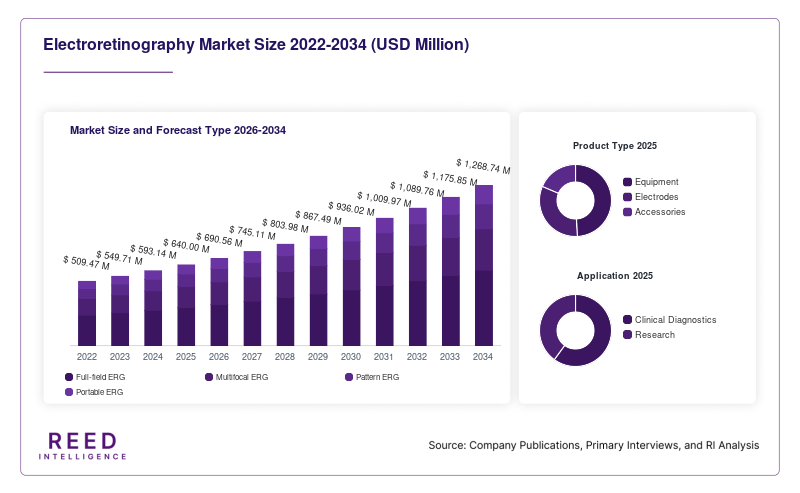
Full-field ERG systems dominated the Electroretinography Market in 2025, accounting for 52.3% of the total share. These systems were widely used due to their ability to assess overall retinal function and provide comprehensive diagnostic insights.
Portable ERG devices are expected to grow at the fastest CAGR of 10.1% during the forecast period. Their compact design and ease of use will drive adoption, particularly in decentralized healthcare settings.
By Product Type
ERG equipment held the largest share of 61.5% in 2025, as these systems form the core component of diagnostic procedures. Hospitals and clinics rely heavily on these devices for accurate retinal assessments.
Accessories such as electrodes and stimulators are projected to grow at a CAGR of 8.6%, driven by recurring demand and technological improvements that enhance performance and patient comfort.
By Application
Clinical diagnostics dominated the Electroretinography Market with a 64.7% share in 2025. The widespread use of ERG in diagnosing retinal disorders contributed to this dominance.
Research applications are expected to grow at a CAGR of 8.8%, supported by increasing studies focused on retinal diseases and treatment innovations.
By End-Use
Hospitals accounted for the largest share of 48.9% in 2025, as they serve as primary centers for advanced diagnostic procedures. The availability of skilled professionals and infrastructure supported this segment.
Specialty eye clinics are projected to grow at a CAGR of 9.0%, driven by increasing patient preference for specialized care and shorter waiting times.
Regional Analysis
North America
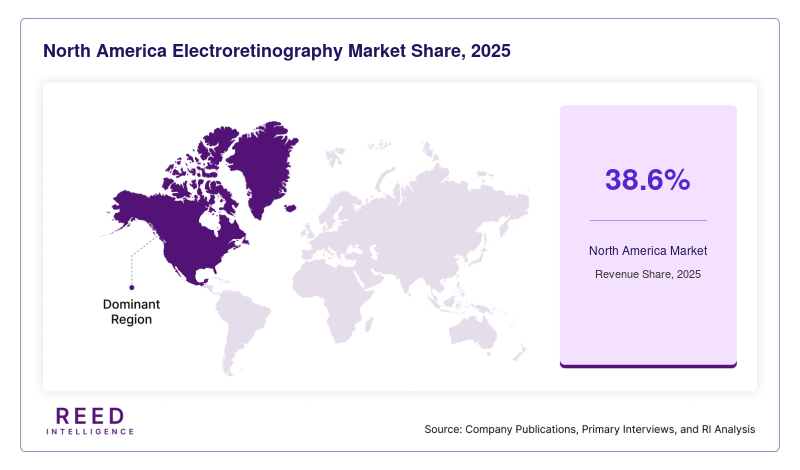
North America accounted for 38.6% of the Electroretinography Market share in 2025 and is expected to grow at a CAGR of 7.5% during 2026–2034. The region has a well-established healthcare system and high adoption of advanced diagnostic technologies, which supported its dominant position.
The United States led the regional market due to strong investment in ophthalmic research and widespread availability of specialized eye care centers. A key growth factor in the country is the increasing use of ERG in clinical trials focused on retinal therapies, which has strengthened demand for advanced systems.
Europe
Europe held a 27.4% share of the Electroretinography Market in 2025 and is projected to expand at a CAGR of 7.2%. The region benefited from supportive healthcare policies and growing emphasis on early disease detection.
Germany emerged as the dominant country due to its strong medical device manufacturing base. The country’s focus on integrating diagnostic technologies into routine healthcare practices has contributed to steady market growth.
Asia Pacific
Asia Pacific captured 20.8% of the market share in 2025 and is expected to register the fastest growth at a CAGR of 9.3%. Rapid urbanization and increasing healthcare expenditure have supported market expansion in this region.
China led the regional market, driven by expanding healthcare infrastructure and a large patient population. The growing number of ophthalmology clinics and hospitals has increased the adoption of ERG systems.
Middle East & Africa
The Middle East & Africa accounted for 7.1% of the Electroretinography Market share in 2025 and is forecasted to grow at a CAGR of 6.8%. The region has been gradually improving its healthcare infrastructure, which supported market growth.
Saudi Arabia dominated the regional market due to increased government spending on healthcare. The development of specialized eye care centers has boosted demand for diagnostic technologies.
Latin America
Latin America held a 6.1% share of the Electroretinography Market in 2025 and is expected to grow at a CAGR of 6.9%. The region’s growth was supported by increasing awareness of eye health and expanding access to healthcare services.
Brazil led the market due to its growing network of healthcare facilities. The country’s focus on improving diagnostic capabilities has contributed to the adoption of ERG systems.
Competitive Landscape
The Electroretinography Market is moderately consolidated, with several key players focusing on innovation and strategic partnerships. Leading companies are investing in product development and expanding their global presence. One prominent market leader is LKC Technologies, known for its advanced ERG systems and continuous innovation. The company recently introduced a next-generation portable ERG device, enhancing accessibility and diagnostic efficiency.
Other major players are strengthening their market position through collaborations with research institutions and healthcare providers. The competitive environment is characterized by technological advancements, product differentiation, and increasing focus on emerging markets. Companies are also emphasizing user-friendly designs and integration with digital healthcare systems to gain a competitive edge.
Key Players List
- LKC Technologies
- Diagnosys LLC
- Roland Consult
- Metrovision
- CSO Italia
- Konan Medical
- Phoenix Research Labs
- Natus Medical Incorporated
- Welch Allyn
- Topcon Corporation
- Canon Medical Systems
- Heidelberg Engineering
- Optomed Oy
- CenterVue SpA
- Visionix Ltd.
Recent Developments
- 2025: Introduction of AI-integrated ERG diagnostic systems improving accuracy and workflow efficiency.
- 2024: Expansion of portable ERG device portfolios by key players to enhance accessibility.
- 2025: Strategic collaborations between medical device companies and research institutes to advance retinal diagnostics.
- 2026: Increased investment in emerging markets to strengthen distribution networks and market presence.
Electroretinography Market Segments
Type
- Full-field ERG
- Multifocal ERG
- Pattern ERG
- Portable ERG
Product Type
- Equipment
- Electrodes
- Accessories
Application
- Clinical Diagnostics
- Research
End-Use
- Hospitals
- Specialty Clinics
- Research Institutes
By Region
- North America
- Europe
- APAC
- Middle East and Africa
- LATAM