Elemental Boron Market Size, Share & Demand Report By Purity Level (Medium Purity Boron, High Purity Boron (99.5% and Above), Ultra-High Purity Boron), By Application (Semiconductors and Electronics, Aerospace Materials, Advanced Ceramics, Metallurgy and Alloys), By End-Use Industry (Electronics Manufacturing, Aerospace and Defense, Renewable Energy, Industrial Manufacturing), By Region & Segment Forecasts, 2026–2034
USD 3950
Market Overview
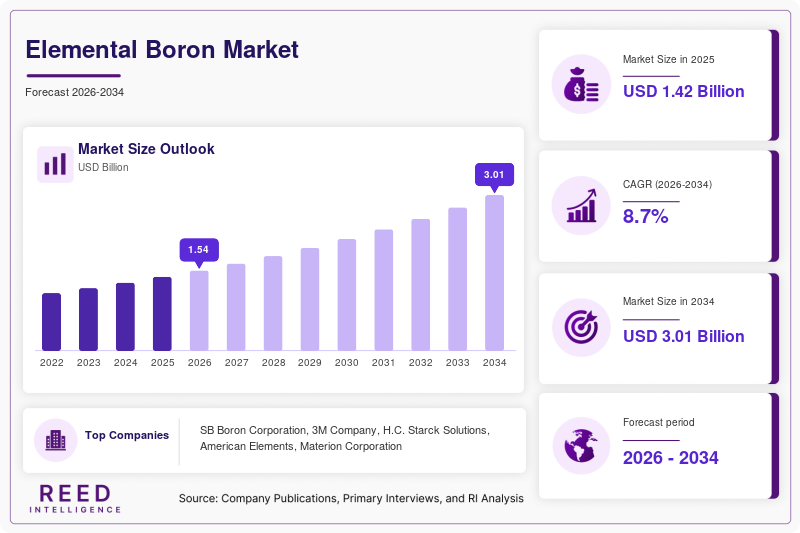
The global Elemental Boron Market size was valued at USD 1.42 billion in 2026 and is projected to reach USD 2.76 billion by 2034, expanding at a CAGR of 8.7% during 2026–2034. Elemental boron is a critical industrial material widely utilized in advanced ceramics, semiconductor manufacturing, aerospace components, metallurgical applications, nuclear shielding materials, and specialty chemical production. The growing importance of lightweight and high-performance materials across industrial sectors has significantly increased the consumption of elemental boron in recent years.
A major factor supporting market growth is the expanding demand for advanced electronic devices and semiconductor components. Boron plays an important role in semiconductor doping processes, helping manufacturers improve electrical conductivity and device performance. In addition, rising investments in renewable energy technologies, electric vehicles, and aerospace engineering have accelerated the use of boron-based materials due to their thermal stability, hardness, and lightweight characteristics. Governments and private industries are increasingly investing in advanced manufacturing technologies, creating favorable conditions for market expansion. Furthermore, ongoing research in energy storage systems and next-generation materials continues to broaden the commercial applications of elemental boron, supporting long-term demand growth.
Key Highlights
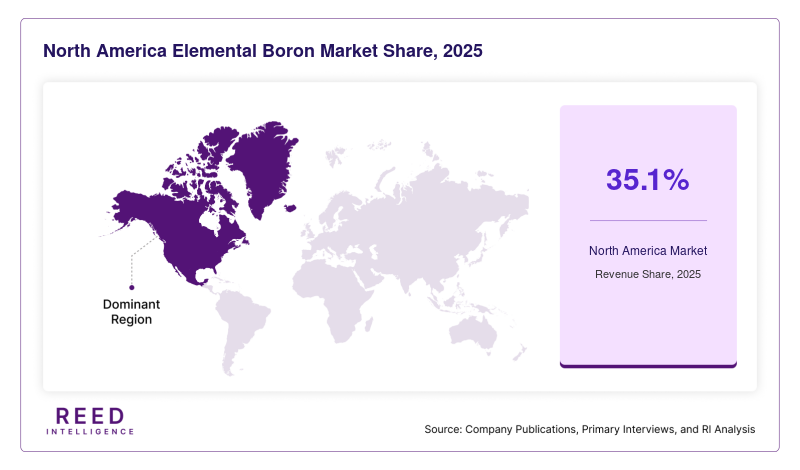
- North America dominated the market with a 35.1% share in 2025.
- while Asia Pacific is expected to grow at the fastest CAGR of 10.9% during 2026–2034.
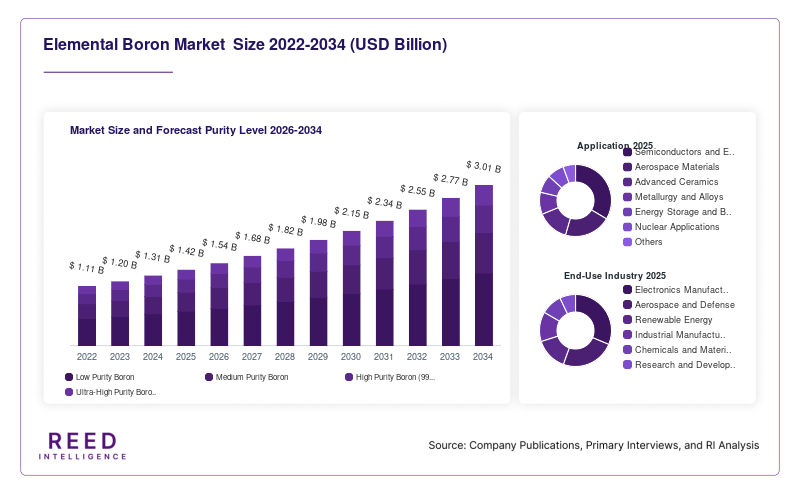
- By purity level, High Purity Boron (99.5% and above) accounted for the largest share of 44.3%.
- while Ultra-High Purity Boron is projected to grow at a CAGR of 10.8%.
- By application, Semiconductors and Electronics led with a 39.4% share.
- whereas Energy Storage and Battery Materials are expected to expand at a CAGR of 11.6%.
- By end-use industry, Electronics Manufacturing accounted for the largest share of 36.8%.
- while Renewable Energy is anticipated to grow at a CAGR of 12.1%.
- The United States remained the dominant country, with market values of USD 405 million in 2024 and USD 442 million in 2025.
Market Trends
Increasing Integration of Boron in Advanced Semiconductor Manufacturing
The semiconductor industry continues to represent one of the most influential demand centers for elemental boron. As manufacturers pursue smaller, faster, and more energy-efficient electronic components, the need for precise doping materials has increased significantly. Elemental boron is widely used to alter the electrical properties of silicon wafers, making it indispensable for integrated circuits, power electronics, and advanced microprocessors. The expansion of artificial intelligence infrastructure, cloud computing facilities, and consumer electronics production is further strengthening demand. Semiconductor producers are investing heavily in fabrication facilities, creating sustained consumption of high-purity boron materials. The trend is particularly evident in technologically advanced economies where chip manufacturing capacity is being expanded to reduce supply chain dependence and improve domestic production capabilities.
Growing Adoption of Boron-Based Materials in Clean Energy Technologies
Clean energy industries are increasingly incorporating boron-derived materials into energy storage systems, solar technologies, and advanced insulation products. The transition toward renewable energy sources has intensified research into materials capable of improving efficiency and durability. Elemental boron is gaining attention due to its thermal resistance, lightweight nature, and chemical stability. Manufacturers of batteries and energy storage systems are evaluating boron-enhanced materials to improve performance characteristics and operational lifespan. The growth of electric vehicles and grid-scale energy storage projects has created new opportunities for boron utilization. As countries continue implementing decarbonization strategies and investing in sustainable energy infrastructure, the demand for elemental boron across clean energy applications is expected to increase steadily throughout the forecast period.
Market Drivers
Rising Demand for Lightweight and High-Strength Aerospace Materials
The aerospace industry continues to prioritize materials that reduce overall aircraft weight while maintaining structural integrity and performance. Elemental boron contributes to the production of advanced composites, ceramic components, and specialty alloys used in commercial and defense aerospace applications. Lightweight materials help improve fuel efficiency, reduce emissions, and enhance operational economics for airlines and aerospace manufacturers. Growing investments in next-generation aircraft programs, satellite deployment projects, and defense modernization initiatives are creating strong demand for boron-containing materials. Additionally, increasing global air passenger traffic and fleet expansion activities support long-term aerospace production growth, directly benefiting the elemental boron market through expanded material consumption across manufacturing and maintenance operations.
Expansion of Electronics and Digital Infrastructure Industries
Rapid digital transformation across industries has accelerated the production of electronic devices, communication systems, and computing infrastructure. Elemental boron serves a critical function in electronic manufacturing processes, particularly within semiconductors and specialized electronic components. The expansion of 5G networks, data centers, industrial automation systems, and smart consumer devices continues to drive demand for advanced semiconductor materials. Governments are supporting domestic electronics manufacturing through incentive programs and infrastructure investments, further strengthening market growth prospects. As digital technologies become increasingly integrated into everyday life and industrial operations, demand for high-purity elemental boron is expected to remain robust, supporting continued market expansion throughout the forecast period.
Market Restraint
Volatility in Raw Material Supply and High Production Costs
The elemental boron market faces challenges associated with raw material availability, extraction complexity, and energy-intensive production processes. Producing high-purity elemental boron requires sophisticated refining technologies and strict quality control measures, resulting in elevated manufacturing costs. Fluctuations in mining activity, energy prices, and global supply chains can influence production economics and market pricing. Smaller manufacturers often encounter difficulties in maintaining profitability when raw material costs rise unexpectedly. Additionally, industries that consume large quantities of boron may delay procurement decisions during periods of price uncertainty. For example, semiconductor and advanced materials manufacturers frequently seek long-term supply agreements to minimize exposure to market volatility. These factors can limit adoption in price-sensitive applications and create operational challenges for suppliers seeking to expand production capacity. While demand remains strong, supply-side constraints and cost pressures continue to represent important barriers to faster market growth.
Market Opportunities
Expanding Use of Boron in Next-Generation Battery Technologies
The rapid development of advanced battery technologies presents a significant opportunity for elemental boron producers. Researchers and manufacturers are exploring boron-based materials to improve battery performance, energy density, safety, and operational lifespan. The accelerating adoption of electric vehicles and renewable energy storage systems has intensified demand for innovative materials capable of addressing performance limitations in existing battery technologies. Boron-enhanced materials are being evaluated for various battery chemistries due to their favorable thermal and structural properties. As investments in battery manufacturing facilities continue increasing worldwide, demand for specialty materials such as elemental boron is expected to rise. Commercialization of advanced battery technologies could create substantial long-term revenue opportunities for market participants.
Emerging Applications in Advanced Defense and Nuclear Technologies
Defense and nuclear sectors are increasingly recognizing the value of elemental boron in specialized applications. Boron's neutron absorption capabilities make it useful for nuclear shielding, reactor control systems, and radiation protection materials. At the same time, defense organizations are investing in advanced armor systems, aerospace platforms, and high-performance materials that benefit from boron's unique characteristics. Growing geopolitical focus on national security and energy independence is encouraging investment in strategic materials and domestic supply chains. These developments create favorable conditions for market growth. As governments expand spending on defense modernization and nuclear infrastructure projects, elemental boron suppliers may benefit from new procurement opportunities and long-term contractual relationships.
Segmental Analysis
By Purity Level
High Purity Boron (99.5% and above) represented the dominant purity category and accounted for approximately 44.3% of total market share in 2024. The segment's leadership is primarily attributed to its widespread use in semiconductor manufacturing, advanced ceramics, specialty alloys, and electronic materials. High purity grades provide the consistency and performance characteristics required for precision industrial applications. Manufacturers increasingly prefer these materials because even minor impurities can significantly impact product performance and manufacturing efficiency. Growth in electronics production, aerospace engineering, and advanced material research continues to reinforce demand. Furthermore, increasing quality standards across industrial sectors have encouraged greater adoption of high purity elemental boron products.
Ultra-high purity boron is projected to be the fastest-growing purity segment, expanding at a CAGR of 10.8% during the forecast period. This growth is supported by increasing demand from advanced semiconductor fabrication facilities and next-generation electronic devices. As microelectronics become more sophisticated, manufacturers require materials with exceptionally low contamination levels. Research institutions and technology companies are also investing in advanced applications that rely on ultra-high purity materials. Continued innovation in computing technologies, energy storage systems, and photonic devices is expected to accelerate adoption. These factors collectively position ultra-high purity boron as a key growth area within the broader market.
By Application
Semiconductors and electronics emerged as the leading application segment, accounting for approximately 39.4% of market revenue in 2024. Elemental boron is extensively used as a doping material in semiconductor manufacturing processes, helping modify electrical properties and improve device performance. The segment benefits from growing demand for smartphones, data centers, industrial automation systems, and advanced computing technologies. Rising investments in semiconductor fabrication facilities across multiple regions continue to strengthen market demand. Additionally, governments are encouraging domestic electronics production, creating favorable conditions for sustained growth. The increasing complexity of electronic devices further reinforces the importance of high-quality boron materials within manufacturing operations.
Energy storage and battery materials are expected to record the fastest CAGR of 11.6% through 2034. Growing adoption of electric vehicles and renewable energy systems has increased demand for advanced battery technologies capable of delivering improved performance and reliability. Researchers are actively exploring boron-based materials to enhance battery efficiency, thermal stability, and lifecycle performance. Significant investments in battery manufacturing facilities worldwide support this trend. As governments pursue electrification strategies and energy transition objectives, demand for innovative battery materials is expected to rise substantially. These developments create strong growth prospects for elemental boron suppliers serving the energy storage industry.
By End-Use Industry
Electronics manufacturing accounted for the largest share of approximately 36.8% in 2024, making it the dominant end-use industry within the Elemental Boron Market. The sector relies heavily on boron for semiconductor fabrication, integrated circuit production, and specialized electronic component manufacturing. Increasing demand for consumer electronics, communication technologies, and industrial automation equipment has expanded material requirements. Electronics manufacturers prioritize high-purity inputs to ensure product quality and performance consistency. Continued digital transformation across industries further supports growth in electronic device production. The segment's strong position is also reinforced by investments in advanced fabrication facilities and growing demand for computing infrastructure.
Renewable energy is anticipated to be the fastest-growing end-use industry, registering a CAGR of 12.1% during the forecast period. The global transition toward sustainable energy systems is increasing demand for advanced materials that improve efficiency, durability, and operational reliability. Elemental boron is finding applications in energy storage technologies, solar energy systems, and thermal management solutions. Governments and private investors continue to allocate substantial resources toward renewable energy infrastructure development. As clean energy deployment accelerates worldwide, demand for boron-based materials is expected to increase significantly. This trend creates substantial opportunities for suppliers focused on renewable energy applications.
Regional Analysis
North America
North America accounted for approximately 35.1% of the global Elemental Boron Market in 2025, making it the leading regional market. The region benefits from strong demand across semiconductor manufacturing, aerospace production, advanced materials development, and defense applications. Significant investments in domestic electronics manufacturing and strategic mineral supply chains are supporting market expansion. The regional market is expected to register a CAGR of 8.2% through 2034 as industrial users continue adopting high-purity boron materials for technologically advanced applications.
The United States remains the dominant country within North America due to its extensive semiconductor ecosystem and aerospace manufacturing base. One unique growth factor is the expansion of domestic chip fabrication facilities supported by public and private investment initiatives. These projects are increasing demand for semiconductor-grade boron materials while encouraging long-term supply agreements. Growing research activity in advanced materials and energy storage technologies also contributes to sustained market growth across the country.
Europe
Europe represented approximately 26.8% of global market revenue in 2025 and continues to be a significant consumer of elemental boron. The region's strong industrial base, advanced manufacturing capabilities, and emphasis on sustainable technologies support market demand. Industries including automotive engineering, renewable energy, aerospace, and industrial ceramics contribute to boron consumption. The European market is forecast to expand at a CAGR of 8.0% during the assessment period as technological innovation continues to drive material requirements.
Germany leads the regional market owing to its extensive manufacturing infrastructure and industrial research capabilities. A unique growth factor is the increasing adoption of boron-containing materials in advanced automotive and renewable energy technologies. The country's transition toward sustainable manufacturing and electrified transportation is encouraging greater use of high-performance materials. Continuous investment in industrial innovation further strengthens demand for elemental boron across multiple sectors.
Asia Pacific
Asia Pacific held nearly 24.6% of the global Elemental Boron Market in 2025 and is expected to achieve the fastest CAGR of 10.9% through 2034. Rapid industrialization, expanding electronics manufacturing, and increasing investment in renewable energy projects are key contributors to regional growth. Countries across the region continue to expand semiconductor production capacity and advanced materials research, creating substantial opportunities for elemental boron suppliers. Strong economic development also supports rising industrial consumption.
China dominates the Asia Pacific market due to its large-scale electronics manufacturing industry and expanding advanced materials sector. A unique growth factor is the country's extensive investment in electric vehicle and battery production infrastructure. These industries require high-performance materials capable of enhancing efficiency and durability. The growing focus on domestic semiconductor production and technological self-sufficiency further supports long-term demand growth for elemental boron products.
Middle East & Africa
The Middle East & Africa accounted for approximately 7.2% of global market revenue in 2025. Although the regional market remains smaller than other major regions, increasing industrial diversification initiatives are creating favorable growth conditions. Governments are investing in advanced manufacturing capabilities, infrastructure development, and strategic industrial sectors. As a result, demand for specialty materials including elemental boron is gradually increasing. The regional market is projected to expand at a CAGR of 7.8% during the forecast period.
Saudi Arabia is the dominant country in the region due to ongoing industrial transformation and economic diversification programs. A unique growth factor is the expansion of advanced industrial projects aimed at reducing dependence on traditional economic sectors. Investments in manufacturing, energy infrastructure, and technology development are supporting demand for specialized materials. Growing interest in nuclear energy and advanced engineering applications also contributes to regional market opportunities.
Latin America
Latin America captured approximately 6.3% of global market revenue in 2025 and continues to demonstrate moderate growth potential. The region is benefiting from increasing industrial activity, infrastructure development, and gradual modernization of manufacturing operations. Demand for elemental boron is supported by metallurgy, ceramics, and emerging electronics applications. The market is expected to grow at a CAGR of 7.5% through 2034 as industrial investment expands and production capabilities improve across key economies.
Brazil remains the leading market within Latin America due to its diversified industrial sector and growing manufacturing base. A unique growth factor is the country's expanding investment in industrial materials and advanced production technologies. Manufacturers are increasingly adopting specialty materials to improve product quality and operational efficiency. Combined with infrastructure development initiatives and industrial modernization efforts, these factors support steady growth in elemental boron consumption.
Competitive Landscape
The Elemental Boron Market is moderately consolidated, with established producers competing through product purity, technological expertise, supply reliability, and strategic partnerships. Market participants continue investing in advanced refining technologies to meet growing demand from semiconductor, aerospace, and energy industries. Product innovation and capacity expansion remain important competitive strategies as manufacturers seek to strengthen their market positions.
SB Boron Corporation maintains a leading position due to its diversified product portfolio and strong presence in high-purity boron production. The company recently expanded specialty boron processing capabilities to support increasing semiconductor industry demand. Other major participants, including 3M Company, H.C. Starck Solutions, American Elements, and Materion Corporation, continue focusing on research, production efficiency, and application development. Strategic collaborations with electronics manufacturers and advanced materials companies are becoming increasingly common. Competitive intensity is expected to increase as emerging applications in energy storage, renewable energy, and advanced electronics create new growth opportunities for market participants.
Key Players
- SB Boron Corporation
- 3M Company
- H.C. Starck Solutions
- American Elements
- Materion Corporation
- ABSCO Limited
- Stanford Advanced Materials
- Noah Chemicals
- SkySpring Nanomaterials Inc.
- Merck KGaA
- Atlantic Equipment Engineers
- Belmont Metals Inc.
- Nanografi Nano Technology
- ALB Materials Inc.
- ProChem Inc.
Recent Developments
- In 2025, a leading elemental boron producer expanded high-purity boron refining capacity to support growing semiconductor manufacturing requirements in North America.
- In 2025, several advanced materials companies announced collaborative research programs focused on boron-enhanced battery materials for electric vehicle applications.
- In 2024, a major specialty materials manufacturer introduced a new ultra-high purity elemental boron product designed for next-generation semiconductor fabrication processes.
- In 2024, multiple aerospace suppliers increased procurement agreements for boron-based advanced materials used in lightweight structural components.
- In 2025, industry participants invested in production modernization initiatives aimed at improving efficiency, product consistency, and supply chain resilience.
Elemental Boron Market Segments
Purity Level
- Low Purity Boron
- Medium Purity Boron
- High Purity Boron (99.5% and Above)
- Ultra-High Purity Boron
Application
- Semiconductors and Electronics
- Aerospace Materials
- Advanced Ceramics
- Metallurgy and Alloys
- Energy Storage and Battery Materials
- Nuclear Applications
- Others
End-Use Industry
- Electronics Manufacturing
- Aerospace and Defense
- Renewable Energy
- Industrial Manufacturing
- Chemicals and Materials
- Research and Development
By Region
- North America
- Europe
- APAC
- Middle East and Africa
- LATAM