Elevated Water Storage Tanks Market Size, Share, Demand Report By Type (Steel Tanks, Concrete Tanks, Composite Tanks), By Application (Municipal Water Supply, Industrial Storage, Fire Protection), By End-Use (Public Utilities, Industrial, Commercial) & Segment Forecasts, 2026–2034
USD 3950
Market Overview
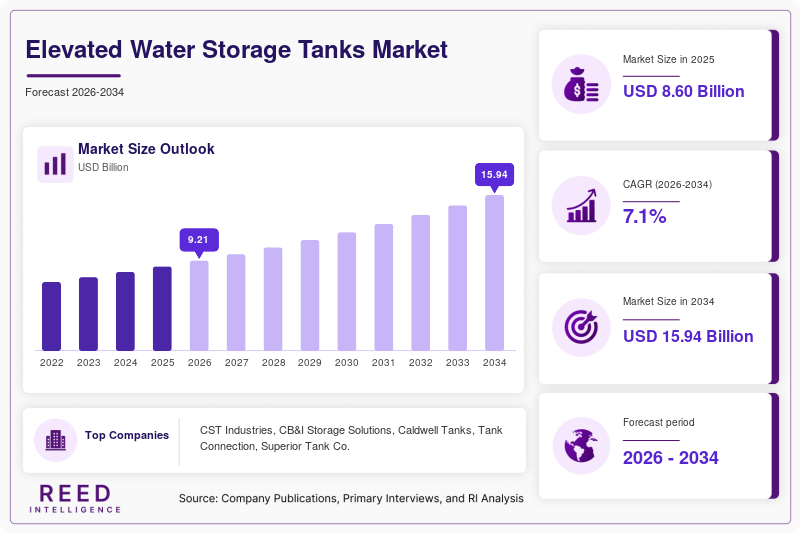
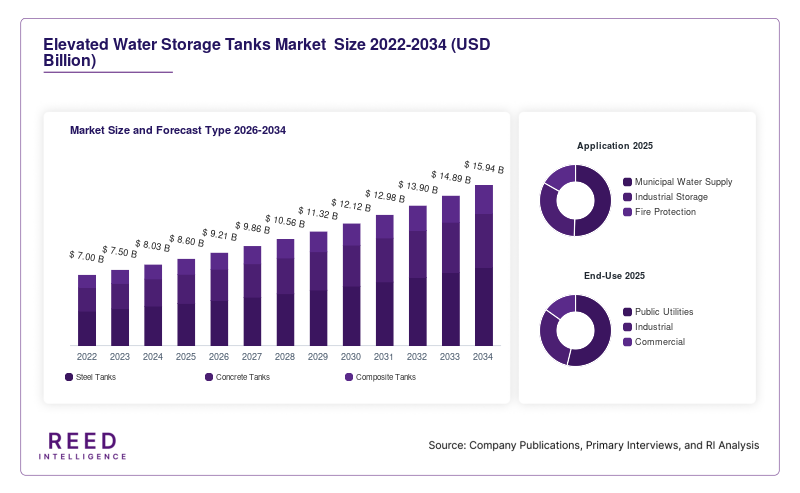
The Elevated Water Storage Tanks Market size was valued at approximately USD 8.6 billion in 2026 and is projected to reach USD 14.9 billion by 2034, expanding at a CAGR of 7.1% during the forecast period (2026–2034). The market is experiencing steady growth driven by increasing investments in water infrastructure modernization and the rising need for reliable water storage solutions in urban and semi-urban areas. Elevated tanks remain a critical component in municipal water distribution systems due to their ability to maintain consistent pressure without heavy reliance on pumping systems.
A major global factor supporting market expansion is the increasing focus on water security and resilience against supply disruptions. Governments and utilities worldwide are prioritizing storage infrastructure to manage demand fluctuations, drought conditions, and population growth. Elevated tanks provide a cost-effective and energy-efficient solution for storing potable water and ensuring continuous supply during peak consumption periods or emergencies.
Key Highlights
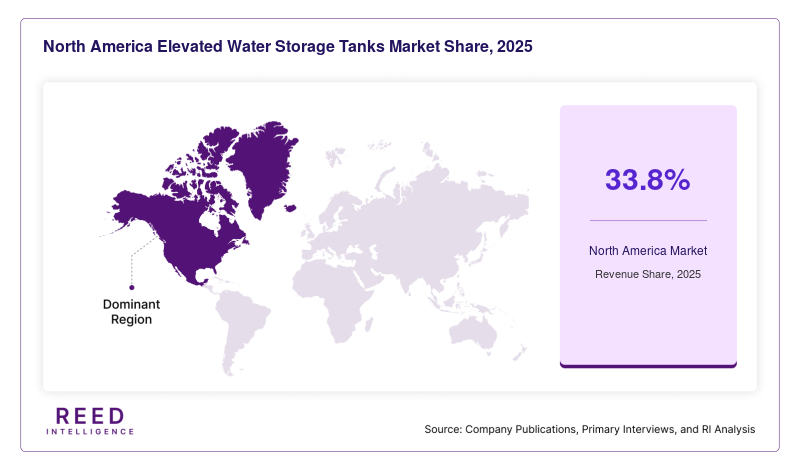
- North America dominated the market with a 33.8% share in 2025.
- Asia Pacific is expected to grow at the fastest CAGR of 8.9% during 2026–2034.
- By type, steel tanks accounted for the largest share of 42.6%, while composite tanks are projected to grow at a CAGR of 9.5%.
- By application, municipal water supply led with a 48.3% share, whereas industrial storage is expected to expand at a CAGR of 8.1%.
- The United States remained the dominant country, with market values of USD 2.1 billion in 2024 and USD 2.3 billion in 2025.
Market Trends
Growing integration of smart monitoring technologies
The integration of smart technologies in elevated water storage tanks is becoming a defining trend across developed and emerging markets. Utilities are increasingly deploying sensors, IoT-enabled monitoring systems, and remote diagnostics to track water levels, structural integrity, and leakage risks in real time. This shift enhances operational efficiency and reduces maintenance costs, which is especially important for large municipal networks managing multiple storage units. Smart systems also support predictive maintenance by identifying early signs of corrosion or stress, helping avoid costly failures and service disruptions.
Additionally, regulatory bodies are encouraging the adoption of digital water management solutions to improve transparency and reduce water loss. The integration of SCADA systems and cloud-based analytics platforms is enabling centralized control and data-driven decision-making. As cities move toward smart infrastructure development, the demand for technologically advanced elevated tanks is expected to rise, particularly in regions investing heavily in digital transformation of utilities.
Increasing use of corrosion-resistant and composite materials
Another notable trend shaping the market is the growing use of advanced materials such as fiberglass-reinforced plastic and composite coatings. Traditional materials like concrete and carbon steel are gradually being supplemented or replaced by materials that offer improved durability and lower lifecycle costs. Composite tanks are gaining attention due to their resistance to corrosion, lightweight structure, and ease of installation, especially in coastal and chemically aggressive environments.
This material shift is also driven by sustainability considerations, as composite tanks require less maintenance and have longer service lives. Manufacturers are investing in research to develop hybrid materials that combine strength with environmental resilience. The adoption of these materials is particularly evident in regions facing high humidity, salinity, or industrial pollution, where conventional tanks often require frequent repairs. This trend is expected to accelerate as end users prioritize long-term cost efficiency and performance.
Market Drivers
Rising urbanization and population growth
The rapid pace of urbanization globally is a key driver for the elevated water storage tanks market. As cities expand and populations grow, the demand for reliable water distribution systems increases significantly. Elevated tanks play a vital role in maintaining consistent water pressure and ensuring uninterrupted supply in densely populated urban areas. Governments are investing heavily in infrastructure projects to support housing developments, commercial complexes, and public utilities, all of which require efficient water storage solutions.
In emerging economies, urban migration is putting pressure on existing water infrastructure, prompting authorities to upgrade or expand storage capacity. Elevated tanks offer a scalable solution that can be deployed quickly and integrated into existing systems. This driver is particularly strong in Asia Pacific and Africa, where urban populations are expected to grow rapidly over the next decade. The need for efficient water management systems in these regions continues to support sustained market growth.
Increasing investments in water infrastructure modernization
Another major driver is the growing investment in upgrading aging water infrastructure, particularly in developed regions. Many countries are dealing with outdated storage systems that are prone to leakage, contamination, and inefficiency. Governments and private entities are allocating funds to replace or refurbish these systems with modern elevated tanks that meet current safety and performance standards.
Infrastructure modernization initiatives are often supported by regulatory mandates aimed at improving water quality and reducing losses. Elevated tanks equipped with advanced coatings and monitoring systems are being adopted to comply with these regulations. Additionally, public-private partnerships are facilitating large-scale projects, enabling faster deployment and improved service delivery. This trend is expected to continue as water utilities prioritize reliability, efficiency, and sustainability in their operations.
Market Restraint
High initial investment and maintenance complexity
Despite steady demand, the market faces challenges related to high initial capital investment and ongoing maintenance requirements. The construction of elevated water storage tanks involves significant costs associated with materials, engineering design, and installation. For smaller municipalities or budget-constrained regions, these costs can act as a barrier to adoption. Additionally, site-specific factors such as soil conditions and seismic requirements can further increase project expenses.
Maintenance is another critical concern, particularly for traditional steel and concrete tanks that are susceptible to corrosion, cracking, and structural wear over time. Regular inspections, repainting, and repairs are necessary to ensure safety and longevity, adding to the total cost of ownership. For example, in coastal regions, salt exposure can accelerate corrosion, requiring more frequent maintenance cycles. These challenges can limit market growth, especially in regions where funding and technical expertise are limited.
Market Opportunities
Expansion in rural water supply programs
The expansion of rural water supply initiatives presents a significant opportunity for the elevated water storage tanks market. Governments and international organizations are increasingly focusing on improving access to clean drinking water in underserved areas. Elevated tanks are well-suited for rural applications due to their ability to provide gravity-based distribution without continuous energy input. This makes them an efficient solution for areas with limited power infrastructure.
Programs aimed at achieving universal water access are driving demand for small- to medium-capacity tanks in remote regions. These projects often involve community-based systems that rely on durable and low-maintenance storage solutions. Manufacturers are responding by offering modular and cost-effective designs tailored to rural needs. As these initiatives continue to expand, particularly in Asia and Africa, the market is expected to benefit from increased deployment of elevated tanks.
Growth in industrial and commercial water storage demand
The rising demand for water storage in industrial and commercial sectors is another promising opportunity. Industries such as manufacturing, power generation, and food processing require consistent water supply for operations, making elevated tanks a reliable solution. These tanks help maintain pressure and ensure availability during peak usage or supply interruptions, which is critical for operational continuity.
Commercial developments, including shopping complexes, hospitals, and educational institutions, are also adopting elevated tanks as part of their infrastructure planning. The growth of industrial zones and smart cities is further contributing to this demand. Additionally, stricter regulations regarding water management and emergency preparedness are encouraging businesses to invest in storage systems. This trend is expected to drive market expansion as industries seek efficient and dependable water storage solutions.
Segmental Analysis
By Type
Steel tanks emerged as the dominant subsegment, accounting for approximately 42.6% of the market share in 2024. These tanks are widely preferred due to their strength, durability, and ability to withstand high pressure. Steel tanks are commonly used in large-scale municipal and industrial applications where reliability is critical. Their adaptability to various designs and capacities makes them suitable for diverse operational requirements. Additionally, advancements in protective coatings have improved their resistance to corrosion, extending their service life and reducing maintenance costs.
Composite tanks are expected to be the fastest-growing subsegment, with a projected CAGR of 9.5% during the forecast period. The growth is driven by their lightweight structure, corrosion resistance, and lower maintenance requirements. These tanks are particularly suitable for regions with harsh environmental conditions, where traditional materials may degrade بسرعة. The increasing focus on sustainability and lifecycle cost efficiency is further supporting the adoption of composite tanks. Manufacturers are also introducing innovative designs to enhance performance and ease of installation.
By Application
Municipal water supply remains the dominant application segment, holding a 48.3% share in 2024. Elevated tanks are a critical component of municipal systems, ensuring consistent water pressure and reliable distribution. The growing demand for clean and safe drinking water is driving investments in municipal infrastructure. Governments are prioritizing the development and maintenance of water storage systems to meet the needs of expanding populations. This segment is expected to maintain its dominance due to ongoing urbanization and infrastructure development.
Industrial storage is projected to be the fastest-growing application, with a CAGR of 8.1%. Industries require reliable water supply for various processes, making elevated tanks an essential part of their operations. The growth of manufacturing and industrial sectors is driving demand for storage solutions. Additionally, stricter regulations regarding water management and safety are encouraging industries to invest in advanced storage systems. This trend is expected to support the expansion of the industrial application segment.
By End-Use
Public utilities dominated the end-use segment, accounting for a significant share in 2024. These entities are responsible for managing water distribution systems and rely heavily on elevated tanks to ensure consistent supply. The increasing focus on infrastructure development and modernization is driving demand in this segment. Public utilities are investing in advanced storage solutions to improve efficiency and reduce water loss. This segment is expected to continue leading the market due to its critical role in water management.
The commercial sector is anticipated to be the fastest-growing end-use segment, with a CAGR of 7.8%. The growth is driven by the expansion of commercial establishments such as malls, hospitals, and educational institutions. These facilities require reliable water supply for daily operations, making elevated tanks a practical solution. The increasing adoption of smart building technologies is also supporting the integration of advanced storage systems. This trend is expected to drive growth in the commercial segment.
Regional Analysis
North America
North America held a significant share of 33.8% in 2025 and is projected to grow at a CAGR of 6.5% during the forecast period. The region benefits from well-established water infrastructure and ongoing investments in modernization projects. Elevated tanks are widely used across municipal systems, particularly in suburban and rural areas where consistent water pressure is essential. The presence of advanced engineering capabilities and strict regulatory standards also supports the adoption of high-quality storage solutions.
The United States remains the dominant country in this region, driven by extensive infrastructure rehabilitation programs. A key growth factor is the increasing focus on replacing aging water systems with modern, corrosion-resistant tanks. Federal funding initiatives aimed at improving water quality and reducing leakage are further accelerating demand. These efforts are expected to sustain market growth in the coming years.
Europe
Europe accounted for approximately 25.6% of the market share in 2025 and is expected to grow at a CAGR of 6.2%. The region’s market is characterized by strong regulatory frameworks and a focus on sustainability. Elevated water storage tanks are widely used in both urban and rural settings, supporting efficient water distribution systems. The adoption of advanced materials and coatings is particularly prominent in this region.
Germany leads the European market, supported by its robust industrial base and infrastructure investments. A unique growth factor is the emphasis on environmental compliance and energy efficiency. Utilities are increasingly adopting tanks with improved insulation and reduced maintenance requirements. This focus on sustainability is driving innovation and supporting market expansion across the region.
Asia Pacific
Asia Pacific is the fastest-growing region, with a projected CAGR of 8.9% from 2026 to 2034, and held a 22.4% share in 2025. Rapid urbanization, population growth, and infrastructure development are key drivers in this region. Elevated water storage tanks are essential for managing water supply in densely populated cities and expanding urban areas. Governments are investing heavily in water infrastructure to support economic growth.
China dominates the Asia Pacific market, driven by large-scale urban development projects. A significant growth factor is the expansion of smart city initiatives, which include advanced water management systems. The integration of modern storage solutions into these projects is boosting demand for elevated tanks. This trend is expected to continue as countries in the region prioritize infrastructure development.
Middle East & Africa
The Middle East & Africa region held a 10.1% share in 2025 and is projected to grow at a CAGR of 7.4%. Water scarcity and the need for efficient storage solutions are key factors driving demand in this region. Elevated tanks are widely used to ensure reliable water supply in arid environments. Governments are investing in infrastructure to improve water access and support economic development.
Saudi Arabia is the leading market in this region, supported by significant investments in water infrastructure. A unique growth factor is the focus on desalination and storage integration. Elevated tanks are used to store treated water and distribute it efficiently across urban and industrial areas. This integration is expected to drive market growth in the region.
Latin America
Latin America accounted for 8.1% of the market share in 2025 and is expected to grow at a CAGR of 6.8%. The region is witnessing steady demand for water storage solutions due to urban expansion and infrastructure development. Elevated tanks are commonly used in municipal systems to ensure consistent water supply.
Brazil leads the market in Latin America, driven by ongoing infrastructure projects. A key growth factor is the increasing focus on improving water access in underserved areas. Government initiatives aimed at expanding water distribution networks are supporting the adoption of elevated tanks. This trend is expected to contribute to market growth in the region.
Competitive Landscape
The Elevated Water Storage Tanks Market is moderately fragmented, with several established players competing on the basis of product quality, innovation, and regional presence. Leading companies are focusing on expanding their product portfolios and adopting advanced materials to enhance performance. Strategic partnerships and acquisitions are also common, enabling companies to strengthen their market position and expand their geographic reach.
CST Industries is considered a leading player in the market, known for its extensive range of storage solutions and global presence. The company has recently introduced advanced coating technologies to improve tank durability and reduce maintenance requirements. Other key players are investing in research and development to develop innovative solutions that meet evolving customer needs. The competitive landscape is expected to remain dynamic, with companies focusing on technological advancements and strategic collaborations.
Key Players
- CST Industries
- CB&I Storage Solutions
- Caldwell Tanks
- Tank Connection
- Superior Tank Co.
- Chicago Bridge & Iron Company
- McDermott International
- Crom Corporation
- Phoenix Fabricators and Erectors
- American Tank Company
- Nalco Water
- Permastore
- Balmoral Tanks
- Islamiya Iron Works
- Snyder Industries
Recent Developments
- CST Industries introduced a new line of corrosion-resistant coatings aimed at extending tank lifespan and reducing maintenance costs in 2025.
- Tank Connection expanded its manufacturing facility to increase production capacity and meet growing demand in emerging markets.
- Caldwell Tanks secured a major contract for municipal water infrastructure development, highlighting the increasing investment in water storage systems.
Elevated Water Storage Tanks Market Segments
Type
- Steel Tanks
- Concrete Tanks
- Composite Tanks
Application
- Municipal Water Supply
- Industrial Storage
- Fire Protection
End-Use
- Public Utilities
- Industrial
- Commercial
By Region
- North America
- Europe
- APAC
- Middle East and Africa
- LATAM