Elevator Modernization Market Size, Share Demand Report By Product Type (Hydraulic, Traction, Machine Room Less), By Application (Residential, Commercial, Industrial), By Service Type (Component Replacement, Full Modernization, Control System Upgrades) & Segment Forecasts, 2026–2034
USD 3950
Elevator Modernization Market Size
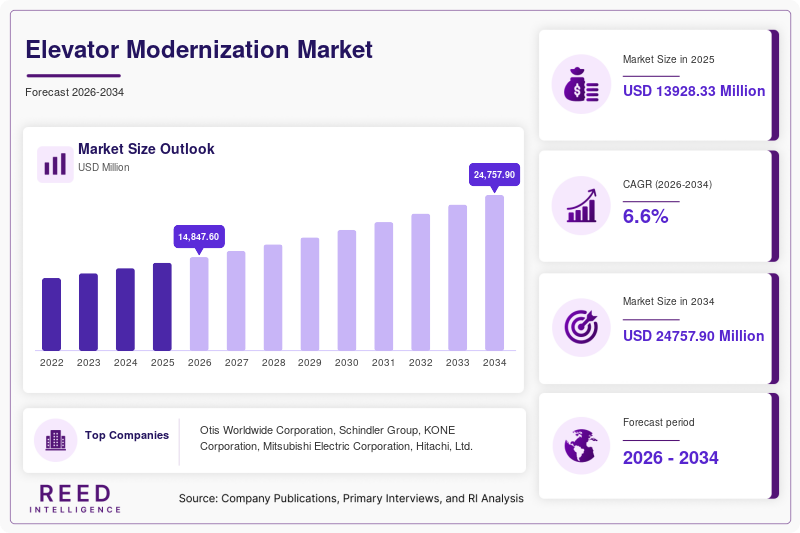
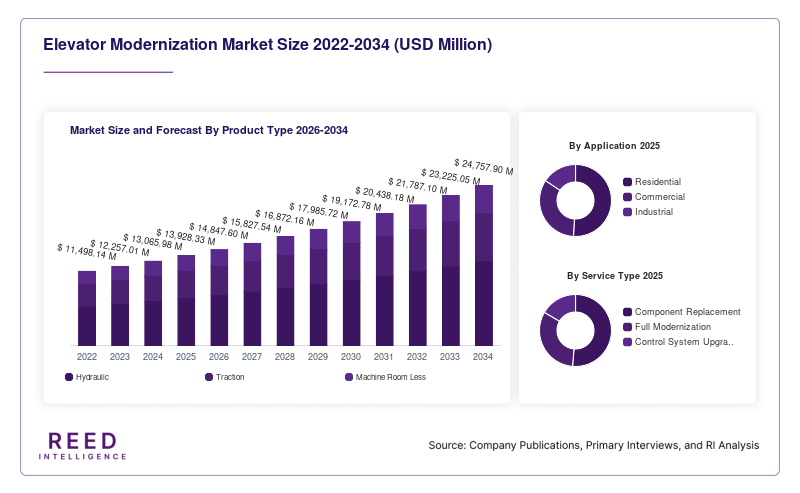
Elevator Modernization market size is projected at USD 14,847.6 million in 2026 and is expected to hit USD 24,847.5 million by 2034 with a CAGR of 6.6% during the forecast period. The increasing need to upgrade aging elevator infrastructure for enhanced safety, energy efficiency, and improved user experience, coupled with the growing emphasis on smart building technologies and regulatory compliance, underpins market expansion. This report delivers a comprehensive analysis of the Elevator Modernization market, including segmentation by type and application, competitive dynamics, and regional growth patterns, equipping stakeholders with critical intelligence. The Elevator Modernization market continues to demonstrate strong growth potential, fueled by the aging global elevator fleet, the rapid urbanization and construction of new buildings, and continuous innovation in modernization technologies and solutions.
Elevator modernization is the process of upgrading existing elevator systems with new technologies and components to improve performance, safety, energy efficiency, and aesthetics. This can include replacing controllers, motors, doors, cabs, and cabling, as well as implementing destination dispatch and IoT capabilities. The global elevator modernization market is substantial, with over 18 million elevators in operation worldwide in 2025, a significant portion of which are over 20 years old and prime candidates for modernization. The number of modernization projects exceeded 250,000 in 2025, reflecting a 7% increase from 2023. Adoption patterns reveal that the Traction type dominates the market, accounting for 48% of total demand, followed by Hydraulic at 32%, and Machine Room Less at 20%. The Elevator Modernization market's trajectory is closely linked to the growth of the global building and construction market, which is projected to reach USD 15 trillion by 2028, and the increasing focus on building life cycle management and sustainability.
Elevator Modernization Market Trends
Integration of IoT and Smart Building Technologies
The Elevator Modernization market is witnessing a significant trend toward the integration of IoT and smart building technologies, driven by the need for predictive maintenance, real-time monitoring, and enhanced operational efficiency. The revenue from IoT-enabled modernization projects grew to USD 4.5 billion in 2025, a year-on-year increase of 15%, as 45% of new modernization projects in 2025 specified IoT and smart connectivity features. Adoption rates of smart technologies in commercial building upgrades reached 40%, with this figure projected to exceed 65% by 2030. The Elevator Modernization market's trend toward IoT integration is reinforced by the need for reduced downtime, the increasing focus on data-driven building management, and the continuous innovation in sensor and communication technologies.
Growing Focus on Energy Efficiency and Sustainability
The increasing focus on energy efficiency and sustainability is a major trend shaping the Elevator Modernization market, with the development of modernized systems that reduce energy consumption and carbon footprint. The market has seen a 15% increase in the demand for energy-efficient modernization since 2022, with 30% of new projects in 2025 featuring regenerative drives and LED lighting upgrades. The use of destination dispatch systems for improved traffic management has also gained significant traction. The Elevator Modernization market's trend toward sustainability is reinforced by the need to reduce operating costs, the increasing regulatory pressure for green buildings, and the continuous innovation in energy-saving technologies and components.
Elevator Modernization Market Drivers
The Elevator Modernization market's expansion is primarily driven by the increasing age of the global elevator fleet, with over 50% of the installed base in major markets exceeding 20 years of service. The need to improve safety, reliability, and compliance with updated codes has been a major driver. The growing emphasis on energy efficiency and reducing operational costs has also fueled market growth. Additionally, the rapid urbanization and construction of new buildings have spurred demand for modernization of existing assets. The Elevator Modernization market's growth is further reinforced by the continuous improvement in modernization technologies, leading to better performance, safety, and user experience.
Elevator Modernization Market Restraints
Despite favorable growth prospects, the Elevator Modernization market faces significant constraints, primarily related to the high cost of modernization projects, which can be 30-50% of the cost of a new elevator. The complexity of installation and the need for building downtime can also be a limitation. The Elevator Modernization market's growth is also tempered by the fragmented ownership of buildings in some regions, which can hinder decision-making, and the challenge of sourcing skilled labor for modernization.
Elevator Modernization Market Opportunities
The Elevator Modernization market presents significant opportunities in the rapidly expanding market for smart building retrofits, where elevator modernization is a key component. The development of standardized and cost-effective modernization kits for common elevator types is expected to grow at a CAGR of 8% through 2034. Emerging opportunities also exist in the integration of modernized elevators with building management systems and security platforms. The Elevator Modernization market's opportunity profile is further enhanced by the growing trend of building digitization and the increasing focus on user experience and accessibility.
Challenges in Elevator Modernization Market
The Elevator Modernization market faces persistent challenges related to the need for continuous innovation to keep pace with evolving building codes and technology standards. The complexity of managing projects in occupied buildings and minimizing disruption to tenants can also be a challenge. The market is also contending with the challenge of ensuring compatibility between new and existing components, and the need for skilled technicians for installation and commissioning. Additionally, the Elevator Modernization market is challenged by the need to provide cost-effective solutions for a wide range of building types and ages.
Elevator Modernization Market Segmentation
The Elevator Modernization market is segmented by Type and Application to provide a comprehensive market perspective. By Type, Traction dominates with a 48% market share, driven by its wide application and efficiency. The Application segment is led by Commercial, which accounts for 50% of the market, followed by Residential at 30%, and Industrial at 20%.
By Type
Traction represent the largest segment in the Elevator Modernization market, commanding a 48% share, with modernization projects exceeding 120,000 units in 2025. These are characterized by their use of steel ropes and counterweights, offering efficiency and high speed. Technical specifications include controller type, motor type, and door operation. The Elevator Modernization market's Traction segment is driven by its use in high-rise and commercial buildings.
Hydraulic capture a 32% share of the Elevator Modernization market, with projects of 80,000 units in 2025. These are characterized by their use of a hydraulic piston for lifting, often in low to mid-rise buildings. Technical specifications include pump and valve upgrades, fluid type, and cylinder replacement. The Elevator Modernization market's Hydraulic segment is driven by its use in residential and low-rise commercial buildings.
Machine Room Less (MRL) represent the remaining 20% of the Elevator Modernization market, with projects of 50,000 units in 2025. These are characterized by their compact design, with the machine located in the hoistway. Technical specifications include compact gearless machines, controller integration, and space-saving designs. The Elevator Modernization market's MRL segment is driven by its use in modern buildings and space-constrained retrofits.
By Application
Commercial dominates the Elevator Modernization market, accounting for 50% of projects, representing 125,000 units in 2025. This segment includes use in offices, hotels, shopping malls, and hospitals. Usage penetration exceeds 30% in the sector. The Elevator Modernization market's Commercial segment is characterized by its focus on traffic management, energy efficiency, and user experience.
Residential accounts for 30% of the Elevator Modernization market, with projects of 75,000 units in 2025. This segment encompasses use in apartment buildings and condominiums. The segment is growing at a steady CAGR, driven by the aging housing stock. The Elevator Modernization market's Residential segment is characterized by its focus on safety, reliability, and aesthetics.
Industrial comprises the remainder of the Elevator Modernization market, accounting for 20% of total projects, with 50,000 units in 2025. This segment includes use in factories, warehouses, and industrial facilities. The segment is projected to grow at a moderate CAGR through 2034. The Elevator Modernization market's Industrial segment is characterized by its focus on durability and heavy-duty performance.
Elevator Modernization Market Regional Outlook
Asia-Pacific Elevator Modernization Market
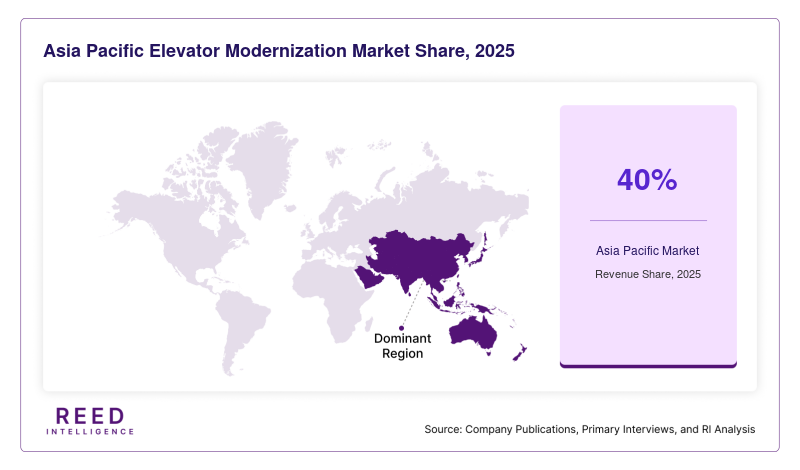
Leads the Elevator Modernization market, commanding a 40% share, with a revenue of USD 5,939.0 million in 2025. China is the primary driver, accounting for 55% of regional demand, driven by the large installed base of aging elevators, rapid urbanization, and significant construction activity. The Asia-Pacific Elevator Modernization market is characterized by its focus on high-volume and cost-effective solutions.
North America Elevator Modernization Market
Represents the second-largest market, capturing a 28% share with a revenue of USD 4,157.3 million in 2025. The United States is the primary driver, accounting for 85% of regional demand, driven by the mature elevator fleet, strong focus on safety and energy efficiency, and significant modernization activity. The North American Elevator Modernization market is characterized by its focus on innovation and premium solutions.
Europe Elevator Modernization Market
Accounts for 22% of the global Elevator Modernization market, with a revenue of USD 3,266.5 million in 2025. The UK, Germany, and France are the primary drivers, collectively accounting for 60% of regional demand, driven by aging infrastructure, strong building codes, and a focus on sustainability. The European Elevator Modernization market is projected to grow at a CAGR of 5% through 2034.
Middle East & Africa and Latin America Elevator Modernization Market
Together account for the remaining 10% of the Elevator Modernization market, with the UAE leading the Middle East market and Brazil leading the Latin American market. Both regions are projected to grow at CAGRs exceeding 7%, driven by infrastructure development and urbanization.
Top players in Elevator Modernization Market
- Otis Worldwide Corporation
- Schindler Group
- KONE Corporation
- Mitsubishi Electric Corporation
- Hitachi, Ltd.
- Toshiba Elevator and Building Systems Corporation
- Fujitec Co., Ltd.
- Thyssenkrupp Elevator AG
- Hyundai Elevator Co., Ltd.
- Shanghai Mitsubishi Elevator
- Hangzhou XiOlift
- Shenyang Yuanda Intellectual Industry Group Co., Ltd.
- Nidec Corporation
- Elevator Technology
- Wittur Group
Otis Worldwide Corporation
Otis Worldwide Corporation holds a dominant position in the Elevator Modernization market, with an estimated 18% global market share, particularly strong in the North American and commercial segments. The company's portfolio of modernization solutions is widely recognized for its quality, innovation, and reliability. Otis's market leadership is reinforced by its significant R&D investment, its extensive service network, and its strong relationships with building owners and managers. Otis commands over 22% of the North American market and 15% of the European market, positioning it as a key player in the Elevator Modernization market.
Schindler Group
Schindler Group is a leading player in the Elevator Modernization market, commanding approximately 14% of the global market share through its comprehensive portfolio of modernization and maintenance services. The company's expertise in vertical transportation and its focus on innovation have solidified its position. Schindler's modernization solutions are known for their quality, efficiency, and integration with its digital platforms. The company's commitment to sustainability and its strong presence in the European and Asian markets have enhanced its competitive advantage.
KONE Corporation holds a significant 12% market share, with particular strength in the smart building and digital solutions segment. Mitsubishi Electric Corporation is a major player in the Asian and global market, holding a 10% share.
Recent Developments in Elevator Modernization Market
- 2025: Otis launched a new suite of IoT-enabled modernization solutions with predictive analytics for enhanced performance and reduced downtime.
- 2025: Schindler Group introduced a new energy-efficient modernization package for hydraulic elevators, featuring regenerative drives and LED lighting.
Elevator Modernization Market Segments
By Product Type
- Hydraulic
- Traction
- Machine Room Less
By Application
- Residential
- Commercial
- Industrial
By Service Type
- Component Replacement
- Full Modernization
- Control System Upgrades
By Region
- North America
- Europe
- APAC
- Middle East and Africa
- LATAM