Embryo Incubator Market Size, Share & Demand Report By Product Type (Time-Lapse Incubators, Benchtop Incubators, Conventional Incubators), By Application (IVF Clinics, Research Laboratories, Cryopreservation Laboratories), By End User (Fertility Clinics, Hospitals, Academic Research Institutes), By Chamber Configuration (Multi-Chamber Incubators, Mini-Chamber Incubators, Large Capacity Incubators), By Region & Segment Forecasts, 2025–2034
USD 3950
Market Overview
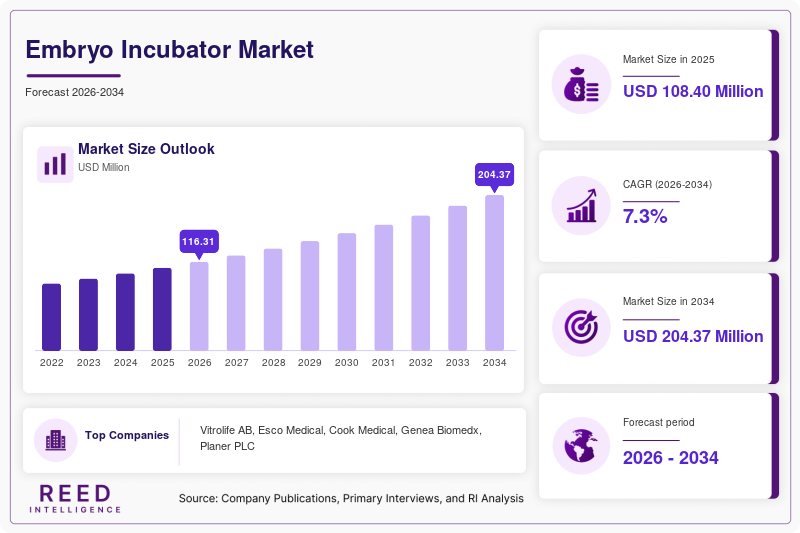
The Embryo Incubator Market size was valued at USD 108.4 million in 2025 and is projected to reach USD 203.7 million by 2034, expanding at a CAGR of 7.3% from 2025 to 2034. Growth in the Embryo Incubator Market is closely linked to the increasing adoption of assisted reproductive technologies (ART) across fertility clinics and hospitals. Rising infertility rates among couples, delayed parenthood, and advancements in in-vitro fertilization (IVF) procedures have collectively supported the demand for advanced incubation technologies used during embryo culture and development.
One global factor supporting the expansion of the Embryo Incubator Market is the increasing acceptance of fertility treatments in both developed and emerging healthcare systems. Government funding programs, expanding insurance coverage for reproductive treatments, and improved awareness of fertility preservation are contributing to higher procedure volumes in fertility centers. As IVF procedures grow worldwide, demand for stable and automated embryo incubation systems that maintain controlled temperature, humidity, and gas conditions continues to rise.
Key Highlights
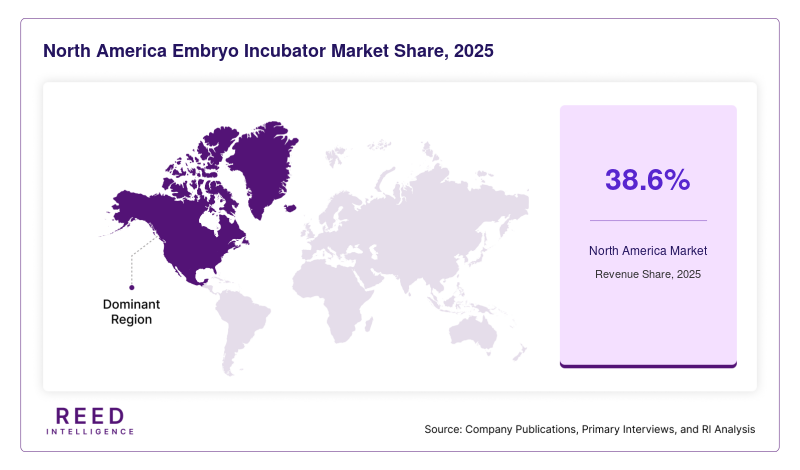
- Dominant region: North America held 38.6% share in 2025, while Asia Pacific is projected to grow fastest at a CAGR of 9.1%.
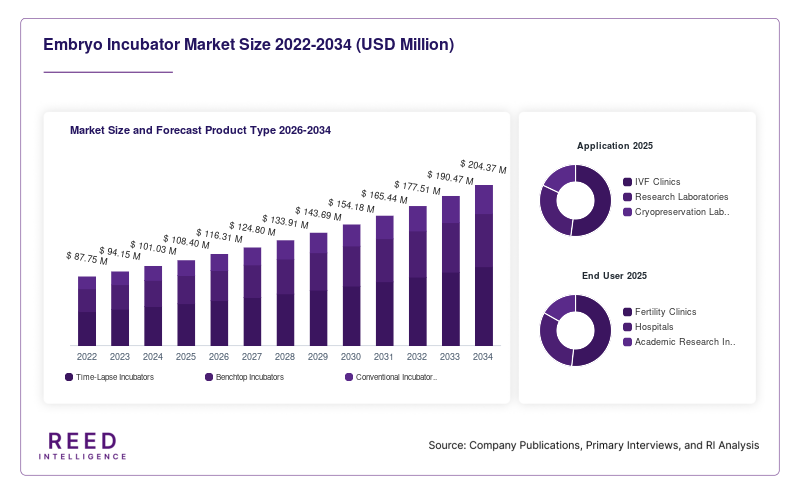
- Leading segment: Time-lapse incubators accounted for 42.4% of the market in 2025, while benchtop incubators are projected to grow fastest at 8.2% CAGR.
- Application segment: IVF clinics dominated with 63.5% share, while research laboratories will expand at 8.5% CAGR.
- Dominant country: The United States recorded USD 34.1 million in 2025 and is estimated to reach USD 36.3 million in 2026.
Market Trends
Integration of Time-Lapse Imaging Technology
One of the most significant trends shaping the Embryo Incubator Market is the growing integration of time-lapse embryo monitoring systems. These systems allow continuous imaging of embryo development without removing embryos from the incubator environment. By minimizing external disturbances, time-lapse incubators improve embryo culture conditions and enhance clinical decision-making.
Fertility specialists increasingly rely on automated image analysis to select the most viable embryos for implantation. The technology provides detailed developmental insights that help reduce multiple embryo transfers and improve success rates of IVF procedures. As fertility clinics continue to adopt digital monitoring tools, time-lapse incubators are becoming a central component of modern embryology laboratories.
Expansion of Compact Benchtop Incubator Systems
Another trend influencing the Embryo Incubator Market is the increasing demand for compact benchtop incubators designed for smaller fertility laboratories and research facilities. These systems offer modular configurations, improved gas control, and independent chambers that reduce contamination risks.
The demand for compact incubators is particularly visible in emerging fertility centers and academic laboratories. Their lower operational costs and space efficiency allow clinics to expand embryo culture capacity without large infrastructure investments. As fertility services expand into smaller clinics and regional healthcare centers, benchtop incubators are expected to gain broader adoption globally.
Market Drivers
Rising Global Infertility Rates
The growing prevalence of infertility among couples is a primary factor driving the Embryo Incubator Market. Lifestyle changes, delayed childbearing, environmental exposure, and health conditions such as polycystic ovary syndrome have increased infertility cases worldwide. According to fertility specialists, millions of couples seek medical intervention every year to achieve pregnancy.
As infertility treatment demand rises, IVF and related assisted reproductive procedures are becoming more common. Embryo incubators are essential laboratory tools used during these procedures to support controlled embryo development. Consequently, increased IVF procedure volumes directly stimulate demand for reliable embryo incubation systems.
Growth of Fertility Clinics Worldwide
Another key driver of the Embryo Incubator Market is the rapid expansion of specialized fertility clinics. Healthcare providers are increasingly establishing dedicated reproductive medicine centers to address growing demand for assisted conception treatments.
New clinics require advanced embryology laboratories equipped with high-precision incubation technologies. Many facilities also upgrade existing equipment to improve laboratory efficiency and patient outcomes. This continuous infrastructure expansion supports steady demand for next-generation embryo incubators across developed and emerging healthcare systems.
Market Restraint
High Equipment and Laboratory Setup Costs
One significant restraint affecting the Embryo Incubator Market is the high cost associated with advanced embryo incubation systems and laboratory infrastructure. Time-lapse incubators and automated culture systems require sophisticated sensors, imaging technologies, and environmental control mechanisms. These components increase the overall equipment cost compared with conventional laboratory incubators.
In addition to the equipment investment, fertility laboratories must maintain strict environmental conditions, including controlled gas supply, sterile workspaces, and specialized monitoring systems. Establishing and maintaining such infrastructure can be expensive, particularly for smaller fertility clinics and hospitals.
Financial limitations may discourage some healthcare providers from upgrading older incubation systems or expanding laboratory capacity. Emerging economies with limited fertility treatment reimbursement programs may face additional barriers to adopting advanced embryo incubators.
Despite these constraints, technological advancements and increased competition among equipment manufacturers may gradually reduce pricing barriers over the forecast period. However, the upfront capital requirement remains a notable challenge for widespread adoption of advanced incubation technologies.
Market Opportunities
Adoption of Artificial Intelligence in Embryo Assessment
Artificial intelligence integration represents a promising opportunity for the Embryo Incubator Market. AI algorithms can analyze large volumes of embryo development data captured by time-lapse incubators. These analytical tools help embryologists identify developmental patterns associated with successful implantation.
AI-enabled embryo selection may reduce subjectivity in IVF procedures and improve clinical success rates. As fertility clinics seek advanced diagnostic support, incubator manufacturers have the opportunity to incorporate AI-driven analytics into their systems.
Expansion of Fertility Services in Emerging Economies
Emerging healthcare markets offer considerable growth potential for the Embryo Incubator Market. Countries across Asia, Latin America, and parts of the Middle East are witnessing increased demand for fertility treatments due to urbanization, changing lifestyles, and rising awareness of reproductive health.
Healthcare providers in these regions are expanding fertility clinics and investing in modern embryology laboratory equipment. Government support for reproductive health programs and medical tourism further strengthens the opportunity for embryo incubator suppliers. As access to fertility services expands, equipment demand is expected to rise significantly.
Segmental Analysis
By Product Type
Time-lapse incubators represented the dominant subsegment in 2025, accounting for 42.4% of the Embryo Incubator Market share. These systems combine embryo culture with continuous imaging capabilities, enabling embryologists to monitor development without removing embryos from controlled incubation conditions. The ability to track cell division patterns and developmental milestones has made time-lapse systems widely adopted in advanced fertility laboratories.
Benchtop incubators are expected to become the fastest-growing subsegment, expanding at a CAGR of 8.2% during the forecast period. These systems are designed with compact chambers and modular configurations suitable for smaller laboratories. Their independent incubation chambers minimize cross-contamination risks and provide flexible laboratory workflow management, making them increasingly attractive to emerging fertility centers.
By Application
IVF clinics accounted for the largest share of the Embryo Incubator Market in 2025 at 63.5%. These specialized clinics perform a high volume of embryo culture procedures during assisted reproductive treatments. Embryo incubators serve as core laboratory equipment during fertilization, embryo development, and pre-implantation stages.
Research laboratories are projected to be the fastest-growing application segment, with a CAGR of 8.5% through 2034. Academic institutions and biotechnology research organizations increasingly conduct reproductive biology studies that require controlled embryo culture environments. The expansion of reproductive medicine research programs is expected to support this growth.
By End User
Fertility clinics represented the dominant end-user segment with 58.7% share in 2025. These facilities specialize in assisted reproductive treatments and require high-performance incubation systems to maintain optimal embryo culture conditions. The large number of procedures performed in fertility clinics contributes to steady equipment demand.
Hospitals will represent the fastest-growing end-user segment, expanding at a CAGR of 7.8% during the forecast period. Many hospital networks are integrating reproductive medicine departments into their healthcare services. This expansion is expected to increase the installation of embryo incubators within hospital-based embryology laboratories.
By Chamber Configuration
Multi-chamber incubators held the largest share of the Embryo Incubator Market in 2025 at 55.1%. These systems allow independent incubation environments within a single unit, enabling laboratories to culture multiple embryos simultaneously while maintaining stable environmental conditions. This configuration improves operational efficiency in high-volume fertility laboratories.
Mini-chamber incubators are projected to be the fastest-growing configuration segment, expanding at a CAGR of 8.0%. These incubators provide highly controlled micro-environments that reduce fluctuations in temperature and gas composition. Their design supports improved embryo viability and allows laboratories to manage incubation conditions more precisely.
Regional Analysis
North America
North America accounted for 38.6% of the Embryo Incubator Market in 2025. The region benefits from a mature fertility treatment ecosystem and widespread adoption of advanced laboratory technologies. The regional market will expand at a CAGR of 6.8% from 2025 to 2034. A high number of IVF procedures performed annually contributes to consistent demand for embryo incubation equipment.
The United States remained the dominant country in the regional market. One major growth factor is the strong presence of specialized fertility clinics and reproductive medicine networks. These facilities operate highly sophisticated embryology laboratories that frequently upgrade incubation technologies to maintain laboratory precision. Continuous investments in fertility research also encourage adoption of advanced incubation systems.
Europe
Europe represented 29.4% of the Embryo Incubator Market in 2025. The region’s established healthcare systems and supportive regulatory frameworks for assisted reproductive technologies supported steady market demand. The European market will grow at a CAGR of 6.9% during the forecast period.
The United Kingdom dominated the regional landscape. A major growth factor is the strong regulatory oversight and structured fertility treatment programs implemented through national healthcare policies. Fertility treatment monitoring systems and clinical standards encourage clinics to adopt advanced embryo incubation technologies to improve treatment efficiency and compliance with laboratory standards.
Asia Pacific
Asia Pacific captured 21.7% share of the Embryo Incubator Market in 2025. The region is characterized by rapidly expanding healthcare infrastructure and increasing adoption of fertility treatments. The regional market will grow at a CAGR of 9.1% between 2025 and 2034, representing the fastest growth globally.
China emerged as the dominant country in the Asia Pacific market. A key growth factor is the expansion of reproductive medicine hospitals and academic fertility research programs. Increasing healthcare investments and supportive reproductive health policies have encouraged the establishment of advanced embryology laboratories equipped with modern incubation technologies.
Middle East & Africa
The Middle East & Africa accounted for 5.4% of the Embryo Incubator Market in 2025. Growing awareness of reproductive medicine and increasing availability of fertility clinics have gradually expanded regional demand. The market will expand at a CAGR of 7.5% through 2034.
The United Arab Emirates represented the dominant country in this region. One major factor supporting growth is the development of private fertility treatment centers that serve both domestic patients and international medical tourists. These facilities focus on providing advanced reproductive treatments, which increases demand for reliable embryo incubation equipment.
Latin America
Latin America held 4.9% of the Embryo Incubator Market in 2025. The region has experienced gradual adoption of assisted reproductive technologies across major urban healthcare centers. The market will grow at a CAGR of 7.2% during the forecast period.
Brazil dominated the regional market. One key growth factor is the expansion of fertility clinics in large metropolitan areas. Private healthcare providers are investing in modern embryology laboratories to support increasing demand for IVF procedures. These investments are supporting gradual growth in the adoption of embryo incubators across the region.
Competitive Landscape
The Embryo Incubator Market is moderately consolidated, with several global medical technology companies and specialized fertility equipment manufacturers competing through product innovation and laboratory integration technologies.
Leading companies focus on improving incubation stability, gas regulation, and embryo monitoring capabilities. Many manufacturers are incorporating digital imaging and data management systems into their incubators to enhance clinical workflow efficiency.
A key market leader is Vitrolife AB, known for its advanced embryo culture solutions and time-lapse incubation technologies. The company has expanded its product portfolio through investments in embryo monitoring systems and laboratory workflow platforms.
Other major participants in the Embryo Incubator Market continue to focus on expanding distribution networks and strengthening partnerships with fertility clinics and reproductive research institutions.
Key Players
- Vitrolife AB
- Esco Medical
- Cook Medical
- Genea Biomedx
- Planer PLC
- Hamilton Thorne Ltd.
- Astec Co., Ltd.
- Labotect GmbH
- K-Systems
- NUVE
- IVFtech ApS
- Panasonic Healthcare (PHC Corporation)
- Thermo Fisher Scientific
- Eppendorf AG
- Memmert GmbH
Recent Developments
- 2024: Vitrolife introduced an upgraded time-lapse incubation platform designed to improve embryo monitoring accuracy and laboratory workflow integration.
- 2024: Hamilton Thorne expanded its reproductive technology product portfolio through a strategic acquisition of laboratory imaging software assets.
- 2023: Esco Medical launched a compact benchtop embryo incubator optimized for smaller fertility clinics and research laboratories.
- 2023: Genea Biomedx enhanced its embryo culture systems with improved environmental control sensors for precise temperature and gas monitoring.
Embryo Incubator Market Segments
Product Type
- Time-Lapse Incubators
- Benchtop Incubators
- Conventional Incubators
Application
- IVF Clinics
- Research Laboratories
- Cryopreservation Laboratories
End User
- Fertility Clinics
- Hospitals
- Academic Research Institutes
Chamber Configuration
- Multi-Chamber Incubators
- Mini-Chamber Incubators
- Large Capacity Incubators
By Region
- North America
- Europe
- APAC
- Middle East and Africa
- LATAM