Emergency Location Transmitter Market Size, Share & Demand Report By Product Type (Automatic Fixed Emergency Transmitters), By Technology (GPS-Enabled Transmitters, Analog Transmitters, Digital Transmitters), By Application (Aviation, Marine, Defense, Outdoor Recreation), By End Use (Commercial Operators, Government Agencies) By Region & Segment Forecasts, 2026–2034
USD 3950
Market Overview
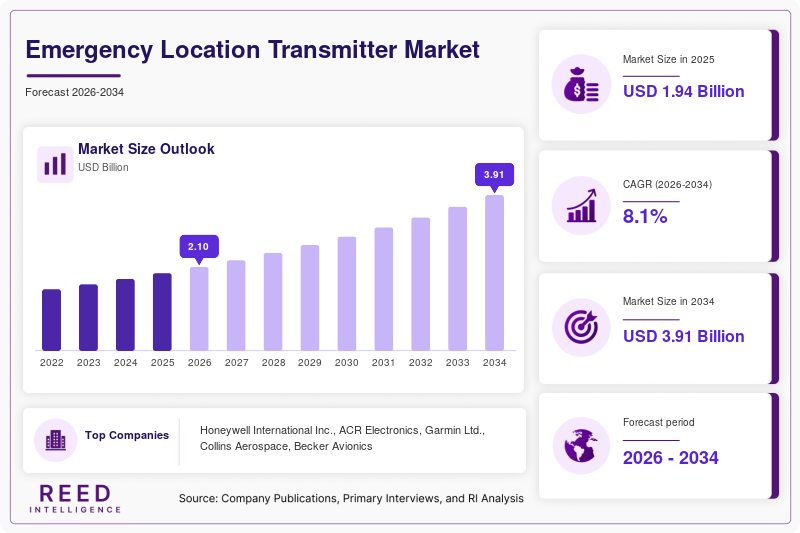
The Emergency Location Transmitter Market size was valued at USD 1.94 billion in 2026 and is projected to reach USD 3.62 billion by 2034, expanding at a CAGR of 8.1% during the forecast period of 2026–2034. The global Emergency Location Transmitter Market growth has been supported by rising emphasis on aviation safety regulations and increasing investments in advanced search-and-rescue infrastructure across commercial aviation, defense, marine, and emergency response sectors. Governments and international aviation organizations continue to strengthen mandates related to aircraft emergency communication systems, which has accelerated the deployment of modern emergency location transmitters globally.
Emergency location transmitters are critical distress signaling devices designed to transmit location information during emergencies involving aircraft, ships, or remote operations. These systems help rescue teams identify the location of individuals or vehicles after accidents, crashes, or operational failures. The increasing use of satellite-based communication systems and GPS-enabled emergency beacons has significantly improved rescue efficiency and reduced response times.
Key Highlights
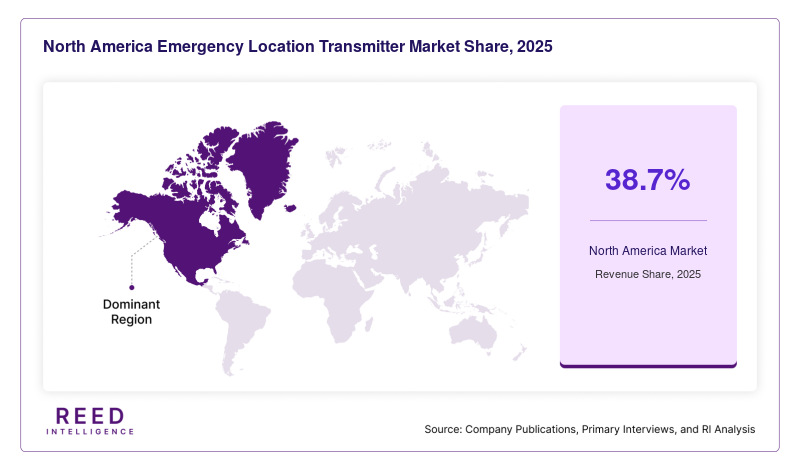
- North America accounted for 38.7% of the global Emergency Location Transmitter Market share in 2025, while Asia Pacific is projected to witness the fastest CAGR of 9.0% during 2026–2034.
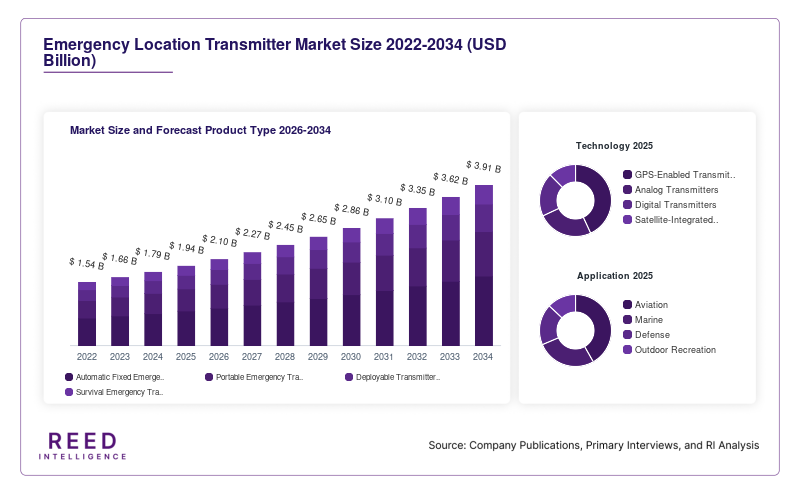
- By product type, automatic fixed emergency transmitters held the dominant share of 42.5% in 2025, whereas portable emergency transmitters are anticipated to grow at the fastest CAGR of 9.3%.
- By technology, GPS-enabled transmitters represented the leading segment with 48.1% market share in 2025, while satellite-integrated transmitters are expected to expand at a CAGR of 8.9%.
- By application, aviation accounted for 51.4% of the market share in 2025, whereas marine applications are projected to register a CAGR of 8.5%.
- By end use, commercial operators dominated with 46.2% share in 2025, while defense and military users are forecast to grow at a CAGR of 8.7%.
- The United States remained the dominant country market and was valued at USD 486.3 million in 2024 and USD 524.7 million in 2025.
Market Trends
Integration of Satellite-Based Distress Communication Systems
The growing integration of satellite communication technologies has become a major trend shaping the Emergency Location Transmitter Market. Modern transmitters increasingly utilize satellite networks for accurate positioning and uninterrupted emergency signal transmission in remote areas.
Satellite-enabled transmitters improve rescue response efficiency by providing real-time location tracking and expanded communication coverage. This trend is particularly important in aviation and maritime operations where rapid emergency response is critical for passenger and crew safety.
Increasing Adoption of Compact and Lightweight Emergency Beacons
Manufacturers are increasingly focusing on the development of compact and lightweight emergency transmitters suitable for portable and personal safety applications. Miniaturization technologies are enabling improved mobility without compromising signal performance.
Portable emergency location transmitters are gaining traction among recreational pilots, hikers, offshore workers, and military personnel. The demand for lightweight safety equipment continues to encourage innovation in battery optimization and compact device engineering.
Market Drivers
Expansion of Global Aviation Safety Regulations
The strengthening of aviation safety regulations worldwide has significantly driven the Emergency Location Transmitter Market. Regulatory agencies continue to mandate advanced distress communication systems for commercial aircraft and private aviation fleets.
Airlines and aircraft manufacturers are increasingly investing in upgraded emergency signaling equipment to improve operational compliance and passenger safety standards. Growing air traffic volumes and aircraft fleet expansion are further contributing to market growth.
Rising Investments in Search-and-Rescue Infrastructure
Governments and emergency response agencies are investing heavily in modern search-and-rescue systems capable of supporting rapid disaster response operations. Emergency location transmitters play a critical role in enabling efficient rescue coordination during aviation accidents, maritime emergencies, and remote-area incidents.
Improved coordination between satellite operators, defense agencies, and rescue organizations has strengthened adoption of advanced emergency communication technologies across multiple industries.
Market Restraint
High Equipment and Certification Costs
High equipment costs and strict certification requirements remain a major restraint for the Emergency Location Transmitter Market. Advanced transmitter systems require compliance with international aviation and marine communication standards, increasing manufacturing and testing expenses.
Small aircraft operators and recreational users may face financial challenges when upgrading to modern emergency transmitter systems. Complex installation procedures and periodic maintenance requirements may also limit adoption in some regions.
Market Opportunities
Growing Demand for Personal Safety and Outdoor Rescue Devices
The increasing popularity of adventure tourism and outdoor recreational activities presents significant opportunities for the Emergency Location Transmitter Market. Hikers, mountaineers, expedition teams, and remote workers increasingly rely on portable emergency beacons for safety and communication.
Manufacturers are developing compact personal locator transmitters with enhanced battery life and satellite connectivity to address growing consumer demand for outdoor emergency communication equipment.
Expansion of Military and Defense Modernization Programs
Rising defense modernization programs are creating new growth opportunities for emergency location transmitter manufacturers. Military organizations are increasingly deploying advanced emergency communication systems for aircraft crews, naval operations, and tactical personnel.
Demand for ruggedized and encrypted emergency transmitters capable of operating in harsh combat environments is expected to increase steadily during the forecast period.
Segmental Analysis
By Product Type
Based on product type, the Emergency Location Transmitter Market is segmented into automatic fixed emergency transmitters, portable emergency transmitters, deployable transmitters, and survival emergency transmitters.
Automatic fixed emergency transmitters dominated the market with a 42.5% share in 2025 due to widespread deployment across commercial and military aircraft. These systems provided reliable automatic activation during crash events and improved rescue coordination efficiency.
Portable emergency transmitters are expected to witness the fastest CAGR of 9.3% during the forecast period. Increasing adoption among outdoor recreational users, defense personnel, and remote-area workers will support segment expansion. Advancements in lightweight transmitter technology are expected to further accelerate demand.
By Technology
Based on technology, the market is categorized into GPS-enabled transmitters, analog transmitters, digital transmitters, and satellite-integrated transmitters.
GPS-enabled transmitters accounted for the largest market share of 48.1% in 2025 owing to accurate location tracking capabilities and improved rescue response efficiency. Commercial aviation and marine operators increasingly adopted GPS-enabled systems for operational safety compliance.
Satellite-integrated transmitters are projected to grow at a CAGR of 8.9% during 2026–2034. Expanded satellite communication coverage and improved long-range distress signaling performance will support segment growth across remote and offshore operations.
By Application
Based on application, the Emergency Location Transmitter Market is segmented into aviation, marine, defense, and outdoor recreation.
Aviation held the dominant share of 51.4% in 2025 due to strict international aviation safety regulations and increasing commercial aircraft fleet expansion. Airlines and aircraft manufacturers continued investing in advanced emergency signaling systems to improve passenger safety standards.
Marine applications are expected to register the fastest CAGR of 8.5% during the forecast period. Increasing global shipping activities and rising offshore exploration operations will strengthen demand for reliable marine distress communication systems.
By End Use
Based on end use, the market is divided into commercial operators, government agencies, defense & military users, and individual consumers.
Commercial operators dominated the market with a 46.2% share in 2025 due to high deployment rates across commercial aviation and shipping fleets. Regulatory compliance requirements and operational safety concerns significantly contributed to segment growth.
Defense and military users are projected to witness the fastest CAGR of 8.7% during the forecast period. Rising investments in tactical communication systems and military aircraft modernization programs will support increasing adoption of rugged emergency transmitters.
Regional Analysis
North America
North America accounted for 38.7% of the global Emergency Location Transmitter Market share in 2025 and is projected to grow at a CAGR of 7.6% during 2026–2034. The region maintained its dominant position due to strong aviation safety regulations and extensive search-and-rescue infrastructure.
The United States remained the leading country market because of large commercial aviation operations, advanced defense capabilities, and increasing investments in satellite-based emergency communication systems. Strong regulatory enforcement further supported market demand.
Europe
Europe represented 25.1% of the global Emergency Location Transmitter Market share in 2025 and is anticipated to expand at a CAGR of 7.8% during the forecast period. The region benefited from strict aviation compliance requirements and growing marine safety initiatives.
Germany dominated the regional market owing to strong aerospace manufacturing capabilities and increasing deployment of emergency communication systems across commercial aviation fleets. Expanding maritime safety regulations also supported product adoption.
Asia Pacific
Asia Pacific captured 22.8% of the global Emergency Location Transmitter Market share in 2025 and is forecast to witness the fastest CAGR of 9.0% through 2034. Rapid aviation sector growth and increasing investments in defense modernization supported regional expansion.
China emerged as the dominant country market due to rising aircraft production, expanding commercial airline operations, and increasing government investments in emergency response infrastructure. The growing marine transportation sector further strengthened market demand.
Middle East & Africa
Middle East & Africa accounted for 7.6% of the global Emergency Location Transmitter Market share in 2025 and is expected to grow at a CAGR of 8.2% during 2026–2034. Increasing aviation investments and expanding offshore oil exploration activities contributed to regional growth.
Saudi Arabia remained the dominant country market owing to ongoing airport infrastructure development and growing investments in aviation modernization programs. Rising maritime trade activities also supported transmitter deployment across regional fleets.
Latin America
Latin America held 5.8% of the global Emergency Location Transmitter Market share in 2025 and is projected to expand at a CAGR of 7.3% during the study period. Increasing commercial aviation activities and expanding emergency response initiatives supported market development.
Brazil led the regional market because of growing airline fleet modernization programs and increasing focus on aviation safety compliance. Investments in coastal rescue operations further strengthened demand for emergency transmitters.
Competitive Landscape
The Emergency Location Transmitter Market remains moderately competitive with major aerospace electronics and communication technology companies focusing on product innovation, satellite integration, and strategic partnerships. Companies are increasingly investing in compact transmitter technologies, digital communication systems, and global distribution expansion.
Honeywell International Inc. remained a leading participant due to its extensive aerospace safety systems portfolio and strong presence in commercial aviation markets. The company recently introduced upgraded emergency transmitter systems integrated with advanced satellite communication capabilities and improved signal accuracy.
ACR Electronics continued expanding its marine safety product portfolio through compact distress beacon innovations. Garmin Ltd. focused on portable GPS-enabled emergency communication devices for aviation and outdoor applications, while Collins Aerospace strengthened aircraft safety equipment integration capabilities. Becker Avionics emphasized advanced digital emergency communication technologies for commercial and military aviation systems.
Key Players List
- Honeywell International Inc.
- ACR Electronics
- Garmin Ltd.
- Collins Aerospace
- Becker Avionics
- Cobham Aerospace Communications
- L3Harris Technologies Inc.
- Thales Group
- Emergency Beacon Corporation
- HR Smith Group
- Kannad Aviation
- Digital Angel Corporation
- Textron Inc.
- Orolia Maritime
- ACK Technologies Inc.
Recent Developments
- In 2025, Honeywell International Inc. launched advanced satellite-enabled emergency transmitter systems for commercial aviation applications.
- In 2024, Garmin Ltd. expanded its portable GPS emergency beacon portfolio for outdoor and aviation safety users.
- In 2025, Collins Aerospace strengthened aircraft safety communication systems through enhanced digital distress signaling technologies.
- In 2024, ACR Electronics introduced compact marine emergency transmitters with improved battery performance and satellite connectivity.
- In 2025, Thales Group increased investments in advanced aerospace emergency communication research programs.
Emergency Location Transmitter Market Segments
Product Type
- Automatic Fixed Emergency Transmitters
- Portable Emergency Transmitters
- Deployable Transmitters
- Survival Emergency Transmitters
Technology
- GPS-Enabled Transmitters
- Analog Transmitters
- Digital Transmitters
- Satellite-Integrated Transmitters
Application
- Aviation
- Marine
- Defense
- Outdoor Recreation
End Use
- Commercial Operators
- Government Agencies
- Defense & Military Users
- Individual Consumers
By Region
- North America
- Europe
- APAC
- Middle East and Africa
- LATAM