Emergency Stretchers Market Size, Share & Demand Report By Product Type (Manual Stretchers, Powered Stretchers, Bariatric Stretchers, Specialized Emergency Stretchers), By Application (Hospital Emergency Departments, Ambulance Services, Disaster Response Operations, Military Medical Services), By End Use (Hospitals, Ambulatory Surgical Centers, Emergency Medical Service Providers, Specialty Clinics), By Region & Segment Forecasts, 2026–2034
USD 3950
Market Overview
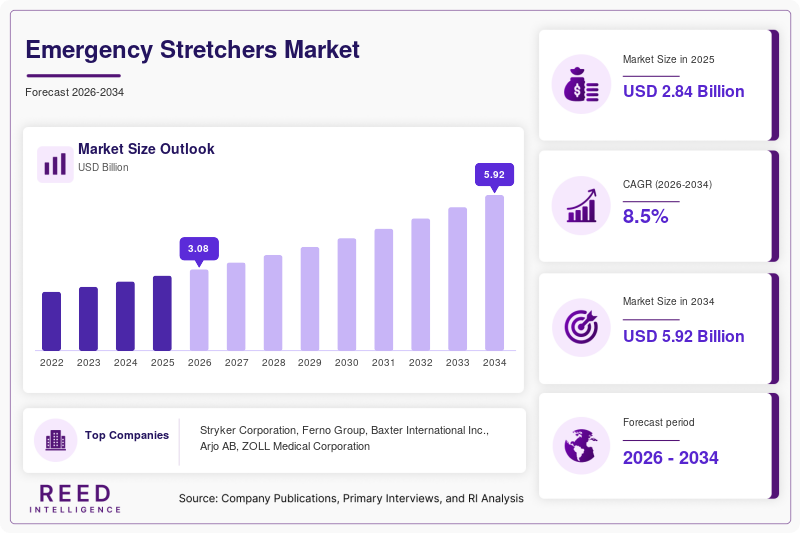
The global Emergency Stretchers Market size was valued at USD 2.84 billion in 2026 and is projected to reach USD 5.47 billion by 2034, expanding at a CAGR of 8.5% during 2026–2034. The market continues to experience steady growth due to rising investments in emergency medical services, increasing trauma and accident cases, and the expansion of healthcare infrastructure across both developed and developing economies. Emergency stretchers are critical patient transportation devices used in ambulances, hospitals, military operations, disaster response units, and emergency care facilities. Their role in ensuring rapid patient mobility and safe transfer has increased their importance within modern healthcare systems.
A major global factor supporting market expansion is the growing emphasis on emergency preparedness and pre-hospital care systems. Governments and healthcare organizations are investing in advanced ambulance fleets, disaster management programs, and emergency response networks to improve patient outcomes. These initiatives have accelerated demand for technologically advanced stretchers equipped with hydraulic lifting systems, powered mobility features, lightweight materials, and improved patient safety mechanisms.
Key Highlights
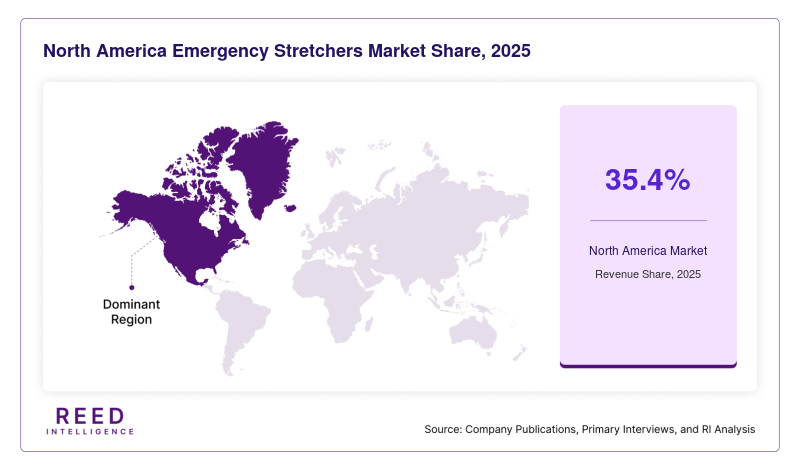
- North America dominated the market with a 35.4% share in 2025, while Asia Pacific is expected to grow at the fastest CAGR of 10.9% during 2026–2034.
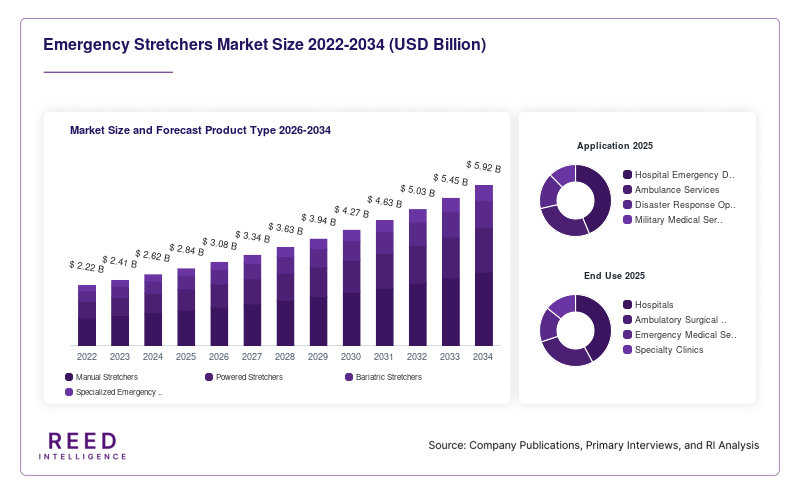
- By product type, manual stretchers accounted for the largest share of 42.8%, while powered stretchers are projected to grow at a CAGR of 11.6%.
- By application, hospital emergency departments led with a 46.3% share, whereas ambulance services are expected to expand at a CAGR of 10.8%.
- By end use, hospitals accounted for the largest share of 51.7%, while ambulatory surgical centers are projected to grow at a CAGR of 9.8%.
- The United States remained the dominant country, with market values of USD 780 million in 2024 and USD 845 million in 2025.
Market Trends
Integration of Powered Mobility and Smart Transportation Features
The Emergency Stretchers Market is witnessing a growing transition toward powered and electronically assisted stretcher systems. Healthcare providers are increasingly adopting powered stretchers that reduce physical strain on emergency personnel and improve patient handling efficiency. These systems feature battery-powered lifting mechanisms, automated loading capabilities, and advanced braking systems that enhance operational safety. Ambulance operators are particularly interested in reducing workplace injuries among paramedics, leading to increased procurement of technologically advanced solutions. The integration of digital controls and ergonomic designs is further improving patient transport quality. As healthcare institutions prioritize workforce safety and operational efficiency, demand for powered emergency stretchers is expected to increase steadily throughout the forecast period.
Rising Adoption of Lightweight and Durable Materials
Manufacturers are increasingly utilizing aluminum alloys, composite materials, and reinforced polymers to develop lightweight emergency stretchers without compromising structural strength. The shift toward lightweight designs allows emergency personnel to transport patients more efficiently, especially in challenging environments such as disaster zones, remote locations, and multi-story buildings. Improved material engineering has also increased product durability and reduced maintenance requirements. Healthcare facilities are seeking equipment that delivers long operational life while minimizing transportation difficulties. The trend is particularly significant in ambulance services where rapid deployment and maneuverability are critical. Growing investments in product innovation and material advancements continue to shape purchasing decisions across healthcare organizations worldwide.
Market Drivers
Expansion of Emergency Medical Services Infrastructure
The rapid expansion of emergency medical services infrastructure is a major factor driving growth in the Emergency Stretchers Market. Governments across multiple regions are increasing investments in ambulance networks, trauma centers, and emergency response facilities to improve healthcare accessibility. As healthcare systems seek faster response times and enhanced patient transportation capabilities, demand for advanced stretchers continues to rise. Urban population growth and increasing healthcare expenditure have further accelerated infrastructure development. Many countries are modernizing ambulance fleets with advanced patient handling equipment to improve operational performance. These investments create significant demand for both manual and powered stretcher solutions, supporting long-term market growth.
Increasing Incidence of Accidents and Medical Emergencies
Growing numbers of road traffic accidents, industrial injuries, sports-related trauma, and medical emergencies are generating substantial demand for emergency transportation equipment. Healthcare providers require reliable stretcher systems capable of safely moving patients during critical situations. Rising prevalence of cardiovascular conditions, respiratory disorders, and age-related mobility limitations has also increased emergency hospital admissions. In many regions, healthcare authorities are strengthening emergency response systems to manage growing patient volumes effectively. This trend is encouraging hospitals, ambulance operators, and emergency response agencies to replace aging equipment with modern stretcher solutions that offer improved patient safety, durability, and operational efficiency.
Market Restraint
High Acquisition and Maintenance Costs of Advanced Stretchers
The relatively high cost associated with technologically advanced emergency stretchers remains a significant challenge for market growth. Powered stretcher systems equipped with electronic lifting mechanisms, automated loading features, and specialized safety components require substantial capital investment. Smaller hospitals, rural healthcare facilities, and budget-constrained emergency service providers often face difficulties in adopting these advanced solutions. In addition to procurement expenses, maintenance costs associated with batteries, hydraulic systems, electronic controls, and replacement components can increase the total cost of ownership. Financial limitations may delay equipment upgrades and encourage continued use of older stretcher models. This challenge is particularly evident in developing economies where healthcare budgets are often allocated toward broader infrastructure priorities. Consequently, adoption rates for premium stretcher technologies may vary considerably across regions, affecting overall market penetration despite growing awareness of their operational benefits.
Market Opportunities
Growing Demand from Emerging Healthcare Markets
Emerging economies present substantial growth opportunities for the Emergency Stretchers Market. Countries across Asia Pacific, Latin America, and parts of Africa are investing heavily in healthcare modernization initiatives. Rising healthcare expenditure, expanding hospital networks, and increasing public awareness regarding emergency care are creating favorable conditions for stretcher manufacturers. Government-supported healthcare programs are encouraging the procurement of modern medical equipment, including patient transportation systems. As urban populations expand and healthcare accessibility improves, demand for emergency stretchers is expected to increase significantly. Manufacturers that establish regional production facilities and cost-effective product portfolios are likely to benefit from expanding opportunities within these high-growth markets.
Technological Innovation and Product Customization
Continuous innovation in stretcher design creates considerable opportunities for market participants. Healthcare providers increasingly seek products tailored to specific applications, including bariatric care, pediatric transportation, disaster response, and military operations. Manufacturers are developing customizable stretcher solutions featuring modular components, enhanced patient safety systems, and compatibility with medical monitoring equipment. Integration of smart technologies such as sensor-based positioning systems and automated safety alerts is also gaining attention. These innovations support improved patient outcomes while enhancing operational efficiency for healthcare professionals. Companies that focus on differentiated product development and specialized applications are expected to strengthen their competitive position and capture emerging revenue streams during the forecast period.
Segmental Analysis
By Product Type
Manual stretchers represented the dominant subsegment within the Emergency Stretchers Market, accounting for approximately 42.8% of total revenue in 2024. These products remain widely utilized due to their affordability, ease of operation, and lower maintenance requirements compared to powered alternatives. Hospitals, emergency clinics, disaster response agencies, and ambulance operators continue to rely on manual stretchers for routine patient transportation activities. Their versatility across various healthcare settings contributes significantly to market leadership. Many healthcare facilities in developing regions prefer manual solutions because of limited capital budgets and minimal infrastructure requirements. Manufacturers continue to improve product durability, portability, and ergonomic functionality, ensuring sustained demand despite the emergence of advanced alternatives.
Powered stretchers are expected to register the fastest growth, expanding at a CAGR of 11.6% during 2026–2034. Rising emphasis on healthcare worker safety and injury prevention is driving adoption of these advanced systems. Powered stretchers reduce physical strain associated with lifting and transferring patients while improving operational efficiency. Ambulance operators are increasingly investing in automated loading systems and battery-powered lifting mechanisms to enhance patient handling capabilities. Healthcare providers also recognize the long-term economic benefits associated with reduced workplace injuries and improved workflow productivity. Technological advancements in battery performance, lightweight construction materials, and safety features continue to strengthen demand for powered stretcher solutions worldwide.
By Application
Hospital emergency departments held the largest share within the application segment, accounting for approximately 46.3% of the market in 2024. Emergency departments manage high patient volumes and require reliable transportation equipment capable of supporting rapid medical intervention. Stretchers play an essential role in transferring patients between emergency rooms, diagnostic units, operating theaters, and intensive care departments. Growing numbers of trauma cases, chronic disease emergencies, and elderly patients contribute to sustained demand within hospital environments. Healthcare facilities continue to prioritize investments in patient transportation equipment that enhances safety, comfort, and operational efficiency. These factors collectively support the segment’s leading position.
Ambulance services are projected to experience the fastest growth at a CAGR of 10.8% during the forecast period. Expansion of emergency response networks and modernization of ambulance fleets are major growth drivers. Governments and private healthcare organizations increasingly invest in advanced emergency transportation systems to improve response times and patient outcomes. Ambulance operators require lightweight, durable, and technologically advanced stretchers capable of functioning effectively in diverse environments. The growing emphasis on pre-hospital care and emergency preparedness further supports segment expansion. Rising demand for mobile healthcare services and disaster response capabilities is expected to strengthen stretcher adoption within ambulance applications.
By End Use
Hospitals accounted for the largest end-use share, representing approximately 51.7% of market revenue in 2024. Hospitals remain primary purchasers of emergency stretchers due to their extensive patient transportation requirements. The growing prevalence of chronic diseases, increasing surgical procedures, and rising emergency admissions continue to support demand. Large healthcare facilities regularly replace aging equipment to maintain safety standards and operational efficiency. Investments in hospital expansion projects and healthcare infrastructure modernization programs also contribute significantly to procurement activity. Furthermore, hospitals increasingly seek advanced stretcher systems designed to improve patient comfort and healthcare worker productivity.
Ambulatory surgical centers are expected to record the fastest growth, registering a CAGR of 9.8% through 2034. The increasing preference for outpatient procedures and cost-effective healthcare delivery models is driving segment expansion. These facilities require efficient patient transportation equipment to support streamlined workflows and rapid patient turnover. Growth in minimally invasive surgeries and same-day discharge procedures further increases demand for modern stretcher solutions. Manufacturers are developing compact and versatile products specifically designed for ambulatory care settings. As healthcare systems continue to emphasize operational efficiency and outpatient treatment models, stretcher adoption within ambulatory surgical centers is expected to increase steadily.
Regional Analysis
North America
North America accounted for approximately 35.4% of the Emergency Stretchers Market in 2025 and is expected to maintain a strong position throughout the forecast period. The region is projected to expand at a CAGR of 7.8% between 2026 and 2034. Market growth is supported by advanced healthcare infrastructure, high healthcare expenditure, and widespread adoption of technologically advanced emergency transportation equipment. Continuous investments in ambulance modernization programs and emergency response systems contribute significantly to market demand across the region.
The United States represents the dominant country within North America. A major growth factor is the increasing focus on reducing occupational injuries among emergency medical personnel through the adoption of powered stretcher systems. Healthcare providers are actively replacing conventional equipment with advanced solutions featuring automated lifting and loading capabilities. Continuous technological innovation and favorable reimbursement environments further support market expansion across the country.
Europe
Europe captured approximately 28.1% of the global market in 2025 and is expected to register a CAGR of 7.6% during the forecast period. The region benefits from well-established healthcare systems, growing elderly populations, and increasing demand for patient transportation services. Healthcare providers across Europe are emphasizing equipment modernization initiatives aimed at improving patient safety and emergency response efficiency. Government healthcare investments continue to support market development.
Germany remains the leading country within the European market. A unique growth factor is the country's strong emphasis on healthcare technology adoption and emergency preparedness programs. Hospitals and ambulance operators increasingly invest in high-performance patient transportation equipment designed to improve operational efficiency. The presence of established medical device manufacturers and robust healthcare funding further contributes to regional market growth.
Asia Pacific
Asia Pacific held approximately 22.7% of the Emergency Stretchers Market in 2025 and is expected to achieve the fastest CAGR of 10.9% through 2034. Rapid urbanization, increasing healthcare investments, and expanding emergency medical services infrastructure are key contributors to growth. Governments across the region are improving healthcare accessibility and strengthening emergency response capabilities. Rising awareness regarding advanced patient transportation equipment further accelerates adoption rates.
China dominates the Asia Pacific market due to its extensive healthcare infrastructure expansion initiatives. One significant growth factor is large-scale investment in hospital construction and ambulance fleet modernization projects. Growing populations, rising healthcare expenditure, and increasing demand for emergency medical services are encouraging procurement of advanced stretcher systems. Domestic manufacturing capabilities also support broader market accessibility and affordability.
Middle East & Africa
The Middle East & Africa region accounted for approximately 7.2% of the market in 2025 and is projected to grow at a CAGR of 8.4% during 2026–2034. Improving healthcare infrastructure and rising government spending on emergency medical services are supporting market development. Several countries are prioritizing healthcare modernization strategies to enhance patient care quality and emergency response efficiency. These initiatives are increasing demand for advanced emergency transportation equipment.
Saudi Arabia remains the dominant country in the region. A notable growth factor is the country's ongoing healthcare transformation programs aimed at expanding healthcare accessibility and emergency care capabilities. Investments in new hospitals, specialized medical facilities, and ambulance services continue to create opportunities for stretcher manufacturers. Growing focus on medical tourism and healthcare quality improvement further supports market expansion.
Latin America
Latin America represented approximately 6.6% of the global market in 2025 and is expected to expand at a CAGR of 8.1% through 2034. Increasing healthcare investments, improving emergency response infrastructure, and rising awareness regarding patient transportation safety are driving market growth. Several countries are strengthening public healthcare systems while encouraging modernization of medical equipment. These developments are creating favorable conditions for stretcher adoption across the region.
Brazil leads the Latin American market owing to its large healthcare sector and expanding emergency medical services network. A unique growth factor is the increasing deployment of mobile healthcare units and ambulance services in underserved regions. Healthcare authorities are investing in equipment upgrades to improve emergency care delivery and patient transportation efficiency. These initiatives continue to generate demand for advanced emergency stretcher solutions.
Competitive Landscape
The Emergency Stretchers Market is characterized by moderate competition, with leading manufacturers focusing on technological innovation, product differentiation, and geographic expansion strategies. Companies continue to invest in research and development to improve patient safety, mobility, and healthcare worker ergonomics. Product portfolios increasingly include powered stretcher systems, bariatric transport solutions, and advanced ambulance loading technologies.
Stryker Corporation remains a leading participant due to its extensive product portfolio, strong distribution network, and continuous investment in emergency medical technologies. The company recently expanded its powered stretcher offerings with enhanced battery performance and safety features designed to reduce caregiver injuries.
Other prominent companies, including Ferno, Baxter International, Arjo, and ZOLL Medical Corporation, continue to strengthen market positions through product innovation and strategic partnerships. Competitive activity increasingly focuses on lightweight materials, automated functionality, and integration with emergency medical workflows. Market participants are also targeting emerging economies through localized manufacturing and distribution initiatives. As healthcare providers seek improved patient transportation solutions, competition is expected to intensify around technological advancement, reliability, and total cost of ownership.
Key Players
- Stryker Corporation
- Ferno Group
- Baxter International Inc.
- Arjo AB
- ZOLL Medical Corporation
- Spencer Italia S.r.l.
- ME.BER. Srl
- Junkin Safety Appliance Company
- Narang Medical Limited
- Zhangjiagang New Fellow Med Co., Ltd.
- Jiangsu Saikang Medical Equipment Co., Ltd.
- ROYAX Group
- PVS SpA
- Medline Industries, LP
- Hillrom Holdings, Inc.
Recent Developments
- In 2025, a leading stretcher manufacturer introduced a next-generation powered stretcher featuring enhanced battery efficiency and automated loading functionality for ambulance applications.
- In 2025, several hospital networks across North America initiated large-scale fleet replacement programs focused on reducing caregiver injuries through advanced patient transportation equipment.
- In 2024, a European medical equipment company expanded production capacity for lightweight aluminum emergency stretchers to address growing regional demand.
- In 2024, multiple ambulance service providers in Asia Pacific adopted smart stretcher systems equipped with improved safety locking mechanisms and ergonomic transport features.
- In 2025, a major healthcare equipment supplier launched a bariatric emergency stretcher designed to support higher patient weight capacities while maintaining mobility and safety standards.
Emergency Stretchers Market Segments
Product Type
- Manual Stretchers
- Powered Stretchers
- Bariatric Stretchers
- Specialized Emergency Stretchers
Application
- Hospital Emergency Departments
- Ambulance Services
- Disaster Response Operations
- Military Medical Services
End Use
- Hospitals
- Ambulatory Surgical Centers
- Emergency Medical Service Providers
- Specialty Clinics
By Region
- North America
- Europe
- APAC
- Middle East and Africa
- LATAM