Emergency Warning Light Market Size, Share, Demand Report By Product Type (LED Emergency Warning Lights, Halogen Warning Lights, Xenon Warning Systems, Smart Connected Warning Systems), By Application (Automotive Emergency Signaling, Industrial Safety Systems, Construction & Mining Safety, Public Safety Services), By End Use (Government & Municipal Fleets, Commercial Transportation, Industrial Facilities, Defense & Security) By Region & Segment Forecasts, 2026–2034
USD 3950
Market Overview
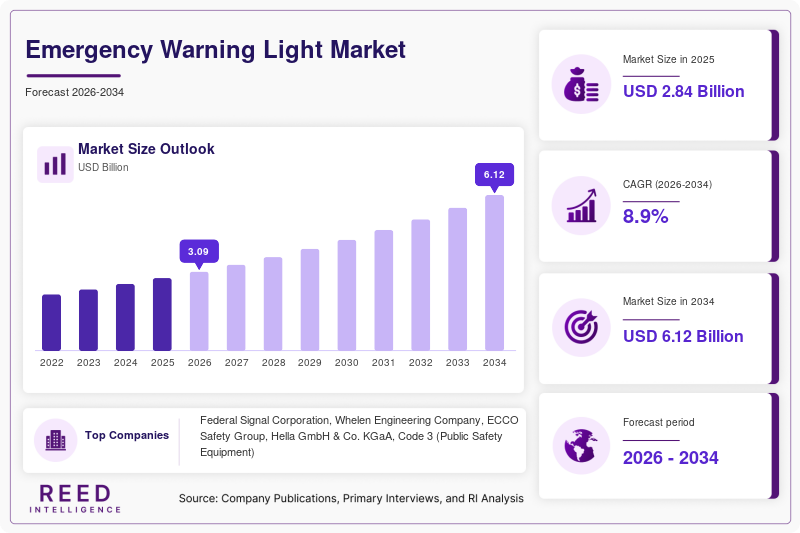
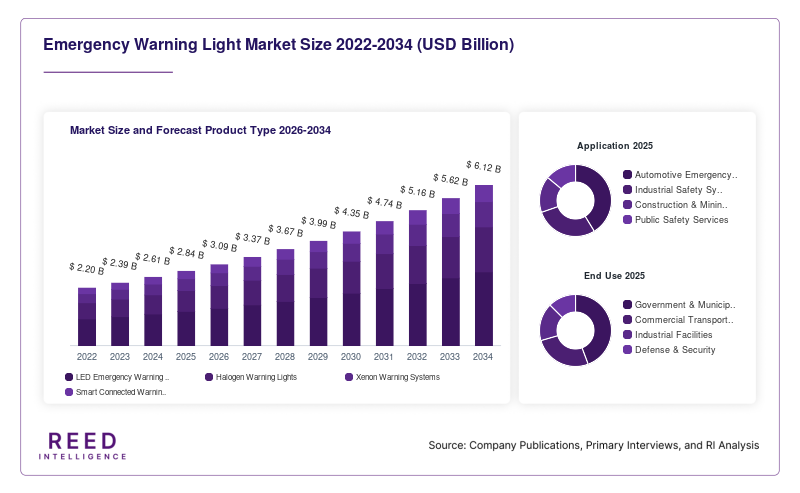
The global Emergency Warning Light Market size was valued at USD 2.84 billion in 2026 and is projected to reach USD 5.61 billion by 2034, expanding at a CAGR of 8.9% during 2026–2034. Emergency warning lights play a critical role in improving visibility, safety, and communication during emergency situations across transportation, public safety, industrial facilities, construction sites, airports, and municipal operations. These systems include light bars, beacon lights, strobe lights, directional warning lights, and LED-based signaling equipment designed to alert drivers, pedestrians, and workers to potential hazards.
One of the primary factors supporting market growth is the increasing emphasis on road safety and emergency response efficiency worldwide. Governments and public agencies continue to invest in advanced emergency vehicle fleets equipped with high-performance warning systems to reduce response times and improve operational effectiveness. The widespread transition from conventional halogen and xenon lighting technologies to energy-efficient LED warning lights has further accelerated market expansion. LED systems provide improved brightness, longer service life, lower power consumption, and enhanced durability under challenging environmental conditions.
Key Highlights
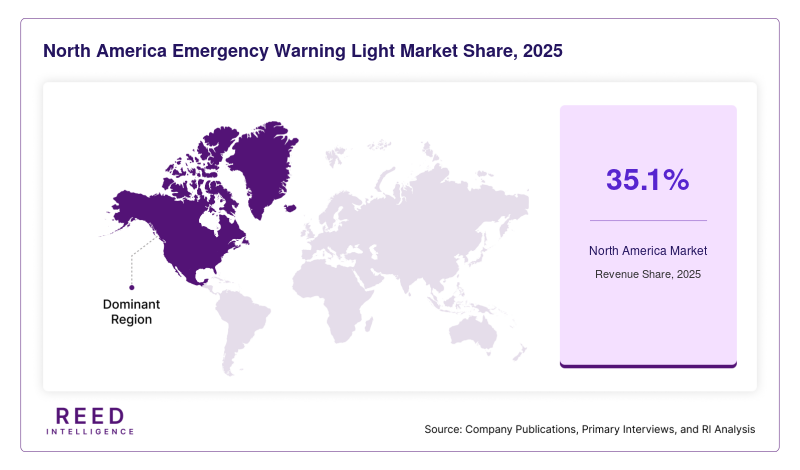
- North America dominated the market with a 35.1% share in 2025, while Asia Pacific is expected to grow at the fastest CAGR of 10.8% during 2026–2034.
- By product type, LED light bars accounted for the largest share of 39.4%, while smart connected warning lights are projected to grow at a CAGR of 12.7%.
- By application, emergency vehicles led with a 44.2% share, whereas industrial safety applications are expected to expand at a CAGR of 11.5%.
- By end-use, public safety agencies accounted for the largest share of 40.8%, while industrial facilities are projected to grow at a CAGR of 10.9%.
- The United States remained the dominant country, with market values of USD 665 million in 2024 and USD 725 million in 2025.
Market Trends
Adoption of Smart and Connected Warning Systems
The Emergency Warning Light Market is witnessing increasing adoption of smart warning systems equipped with wireless communication, GPS integration, and remote monitoring capabilities. Fleet operators and public safety agencies are seeking advanced solutions that provide centralized control and real-time operational visibility. Connected warning lights allow emergency response teams to coordinate vehicle movements more efficiently while improving situational awareness. The integration of cloud-based monitoring platforms also enables maintenance scheduling and performance diagnostics. These technologies support operational efficiency while reducing equipment downtime. As municipalities continue investing in smart city infrastructure, demand for intelligent emergency warning systems is expected to increase steadily across transportation, emergency services, and industrial environments.
Growing Shift Toward Advanced LED-Based Solutions
LED technology continues to transform the emergency warning lighting industry. Organizations are replacing traditional incandescent, halogen, and xenon-based systems with advanced LED solutions due to their superior energy efficiency and longer lifespan. Modern LED warning lights offer improved visibility, programmable flash patterns, and enhanced reliability under adverse weather conditions. Manufacturers are introducing compact and lightweight products that deliver higher illumination levels while minimizing power consumption. Furthermore, advancements in optical engineering are improving light distribution and visibility from multiple angles. The growing emphasis on sustainability and operational cost reduction is encouraging fleet operators, industrial facilities, and public safety agencies to accelerate the transition toward LED-based emergency warning equipment.
Market Drivers
Expansion of Emergency Response and Public Safety Infrastructure
The increasing investment in emergency response infrastructure is a major driver of the Emergency Warning Light Market. Governments worldwide are expanding ambulance fleets, police vehicles, firefighting units, and disaster management resources to improve public safety outcomes. Modern emergency vehicles require highly visible warning systems capable of operating effectively in congested urban environments and challenging weather conditions. As public authorities focus on reducing emergency response times, procurement of advanced warning lights continues to rise. The trend is particularly strong in developing economies where investments in healthcare infrastructure, urban transportation systems, and emergency preparedness programs are increasing. These developments are generating sustained demand for technologically advanced warning light solutions.
Rising Industrial and Construction Safety Requirements
Industrial facilities and construction sites are placing greater emphasis on worker safety and hazard prevention. Emergency warning lights are increasingly used to signal equipment movement, hazardous conditions, restricted zones, and operational emergencies. Regulatory agencies across multiple countries are enforcing stricter workplace safety standards, encouraging organizations to adopt reliable warning systems. Large-scale infrastructure projects, mining operations, logistics centers, and manufacturing facilities are contributing significantly to equipment demand. Furthermore, the growing use of automated machinery and material handling equipment has increased the need for visual warning systems that enhance awareness and reduce accident risks. These factors continue to support long-term market growth across industrial sectors.
Market Restraint
High Initial Costs Associated with Advanced Warning Systems
The relatively high cost of advanced emergency warning light systems remains a key challenge for market participants. Modern LED light bars, smart controllers, wireless synchronization technologies, and connected monitoring systems often require significant upfront investment compared to traditional lighting solutions. Budget constraints can limit procurement activities among smaller municipalities, volunteer emergency organizations, and small industrial operators. In developing regions, cost sensitivity may delay technology upgrades despite the long-term operational benefits offered by advanced products. Installation expenses, integration requirements, and maintenance considerations further increase total ownership costs. For example, fleet modernization programs involving hundreds of emergency vehicles can require substantial capital expenditure, leading some organizations to extend replacement cycles. These financial constraints may slow adoption rates in certain markets, particularly where public funding and infrastructure budgets remain limited. As a result, manufacturers must focus on cost-effective product innovation and flexible deployment models to address this restraint.
Market Opportunities
Increasing Demand from Smart City Development Projects
Smart city initiatives are creating substantial opportunities for Emergency Warning Light Market participants. Urban planners are integrating intelligent traffic management systems, connected transportation networks, and advanced public safety infrastructure into city development strategies. Emergency warning lights equipped with communication capabilities can interact with traffic signals, fleet management platforms, and municipal control centers. This integration improves emergency vehicle movement and enhances public safety outcomes. As governments continue investing in digital infrastructure, demand for connected warning systems is expected to increase significantly. Manufacturers that develop interoperable and data-enabled solutions are likely to benefit from expanding opportunities across urban transportation, emergency services, and municipal operations.
Growth Potential in Emerging Economies
Emerging economies across Asia Pacific, Latin America, the Middle East, and Africa offer substantial growth potential for market participants. Rapid urbanization, increasing vehicle ownership, expanding healthcare infrastructure, and rising public safety investments are supporting demand for emergency warning equipment. Governments are allocating resources toward fleet modernization programs and disaster preparedness initiatives, creating favorable market conditions. Industrial development is also increasing the need for workplace safety solutions in manufacturing, logistics, and construction sectors. Additionally, growing awareness regarding road safety and accident prevention is encouraging wider adoption of advanced warning technologies. Companies that establish regional distribution networks and localized manufacturing capabilities can capitalize on these expanding opportunities.
Segmental Analysis
By Product Type
LED light bars emerged as the dominant subsegment within the product type category, accounting for approximately 39.4% of market revenue in 2024. These products are widely deployed across police vehicles, ambulances, fire trucks, utility fleets, and highway maintenance vehicles due to their high visibility and operational reliability. LED light bars provide superior illumination compared to conventional warning systems while offering lower energy consumption and extended service life. Their ability to support multiple flash patterns and configurations further enhances operational flexibility. Public safety agencies continue to prioritize LED light bars because they improve visibility under various weather and lighting conditions. Continuous advancements in optical technology and housing durability have strengthened their position as the leading product category.
Smart connected warning lights represent the fastest-growing subsegment and are projected to expand at a CAGR of 12.7% through 2034. These systems integrate wireless communication, GPS connectivity, remote diagnostics, and centralized control functions. Organizations increasingly seek connected solutions that improve fleet coordination and operational awareness. Smart warning lights can interact with vehicle management platforms and municipal traffic systems, enabling enhanced emergency response performance. The growing adoption of smart city infrastructure and connected transportation networks is creating strong demand for these products. Manufacturers are investing heavily in software integration and cloud-enabled monitoring capabilities to capitalize on this rapidly expanding market opportunity.
By Application
Emergency vehicles accounted for the largest application segment, holding approximately 44.2% of market revenue in 2024. Police departments, ambulance operators, fire services, and rescue organizations rely extensively on emergency warning lights to ensure visibility and facilitate rapid response during critical incidents. The increasing modernization of emergency vehicle fleets has strengthened demand for advanced lighting technologies that improve operational effectiveness and public awareness. Governments and public agencies continue to allocate substantial budgets toward emergency preparedness and fleet upgrades. Furthermore, the growing frequency of natural disasters, traffic incidents, and healthcare emergencies has increased the importance of reliable warning systems, reinforcing the segment's leadership position within the market.
Industrial safety applications are expected to register the fastest CAGR of 11.5% during the forecast period. Manufacturing facilities, logistics centers, warehouses, mining operations, and construction sites increasingly deploy warning lights to enhance workplace safety and operational awareness. Regulatory requirements related to occupational safety are encouraging broader adoption of visual warning systems. The growing use of automation and autonomous equipment has further increased the need for effective hazard communication solutions. Companies are implementing advanced warning technologies to reduce accident risks and improve compliance with safety standards. These factors are expected to support strong growth within the industrial safety segment throughout the forecast period.
By End-Use
Public safety agencies held the largest share of the Emergency Warning Light Market in 2024, accounting for approximately 40.8% of total revenue. This segment includes law enforcement agencies, emergency medical services, firefighting departments, and disaster response organizations. These entities require highly reliable warning systems capable of operating under demanding conditions. Increasing investments in emergency preparedness, fleet modernization, and public safety infrastructure continue to support demand. Governments worldwide recognize the importance of efficient emergency response capabilities and are allocating resources toward advanced equipment procurement. The adoption of LED-based and programmable warning systems has become increasingly common among public safety organizations seeking improved operational performance and reduced maintenance requirements.
Industrial facilities are projected to emerge as the fastest-growing end-use segment, expanding at a CAGR of 10.9% through 2034. Manufacturing plants, energy facilities, logistics hubs, and construction operations are increasingly incorporating emergency warning lights into safety management programs. The rising emphasis on accident prevention and regulatory compliance is encouraging organizations to invest in advanced warning technologies. Industrial operators are also adopting smart safety systems that integrate visual alerts with automated monitoring platforms. Growing investments in industrial automation and workplace safety modernization are expected to create sustained demand. As operational environments become more complex, the need for effective visual warning solutions will continue to strengthen growth within this segment.
Regional Analysis
North America
North America accounted for approximately 35.1% of the global Emergency Warning Light Market in 2025 and maintained its position as the leading regional market. The region benefits from well-established emergency response infrastructure, extensive deployment of advanced vehicle fleets, and strong adoption of LED-based warning technologies. Market growth is projected at a CAGR of 7.9% through 2034, supported by ongoing investments in public safety modernization and transportation infrastructure development. Demand remains particularly strong among law enforcement agencies, ambulance services, and fire departments.
The United States represents the dominant country within the region. Continuous fleet replacement programs and increasing investments in emergency preparedness support market expansion. The country also benefits from a strong presence of warning light manufacturers and technology developers. A unique growth factor is the widespread implementation of integrated fleet management systems that increasingly incorporate connected warning equipment to improve emergency response coordination and operational efficiency.
Europe
Europe captured approximately 27.4% of the global market in 2025 and continues to demonstrate stable growth prospects. The region is expected to register a CAGR of 8.1% during the forecast period. Demand is supported by strict road safety regulations, modernization of emergency service fleets, and increasing adoption of energy-efficient lighting technologies. Public agencies across several countries are replacing legacy warning systems with advanced LED solutions that offer improved visibility and lower maintenance requirements.
Germany remains the leading country in the European market due to its strong automotive sector and advanced emergency response infrastructure. Investments in intelligent transportation systems and connected vehicle technologies further support market growth. A unique factor driving regional expansion is the integration of emergency warning systems with smart mobility initiatives designed to improve traffic flow and emergency vehicle accessibility in densely populated urban areas.
Asia Pacific
Asia Pacific held approximately 22.8% of the Emergency Warning Light Market in 2025 and is expected to register the fastest CAGR of 10.8% through 2034. Rapid urbanization, infrastructure development, and increasing public safety investments are supporting market growth. Expanding transportation networks and rising industrial activities are generating significant demand for warning and signaling equipment. Governments throughout the region are strengthening emergency response capabilities while upgrading municipal and healthcare infrastructure.
China represents the dominant country in the region due to large-scale investments in transportation, manufacturing, and public safety systems. The country's expanding industrial base also contributes significantly to warning light demand. A unique growth factor is the rapid deployment of smart city projects that incorporate intelligent traffic management and connected public safety technologies, creating opportunities for advanced warning system manufacturers.
Middle East & Africa
The Middle East & Africa accounted for approximately 7.3% of the global market in 2025. Although relatively smaller in size, the region is expected to achieve a CAGR of 8.7% during the forecast period. Infrastructure expansion, industrial diversification, and growing investments in emergency response capabilities are supporting market demand. Governments are increasingly focused on enhancing public safety systems and disaster preparedness programs, creating favorable conditions for warning light adoption.
Saudi Arabia remains the dominant market within the region due to large-scale infrastructure projects and ongoing investments in transportation modernization. Emergency services and industrial facilities continue to expand their adoption of advanced safety equipment. A unique growth factor is the implementation of major development initiatives that require enhanced safety standards across construction, logistics, and public infrastructure sectors.
Latin America
Latin America represented approximately 7.4% of the global Emergency Warning Light Market in 2025 and is forecast to grow at a CAGR of 8.5% through 2034. Market expansion is supported by improving public safety investments, transportation modernization projects, and increasing awareness regarding workplace safety. Several countries are strengthening emergency response infrastructure while upgrading law enforcement and healthcare vehicle fleets.
Brazil is the leading country in the regional market due to its large population, extensive transportation network, and expanding industrial activities. Government initiatives focused on road safety and emergency preparedness are contributing to product demand. A unique growth factor is the increasing modernization of municipal emergency fleets, which is encouraging broader adoption of high-performance LED warning systems across public service operations.
Competitive Landscape
The Emergency Warning Light Market is moderately competitive, with manufacturers focusing on technological innovation, product reliability, and geographic expansion strategies. Companies are increasingly investing in LED technology, wireless connectivity, intelligent control systems, and ruggedized product designs to strengthen their market positions. Strategic partnerships with vehicle manufacturers, public safety agencies, and industrial equipment providers remain common growth approaches.
Whelen Engineering Company continues to be a leading participant due to its extensive product portfolio, strong distribution network, and ongoing investments in advanced warning technologies. A recent development involved the introduction of an integrated smart warning platform designed to enhance fleet connectivity and remote diagnostics capabilities.
Other major participants, including Federal Signal Corporation, ECCO Safety Group, SoundOff Signal, and Code 3, are focusing on expanding product functionality and improving visibility performance. Market competition is also increasing as regional manufacturers introduce cost-effective LED solutions targeting emerging economies. Product customization, regulatory compliance, and technological differentiation remain critical factors influencing competitive success across global markets.
Key Players
- Whelen Engineering Company
- Federal Signal Corporation
- ECCO Safety Group
- SoundOff Signal
- Code 3
- Standby Group
- Tomar Electronics
- Feniex Industries
- Hella GmbH & Co. KGaA
- Hänsch GmbH
- Britax PMG
- PatrolEyes
- Sinowatcher Technology
- Juluen Enterprise Co., Ltd.
- Vision Alert
Recent Developments
- In 2025, key manufacturers in the Emergency Warning Light Market expanded production capacity for advanced LED-based warning systems to meet rising demand from automotive and public safety fleets.
- In 2025, several companies launched next-generation smart emergency warning lights integrated with IoT connectivity, enabling real-time fleet monitoring and adaptive signaling for emergency response vehicles.
- In 2024, a leading safety lighting manufacturer introduced ultra-high-intensity LED emergency beacons designed for improved visibility in extreme weather and low-light conditions, targeting highway and industrial applications.
- In 2024, industry players increased investment in R&D programs focused on enhancing energy efficiency, thermal stability, and durability of emergency warning lighting systems for heavy-duty and off-road environments.
- In 2025, strategic partnerships between automotive OEMs and lighting solution providers accelerated the integration of intelligent emergency signaling systems into modern connected vehicle platforms and smart city infrastructure projects.
Emergency Warning Light Market Segments
Product Type
- LED Emergency Warning Lights
- Halogen Warning Lights
- Xenon Warning Systems
- Smart Connected Warning Systems
Application
- Automotive Emergency Signaling
- Industrial Safety Systems
- Construction & Mining Safety
- Public Safety Services
End Use
- Government & Municipal Fleets
- Commercial Transportation
- Industrial Facilities
- Defense & Security
By Region
- North America
- Europe
- APAC
- Middle East and Africa
- LATAM