Emulsifying Waxes Market Size, Share & Demand Report By Type (Non-Ionic Emulsifying Waxes, Anionic Emulsifying Waxes, Cationic Emulsifying Waxes), By Application (Cosmetics & Personal Care, Pharmaceuticals, Industrial Applications), By End-Use (Personal Care Industry, Pharmaceutical Industry, Industrial Sector) & Segment Forecasts, 2025–2034
USD 3950
Market Overview
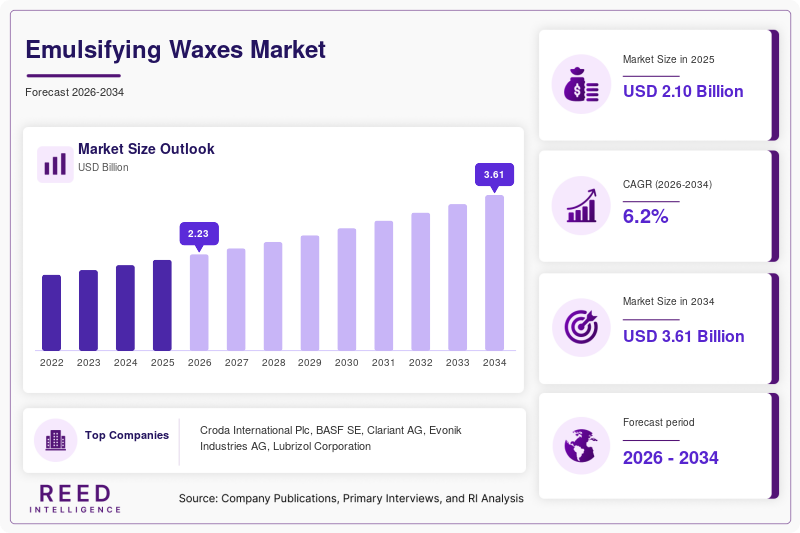
The global Emulsifying Waxes Market size is estimated at USD 2.1 billion, and it is projected to reach approximately USD 2.25 billion in 2026. Over the forecast period from 2025 to 2034, the market is expected to grow at a compound annual growth rate (CAGR) of 6.2%, reaching nearly USD 3.6 billion by 2034. This growth reflects rising product innovation, expanding personal care industries, and increased demand for stable emulsions in multiple sectors.
Emulsifying waxes are widely used as stabilizing agents that help blend oil and water-based ingredients, making them essential in creams, lotions, ointments, and industrial formulations. Their functionality, ease of formulation, and cost-effectiveness make them indispensable in both consumer and industrial markets. The growing inclination toward skincare products, especially in emerging economies, has significantly boosted product consumption.
Key Highlights
- Market size valued at USD 2.1 billion in 2025, reflecting steady demand across cosmetics, pharmaceuticals, and industrial applications. Growth at this stage is supported by increasing product usage in personal care formulations and expanding global consumption patterns.
- Expected to reach USD 3.6 billion by 2034, driven by rising adoption across emerging markets and continuous innovation in product formulations. The long-term outlook indicates stable expansion backed by diversified end-use industries.
- CAGR of 6.2% from 2025 to 2034, indicating consistent and moderate growth over the forecast period. This growth trajectory reflects increasing demand, technological advancements, and broader application scope.
- Strong demand from cosmetics and pharmaceutical industries continues to be a primary growth contributor. Emulsifying waxes are essential for formulation stability, texture enhancement, and improved product performance in these sectors.
Market Trends
Rising Demand for Natural and Organic Emulsifying Waxes
The shift toward natural and organic ingredients is significantly influencing the emulsifying waxes market. Consumers are increasingly concerned about synthetic chemicals in personal care products, leading to a preference for plant-based and biodegradable alternatives. This trend is especially strong in premium skincare segments, where brands are emphasizing clean-label formulations. Manufacturers are responding by developing emulsifying waxes derived from natural sources such as vegetable oils and beeswax. These products not only meet consumer expectations but also comply with stringent environmental regulations. As a result, the adoption of natural emulsifying waxes is expected to grow steadily across global markets.
Expansion of Multifunctional Ingredient Formulations
Another important trend is the growing demand for multifunctional ingredients that reduce formulation complexity. Emulsifying waxes are increasingly being designed to provide additional benefits such as thickening, moisturizing, and stabilizing properties. This trend is particularly relevant in the cosmetics and personal care sector, where manufacturers aim to simplify formulations while maintaining high performance. Multifunctional emulsifying waxes help reduce production costs and improve product efficiency. As a result, companies are investing in research and development to create innovative blends that cater to evolving consumer preferences and industry requirements.
Market Drivers
Growth of the Global Cosmetics and Personal Care Industry
The expanding cosmetics and personal care industry is a major driver for the emulsifying waxes market. Increasing consumer spending on skincare, haircare, and beauty products is fueling demand for stable and effective formulations. Emulsifying waxes play a critical role in ensuring product consistency and performance. The rise of e-commerce and social media marketing has also contributed to higher product visibility and consumption. Emerging markets, in particular, are experiencing strong growth due to urbanization and changing lifestyles. This increasing demand for high-quality personal care products is directly boosting the consumption of emulsifying waxes worldwide.
Increasing Use in Pharmaceutical Applications
The pharmaceutical industry is another key driver of market growth. Emulsifying waxes are widely used in ointments, creams, and topical drug formulations due to their ability to stabilize mixtures and enhance product efficacy. The growing prevalence of skin-related conditions and the increasing demand for topical treatments are driving the use of emulsifying waxes in pharmaceutical applications. Additionally, advancements in drug delivery systems are encouraging the development of specialized emulsifying waxes that improve the absorption and effectiveness of active ingredients. This expanding application scope is supporting sustained market growth.
Market Restraint
Volatility in Raw Material Prices
One of the primary challenges facing the emulsifying waxes market is the volatility in raw material prices. Emulsifying waxes are often derived from petroleum-based or natural sources such as vegetable oils, both of which are subject to price fluctuations due to supply chain disruptions, geopolitical factors, and environmental conditions. These fluctuations can increase production costs and impact profit margins for manufacturers.
For example, variations in crude oil prices can directly affect the cost of synthetic emulsifying waxes, while changes in agricultural output can influence the availability and pricing of natural waxes. This uncertainty makes it difficult for manufacturers to maintain consistent pricing strategies. Additionally, small and medium-sized enterprises may face challenges in absorbing these cost increases, potentially limiting market growth. As a result, companies are exploring alternative raw materials and supply chain strategies to mitigate this risk.
Market Opportunities
Development of Sustainable and Biodegradable Products
The increasing focus on sustainability presents a significant opportunity for the emulsifying waxes market. Consumers and regulatory bodies are encouraging the use of environmentally friendly ingredients, prompting manufacturers to invest in biodegradable and renewable emulsifying waxes. This shift is creating new avenues for innovation and product differentiation. Companies that develop sustainable solutions are likely to gain a competitive advantage and expand their market presence. The demand for green products is expected to grow across both developed and emerging markets, providing long-term growth opportunities.
Expansion in Emerging Markets
Emerging economies offer substantial growth potential for the emulsifying waxes market. Rapid urbanization, rising disposable incomes, and increasing awareness of personal care products are driving demand in regions such as Asia Pacific and Latin America. Local manufacturers are expanding their production capacities to cater to growing domestic demand. Additionally, international companies are entering these markets through partnerships and acquisitions. This expansion is expected to enhance market penetration and create new revenue streams for industry participants.
Segmental Analysis
By Type
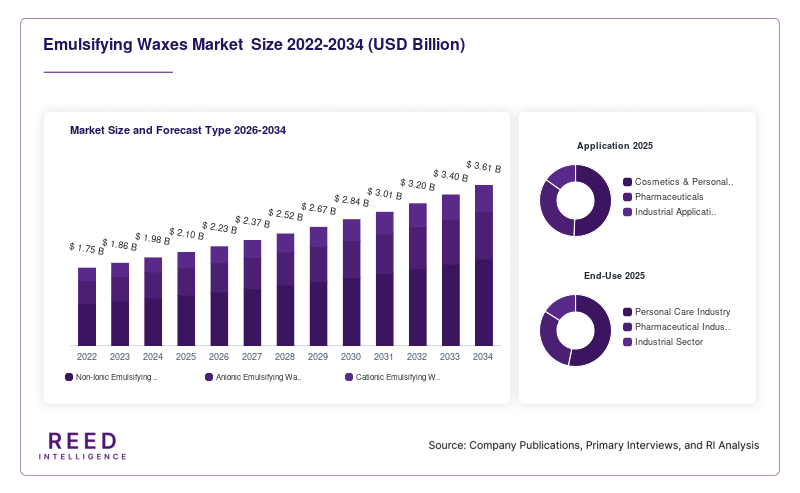
The non-ionic emulsifying wax segment dominated the market in 2024, accounting for approximately 45% of the total share. These waxes are widely used due to their stability, compatibility with various ingredients, and ease of formulation. They are particularly popular in cosmetics and personal care products, where consistency and texture are critical. Non-ionic emulsifying waxes are also less likely to cause skin irritation, making them suitable for sensitive skin formulations.
The anionic emulsifying wax segment is expected to be the fastest-growing, with a CAGR of 6.8% during the forecast period. This growth is driven by increasing demand in industrial applications and specialized formulations. Anionic waxes offer strong emulsification properties and are commonly used in products requiring high stability. The growing demand for advanced formulations in pharmaceuticals and industrial applications is supporting this segment’s expansion.
By Application
The cosmetics and personal care segment held the largest market share in 2024, accounting for over 50% of total revenue. Emulsifying waxes are essential in the production of creams, lotions, and conditioners. The increasing demand for skincare and beauty products is driving this segment’s growth. Manufacturers are focusing on developing innovative formulations to meet consumer preferences for high-quality products.
The pharmaceutical application segment is expected to grow at the fastest rate, with a CAGR of 6.9%. The increasing use of emulsifying waxes in topical formulations and drug delivery systems is driving this growth. Advances in pharmaceutical research are also contributing to the development of new applications for emulsifying waxes.
By End-Use
The personal care industry dominated the market in 2024, accounting for around 48% of total demand. Emulsifying waxes are widely used in skincare, haircare, and cosmetic products. The growing focus on personal grooming and hygiene is driving demand in this segment. Manufacturers are also investing in product innovation to cater to diverse consumer needs.
The industrial end-use segment is expected to be the fastest-growing, with a CAGR of 6.5%. This growth is driven by increasing demand for emulsifying waxes in applications such as coatings, lubricants, and textiles. The expansion of industrial activities and the need for efficient formulations are supporting this segment’s growth.
Regional Analysis
North America
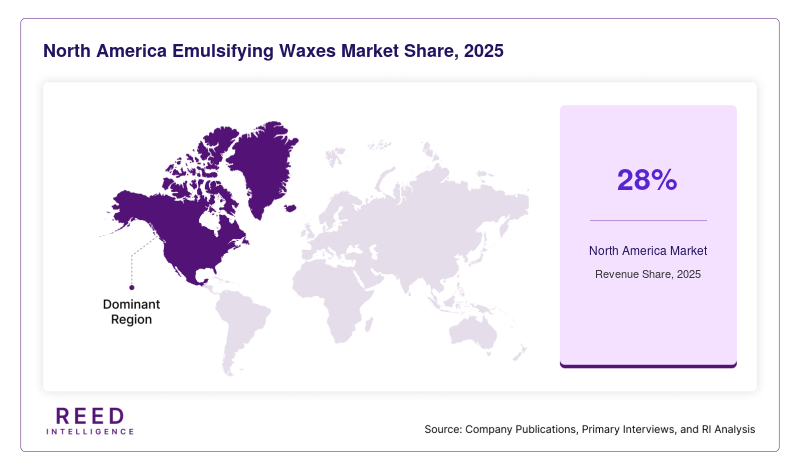
North America held a significant share of the emulsifying waxes market in 2025, accounting for approximately 28% of global revenue. The region is expected to grow at a CAGR of 5.5% during the forecast period. The presence of well-established cosmetics and pharmaceutical industries is driving demand for emulsifying waxes. Increasing consumer preference for premium skincare products is also contributing to market growth.
The United States dominates the regional market due to its strong manufacturing base and high consumer spending on personal care products. A key growth factor is the increasing demand for clean-label and organic products, which is encouraging manufacturers to develop natural emulsifying waxes.
Europe
Europe accounted for around 25% of the global market share in 2025 and is projected to grow at a CAGR of 5.8%. The region is characterized by strict regulatory standards and a strong focus on sustainability. These factors are driving the adoption of eco-friendly emulsifying waxes.
Germany is a leading market within Europe, supported by its advanced chemical industry and strong emphasis on research and development. A unique growth factor is the region’s regulatory push for sustainable ingredients, which is accelerating innovation in biodegradable emulsifying waxes.
Asia Pacific
Asia Pacific is the fastest-growing region, holding a 30% market share in 2025 and expected to grow at a CAGR of 7.2%. Rapid urbanization and increasing consumer awareness are driving demand for personal care products.
China leads the regional market due to its large population and expanding cosmetics industry. A key growth factor is the rising middle-class population, which is increasing demand for affordable and high-quality personal care products.
Middle East & Africa
The Middle East & Africa region accounted for approximately 9% of the global market share in 2025 and is expected to grow at a CAGR of 5.9%. The market is driven by increasing demand for personal care and pharmaceutical products.
The United Arab Emirates is a major contributor to regional growth. A unique factor is the growing tourism and hospitality sector, which is boosting demand for premium personal care products in hotels and spas.
Latin America
Latin America held around 8% of the market share in 2025 and is projected to grow at a CAGR of 6.1%. The region is experiencing steady growth due to rising consumer awareness and increasing disposable incomes.
Brazil dominates the regional market due to its large population and strong cosmetics industry. A key growth factor is the increasing demand for natural and organic products, which is driving the adoption of plant-based emulsifying waxes.
Competitive Landscape
The emulsifying waxes market is moderately fragmented, with several global and regional players competing on product quality, innovation, and pricing. Leading companies are focusing on research and development to introduce advanced and sustainable products. Strategic partnerships, mergers, and acquisitions are common strategies used to strengthen market presence.
Croda International Plc is recognized as a market leader due to its extensive product portfolio and strong focus on innovation. The company recently introduced a new range of bio-based emulsifying waxes to meet growing demand for sustainable solutions. Other major players are also investing in eco-friendly products and expanding their global distribution networks to enhance market reach.
Key Players
- Croda International Plc
- BASF SE
- Clariant AG
- Evonik Industries AG
- Lubrizol Corporation
- Stepan Company
- Lonza Group AG
- Koster Keunen Inc.
- Innospec Inc.
- Vantage Specialty Chemicals
- AAK AB
- Sasol Limited
- Colonial Chemical Inc.
- Nikko Chemicals Co., Ltd.
- Galaxy Surfactants Ltd.
Recent Developments
- In 2024, Croda International Plc launched a new line of plant-based emulsifying waxes targeting sustainable skincare formulations.
- In 2025, BASF SE expanded its production capacity for specialty waxes to meet rising global demand.
- In 2025, Clariant AG introduced innovative multifunctional emulsifiers designed to improve formulation efficiency in personal care products.
Emulsifying Waxes Market Segments
Type
- Non-Ionic Emulsifying Waxes
- Anionic Emulsifying Waxes
- Cationic Emulsifying Waxes
Application
- Cosmetics & Personal Care
- Pharmaceuticals
- Industrial Applications
End-Use
- Personal Care Industry
- Pharmaceutical Industry
- Industrial Sector
By Region
- North America
- Europe
- APAC
- Middle East and Africa
- LATAM