Enclosed Belt Conveyor Market Size, Share & Trends Analysis Report By Conveyor Type (Pipe & Tubular Belt Conveyors, Covered Troughed Belt Conveyors), By Application (Mining & Minerals, Cement & Construction Materials, Power Generation, Ports & Bulk Terminals), By End Use (Mining, Cement & Aggregates, Power & Utilities), By Distribution Channel (Direct Sales, EPC & System Integrators) Forecasts, 2026–2034
USD 3950
Enclosed Belt Conveyor Market Size
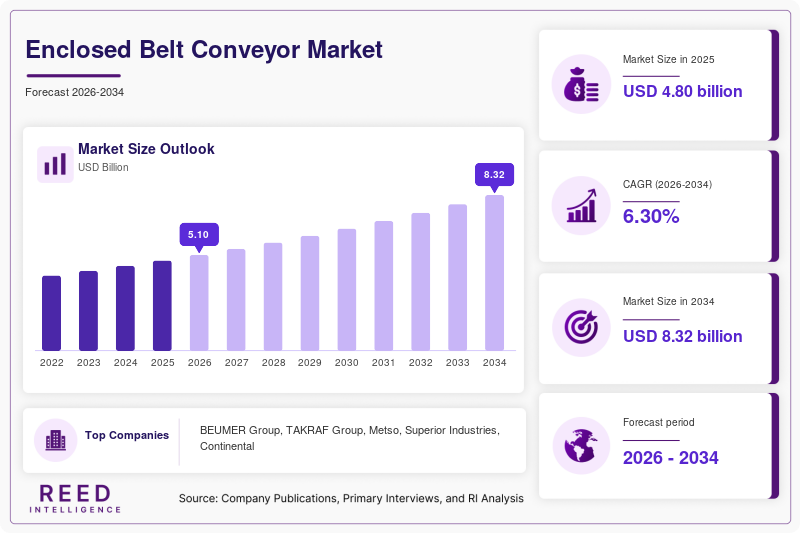
The global Enclosed Belt Conveyor Market size was valued at USD 4.80 billion in 2025 and is projected to grow from USD 5.10 billion in 2026 to USD 8.32 billion by 2034, registering a CAGR of 6.30% during the forecast period from 2026 to 2034.
Enclosed belt conveyors are bulk-material transportation systems designed to keep conveyed material substantially contained during movement. The category includes pipe or tubular conveyors, covered troughed conveyors, U-shape systems and other enclosed belt configurations. Their commercial value comes from solving problems that conventional open conveyors can leave unresolved: dust emissions, material spillage, weather exposure, contamination, product loss and restrictions on conveyor routing.
BEUMER Group states that pipe conveyors can transport bulk materials over distances of up to 10 km and capacities of up to 6,000 tonnes per hour, while their closed structure reduces spillage and protects material from rain, wind and surrounding contamination. TAKRAF similarly describes tube conveyors as systems that completely enclose material for most of the conveying route, reducing dust and spillage while allowing horizontal and vertical curves.
Demand is increasingly connected to environmental and operational requirements. In February 2026, Superior Industries highlighted conveyor containment solutions in response to tighter respirable-silica and dust-control requirements in mining and aggregates. Rio Tinto also commissioned a sealed 1.1-km alumina conveyor at its Kitimat smelter in April 2026, transporting approximately 800,000 tonnes annually while reducing particulate emissions by 40%.
The market therefore extends beyond conveyor equipment itself into engineered systems, dust control, digital monitoring, lifecycle maintenance and automated material-flow management.
Enclosed Belt Conveyor Market Drivers
Dust and Spillage Control Is Increasing the Value of Enclosed Conveying
Dust containment is becoming a direct purchasing criterion for bulk-material handling systems. Open conveyors can release fine material at transfer points, along the conveying route and during loading or unloading. Enclosed systems reduce the exposure pathway by physically containing the material.
Superior Industries reported in February 2026 that mining and aggregate operators were increasing investment in containment systems as they prepared for stricter MSHA requirements concerning respirable crystalline silica. The company specifically links enclosed or sealed conveyor zones with lower fugitive dust, reduced spillage, lower cleanup requirements and improved worker safety.
The same mechanism is visible in industrial projects. Rio Tinto's new alumina conveyor at Kitimat uses a sealed pipe design and achieved a reported 40% reduction in particulate emissions.
For mines, cement plants, grain terminals and ports, the commercial benefit extends beyond compliance. Less spilled material means less cleanup labor, lower product loss and fewer interruptions. Superior notes that fugitive material can damage conveyor components and create slip and trip hazards.
Long-Distance and Complex Routing Favor Enclosed Belt Systems
Enclosed belt conveyors can reduce the need for multiple transfer points when a material stream must travel through difficult terrain. BEUMER's pipe conveyors can accommodate horizontal curves, inclines and long center distances, with individual systems extending up to 10 km.
TAKRAF identifies similar advantages for tube conveyors, including horizontal and vertical curves that can reduce the number of conventional conveyor sections, transfer stations and associated drives.
The commercial mechanism is important for greenfield and brownfield projects. Fewer transfer points can reduce civil construction requirements, equipment interfaces and locations where material is exposed to the environment. This becomes particularly valuable where a conveyor must cross roads, sensitive environmental areas or developed industrial sites.
Metso's current Foresight overland conveyor platform illustrates the broader movement toward pre-engineered, configurable conveying systems. The company states that its system can be configured for capacities up to 15,000 tonnes per hour and uses modular components to simplify feasibility, transportation and installation.
Mining and Bulk-Material Automation Is Increasing Conveyor Investment
Mining companies increasingly treat conveyor systems as strategic production infrastructure rather than passive transport equipment. BHP's June 2026 agreement with China's BOTON expands collaboration on intelligent conveyor systems, including AI-based belt alignment, X-ray digital scanning, robotic inspection and longitudinal rip detection.
The commercial mechanism is higher availability. A failure on a high-capacity conveyor can interrupt an entire production chain, making predictive monitoring valuable even when the conveyor itself is mechanically robust. Continental's monitoring portfolio can detect belt damage, splice deterioration, belt tracking problems and other conditions while the conveyor remains in operation.
This creates an opportunity for enclosed-conveyor manufacturers to sell complete systems that combine belts, drives, covers, sensors, monitoring software and maintenance services. Customers increasingly evaluate equipment based on lifecycle cost and uptime rather than purchase price alone.
Enclosed Belt Conveyor Market Restraints
Higher Initial Engineering and Capital Costs
Enclosed belt systems generally require more specialized engineering than conventional open troughed conveyors. Pipe conveyors need transition sections, specially configured idlers, enclosed loading and discharge arrangements, belt-training systems and access provisions for inspection.
TAKRAF notes that tube conveyors can face belt rotation and overlap-management challenges, which require specialized belt-training technology.
The additional engineering can increase upfront capital requirements, especially for short, simple conveying routes where a conventional conveyor with localized covers may satisfy the application. Customers therefore tend to select full enclosure when environmental protection, material containment, routing flexibility or product protection provides sufficient operational value.
Maintenance Access and Belt Alignment Can Be More Complex
Enclosure protects material and equipment but can make visual inspection and access more demanding. Pipe conveyors operate with the belt formed into a closed tube, meaning belt rotation, overlap and alignment must be managed carefully.
TAKRAF's Automatic Belt Training System specifically addresses belt rotation and overlap in tube conveyors, showing that enclosed configurations can require additional control and maintenance technologies.
The industry is addressing this through modular access, digital inspection and condition monitoring. Continental's SurfaceProtect uses laser scanning to identify belt cuts, gouges, edge damage and abnormal wear, while its TotalProtect system uses X-ray technology to identify belt and splice problems.
Enclosed Belt Conveyor Market Opportunities
Sealed Conveying for Mining and Mineral Processing
Mining remains a major opportunity because ore, concentrates and fine mineral products can create dust, contamination and material-loss problems. BEUMER identifies pipe conveyors for long-distance transport of ores, limestone, gravel and other bulk materials, with enclosed systems reducing environmental exposure.
The opportunity is particularly strong for copper, iron ore, alumina, lithium, nickel and other minerals where new processing and transportation infrastructure is being developed. Rio Tinto's Kitimat project demonstrates how an enclosed conveyor can simultaneously address throughput, emissions and long-term infrastructure reliability.
Ports and Bulk-Terminal Modernization
Ports handling coal, iron ore, fertilizer, cement, grain and other bulk materials need high-throughput transport while controlling dust and material loss. BEUMER notes that powdered bulk materials at ports can require completely enclosed conveying systems with filtration to prevent interaction between the cargo and surrounding environment.
Current infrastructure investment provides a direct pipeline for conveyor demand. JSW Infrastructure reported in May 2026 that civil work for the conveyor at its 7-million-tonne-per-year V.O. Chidambaranar Port dry-bulk project was 90% complete, with the project expected to be completed in the second half of 2026.
Digital Monitoring and Predictive Maintenance
Digital monitoring creates a higher-value aftermarket around enclosed conveyor systems. Continental's LoadSense uses radar and ultrasonic technologies to monitor material flow, belt position, load distribution and spillage, while its belt-monitoring portfolio identifies damage and deterioration before failures cause extended downtime.
For enclosed systems, this is especially relevant because portions of the belt are physically hidden during operation. Remote condition monitoring can reduce the need for manual inspection and allow maintenance teams to plan interventions around production schedules.
Segmental Analysis
By Conveyor Type
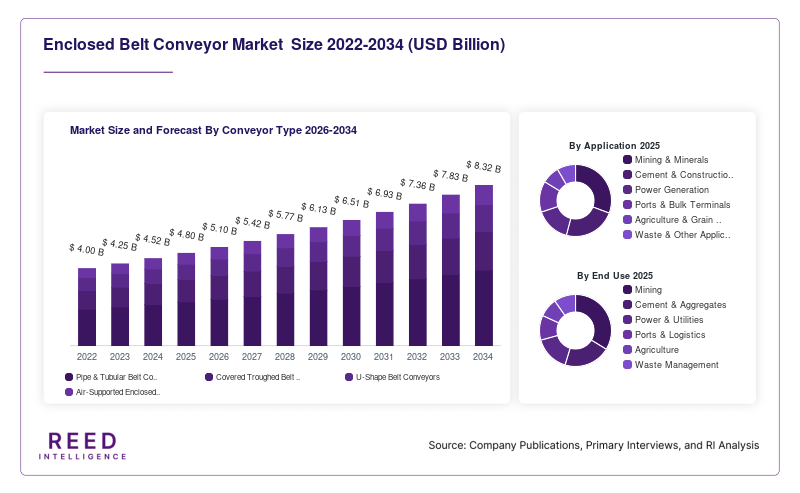
Pipe & Tubular Belt Conveyors represent approximately 43% of the global market in 2025. Their principal advantage is full material containment over long distances. BEUMER states that pipe conveyors can reach 10 km center distances and capacities up to 6,000 tonnes per hour, while TAKRAF lists tube conveyors with capacities up to 2,200 tonnes per hour and single-flight lengths up to 4.4 km.
Covered Troughed Belt Conveyors account for approximately 32%, offering a simpler enclosure approach where complete tubular formation is unnecessary. Superior's conveyor covers are designed to protect materials from rain, wind and sunlight while also reducing dust and spillage.
U-Shape Belt Conveyors represent approximately 14%, while Air-Supported Enclosed Belt Conveyors account for approximately 11%.
Air-Supported Enclosed Belt Conveyors are the fastest-growing conveyor-type segment, with approximately 7.4% CAGR, supported by lower friction, fewer rotating parts, reduced maintenance and enclosed low-dust operation. BEUMER reports that its air-supported systems can reduce power and maintenance requirements compared with conventional configurations.
By Application
Mining & Minerals represents approximately 35% of the market in 2025. Mines require continuous high-capacity movement of ore, concentrates and waste, making belt conveying central to many material-flow systems. Superior describes its mine-duty conveyor systems as being designed for heavy loads and reduced maintenance, while Metso offers high-capacity overland systems for in-pit and ex-pit applications.
Cement & Construction Materials accounts for approximately 21%, followed by Ports & Bulk Terminals at 16%, Power Generation at 11%, Agriculture & Grain Handling at 10%, and waste and other applications at 7%.
Ports & Bulk Terminals are the fastest-growing application, with approximately 7.2% CAGR, supported by investments in dry-bulk terminals and requirements to control dust during storage, conveying and ship loading. BEUMER's port systems specifically use enclosed conveying for powdery bulk materials.
By End Use
Mining accounts for approximately 34% of the market in 2025. High throughput, long conveying distances and environmental-control requirements make enclosed systems valuable in mine-to-plant and stockyard applications.
Cement & Aggregates represents approximately 22%, Ports & Logistics 17%, Power & Utilities 11%, Agriculture 9%, and Waste Management 7%.
Ports & Logistics is the fastest-growing end-use segment, with approximately 7.3% CAGR. Expansion of bulk terminals creates demand for enclosed conveying between unloading, storage and ship-loading systems. Current port projects in India and Morocco demonstrate ongoing investment in conveyor galleries and bulk-material infrastructure.
By Distribution Channel
Direct Sales represents approximately 49% of the market in 2025. Large conveyor installations are typically engineered around customer-specific material characteristics, route geometry, throughput and site constraints, favoring direct engagement between manufacturers and industrial customers.
EPC & System Integrators account for approximately 39% and are particularly important for greenfield mining, cement, port and power projects.
Distributors & Dealers represent approximately 12%.
EPC & System Integrators are the fastest-growing channel, with approximately 7.1% CAGR, as customers increasingly procure complete material-handling systems rather than individual conveyor components. BEUMER and Metso both emphasize integrated engineering, planning and complete bulk-material handling solutions.
Regional Analysis
North America Enclosed Belt Conveyor Market
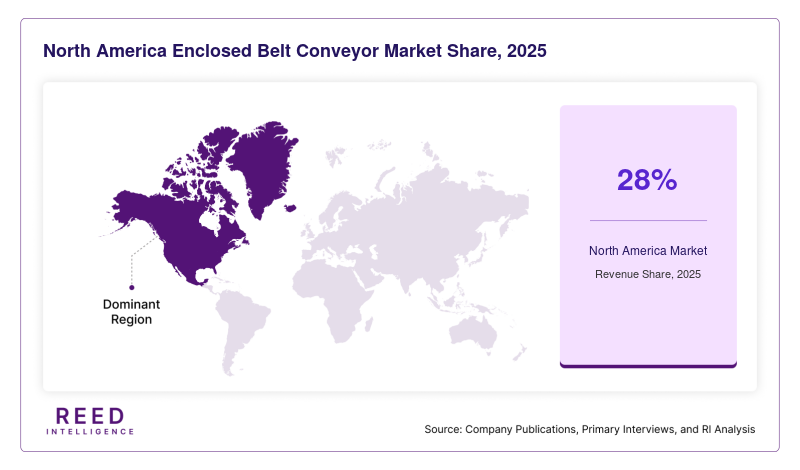
North America represents approximately 28% of the global Enclosed Belt Conveyor Market in 2025. The region has a mature mining, aggregates, grain and industrial-material handling base, with demand increasingly linked to dust containment, worker safety and modernization of existing conveyor infrastructure.
The regulatory mechanism is particularly visible in mining and aggregates. Superior Industries reported in February 2026 that operators were investing in conveyor containment as they prepared for tighter MSHA requirements relating to respirable crystalline silica.
The region also has a substantial replacement and retrofit market. Conveyor covers, skirtboards, belt cleaners and monitoring systems can be installed on existing infrastructure, allowing operators to improve containment without completely replacing the conveyor.
North America is projected to grow at approximately 5.8% CAGR through 2034. Mining, aggregates and grain handling remain important customer groups, while digital monitoring adds an aftermarket opportunity. Continental's belt-health systems provide examples of how condition monitoring is being integrated into industrial conveyor operations.
Europe Enclosed Belt Conveyor Market
Europe accounts for approximately 24% of the global market in 2025. The region has strong demand for enclosed conveying where environmental regulations, urban proximity and stringent workplace standards make dust and material containment important.
BEUMER, headquartered in Germany, maintains a broad bulk-material handling portfolio covering pipe conveyors, overland conveyors, air-supported systems and complete material-handling solutions.
European cement, waste-to-energy, ports and mineral-processing facilities also provide demand for systems capable of transporting dusty or sensitive materials while limiting environmental exposure. BEUMER identifies alternative fuels, cement, clinker, ores and waste among applications for enclosed conveying technologies.
Europe is projected to grow at approximately 5.5% CAGR. The market is comparatively mature, so replacement, modernization, energy efficiency and environmental upgrades will be more important than first-time installation alone.
APAC Enclosed Belt Conveyor Market
APAC represents approximately 31% of the global market in 2025 and is the fastest-growing region, with approximately 8.0% CAGR.
The region combines large mining operations, expanding cement production, bulk ports, grain infrastructure and industrial development. China, India, Australia, Indonesia and Southeast Asia are particularly important markets for bulk conveying.
India provides visible project activity. Coal India issued a March 2026 tender for installation and commissioning of multiple conveyor systems, while NMDC issued a 2026 tender covering the revamping and addition of conveyors at its Bailadila iron-ore mine in Chhattisgarh.
Australia also has a strong mining conveyor base. BHP's June 2026 agreement with BOTON focuses on intelligent and lower-carbon conveyor systems, including automated inspection and belt-alignment technologies.
APAC's growth is therefore supported by both new conveyor installations and technology upgrades to existing systems. The main constraints are differences in engineering standards, local procurement requirements and the capital intensity of large mining and port projects.
Middle East and Africa Enclosed Belt Conveyor Market
Middle East and Africa represents approximately 9% of the market in 2025 and is projected to grow at approximately 6.9% CAGR.
The region has significant requirements for cement, minerals, fertilizer, ports and other dry-bulk commodities. Dust containment is particularly important in arid environments because wind can distribute fine materials over surrounding areas and increase cleanup requirements.
Port development is another demand mechanism. Bulk-material terminals in North Africa and the Gulf require conveyors connecting unloading, stockpiling and loading systems. A 2026 bulk-cargo conveyor project at Morocco's Port of Safi reached modular steel-gallery pre-assembly, illustrating ongoing investment in enclosed or structurally protected conveying infrastructure.
The region's commercial opportunity favors suppliers capable of delivering high-temperature, high-dust and high-capacity systems together with lifecycle service. The principal constraints are project financing, long logistics chains and exposure to commodity-cycle investment.
LATAM Enclosed Belt Conveyor Market
LATAM accounts for approximately 8% of the global market in 2025 and is expected to expand at approximately 6.6% CAGR.
Mining remains the central demand base, particularly copper, iron ore, gold and other minerals. Brazil, Chile, Peru and Mexico have large bulk-material operations where long-distance conveying can reduce truck movements and provide more continuous material flow.
TAKRAF's Chuquicamata project in Chile demonstrates the scale of conveyor infrastructure possible in the region. The system transports crushed copper ore through an underground route and then via an overland conveyor, using gearless drives to reduce major wear components and maintenance requirements.
Ports and agricultural terminals add another demand layer. Grain handling requires containment because dust and product loss can affect both operating efficiency and environmental performance. A 2025 grain-terminal project in Mexico used enclosed belt conveyors for an 850-tonne-per-hour system.
The principal constraints are commodity-price volatility, infrastructure financing and project-cycle fluctuations.
Competitive Landscape
The Enclosed Belt Conveyor Market includes specialized bulk-material handling companies, conveyor OEMs, belt manufacturers, engineering firms and system integrators. Competition is based on capacity, routing flexibility, containment performance, energy use, belt life, maintenance access, engineering capability and lifecycle support.
BEUMER Group has a broad enclosed-conveying portfolio spanning pipe conveyors, overland conveyors, air-supported belt conveyors and complete bulk-material handling systems. Its pipe conveyors can handle long distances and high capacities while keeping bulk material enclosed.
TAKRAF Group competes strongly in engineered tube and overland conveyor systems. Its tube conveyor technology emphasizes enclosed transport, curved routing and reduced transfer requirements.
Metso competes through standardized and modular mining-conveyor platforms. Its Foresight system is designed to simplify feasibility, configuration, assembly and maintenance, with capacities up to 15,000 tonnes per hour.
Key Market Players
- BEUMER Group
- TAKRAF Group
- Metso
- Superior Industries
- Continental
- FLSmidth
- thyssenkrupp Polysius
- Martin Engineering
- Fenner Dunlop
- Bridgestone
- Yokohama Rubber
- Sandvik
- RUD Group
- KWS Manufacturing
- FEECO International
Recent Market Developments
- September 2026 – Rio Tinto commissioned a sealed alumina conveyor at Kitimat. The 1.1-km system transports approximately 800,000 tonnes of alumina annually and reportedly reduces particulate emissions by 40%. The project demonstrates the commercial value of enclosed conveying for both environmental control and long-term infrastructure reliability.
- June 2026 – BHP and BOTON expanded their conveyor technology partnership. The agreement covers intelligent conveyor development, including AI-based belt alignment, X-ray scanning, robotic inspection and lifecycle carbon-footprint tracking.
Enclosed Belt Conveyor Market Segments
By Conveyor Type
- Pipe & Tubular Belt Conveyors
- Covered Troughed Belt Conveyors
- U-Shape Belt Conveyors
- Air-Supported Enclosed Belt Conveyors
By Application
- Mining & Minerals
- Cement & Construction Materials
- Power Generation
- Ports & Bulk Terminals
- Agriculture & Grain Handling
- Waste & Other Applications
By End Use
- Mining
- Cement & Aggregates
- Power & Utilities
- Ports & Logistics
- Agriculture
- Waste Management
By Distribution Channel
- Direct Sales
- EPC & System Integrators
- Distributors & Dealers
By Region
- North America
- Europe
- APAC
- Middle East and Africa
- LATAM