EndoAVF Device Market Size, Share & Demand Report By Type (Radiofrequency-based Devices, Ultrasound-based Devices), By Application (Hemodialysis Access Creation, Pre-dialysis Vascular Access Planning), By End-Use (Hospitals, Ambulatory Surgical Centers, Specialty Clinics), By Region & Segment Forecasts, 2025–2034
USD 3950
Market Overview
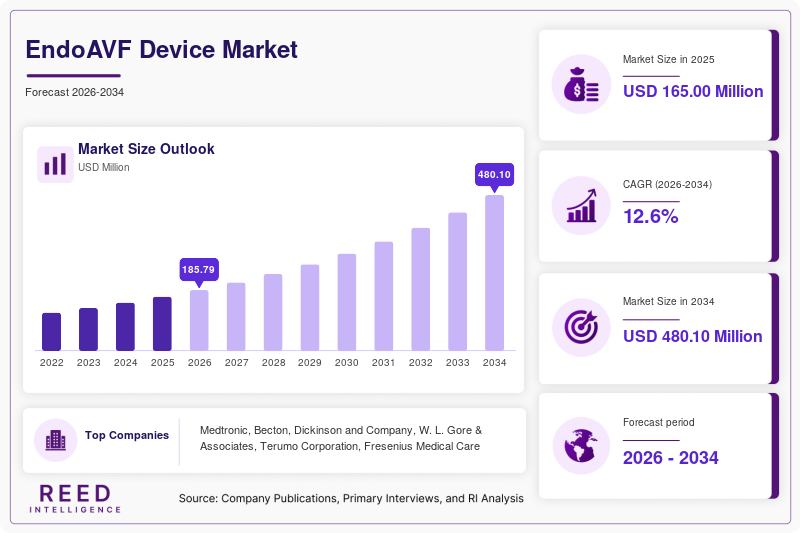
The global EndoAVF Device Market size is experiencing steady expansion driven by advancements in minimally invasive vascular access procedures and the rising prevalence of chronic kidney disease (CKD). The market size was estimated at USD 165 million in 2025 and is projected to reach approximately USD 185 million in 2026. With increasing clinical adoption and supportive reimbursement frameworks, the market is expected to grow to USD 540 million by 2034, registering a compound annual growth rate (CAGR) of 12.6% from 2025 to 2034.
EndoAVF (Endovascular Arteriovenous Fistula) devices are gaining attention as a viable alternative to surgical AV fistula creation, particularly for hemodialysis patients. These devices enable percutaneous creation of arteriovenous fistulas, reducing surgical trauma and improving patient recovery time. The shift toward outpatient care and reduced hospital stays further supports adoption.
Key Highlights
- Market size reached USD 165 million in 2025
- Expected to grow at a CAGR of 12.6% from 2025 to 2034
- Forecasted to reach USD 540 million by 2034
- Minimally invasive procedures driving adoption
- Increasing ESRD prevalence expanding demand
Market Trends
Shift Toward Minimally Invasive Dialysis Access Procedures
The EndoAVF Device Market is witnessing a strong transition toward minimally invasive approaches for vascular access creation. Traditional surgical fistula creation often involves longer recovery times and higher complication rates. In contrast, EndoAVF devices allow for percutaneous procedures that reduce trauma and enhance patient comfort. This trend is supported by advancements in imaging technologies such as ultrasound and fluoroscopy, which improve procedural accuracy. Hospitals and outpatient centers are increasingly adopting these techniques to optimize resource utilization and reduce operational costs. The growing emphasis on same-day discharge and shorter hospital stays further reinforces the demand for minimally invasive EndoAVF solutions across developed and emerging healthcare systems.
Integration of Advanced Imaging and Navigation Technologies
Another notable trend in the EndoAVF Device Market is the integration of advanced imaging and navigation systems into device platforms. Manufacturers are focusing on enhancing procedural precision through real-time visualization tools, enabling clinicians to achieve higher success rates. Technologies such as 3D imaging and AI-assisted navigation are being incorporated to improve vessel targeting and reduce complications. This trend is particularly relevant in complex patient cases where anatomical variations pose challenges. As healthcare providers increasingly rely on data-driven decision-making, the adoption of technologically advanced EndoAVF devices is expected to rise, contributing to improved clinical outcomes and broader acceptance of these solutions.
Market Drivers
Rising Prevalence of Chronic Kidney Disease and ESRD
The increasing incidence of chronic kidney disease (CKD) and end-stage renal disease (ESRD) is a primary driver of the EndoAVF Device Market. Aging populations, rising diabetes rates, and hypertension are major contributing factors to kidney failure worldwide. As the number of patients requiring hemodialysis continues to grow, the demand for reliable and efficient vascular access solutions has intensified. EndoAVF devices provide a less invasive alternative to traditional surgical methods, making them particularly suitable for elderly and high-risk patients. Healthcare systems are prioritizing early and effective vascular access creation, which is accelerating the adoption of these devices. This growing patient pool ensures sustained demand and long-term market expansion.
Increasing Preference for Outpatient and Cost-Effective Procedures
Healthcare systems globally are shifting toward outpatient care models to reduce costs and improve efficiency. EndoAVF procedures align well with this trend, as they can often be performed in outpatient settings with minimal recovery time. This reduces hospitalization costs and allows healthcare providers to treat more patients within the same timeframe. Additionally, payers and insurance providers are increasingly supporting minimally invasive procedures due to their cost-effectiveness and lower complication rates. The ability to deliver high-quality care at reduced costs is encouraging hospitals and clinics to adopt EndoAVF devices, further driving market growth.
Market Restraint
Limited Awareness and Training Among Healthcare Professionals
Despite the advantages of EndoAVF devices, limited awareness and insufficient training among healthcare professionals remain significant barriers to market growth. Many clinicians are more familiar with traditional surgical techniques and may be hesitant to adopt newer technologies without adequate training and clinical evidence. This lack of expertise can lead to slower adoption rates, particularly in developing regions where access to advanced training programs is limited.
The impact of this restraint is evident in the uneven adoption of EndoAVF devices across regions. For example, while developed markets have shown higher uptake due to better training infrastructure, emerging markets lag behind due to limited exposure and resource constraints. Additionally, the initial investment required for training and equipment can deter smaller healthcare facilities. Addressing this challenge requires targeted educational initiatives, partnerships with healthcare institutions, and the development of user-friendly devices that simplify procedural workflows.
Market Opportunities
Expansion in Emerging Markets
Emerging economies present significant growth opportunities for the EndoAVF Device Market. Countries in Asia Pacific, Latin America, and parts of Africa are experiencing a rise in chronic diseases, including CKD, due to urbanization and lifestyle changes. Governments and private healthcare providers are investing in dialysis infrastructure to meet the growing demand. This creates a favorable environment for the adoption of EndoAVF devices. Additionally, improving healthcare access and increasing awareness about advanced treatment options are expected to drive market penetration. Manufacturers can capitalize on these opportunities by offering cost-effective solutions and establishing local distribution networks.
Technological Innovation and Product Development
Continuous innovation in device design and functionality offers substantial opportunities for market growth. Companies are focusing on developing next-generation EndoAVF devices with improved safety profiles, enhanced precision, and shorter procedure times. Innovations such as AI integration, advanced imaging compatibility, and ergonomic designs are expected to attract healthcare providers. Furthermore, the development of devices suitable for a wider range of patient anatomies can expand the addressable market. Strategic collaborations between device manufacturers and research institutions can accelerate innovation and drive the adoption of advanced EndoAVF technologies.
Segmental Analysis
By Type
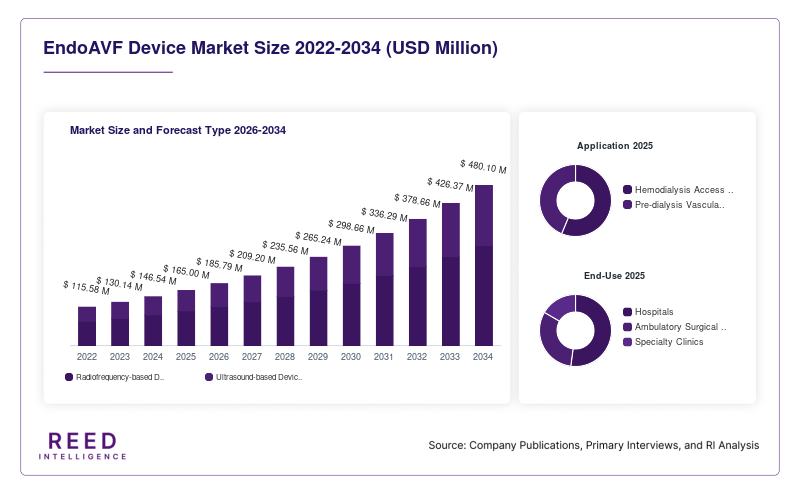
The radiofrequency-based EndoAVF devices segment dominated the market in 2024, accounting for approximately 62% of the total share. These devices are widely used due to their precision and ability to create consistent fistulas with minimal complications. Healthcare providers prefer radiofrequency-based systems because they offer controlled energy delivery and improved procedural outcomes. Additionally, the availability of well-established clinical data supporting their efficacy has contributed to their widespread adoption. Hospitals and specialized clinics are increasingly incorporating these devices into their treatment protocols, further strengthening their market position.
The ultrasound-based EndoAVF devices segment is expected to be the fastest-growing, with a projected CAGR of 14.2% during the forecast period. This growth is driven by advancements in imaging technology that enhance procedural accuracy and reduce complications. Ultrasound-based systems allow real-time visualization, enabling clinicians to achieve better outcomes in complex cases. The increasing demand for non-invasive imaging solutions and the growing focus on patient safety are key factors driving the adoption of this segment.
By Application
Hemodialysis access creation remains the dominant application segment, accounting for around 78% of the market share in 2024. The rising number of ESRD patients requiring long-term dialysis is the primary factor driving this segment. EndoAVF devices provide a reliable and less invasive solution for vascular access, making them the preferred choice for hemodialysis procedures. Healthcare providers are increasingly adopting these devices to improve patient outcomes and reduce complications associated with traditional surgical methods.
The pre-dialysis vascular access planning segment is expected to grow at the fastest CAGR of 13.8%. Early intervention and proactive planning for vascular access are becoming more common as healthcare providers aim to improve patient outcomes. EndoAVF devices play a crucial role in this approach by enabling timely and efficient fistula creation. Increasing awareness about the benefits of early access planning and advancements in diagnostic technologies are driving growth in this segment.
By End-Use
Hospitals dominated the end-use segment in 2024, holding approximately 55% of the market share. The availability of advanced infrastructure, skilled professionals, and comprehensive patient care services makes hospitals the primary setting for EndoAVF procedures. Additionally, hospitals often serve as referral centers for complex cases, further contributing to their dominance. The integration of advanced imaging systems and specialized departments supports the widespread adoption of EndoAVF devices in hospital settings.
Ambulatory surgical centers (ASCs) are projected to be the fastest-growing segment, with a CAGR of 15.1%. The shift toward outpatient care and cost-effective treatment options is driving the growth of ASCs. These centers offer shorter procedure times, reduced costs, and improved patient convenience. The increasing preference for minimally invasive procedures aligns well with the capabilities of ASCs, making them an attractive option for EndoAVF device adoption.
Regional Analysis
North America
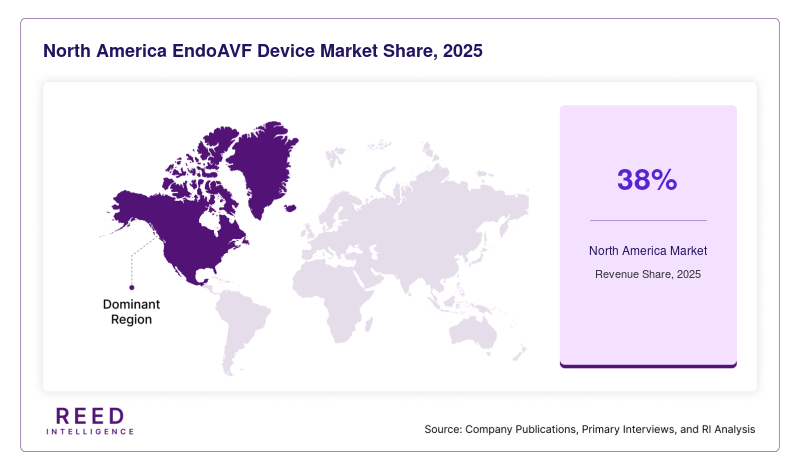
North America accounted for approximately 38% of the EndoAVF Device Market share in 2025, making it the largest regional market. The region is expected to maintain its dominance with a CAGR of around 11.8% through 2034. High healthcare expenditure, advanced infrastructure, and early adoption of innovative technologies contribute to market growth. Favorable reimbursement policies and strong presence of leading market players further support expansion.
The United States dominates the regional market due to its large ESRD patient population and advanced healthcare system. A unique growth factor in this region is the widespread adoption of outpatient procedures, which aligns with the benefits of EndoAVF devices. Continuous investments in research and development also drive innovation and market growth.
Europe
Europe held nearly 27% of the market share in 2025 and is projected to grow at a CAGR of 11.2%. The region benefits from well-established healthcare systems and increasing focus on minimally invasive procedures. Government initiatives to improve dialysis access and patient outcomes are contributing to market growth.
Germany leads the European market due to its robust healthcare infrastructure and high adoption of advanced medical technologies. A unique growth factor is the emphasis on cost-effective healthcare solutions, which encourages the use of minimally invasive EndoAVF procedures to reduce hospital stays and associated costs.
Asia Pacific
Asia Pacific accounted for around 20% of the market share in 2025 and is expected to grow at the fastest CAGR of 14.5%. Rapid urbanization, increasing healthcare investments, and rising prevalence of CKD are key factors driving growth in this region.
China is the dominant country in the region due to its large population and expanding healthcare infrastructure. A unique growth factor is the increasing government focus on improving access to dialysis services, which is boosting the adoption of EndoAVF devices in both urban and rural areas.
Middle East & Africa
The Middle East & Africa region held approximately 8% of the market share in 2025 and is projected to grow at a CAGR of 12.0%. Improving healthcare infrastructure and increasing awareness about advanced treatment options are supporting market growth.
Saudi Arabia leads the regional market due to significant investments in healthcare modernization. A unique growth factor is the rising prevalence of lifestyle-related diseases, such as diabetes, which increases the demand for dialysis and vascular access solutions.
Latin America
Latin America accounted for about 7% of the market share in 2025 and is expected to grow at a CAGR of 12.3%. The region is witnessing gradual improvements in healthcare infrastructure and increased adoption of advanced medical technologies.
Brazil dominates the market due to its large patient population and expanding healthcare sector. A unique growth factor is the growing number of private healthcare providers investing in modern dialysis facilities, which supports the adoption of EndoAVF devices.
Competitive Landscape
The EndoAVF Device Market is moderately consolidated, with a few key players holding significant market share. Companies are focusing on product innovation, strategic partnerships, and geographic expansion to strengthen their positions. The competitive landscape is characterized by continuous research and development activities aimed at improving device performance and patient outcomes.
One of the leading players in the market is Medtronic, which has established a strong presence through its advanced product portfolio and global distribution network. The company recently introduced an upgraded EndoAVF system with enhanced imaging compatibility, improving procedural efficiency. Other major players are also investing in clinical trials and collaborations to expand their market reach and address unmet needs in vascular access solutions.
Key Players
- Medtronic
- Becton, Dickinson and Company
- W. L. Gore & Associates
- Terumo Corporation
- Fresenius Medical Care
- AngioDynamics
- Merit Medical Systems
- Teleflex Incorporated
- Nipro Corporation
- Cook Medical
- Abbott Laboratories
- Boston Scientific Corporation
- Asahi Intecc Co., Ltd.
- Cardinal Health
- Smiths Medical
Recent Developments
- In 2024, Medtronic launched an advanced EndoAVF device with improved imaging integration for enhanced procedural accuracy.
- In 2023, Becton, Dickinson and Company expanded its vascular access portfolio through a strategic acquisition, strengthening its market presence.
- In 2024, Terumo Corporation introduced a next-generation ultrasound-guided EndoAVF system aimed at improving clinical outcomes and reducing procedure time.
EndoAVF Device Market Segments
Type
- Radiofrequency-based Devices
- Ultrasound-based Devices
Application
- Hemodialysis Access Creation
- Pre-dialysis Vascular Access Planning
End-Use
- Hospitals
- Ambulatory Surgical Centers
- Specialty Clinics
By Region
- North America
- Europe
- APAC
- Middle East and Africa
- LATAM