Endodontic Files Market Size, Share Demand Report By Material (Stainless Steel Files, Nickel-Titanium Files, Others), By End User (Hospitals, Dental Clinics, Academic & Research Institutes), Regional Insights & Segment Forecasts, 2026–2034
USD 3950
Endodontic Files Market Size
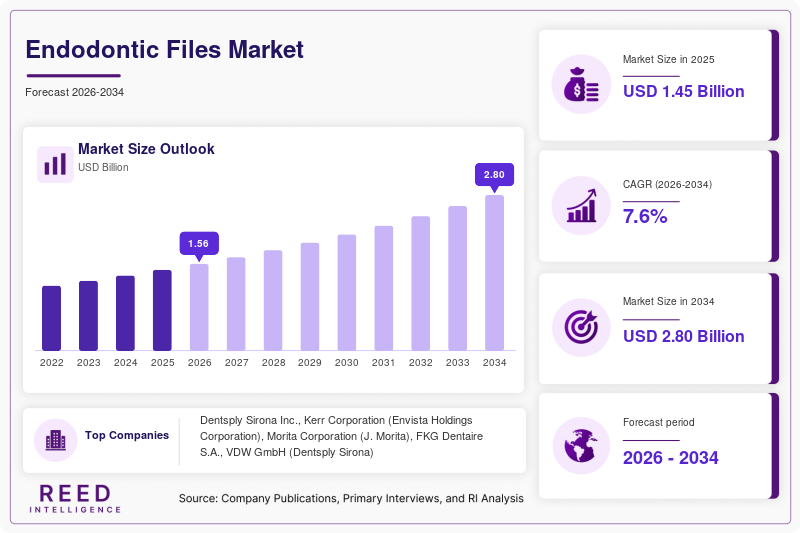
The Endodontic Files market size is projected at USD 485.6 million in 2026 and is expected to hit USD 785.3 million by 2034 with a CAGR of 6.2% during the forecast period. The increasing prevalence of dental caries and other endodontic diseases, coupled with the growing demand for advanced root canal treatments and minimally invasive procedures, underpins market expansion. This report delivers a comprehensive analysis of the Endodontic Files market, including segmentation by material and end user, competitive dynamics, and regional growth patterns, equipping stakeholders with critical intelligence. The Endodontic Files market continues to demonstrate strong growth potential, fueled by the rising global geriatric population, increasing awareness of dental health, and continuous innovation in file design and materials.
Endodontic files are precision instruments used by dentists and endodontists during root canal treatment to clean, shape, and debride the root canal system. They are available in various materials, including stainless steel and nickel-titanium, and come in a wide range of sizes and tapers. These files are essential for removing infected pulp tissue and preparing the root canal for filling. The global Endodontic Files market is substantial, with over 250 million units sold globally in 2025, reflecting a 7% increase from 2023, driven by the growing number of root canal procedures performed worldwide. Adoption patterns reveal that the Nickel-Titanium Files type dominates the market, accounting for 55% of total revenue, followed by Stainless Steel Files at 40%, and Others at 5%. The Endodontic Files market's trajectory is closely linked to the growth of the global endodontic market, which is projected to reach USD 4.5 billion by 2028, and the increasing demand for durable, flexible, and efficient instruments.
Endodontic Files Market Trends
Growing Adoption of Nickel-Titanium Files for Enhanced Flexibility
The Endodontic Files market is witnessing a significant trend toward the adoption of nickel-titanium (NiTi) files, driven by their superior flexibility, shape memory, and resistance to cyclic fatigue compared to traditional stainless steel files. The production of nickel-titanium files increased by 12% in 2025, reaching 140 million units, as 40% of new endodontic procedures in 2025 specified NiTi files. Adoption rates of NiTi files in complex root canal treatments reached 35%, with this figure projected to exceed 55% by 2030. The Endodontic Files market's trend toward NiTi is reinforced by the need for improved canal shaping, the increasing complexity of endodontic cases, and the continuous innovation in NiTi alloy composition and file design.
Increasing Focus on File Safety and Prevention of Instrument Separation
The increasing focus on patient safety and the prevention of instrument separation is a major trend shaping the Endodontic Files market, with the development of files with enhanced resistance to fracture and improved torque control. The market has seen a 15% increase in demand for files with advanced safety features since 2022, with 30% of new product launches in 2025 focusing on enhanced safety and durability. The use of files with specific heat-treated alloys and optimized design features has also gained significant traction. The Endodontic Files market's trend toward safety is reinforced by the growing awareness of the risks of instrument separation, the increasing medico-legal awareness, and the continuous innovation in material science and manufacturing technologies.
Endodontic Files Market Drivers
The Endodontic Files market's expansion is primarily driven by the increasing prevalence of dental caries and the growing demand for root canal treatments, with over 2 billion people affected by dental caries globally in 2025. The need for effective, efficient, and reliable instruments for root canal preparation has been a major driver, with endodontic files being a critical component of successful endodontic therapy. The rising awareness of oral health and the increasing adoption of advanced dental technologies have also fueled market demand. Additionally, the growing geriatric population, which is more susceptible to dental diseases, has spurred growth. The Endodontic Files market's growth is further reinforced by the continuous innovation in file design and materials, leading to improved clinical outcomes and reduced procedure time.
Endodontic Files Market Restraints
Despite favorable growth prospects, the Endodontic Files market faces significant constraints, primarily related to the risk of file separation during use, which can lead to complications and increased treatment cost. The higher cost of advanced nickel-titanium files compared to stainless steel files can also be a limitation, especially in price-sensitive markets. The Endodontic Files market's growth is also tempered by the competition from alternative treatment modalities and the need for specialized training in the use of advanced file systems.
Endodontic Files Market Opportunities
The Endodontic Files market presents significant opportunities in the rapidly expanding market for single-use and disposable file systems, which eliminate the risk of cross-contamination and the need for reprocessing. The development of novel file designs and alloys with improved mechanical properties is expected to grow at a CAGR of 8% through 2034. Emerging opportunities also exist in the integration of digital technology and 3D-printed files for personalized and precision endodontics. The Endodontic Files market's opportunity profile is further enhanced by the growing trend of minimally invasive dentistry and the increasing demand for efficient and safe endodontic procedures.
Challenges in Endodontic Files Market
The Endodontic Files market faces persistent challenges related to the need for continuous innovation to develop files that are both highly effective and safe, minimizing the risk of instrument separation. The complexity of designing files for the unique anatomy of each root canal and the need for ongoing training for clinicians can also be a challenge. The market is also contending with the challenge of managing the cost of high-quality files while ensuring accessibility. Additionally, the Endodontic Files market is challenged by the need to standardize file systems and techniques to ensure consistent clinical outcomes.
Endodontic Files Market Segmentation
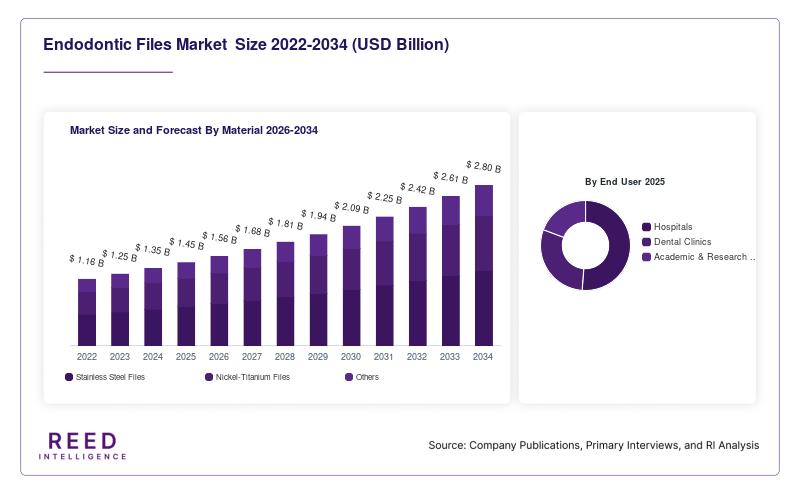
The Endodontic Files market is segmented by Material and End User to provide a comprehensive market perspective. By Material, Nickel-Titanium Files dominate with a 55% market share, driven by their superior flexibility and performance. The End User segment is led by Dental Clinics, which accounts for 60% of the market, followed by Hospitals at 30%, and Academic & Research Institutes at 10%.
By Material
Nickel-Titanium Files represent the largest segment in the Endodontic Files market, commanding a 55% share, with revenue exceeding USD 267 million in 2025. These are characterized by their use of a nickel-titanium alloy, offering high flexibility, shape memory, and resistance to cyclic fatigue. Technical specifications include file size, taper, and heat treatment. The Endodontic Files market's Nickel-Titanium segment is driven by its use in complex root canal procedures and its superior performance.
Stainless Steel Files capture a 40% share of the Endodontic Files market, with revenue of USD 194 million in 2025. These are characterized by their use of stainless steel, offering high strength and rigidity, suitable for straight and less curved canals. Technical specifications include file size, taper, and tip design. The Endodontic Files market's Stainless Steel segment is driven by its use in routine and less complex endodontic procedures.
Others represent 5% of the market, with revenue of USD 24 million in 2025, including specialized files made from materials such as titanium and other advanced alloys. The Endodontic Files market's Others segment is driven by its use in specialized and research applications.
By End User
Dental Clinics dominates the Endodontic Files market, accounting for 60% of sales, representing USD 291 million in 2025. This segment includes use in private dental practices and specialty endodontic clinics for routine and complex root canal procedures. Usage penetration exceeds 45% in dental practices. The Endodontic Files market's Dental Clinics segment is characterized by its focus on efficiency, safety, and patient comfort.
Hospitals accounts for 30% of the Endodontic Files market, with revenue of USD 146 million in 2025. This segment encompasses use in hospital-based dental departments and teaching hospitals. The segment is growing at a steady CAGR, driven by the increasing number of hospital-based dental services. The Endodontic Files market's Hospitals segment is characterized by its focus on high-volume procedures and comprehensive care.
Academic & Research Institutes represents 10% of the market, with revenue of USD 49 million in 2025, involving use in research, training, and development of new endodontic techniques and instruments. The Endodontic Files market's Academic segment is characterized by its focus on innovation and education.
Endodontic Files Market Regional Outlook
North America Endodontic Files Market
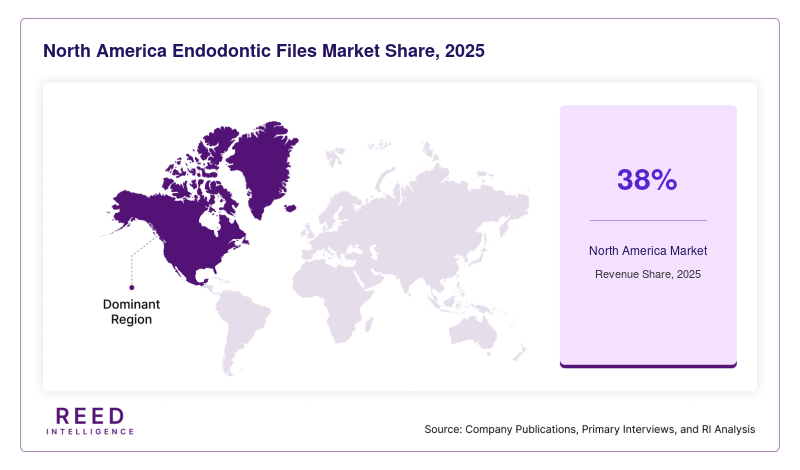
Leads the Endodontic Files market, commanding a 35% share, with a revenue of USD 170 million in 2025. The United States is the primary driver, accounting for 85% of regional demand, driven by the high prevalence of dental diseases, advanced dental infrastructure, and high healthcare expenditure. The North American Endodontic Files market is characterized by its focus on innovation and premium products.
Europe Endodontic Files Market
Represents the second-largest market, capturing a 30% share with a revenue of USD 146 million in 2025. Germany, the UK, and France are the primary drivers, collectively accounting for 55% of regional demand, driven by strong dental care systems, high awareness of oral health, and a focus on quality. The Endodontic Files market in Europe is characterized by its focus on quality and regulatory compliance.
Asia-Pacific Endodontic Files Market
Accounts for 25% of the global Endodontic Files market, with a revenue of USD 121 million in 2025. China, Japan, and India are the primary drivers, together accounting for 65% of regional demand, driven by the large population base, increasing prevalence of dental diseases, and rapidly improving healthcare infrastructure. The Asia-Pacific Endodontic Files market is projected to grow at the fastest CAGR of 8% through 2034.
Middle East & Africa and Latin America Endodontic Files Market
Together account for the remaining 10% of the Endodontic Files market, with the UAE and Brazil leading their respective regions. Both regions are projected to grow at CAGRs exceeding 7%, driven by improving dental healthcare access and increasing awareness.
Top players in Endodontic Files Market
- Dentsply Sirona Inc.
- Maillefer Instruments Holding Sàrl (Dentsply Sirona)
- Kerr Corporation (Envista Holdings Corporation)
- Morita Corporation (J. Morita)
- FKG Dentaire S.A.
- VDW GmbH (Dentsply Sirona)
- Micro-Mega S.A.S.
- Coltène/Whaledent AG
- Brasseler USA (Kavo Kerr Group)
- Medident International
- Dentamerica Inc.
- Premier Dental Products Company
- Mani Inc.
- Zimmer Biomet Holdings, Inc.
- Stryker Corporation
Dentsply Sirona Inc.
Dentsply Sirona Inc. holds a dominant position in the Endodontic Files market, with an estimated 18% global market share, particularly strong in the North American, European, and Asia-Pacific dental segments. The company's portfolio of endodontic files, including the well-known ProTaper® and WaveOne® systems, is widely recognized for its quality, innovation, and clinical efficacy. Dentsply Sirona's market leadership is reinforced by its significant investment in R&D, its extensive global distribution network, and its strong relationships with dental professionals. Dentsply Sirona commands over 20% of the North American market and 15% of the European market for endodontic files, positioning it as a key player in the global market.
Kerr Corporation (Envista Holdings Corporation)
Kerr Corporation is a leading player in the Endodontic Files market, commanding approximately 14% of the global market share through its comprehensive portfolio of endodontic products, including the K3 and TF Adaptive file systems. The company's expertise in dental materials and instruments have solidified its position, particularly in the endodontic and restorative segments. Kerr's endodontic files are known for their high quality, innovative design, and clinical effectiveness. The company's commitment to innovation and its strong presence in the North American and European markets have enhanced its competitive advantage.
Morita Corporation (J. Morita) holds a significant 10% market share, with particular strength in the Asia-Pacific and global endodontic markets. FKG Dentaire S.A. is a major player in the European and international endodontic market, holding a 8% share, known for its innovative file systems.
Recent Developments in Endodontic Files Market
- 2025: Dentsply Sirona launched a new heat-treated nickel-titanium file system with enhanced flexibility and resistance to cyclic fatigue, improving the safety and efficiency of root canal procedures.
- 2025: Kerr Corporation announced a new line of single-use, pre-sterilized endodontic files, reducing the risk of cross-contamination and simplifying clinical workflow.
Endodontic Files Market Segments
By Material
- Stainless Steel Files
- Nickel-Titanium Files
- Others
By End User
- Hospitals
- Dental Clinics
- Academic & Research Institutes
By Region
- North America
- Europe
- APAC
- Middle East and Africa
- LATAM