Endoscopic Spinal Surgery Market Size, Share, Demand Report by Procedure Type (Transforaminal Endoscopic Discectomy, Interlaminar Endoscopic Discectomy, Biportal Endoscopic Spine Surgery), By Application (Lumbar Spine Disorders, Cervical Spine Disorders, Thoracic Spine Disorders), By End Use (Hospitals, Ambulatory Surgical Centers, Specialty Clinics) & Regional Forecasts, 2026–2034
USD 3950
Market Overview
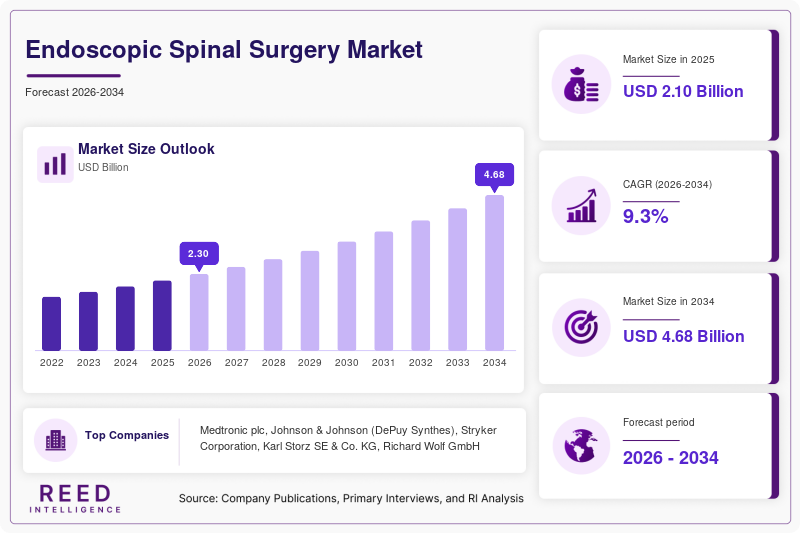
The Endoscopic Spinal Surgery Market size was valued at USD 2.1 billion in 2026 and is projected to reach USD 4.3 billion by 2034, expanding at a CAGR of 9.3% during 2026–2034. The market growth is primarily driven by the global shift toward minimally invasive surgical procedures, supported by advancements in high-definition imaging systems, robotic-assisted navigation, and enhanced endoscopic instrumentation. Increasing prevalence of spinal disorders such as herniated discs, spinal stenosis, and degenerative disc diseases has further accelerated demand for endoscopic interventions that offer reduced hospital stays and faster recovery.
A key global factor supporting market expansion is the rising adoption of outpatient spine surgery, enabled by improved surgical precision and reduced procedural risks associated with endoscopic techniques. Healthcare systems across developed and emerging economies are increasingly focusing on cost-efficient treatment models, further boosting adoption.
Key Highlights:
- Dominant region share: North America (38%)
- Fastest-growing region CAGR: Asia Pacific (11.2%)
- Leading subsegment: Transforaminal Endoscopic Discectomy (42% share)
- Fastest-growing subsegment: Biportal Endoscopic Spine Surgery (10.5% CAGR)
- Dominant country market value: United States (2024: USD 0.72 billion; 2025: USD 0.79 billion)
The Endoscopic Spinal Surgery Market continues to evolve with technological integration and rising patient preference for minimally invasive spine care, strengthening its global footprint.
Market Trends
Integration of Robotics and Navigation Systems
The Endoscopic Spinal Surgery Market is witnessing increasing integration of robotic-assisted platforms and AI-powered navigation systems. These technologies enhance surgical precision, reduce human error, and enable surgeons to perform complex spinal procedures through smaller incisions. Real-time imaging fusion and 3D visualization systems are becoming standard in advanced surgical centers, improving procedural outcomes and accelerating adoption across tertiary hospitals.
Shift Toward Outpatient and Ambulatory Spine Procedures
A significant trend shaping the Endoscopic Spinal Surgery Market is the transition of spinal surgeries from inpatient hospital settings to ambulatory surgical centers (ASCs). Shorter recovery times, reduced hospitalization costs, and improved patient comfort are encouraging this shift. ASCs are increasingly investing in endoscopic spine systems due to their operational efficiency and lower procedural overhead. This trend is particularly strong in developed healthcare systems where cost containment and patient throughput optimization are priorities.
Market Drivers
Rising Prevalence of Spinal Disorders
The increasing incidence of degenerative disc diseases, spinal stenosis, and trauma-related spinal injuries is a primary driver of the Endoscopic Spinal Surgery Market. Aging populations and sedentary lifestyles are contributing to higher demand for minimally invasive spinal interventions that offer reduced postoperative complications and faster mobility recovery.
Technological Advancements in Endoscopic Systems
Continuous innovation in endoscopic visualization systems, including high-definition cameras, fiber-optic instruments, and improved surgical tools, is significantly driving the Endoscopic Spinal Surgery Market. These advancements enable surgeons to perform complex procedures with higher accuracy and minimal tissue damage, increasing procedural success rates and expanding clinical applications across cervical, thoracic, and lumbar spine regions.
Market Restraint
High Initial Equipment and Training Costs
One of the major restraints in the Endoscopic Spinal Surgery Market is the high cost associated with advanced endoscopic surgical systems and the specialized training required for surgeons. Smaller healthcare facilities and hospitals in emerging economies often face budget limitations, restricting widespread adoption. Additionally, the learning curve associated with mastering endoscopic spinal techniques can delay procedural integration in new clinical settings.
Market Opportunities
Expansion in Emerging Healthcare Markets
The Endoscopic Spinal Surgery Market presents significant growth opportunities in emerging economies across Asia Pacific, Latin America, and the Middle East. Rapid healthcare infrastructure development, rising medical tourism, and increasing awareness of minimally invasive procedures are expected to drive adoption in these regions over the forecast period.
Development of Next-Generation Endoscopic Platforms
Ongoing R&D in ultra-thin endoscopes, enhanced imaging systems, and AI-assisted surgical planning tools is creating new opportunities within the Endoscopic Spinal Surgery Market. These innovations are expected to improve procedural efficiency, expand surgical indications, and reduce complication rates, thereby increasing clinical acceptance and market penetration.
Segmental Analysis
By Procedure Type
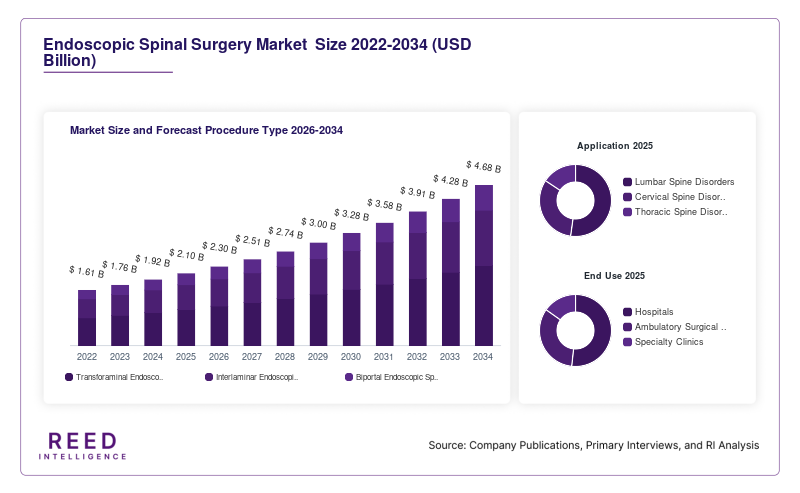
The Transforaminal Endoscopic Discectomy segment dominated the Endoscopic Spinal Surgery Market, accounting for 42% share in 2025. This dominance is attributed to its effectiveness in treating lumbar disc herniation with minimal tissue disruption and faster recovery time. Its widespread clinical adoption across hospitals and specialty spine centers further strengthens its position.
The Biportal Endoscopic Spine Surgery segment is expected to register the fastest growth with a CAGR of 10.5% during 2026–2034 in the Endoscopic Spinal Surgery Market. This growth is driven by improved surgical flexibility, enhanced visualization, and increasing surgeon preference for dual-channel techniques that allow better instrument maneuverability.
By Application
The Lumbar Spine Disorders segment held the largest share of 48% in 2025 in the Endoscopic Spinal Surgery Market. High prevalence of lumbar disc degeneration and lower back pain across aging populations is the primary growth driver. Increasing sedentary lifestyles further contribute to segment dominance.
The Cervical Spine Disorders segment is expected to grow at the fastest CAGR of 9.8%, driven by rising incidence of cervical disc herniation and technological advancements enabling safer anterior and posterior cervical endoscopic procedures.
By End-Use
Hospitals represented the dominant end-use segment, accounting for 55% share in 2025 in the Endoscopic Spinal Surgery Market. Their dominance is supported by advanced surgical infrastructure, availability of skilled neurosurgeons, and higher patient inflow for complex spinal procedures.
Ambulatory Surgical Centers (ASCs) are projected to witness the fastest growth with a CAGR of 10.2%, driven by cost efficiency, reduced hospital stay requirements, and increasing preference for outpatient spinal surgeries.
Regional Analysis
North America
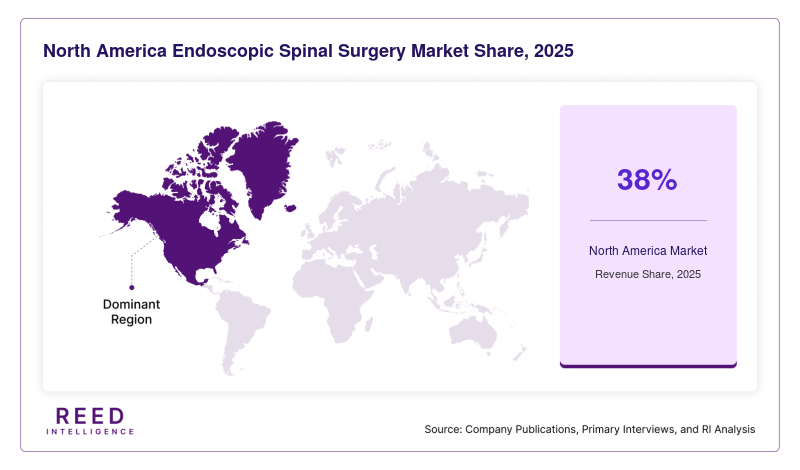
North America accounted for 38% share of the Endoscopic Spinal Surgery Market in 2025, and is projected to grow at a CAGR of 8.7% from 2026 to 2034. The region’s strong performance is supported by advanced healthcare infrastructure, high adoption of minimally invasive surgical techniques, and favorable reimbursement frameworks. Increasing demand for outpatient spine procedures further strengthens regional expansion.
The United States dominated the North American Endoscopic Spinal Surgery Market due to its high prevalence of spinal disorders and early adoption of robotic-assisted endoscopic systems. Strong presence of specialized spine centers and continuous technological innovation further contribute to market growth.
Europe
Europe held a 27% share in 2025 and is expected to register a CAGR of 8.5% through 2034 in the Endoscopic Spinal Surgery Market. Growth is driven by increasing geriatric population and rising preference for minimally invasive surgeries in countries with well-established public healthcare systems.
Germany led the regional market due to strong orthopedic and neurosurgical capabilities, along with widespread integration of advanced surgical navigation technologies.
Asia Pacific
Asia Pacific accounted for 22% share in 2025 and is projected to grow at the fastest CAGR of 11.2% in the Endoscopic Spinal Surgery Market. Rapid urbanization, increasing healthcare expenditure, and growing awareness of minimally invasive spine procedures are key drivers.
China is the dominant country, supported by large patient volume, expanding hospital infrastructure, and government investments in advanced surgical technologies.
Middle East & Africa
The region held a 7% share in 2025 and is expected to grow at a CAGR of 8.9%. Growth in the Endoscopic Spinal Surgery Market is supported by increasing medical tourism, especially in the Gulf countries, along with rising investments in specialty hospitals.
The United Arab Emirates leads the region due to advanced healthcare facilities and strong adoption of modern surgical technologies.
Latin America
Latin America captured 6% share in 2025 and is projected to expand at a CAGR of 8.3%. Growth is driven by improving healthcare infrastructure and increasing adoption of minimally invasive procedures in urban hospitals.
Brazil is the leading market due to rising spinal disorder cases and gradual integration of advanced surgical systems in private healthcare facilities.
Competitive Landscape
The Endoscopic Spinal Surgery Market is moderately consolidated, with leading players focusing on product innovation, strategic partnerships, and global expansion. Key companies are investing heavily in minimally invasive surgical systems and integrated imaging solutions to strengthen their competitive position.
Medtronic plc remains a market leader, supported by its extensive spinal product portfolio and continuous technological advancements in endoscopic platforms. Recent developments include enhanced navigation-integrated spine systems.
Other prominent players such as Johnson & Johnson (DePuy Synthes), Karl Storz SE & Co. KG, Stryker Corporation, and Richard Wolf GmbH are actively expanding their product offerings and strengthening distribution networks across emerging markets. These companies are focusing on robotic integration, improved visualization tools, and surgeon training programs to enhance adoption of endoscopic spine procedures globally.
Key Players List
- Medtronic plc
- Johnson & Johnson (DePuy Synthes)
- Stryker Corporation
- Karl Storz SE & Co. KG
- Richard Wolf GmbH
- Olympus Corporation
- Zimmer Biomet Holdings, Inc.
- B. Braun Melsungen AG
- Joimax GmbH
- Spineology Inc.
- Elliquence LLC
- MaxMoreSpine
- NuVasive Inc.
- Orthofix Medical Inc.
- Accelus Inc.
Recent Developments
- In 2025, several manufacturers expanded AI-integrated navigation systems to enhance precision in the Endoscopic Spinal Surgery Market.
- New biportal endoscopic platforms were introduced to improve surgeon flexibility and visualization.
- Strategic collaborations between device manufacturers and hospital chains increased training programs for minimally invasive spine procedures.
- Expanding regulatory approvals in Asia Pacific accelerated product commercialization across emerging healthcare markets.
- Leading companies invested in next-generation high-definition endoscopes to improve surgical outcomes and reduce procedure time.
Endoscopic Spinal Surgery Market Segments
Procedure Type
- Transforaminal Endoscopic Discectomy
- Interlaminar Endoscopic Discectomy
- Biportal Endoscopic Spine Surgery
Application
- Lumbar Spine Disorders
- Cervical Spine Disorders
- Thoracic Spine Disorders
End Use
- Hospitals
- Ambulatory Surgical Centers
- Specialty Clinics
By Region
- North America
- Europe
- APAC
- Middle East and Africa
- LATAM