Endoscopic Submucosal Dissection Market Size, Share & Demand Report By Product (ESD Knives, Injection Systems, Hemostatic Devices, Endoscopic Caps, Electrosurgical Units), By Application (Gastric Cancer, Colorectal Cancer, Esophageal Cancer, Other Gastrointestinal Lesions), By End Use (Hospitals, Ambulatory Surgical Centers, Specialty Gastroenterology Clinics) & Segment Forecasts, 2025–2034
USD 3950
Market Overview
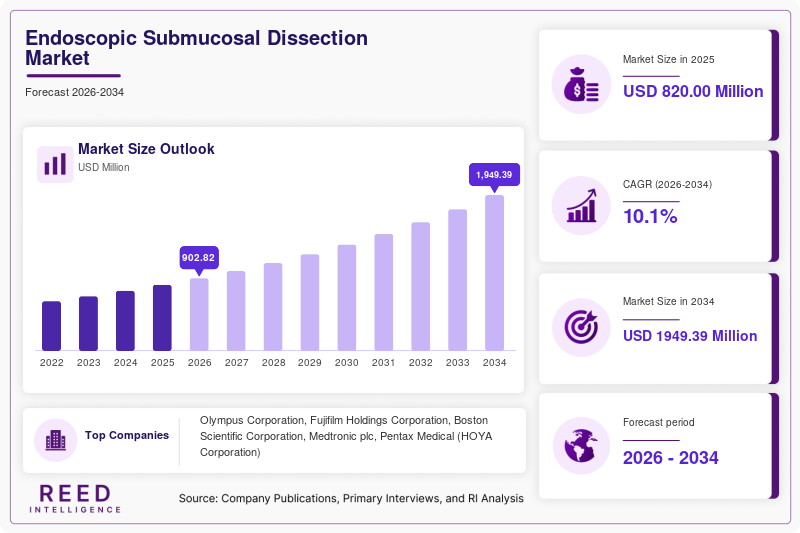
The Endoscopic Submucosal Dissection Market size was valued at USD 820 million in 2025 and is projected to reach USD 1.95 billion by 2034, expanding at a CAGR of 10.1% from 2025 to 2034. Growth of the Endoscopic Submucosal Dissection Market is supported by the increasing global burden of gastrointestinal cancers and the shift toward minimally invasive therapeutic procedures. Endoscopic submucosal dissection (ESD) is widely adopted for early-stage gastrointestinal tumor removal because it enables en bloc resection while preserving surrounding tissue.
Hospitals and specialty gastroenterology centers are progressively incorporating advanced endoscopic procedures to improve clinical outcomes and reduce patient recovery time. Technological improvements in endoscopy systems, visualization platforms, and electrosurgical knives are also contributing to the expansion of the Endoscopic Submucosal Dissection Market. Device manufacturers are investing in product innovation such as precision ESD knives, enhanced imaging tools, and ergonomic endoscopic platforms designed to support complex procedures.
Key Highlights
- Asia Pacific accounted for 41% of the Endoscopic Submucosal Dissection Market share in 2025, while Latin America is projected to register the fastest CAGR of 11.8% through 2034.
- ESD knives dominated the product segment with 38% share in 2024, while injection systems are expected to grow at a CAGR of 11.6%.
- Hospitals represented the dominant end-use segment with 62% share, whereas ambulatory surgical centers are projected to grow at a CAGR of 11.3%.
- Japan remained the dominant country, with market values rising from USD 142 million in 2024 to USD 151 million in 2025.
Market Trends
The Endoscopic Submucosal Dissection Market is evolving as healthcare systems increasingly adopt advanced therapeutic endoscopy technologies. Several structural and technological developments are shaping the growth trajectory of this industry.
Integration of Advanced Imaging in Endoscopic Procedures
A notable trend in the Endoscopic Submucosal Dissection Market is the integration of high-definition imaging systems, narrow-band imaging, and digital visualization platforms. These technologies allow physicians to detect early-stage lesions with greater precision and perform accurate submucosal dissections. Modern endoscopic platforms developed by companies such as Olympus Corporation and Fujifilm Holdings Corporation combine advanced imaging with therapeutic tools, enabling clinicians to perform complex ESD procedures more efficiently.
Expansion of Endoscopic Training and Skill Development
Another trend influencing the Endoscopic Submucosal Dissection Market is the expansion of specialized training programs for gastroenterologists and endoscopic surgeons. Medical institutions and professional societies are investing in simulation-based training modules and workshops designed to improve technical proficiency in ESD procedures. These training initiatives are helping address the technical complexity associated with the procedure, encouraging broader adoption across hospitals and specialty centers globally.
Market Drivers
Rising Incidence of Gastrointestinal Cancers
The growing global prevalence of gastrointestinal cancers has emerged as a major driver of the Endoscopic Submucosal Dissection Market. Conditions such as gastric cancer, colorectal cancer, and esophageal cancer are increasingly diagnosed at early stages due to improved screening programs. Endoscopic submucosal dissection allows physicians to remove early-stage lesions without the need for open surgery, reducing hospital stays and improving patient outcomes. Healthcare systems are therefore encouraging the use of endoscopic therapeutic procedures as a cost-efficient alternative to surgical interventions.
Advancements in Endoscopic Device Technology
Continuous technological development in endoscopic instruments is another important factor driving the Endoscopic Submucosal Dissection Market. Companies including Boston Scientific Corporation and Medtronic plc are investing in precision electrosurgical knives, injection systems, and specialized accessories designed for ESD procedures. These innovations improve procedural safety, enhance visualization, and increase physician control during submucosal dissection. As technology becomes more refined, healthcare providers are expected to expand the use of ESD in gastrointestinal oncology treatment.
Market Restraint
Technical Complexity and Limited Skilled Professionals
One of the primary restraints affecting the Endoscopic Submucosal Dissection Market is the high level of technical expertise required to perform the procedure. Endoscopic submucosal dissection involves precise manipulation of specialized instruments within the gastrointestinal tract, making it a technically demanding procedure. Physicians must undergo extensive training to develop the skills required for accurate lesion removal while minimizing the risk of complications.
In many healthcare systems, particularly in developing regions, the number of clinicians trained in ESD remains limited. This shortage restricts the availability of the procedure to specialized medical centers. As a result, adoption rates may remain slower in certain regions where training infrastructure is still evolving.
Furthermore, procedural complexity can lead to longer operating times compared with conventional endoscopic mucosal resection techniques. This may reduce the number of procedures that can be performed in a single clinical session. The need for advanced equipment and trained personnel therefore represents a barrier to rapid expansion of the Endoscopic Submucosal Dissection Market in certain healthcare environments.
Market Opportunities
Growth of Early Cancer Screening Programs
The expansion of national screening initiatives for gastrointestinal cancers presents a significant opportunity for the Endoscopic Submucosal Dissection Market. Governments and healthcare organizations are increasingly promoting early detection programs for gastric and colorectal cancer. As screening rates increase, more early-stage lesions are identified, creating a larger patient pool suitable for minimally invasive ESD treatment. This trend is expected to generate sustained demand for ESD instruments and related endoscopic systems.
Development of Robotic and AI-Assisted Endoscopy
Emerging digital technologies are creating new opportunities within the Endoscopic Submucosal Dissection Market. Artificial intelligence–based lesion detection systems and robotic-assisted endoscopic platforms are being developed to improve procedural accuracy. These technologies can assist physicians in identifying tumor boundaries and performing precise dissections. Companies such as HOYA Corporation are exploring advanced imaging technologies that support digital endoscopy workflows. As AI-assisted endoscopy becomes more widely available, the efficiency and reliability of ESD procedures are expected to improve, expanding the addressable market.
Segmental Analysis
By Product
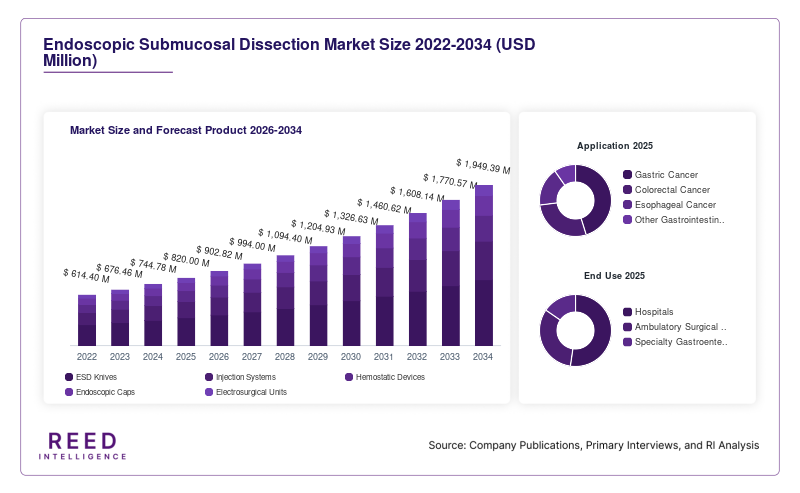
The ESD knives segment dominated the Endoscopic Submucosal Dissection Market in 2024, accounting for approximately 38% of total revenue share. ESD knives are essential tools used to perform precise mucosal incision and submucosal dissection during the procedure. The high demand for these instruments is driven by their critical role in enabling accurate lesion removal while minimizing damage to surrounding tissue. Hospitals and gastroenterology centers maintain a consistent supply of ESD knives to support therapeutic endoscopy procedures.
The injection systems segment will likely grow at a CAGR of 11.6% during the forecast period. Injection systems are used to lift the mucosal layer and create a safe working space during submucosal dissection. Growing demand for specialized injection solutions that enhance procedural safety will support the expansion of this segment.
By Application
The gastric cancer segment held the largest share of the Endoscopic Submucosal Dissection Market in 2024, representing approximately 44% of total revenue. The procedure is widely used for treating early-stage gastric tumors because it allows complete lesion removal while preserving the stomach structure. High prevalence of gastric cancer in certain regions and the availability of advanced endoscopic technologies contributed to the strong adoption of ESD for this application.
The colorectal cancer segment is expected to grow at a CAGR of 11.2% through 2034. Improvements in colorectal cancer screening programs will likely increase the detection of early-stage lesions suitable for ESD treatment. The increasing use of advanced colonoscopy technologies will also support the growth of this segment.
By End Use
The hospitals segment accounted for the dominant share of the Endoscopic Submucosal Dissection Market in 2024, representing 62% of total market revenue. Hospitals typically possess advanced endoscopic equipment and specialized gastroenterology departments capable of performing complex procedures such as ESD. Additionally, hospitals often serve as referral centers for patients requiring specialized gastrointestinal treatment.
The ambulatory surgical centers segment will expand at a CAGR of 11.3% between 2025 and 2034. The growing shift toward outpatient procedures is encouraging the development of specialized surgical centers equipped with advanced endoscopic technologies. These facilities offer efficient procedural workflows and shorter patient recovery times, supporting segment growth.
Regional Analysis
North America
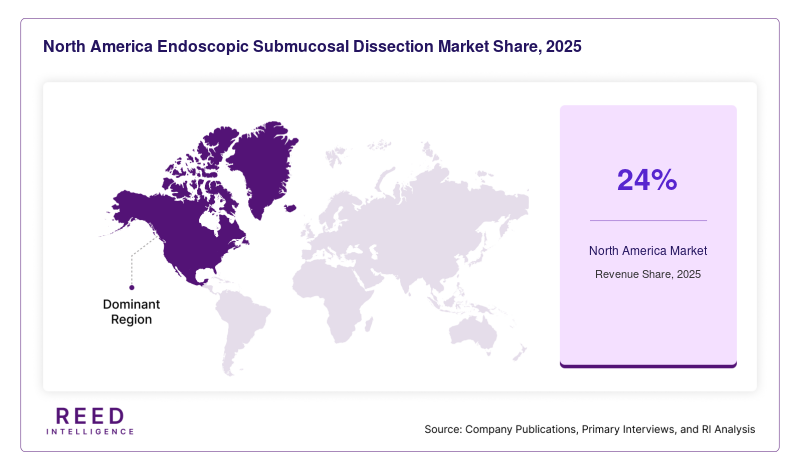
North America accounted for 24% of the Endoscopic Submucosal Dissection Market share in 2025. The regional market will likely expand at a CAGR of 9.2% between 2025 and 2034. Healthcare systems across the region are progressively integrating advanced therapeutic endoscopy into oncology treatment pathways. Hospitals and specialized gastroenterology centers have invested in high-definition endoscopy platforms and electrosurgical systems that support ESD procedures. Increasing awareness of minimally invasive treatment options among clinicians and patients is also contributing to the adoption of endoscopic submucosal dissection technologies.
The United States represented the dominant country in the regional Endoscopic Submucosal Dissection Market. The country benefits from a well-established healthcare infrastructure and widespread access to advanced medical technologies. Academic medical centers in the U.S. are conducting research on endoscopic oncology procedures, which is helping expand clinical evidence supporting ESD use. Additionally, the presence of major medical device manufacturers and specialized training programs is supporting procedural adoption in gastroenterology practices.
Europe
Europe represented approximately 21% of the Endoscopic Submucosal Dissection Market share in 2025. The regional market is projected to grow at a CAGR of 9.4% during the forecast period. Several European healthcare systems have incorporated minimally invasive endoscopic procedures into their cancer treatment protocols. Increased adoption of advanced diagnostic endoscopy is enabling physicians to detect early gastrointestinal lesions suitable for ESD treatment.
Germany accounted for a significant share of the European Endoscopic Submucosal Dissection Market. The country has a strong network of specialized gastroenterology clinics and university hospitals that conduct therapeutic endoscopy procedures. Medical research institutions in Germany are actively studying improvements in endoscopic techniques and training methodologies. This environment has facilitated the gradual expansion of ESD adoption across the country’s healthcare system.
Asia Pacific
Asia Pacific held the largest share of the Endoscopic Submucosal Dissection Market at 41% in 2025. The market in this region will likely grow at a CAGR of 10.4% from 2025 to 2034. The region has a long history of endoscopic innovation, particularly in countries with high incidence rates of gastric cancer. Healthcare providers in the region frequently use ESD procedures as a standard approach for treating early gastrointestinal tumors.
Japan remained the dominant country within the Asia Pacific Endoscopic Submucosal Dissection Market. The procedure was widely adopted in Japanese medical institutions before expanding to other global regions. Japanese hospitals have extensive clinical experience with ESD, supported by established training programs and research initiatives. Additionally, the presence of advanced endoscopy manufacturers has facilitated continuous innovation in the regional market.
Middle East & Africa
The Middle East & Africa accounted for 7% of the Endoscopic Submucosal Dissection Market share in 2025. The regional market will likely expand at a CAGR of 9.7% during the forecast period. Healthcare systems in several countries across the region are investing in modern medical infrastructure and specialized treatment centers. Increasing awareness of minimally invasive gastrointestinal procedures is gradually improving adoption rates.
The United Arab Emirates represented a key country within the regional Endoscopic Submucosal Dissection Market. Healthcare authorities in the country are focusing on advanced medical technologies and expanding specialized gastroenterology services. Several hospitals in the UAE are incorporating high-end endoscopic platforms to provide advanced diagnostic and therapeutic procedures, supporting the gradual expansion of ESD services.
Latin America
Latin America held approximately 7% share of the Endoscopic Submucosal Dissection Market in 2025. The region is projected to grow at the fastest CAGR of 11.8% through 2034. Increasing investment in healthcare infrastructure and the expansion of specialized endoscopy units are supporting the regional market outlook. Hospitals are gradually adopting advanced endoscopic procedures as awareness of minimally invasive cancer treatment increases.
Brazil accounted for a significant share of the regional Endoscopic Submucosal Dissection Market. The country has a large patient population and a growing network of private healthcare providers offering advanced gastrointestinal treatment. Medical institutions in Brazil are expanding endoscopy training programs and collaborating with international specialists to improve procedural expertise.
Competitive Landscape
The Endoscopic Submucosal Dissection Market is moderately consolidated, with several global medical device manufacturers focusing on product innovation and technology integration. Companies are investing in improved endoscopic visualization systems, electrosurgical platforms, and specialized accessories to support ESD procedures.
Olympus Corporation remains a prominent market participant due to its extensive portfolio of endoscopy systems and ESD accessories. The company continues to invest in digital endoscopy platforms and advanced imaging technologies that support therapeutic procedures.
Other key participants include Fujifilm Holdings Corporation, Boston Scientific Corporation, Medtronic plc, and HOYA Corporation. These companies focus on expanding their endoscopic device portfolios through product development and strategic collaborations with healthcare institutions.
Key Players
- Olympus Corporation
- Fujifilm Holdings Corporation
- Boston Scientific Corporation
- Medtronic plc
- HOYA Corporation (Pentax Medical)
- ERBE Elektromedizin GmbH
- ConMed Corporation
- Cook Medical
- Micro-Tech Endoscopy
- Ovesco Endoscopy AG
- Karl Storz SE & Co. KG
Recent Developments
- 2024: Olympus introduced an upgraded ESD knife designed to improve precision during submucosal dissection procedures.
- 2024: Fujifilm expanded its endoscopy product portfolio with enhanced visualization systems supporting therapeutic procedures.
- 2023: Boston Scientific launched new endoscopic accessories designed for advanced gastrointestinal interventions.
- 2023: Medtronic expanded its electrosurgical platform capabilities to support therapeutic endoscopy procedures.
- 2023: Pentax Medical introduced imaging improvements in digital endoscopy platforms to support lesion detection and endoscopic therapy.
Endoscopic Submucosal Dissection Market Segments
Product
- ESD Knives
- Injection Systems
- Hemostatic Devices
- Endoscopic Caps
- Electrosurgical Units
Application
- Gastric Cancer
- Colorectal Cancer
- Esophageal Cancer
- Other Gastrointestinal Lesions
End Use
- Hospitals
- Ambulatory Surgical Centers
- Specialty Gastroenterology Clinics
By Region
- North America
- Europe
- APAC
- Middle East and Africa
- LATAM