Endoscopy Cameras Market Size, Share, Demand Report by Type (HD Camera Systems, 4K / Ultra HD Systems, Wireless Capsule Cameras), By Technology (CCD-Based Systems, CMOS-Based Systems, Fiber Optic Imaging Systems), By Application (Gastroenterology, Urology, Gynecology, Orthopedics, Oncology), By End Use (Hospitals, Ambulatory Surgical Centers, Specialty Clinics, Diagnostic Centers), By Region & Segment Forecasts, 2026–2034
USD 3950
Market Overview
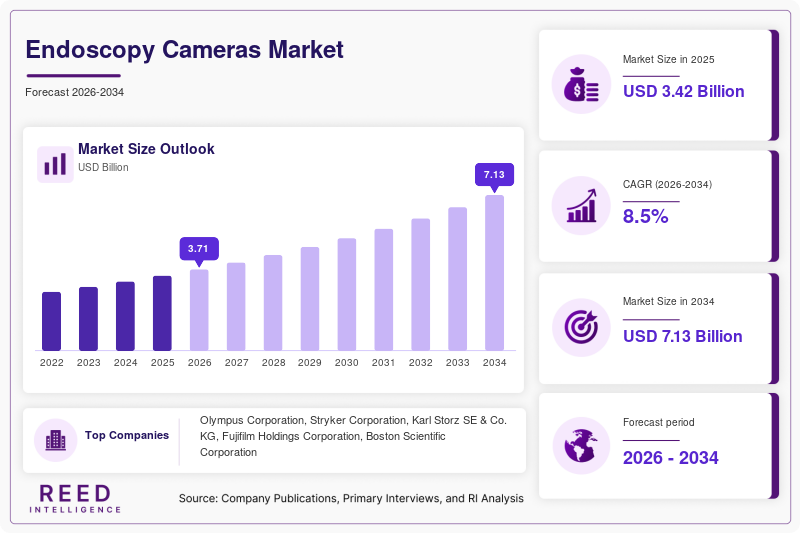
The Endoscopy Cameras Market was valued at USD 3.42 billion in 2026 and is projected to reach USD 6.58 billion by 2034, expanding at a CAGR of 8.5% during the forecast period (2026–2034). The market growth is strongly supported by the global shift toward minimally invasive surgical procedures, where endoscopic imaging plays a critical role in diagnosis and real-time surgical guidance. Healthcare providers across developed and emerging economies are increasingly investing in advanced visualization technologies, as these systems improve procedural accuracy, reduce surgical risks, and significantly shorten patient recovery time.
A major global growth factor for the Endoscopy Cameras Market is the rapid technological evolution in imaging systems, particularly the adoption of 4K ultra-high-definition and 3D visualization platforms. These innovations are transforming surgical environments by enabling clearer anatomical visualization, improved depth perception, and enhanced detection of abnormalities during complex procedures. As hospitals modernize operating rooms and outpatient facilities, demand for next-generation endoscopy cameras continues to expand at a steady pace.
Key Highlights
- Dominant region (2025): North America held 38.6% share of the global Endoscopy Cameras Market
- Fastest-growing region (2026–2034): Asia Pacific expected to grow at 9.7% CAGR
- Leading subsegment: Flexible endoscopy cameras dominated with 42.3% share in 2025
- Fastest-growing subsegment: Wireless endoscopy cameras growing at 10.8% CAGR
- Dominant country (2024): United States – USD 1.12 billion
- Dominant country (2025): United States – USD 1.21 billion
Market Trends
Shift Toward Ultra-High-Definition Imaging Systems
The Endoscopy Cameras Market is experiencing a strong transition from conventional imaging systems to ultra-high-definition technologies such as 4K and 3D endoscopy cameras. This shift is being driven by increasing demand for superior image clarity in complex surgical procedures, especially in gastroenterology and laparoscopic surgeries. Healthcare institutions are actively upgrading legacy systems to advanced imaging platforms to enhance diagnostic precision and surgical outcomes, which is further accelerating market expansion globally.
Rising Adoption of Wireless and Capsule-Based Technologies
Another important trend shaping the Endoscopy Cameras Market is the increasing adoption of wireless, capsule-based, and compact imaging systems. These technologies are gaining traction due to their ability to improve patient comfort, reduce procedural invasiveness, and enable remote diagnostic capabilities. The integration of wireless transmission and real-time data analytics is also supporting telemedicine applications, particularly in outpatient and ambulatory care settings.
Market Drivers
Increasing Demand for Minimally Invasive Surgical Procedures
The growing preference for minimally invasive procedures is one of the strongest drivers of the Endoscopy Cameras Market. These procedures are widely preferred by both patients and healthcare providers because they reduce hospital stays, minimize post-operative complications, and offer faster recovery compared to traditional surgeries. As chronic diseases such as gastrointestinal disorders and cancer continue to rise, the demand for endoscopic diagnostics and therapeutic procedures is also increasing significantly.
Expansion and Modernization of Healthcare Infrastructure
The expansion of healthcare infrastructure, particularly in emerging economies, is another major driver for the Endoscopy Cameras Market. Governments and private healthcare providers are investing heavily in hospital modernization, advanced diagnostic imaging systems, and surgical infrastructure upgrades. This is leading to increased installation of high-performance endoscopy systems in hospitals, diagnostic centers, and specialty clinics across Asia Pacific, Latin America, and parts of the Middle East.
Market Restraint
High Cost of Advanced Imaging Systems and Maintenance
Despite strong growth potential, the Endoscopy Cameras Market faces challenges due to the high cost associated with advanced imaging systems, installation, and maintenance. High-definition and 3D endoscopy systems require significant capital investment, which can be a major barrier for small hospitals and healthcare facilities in developing regions. Additionally, ongoing maintenance, software upgrades, and technical support further increase operational costs, limiting widespread adoption in cost-sensitive markets.
Market Opportunities
Integration of Artificial Intelligence in Endoscopic Imaging
The integration of artificial intelligence into imaging and diagnostic workflows presents a major opportunity in the Endoscopy Cameras Market. AI-powered systems can assist in real-time lesion detection, image enhancement, and automated diagnostic support, reducing the workload on surgeons and improving clinical accuracy. This trend is expected to redefine the future of endoscopic procedures by enabling faster and more reliable decision-making.
Expansion of Ambulatory Surgical and Outpatient Centers
The rapid growth of ambulatory surgical centers (ASCs) is creating new opportunities for the Endoscopy Cameras Market. These centers are increasingly adopting compact and cost-effective endoscopic imaging systems to support outpatient surgical procedures. The shift toward same-day surgeries and decentralized healthcare delivery models is expected to significantly boost demand for portable and efficient endoscopy camera systems.
Segmental Analysis
By Type
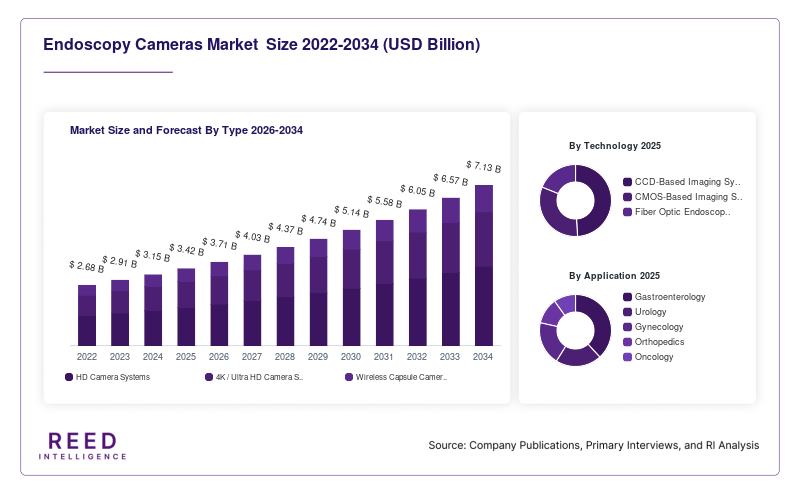
Flexible endoscopy cameras dominated the Endoscopy Cameras Market with 44.2% share in 2025, due to their wide usage in gastrointestinal and diagnostic applications. Their adaptability across multiple procedures makes them a standard choice in hospitals. Wireless endoscopy cameras, on the other hand, are expected to grow at 10.8% CAGR, driven by increasing demand for non-invasive capsule endoscopy and remote diagnostic capabilities.
By Application
Gastroenterology held 39.5% share in 2025, supported by rising prevalence of digestive disorders and increasing screening programs worldwide. Laparoscopy is expected to grow at 9.4% CAGR, driven by increasing adoption of minimally invasive abdominal surgeries and improved surgical precision offered by advanced imaging systems.
By End Use
Hospitals dominated the market with 58.1% share in 2025, due to high patient volume and availability of advanced surgical infrastructure. Ambulatory surgical centers are expected to grow at 10.1% CAGR, driven by rising outpatient procedures and demand for cost-efficient surgical care models.
By Technology
HD endoscopy cameras accounted for 46.7% share in 2025, as they offer a balance between cost and performance. However, 3D endoscopy systems are projected to grow at 9.8% CAGR, supported by improved depth perception and enhanced surgical accuracy.
Regional Analysis
North America
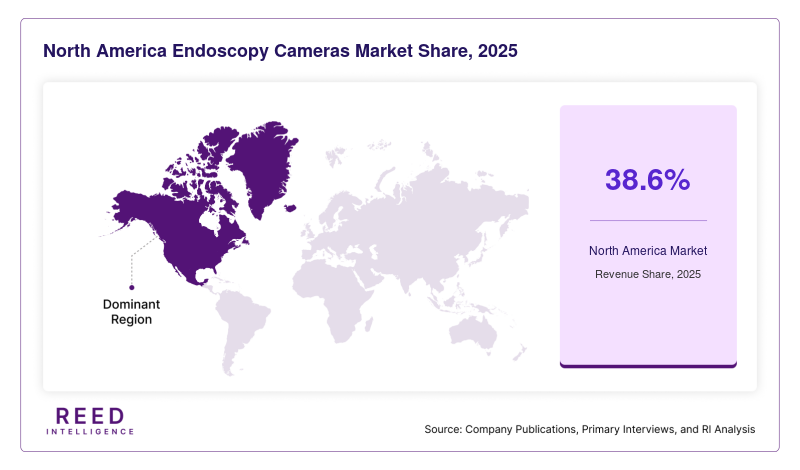
North America accounted for 38.6% share of the Endoscopy Cameras Market in 2025, supported by advanced healthcare infrastructure, high adoption of minimally invasive procedures, and strong presence of leading medical device manufacturers. The region is expected to grow at a 7.9% CAGR (2026–2034) as hospitals continue upgrading to AI-enabled and high-definition imaging systems. The United States dominates the region due to strong reimbursement systems, rapid technological adoption, and continuous innovation in surgical imaging technologies.
Europe
Europe held 27.4% share in 2025 and is projected to grow at a 7.2% CAGR during 2026–2034. The region benefits from strong regulatory frameworks, advanced medical device manufacturing capabilities, and increasing demand for precision diagnostics. Germany leads the European Endoscopy Cameras Market due to its well-established healthcare system and strong focus on medical technology innovation.
Asia Pacific
Asia Pacific accounted for 21.3% share in 2025 and is expected to register the fastest growth at 9.7% CAGR (2026–2034). Rapid expansion of healthcare infrastructure, increasing medical tourism, and rising government investments in hospital modernization are key growth drivers. China leads the regional market due to large patient population, growing healthcare expenditure, and expanding adoption of advanced surgical imaging systems.
Middle East & Africa
The Middle East & Africa region held 7.1% share in 2025 and is expected to grow at a 6.8% CAGR (2026–2034). Growth is supported by increasing investments in specialty hospitals, particularly in Gulf countries. Saudi Arabia dominates the region due to its healthcare modernization programs and rising adoption of advanced diagnostic imaging systems.
Latin America
Latin America accounted for 5.6% share in 2025 and is projected to grow at a 6.5% CAGR during the forecast period. Brazil leads the region, supported by expanding private healthcare infrastructure and increasing awareness of minimally invasive surgical procedures.
Competitive Landscape
The Endoscopy Cameras Market is highly competitive, with leading global players focusing on innovation, strategic partnerships, and product diversification. Key companies include Olympus Corporation, Karl Storz SE & Co. KG, Stryker Corporation, Medtronic plc, and Fujifilm Holdings Corporation. Olympus continues to maintain a strong position due to its advanced imaging portfolio, particularly in 4K and AI-enabled endoscopy systems.
Karl Storz emphasizes modular imaging platforms and precision optics, while Stryker focuses on integrated surgical visualization ecosystems. Medtronic is expanding its minimally invasive surgical solutions, and Fujifilm is strengthening its imaging enhancement technologies. Recent developments include AI-based diagnostic tools, wireless imaging systems, and cloud-connected surgical platforms. Competition in the Endoscopy Cameras Market is intensifying as companies focus on affordability, portability, and advanced visualization capabilities to capture emerging market demand.
Key Players List
- Olympus Corporation
- Karl Storz SE & Co. KG
- Stryker Corporation
- Medtronic plc
- Fujifilm Holdings Corporation
- HOYA Corporation
- Richard Wolf GmbH
- Smith & Nephew plc
- Boston Scientific Corporation
- ConMed Corporation
- Ambu A/S
- B. Braun Melsungen AG
- Pentax Medical
- Mindray Medical International
- SonoScape Medical Corp
Recent Developments
- In 2026, Olympus Corporation introduced an upgraded imaging platform with enhanced digital clarity for advanced endoscopic procedures.
- Stryker Corporation expanded its visualization portfolio with improved integration between imaging systems and surgical environments.
- Fujifilm Holdings launched a compact CMOS-based endoscopy camera designed for outpatient surgical applications.
- Karl Storz announced expansion of its manufacturing capacity to meet increasing global demand for endoscopic imaging systems.
- Boston Scientific continued development of AI-assisted imaging tools aimed at improving lesion detection and diagnostic precision in endoscopy workflows.
Endoscopy Cameras Market Segments
By Type
- HD Camera Systems
- 4K / Ultra HD Camera Systems
- Wireless Capsule Cameras
By Technology
- CCD-Based Imaging Systems
- CMOS-Based Imaging Systems
- Fiber Optic Endoscopic Systems
By Application
- Gastroenterology
- Urology
- Gynecology
- Orthopedics
- Oncology
By End Use
- Hospitals
- Ambulatory Surgical Centers
- Specialty Clinics
- Diagnostic Centers
By Region
- North America
- Europe
- APAC
- Middle East and Africa
- LATAM