Energy Harvesting for Small Sensor Market Size, Share Demand Report By Technology (Solar Energy Harvesting, Thermal Energy Harvesting, Vibration Energy Harvesting, Radio Frequency Energy Harvesting), By Application (Industrial IoT, Smart Healthcare Monitoring, Environmental Monitoring, Smart Buildings), By End-Use (Industrial, Healthcare, Consumer Electronics, Agriculture), By Region & Segment Forecasts, 2026–2034
USD 3950
Market Overview
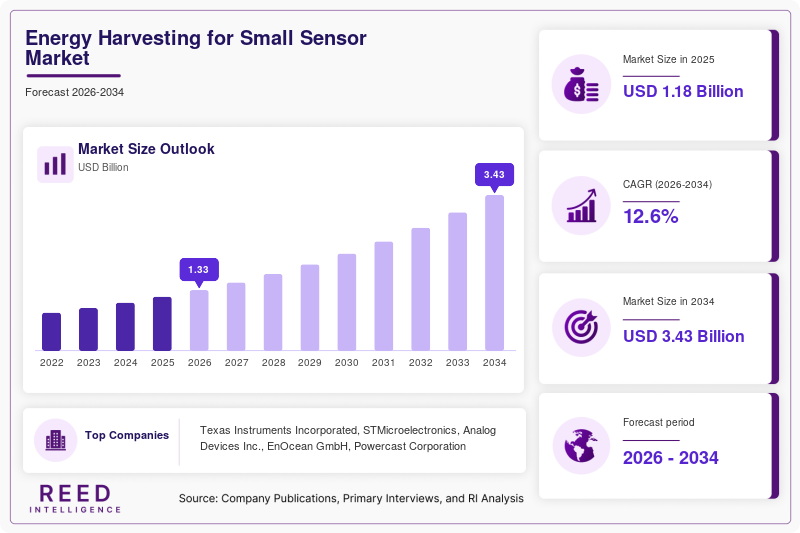
The global Energy Harvesting for Small Sensor Market size was valued at approximately USD 1.18 billion in 2026 and is projected to reach USD 3.05 billion by 2034, expanding at a CAGR of 12.6% during the forecast period (2026–2034). This growth reflects increasing adoption of low-power electronics, wireless sensor networks, and battery-free solutions across industries such as healthcare, industrial automation, and smart infrastructure. The market has evolved from niche deployments into a broader ecosystem supported by advancements in microelectronics, energy-efficient communication protocols, and sustainable design practices.
A key global factor supporting market growth is the rising demand for maintenance-free and long-lasting sensor systems. Traditional battery-powered sensors often require periodic replacement, which increases operational costs and environmental burden. Energy harvesting technologies—such as solar, thermal, vibration, and radio frequency harvesting—enable continuous operation without external power sources. This capability is especially valuable in remote, hazardous, or inaccessible environments, where replacing batteries is complex or costly. As industries move toward predictive maintenance and real-time monitoring, energy harvesting is becoming a practical solution for powering distributed sensor networks.
Key Highlights
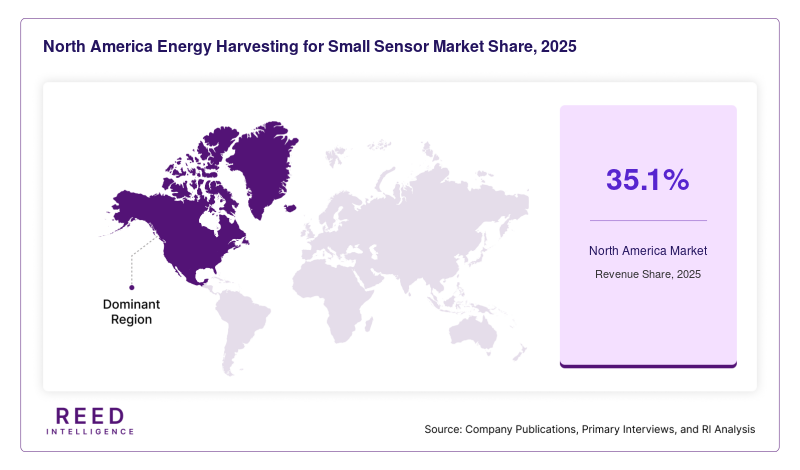
- North America dominated the market with a 35.1% share in 2025.
- Asia Pacific is expected to grow at the fastest CAGR of 13.4% during 2026–2034.
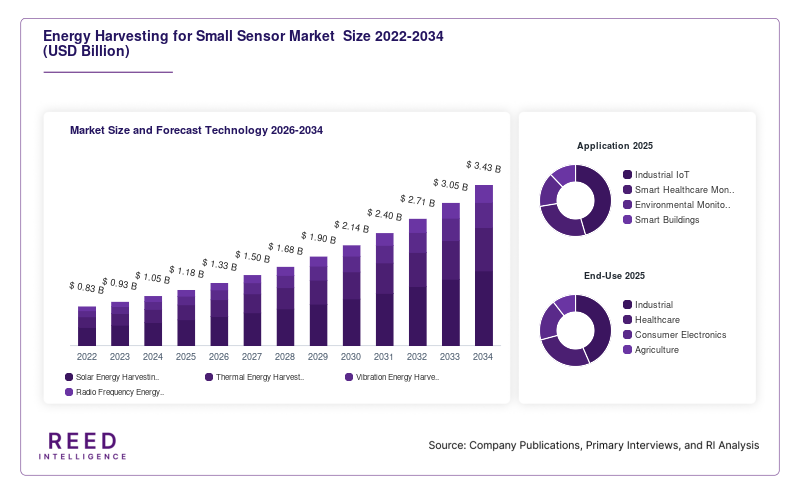
- By technology, solar energy harvesting accounted for the largest share of 39.2%, while vibration-based systems are projected to grow at a CAGR of 13.1%.
- By application, industrial IoT led with a 42.6% share, whereas smart healthcare monitoring is expected to expand at a CAGR of 12.9%.
- The United States remained the dominant country, with market values of USD 520 million in 2024 and USD 575 million in 2025.
Market Trends
Growing Integration of Energy Harvesting in IoT Ecosystems
The integration of energy harvesting technologies into Internet of Things ecosystems is becoming a central trend in the market. As IoT deployments expand across industrial, commercial, and residential sectors, the need for scalable and low-maintenance power solutions has intensified. Energy harvesting enables sensors to operate autonomously by converting ambient energy into usable electrical power. This eliminates the need for wired infrastructure or frequent battery replacement, reducing installation and maintenance costs.
Moreover, advancements in ultra-low-power chipsets and communication protocols such as Bluetooth Low Energy and LoRaWAN are enhancing compatibility with energy harvesting systems. These developments allow sensors to function efficiently even with limited energy input. The trend is particularly evident in smart buildings, agriculture monitoring, and asset tracking, where thousands of sensors are deployed simultaneously. As organizations aim to scale IoT networks, energy harvesting is becoming a practical and cost-effective solution that aligns with long-term operational efficiency and sustainability goals.
Advancements in Hybrid Energy Harvesting Systems
Another notable trend is the development of hybrid energy harvesting systems that combine multiple energy sources to improve reliability and performance. Instead of relying on a single energy source such as solar or thermal, hybrid systems integrate two or more mechanisms—such as solar and vibration or thermal and RF—to ensure continuous power generation under varying environmental conditions. This approach addresses the limitations of individual energy harvesting methods, such as dependence on sunlight or specific temperature gradients.
Hybrid systems are gaining traction in industrial environments where energy conditions fluctuate. For example, machinery may produce vibration energy intermittently, while ambient heat remains constant. Combining these sources ensures stable power output for sensors. Additionally, research into energy storage components such as supercapacitors and micro-batteries is enhancing the efficiency of hybrid systems. These innovations are enabling broader adoption across sectors that require consistent and reliable sensor performance, including transportation, healthcare, and smart cities.
Market Drivers
Increasing Demand for Battery-Free Sensor Solutions
The growing demand for battery-free sensor solutions is a major driver of the energy harvesting for small sensor market. Industries are increasingly seeking alternatives to traditional battery-powered systems due to the limitations associated with battery lifespan, replacement costs, and environmental impact. Energy harvesting technologies offer a sustainable solution by enabling sensors to operate continuously without manual intervention.
In industrial settings, battery replacement can lead to downtime and increased labor costs, particularly in large-scale deployments. Energy harvesting eliminates these challenges by providing a self-sustaining power source. This is especially beneficial in applications such as structural health monitoring, environmental sensing, and industrial automation, where sensors are often deployed in remote or hard-to-reach locations. The ability to maintain uninterrupted operation enhances system reliability and reduces total cost of ownership. As industries prioritize efficiency and sustainability, the demand for battery-free solutions is expected to continue driving market growth.
Expansion of Smart Infrastructure and Industrial Automation
The rapid expansion of smart infrastructure and industrial automation is another key driver of market growth. Governments and private organizations are investing heavily in smart city projects, which rely on interconnected sensor networks to monitor and manage urban systems such as traffic, energy consumption, and environmental conditions. Energy harvesting technologies enable these sensors to function independently, reducing the need for extensive wiring and maintenance.
In industrial automation, energy harvesting supports predictive maintenance and real-time monitoring by powering sensors attached to machinery and equipment. These sensors collect data on parameters such as vibration, temperature, and pressure, enabling early detection of potential issues. This helps organizations improve operational efficiency and reduce downtime. The increasing adoption of Industry 4.0 practices is further accelerating demand for energy harvesting solutions, as companies seek to implement intelligent and autonomous systems across their operations.
Market Restraint
High Initial Costs and Integration Challenges
Despite its advantages, the energy harvesting for small sensor market faces challenges related to high initial costs and integration complexity. Implementing energy harvesting systems often requires specialized components, including energy converters, power management circuits, and storage devices. These components can increase the upfront cost of deployment compared to conventional battery-powered solutions.
Additionally, integrating energy harvesting technologies into existing systems can be technically complex. Engineers must carefully design systems to match energy availability with sensor power requirements, which can vary depending on environmental conditions. Inconsistent energy sources may affect performance, requiring advanced power management strategies. For example, in indoor environments with limited sunlight, solar harvesting systems may not generate sufficient energy to sustain continuous operation. These challenges can limit adoption, particularly among small and medium enterprises with budget constraints. However, ongoing advancements in technology and economies of scale are expected to gradually reduce costs and simplify integration processes.
Market Opportunities
Rising Adoption in Healthcare Monitoring Applications
The increasing adoption of energy harvesting in healthcare monitoring presents significant opportunities for market growth. Wearable and implantable medical devices require reliable and long-lasting power sources to ensure continuous monitoring of patient health. Energy harvesting technologies can convert body heat, motion, or ambient light into electrical energy, enabling these devices to operate without frequent battery replacement.
This capability is particularly valuable in remote patient monitoring and chronic disease management, where continuous data collection is essential. Energy harvesting reduces the need for invasive procedures to replace batteries in implantable devices, improving patient comfort and safety. Additionally, the growing focus on preventive healthcare and digital health solutions is driving demand for advanced sensor technologies. As healthcare systems increasingly adopt connected devices, energy harvesting is expected to play a crucial role in supporting the development of sustainable and efficient medical solutions.
Emerging Applications in Smart Agriculture and Environmental Monitoring
Energy harvesting is also creating opportunities in smart agriculture and environmental monitoring. Farmers are increasingly using sensor networks to monitor soil moisture, temperature, and crop health. Energy harvesting enables these sensors to operate autonomously in remote fields without access to power infrastructure. This reduces maintenance requirements and ensures continuous data collection, which is critical for optimizing agricultural practices.
In environmental monitoring, energy harvesting supports the deployment of sensors in challenging locations such as forests, oceans, and mountainous regions. These sensors collect data on air quality, water levels, and climate conditions, contributing to better resource management and disaster prevention. The ability to operate independently for extended periods makes energy harvesting an attractive solution for these applications. As global concerns about sustainability and environmental protection continue to grow, the demand for energy harvesting technologies in these sectors is expected to increase.
Segmental Analysis
By Technology
Solar energy harvesting emerged as the dominant subsegment, accounting for approximately 39.2% of the market share in 2024. This dominance is attributed to the widespread availability of solar energy and the relatively mature technology associated with photovoltaic systems. Solar harvesting is widely used in outdoor applications such as environmental monitoring, smart agriculture, and infrastructure management. The decreasing cost of solar panels and advancements in efficiency have further supported adoption. Additionally, solar-based systems are easy to integrate with sensor networks, making them a preferred choice for many applications.
Vibration-based energy harvesting is projected to be the fastest-growing subsegment, with a CAGR of 13.1% during the forecast period. This growth is driven by increasing adoption in industrial environments where machinery generates mechanical vibrations. These systems convert kinetic energy into electrical energy, enabling sensors to operate continuously. The ability to harness energy from existing mechanical processes makes vibration-based harvesting an efficient solution for industrial applications.
By Application
Industrial IoT accounted for the largest share of 42.6% in 2024, driven by the growing adoption of smart manufacturing and automation technologies. Energy harvesting enables the deployment of wireless sensor networks across industrial facilities, supporting real-time monitoring and predictive maintenance. This helps organizations improve operational efficiency and reduce downtime. The increasing focus on Industry 4.0 is further driving demand for energy harvesting solutions in this segment.
Smart healthcare monitoring is expected to be the fastest-growing subsegment, with a CAGR of 12.9% during the forecast period. The growth is driven by the increasing adoption of wearable and implantable medical devices. Energy harvesting technologies enable these devices to operate without frequent battery replacement, improving patient comfort and reducing maintenance requirements.
By End-Use
The industrial sector held the largest share of 44.3% in 2024, driven by the widespread adoption of energy harvesting technologies in manufacturing and automation processes. Industries are increasingly using sensor networks to monitor equipment performance and optimize operations. Energy harvesting enables these sensors to operate autonomously, reducing maintenance costs and improving efficiency.
The healthcare sector is expected to be the fastest-growing subsegment, with a CAGR of 12.7% during the forecast period. The growth is driven by increasing demand for advanced medical devices and remote patient monitoring solutions. Energy harvesting technologies support the development of sustainable and efficient healthcare systems.
Regional Analysis
North America
North America accounted for approximately 35.1% of the global market share in 2025 and is expected to maintain steady growth at a CAGR of 11.8% during the forecast period. The region benefits from strong technological infrastructure, high adoption of IoT solutions, and significant investment in research and development. Industries such as healthcare, aerospace, and industrial automation are driving demand for energy harvesting technologies, particularly for applications requiring reliable and maintenance-free sensor systems.
The United States dominates the regional market, supported by advancements in smart infrastructure and industrial automation. A unique growth factor is the widespread adoption of predictive maintenance solutions across manufacturing sectors. Companies are increasingly deploying energy-harvesting sensors to monitor equipment performance and reduce downtime. This trend is expected to sustain market growth in the region.
Europe
Europe held a market share of around 26.4% in 2025 and is projected to grow at a CAGR of 12.1% through 2034. The region’s focus on sustainability and energy efficiency is a key driver of market growth. Governments are implementing regulations and initiatives to reduce carbon emissions, encouraging the adoption of energy-efficient technologies such as energy harvesting systems for small sensors.
Germany leads the European market due to its strong industrial base and emphasis on Industry 4.0 initiatives. A unique growth factor is the integration of energy harvesting technologies in smart manufacturing processes. German companies are adopting advanced sensor systems to enhance production efficiency and reduce energy consumption, supporting the growth of the market.
Asia Pacific
Asia Pacific is expected to be the fastest-growing region, with a CAGR of 13.4% during the forecast period, and accounted for approximately 22.7% of the market share in 2025. Rapid industrialization, urbanization, and increasing adoption of smart technologies are driving demand for energy harvesting solutions. The region is witnessing significant investments in smart city projects and industrial automation.
China dominates the regional market, supported by large-scale manufacturing activities and government initiatives promoting smart infrastructure. A unique growth factor is the expansion of smart agriculture practices, where energy-harvesting sensors are used to monitor crop conditions and optimize resource utilization. This is contributing to the rapid growth of the market in the region.
Middle East & Africa
The Middle East & Africa region accounted for around 8.5% of the market share in 2025 and is expected to grow at a CAGR of 10.9% during the forecast period. The adoption of energy harvesting technologies is gradually increasing, driven by investments in infrastructure development and smart city initiatives. The region is focusing on improving energy efficiency and reducing dependence on traditional power sources.
The United Arab Emirates is a key market in the region, with a unique growth factor being the development of smart city projects such as Dubai’s digital transformation initiatives. These projects involve the deployment of large-scale sensor networks, creating demand for energy harvesting solutions to support sustainable and efficient operations.
Latin America
Latin America held a market share of approximately 7.3% in 2025 and is projected to grow at a CAGR of 11.2% during the forecast period. The region is experiencing increasing adoption of IoT technologies in sectors such as agriculture, mining, and environmental monitoring. Energy harvesting is gaining attention as a cost-effective solution for powering sensors in remote and off-grid locations.
Brazil dominates the regional market, supported by its large agricultural sector. A unique growth factor is the use of energy-harvesting sensors in precision agriculture. Farmers are leveraging these technologies to monitor soil conditions and optimize irrigation practices, contributing to improved productivity and resource efficiency.
Competitive Landscape
The energy harvesting for small sensor market is characterized by the presence of several established players and emerging companies focusing on innovation and strategic partnerships. Leading companies are investing in research and development to enhance the efficiency and reliability of energy harvesting technologies. They are also expanding their product portfolios to cater to diverse applications across industries.
Texas Instruments Incorporated is considered a leading player in the market, known for its advanced power management solutions and energy harvesting integrated circuits. A recent development includes the introduction of ultra-low-power energy harvesting chips designed for IoT applications, enabling improved efficiency and extended device lifespan. Other companies are focusing on collaborations and acquisitions to strengthen their market position and expand their global presence.
Key Players
- Texas Instruments Incorporated
- STMicroelectronics
- Analog Devices Inc.
- EnOcean GmbH
- Powercast Corporation
- Cymbet Corporation
- e-peas SA
- ABB Ltd.
- Schneider Electric SE
- Honeywell International Inc.
- Microchip Technology Inc.
- Fujitsu Limited
- Renesas Electronics Corporation
- Silicon Laboratories Inc.
- Murata Manufacturing Co., Ltd.
Recent Developments
- A leading semiconductor company launched a new energy harvesting PMIC designed for ultra-low-power IoT sensors, improving efficiency and reducing energy loss.
- A technology firm introduced a hybrid energy harvesting module combining solar and vibration energy for industrial applications.
- A global electronics manufacturer partnered with a healthcare provider to develop energy-harvesting wearable devices for remote patient monitoring.
Energy Harvesting for Small Sensor Market Segments
Technology
- Solar Energy Harvesting
- Thermal Energy Harvesting
- Vibration Energy Harvesting
- Radio Frequency Energy Harvesting
Application
- Industrial IoT
- Smart Healthcare Monitoring
- Environmental Monitoring
- Smart Buildings
End-Use
- Industrial
- Healthcare
- Consumer Electronics
- Agriculture
By Region
- North America
- Europe
- APAC
- Middle East and Africa
- LATAM