Energy Storage For Unmanned Aerial Vehicle Market Size, Share & Demand Report By Type (Lithium-ion Batteries, Lithium-sulfur Batteries, Solid-state Batteries, Hydrogen Fuel Cells), By UAV Type (Fixed-wing, Rotary-wing, Hybrid), By Application (Defense, Commercial, Industrial), By End-Use (Government & Defense, Commercial Enterprises) By Region & Segment Forecasts, 2026–2034
USD 3950
Market Overview
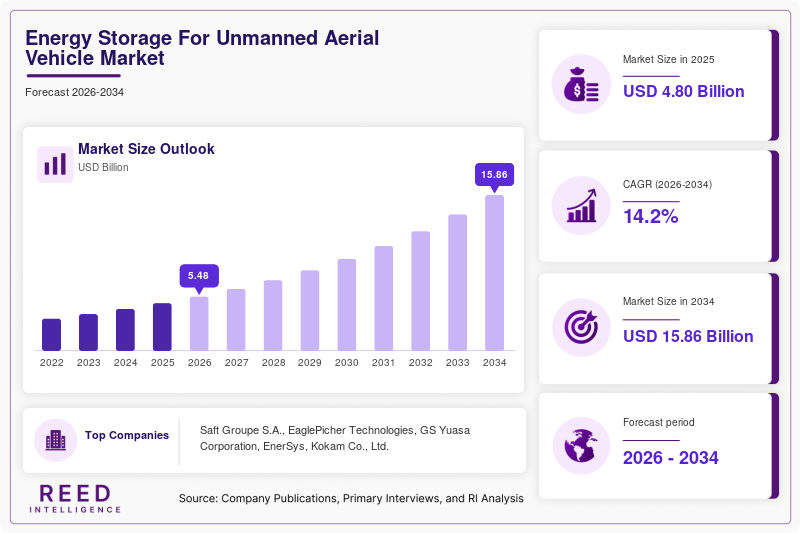
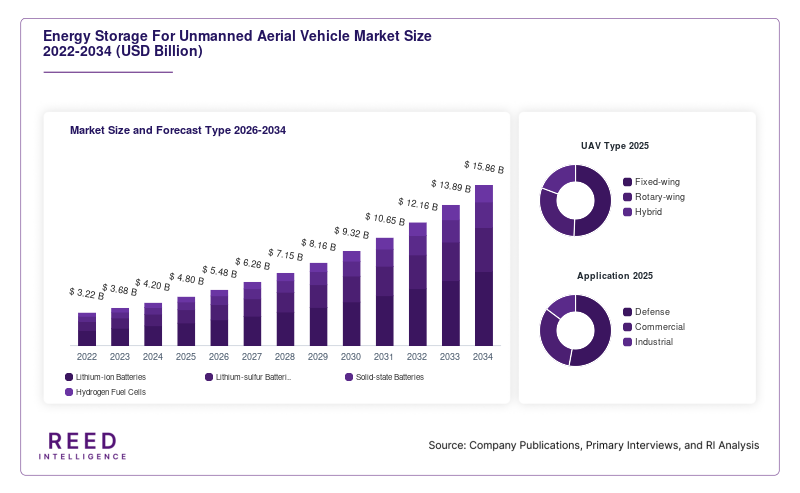
The Energy Storage For Unmanned Aerial Vehicle Market size was valued at approximately USD 4.8 billion in 2026 and is projected to reach USD 13.9 billion by 2034, expanding at a CAGR of 14.2% during the forecast period (2026–2034). The market has experienced consistent expansion due to increasing deployment of unmanned aerial vehicles (UAVs) across defense, agriculture, logistics, and surveillance applications. One of the primary global factors supporting market growth is the rising demand for long-endurance drones, which has accelerated innovation in advanced energy storage technologies such as lithium-sulfur batteries, hydrogen fuel cells, and hybrid energy systems.
Energy storage systems are a critical component in UAV operations, influencing flight duration, payload capacity, and operational efficiency. The growing emphasis on reducing downtime and improving energy density has led to significant investments in battery innovation and lightweight storage solutions. Additionally, regulatory support for drone adoption in commercial sectors has further driven demand for efficient and reliable energy storage systems.
Key Highlights:
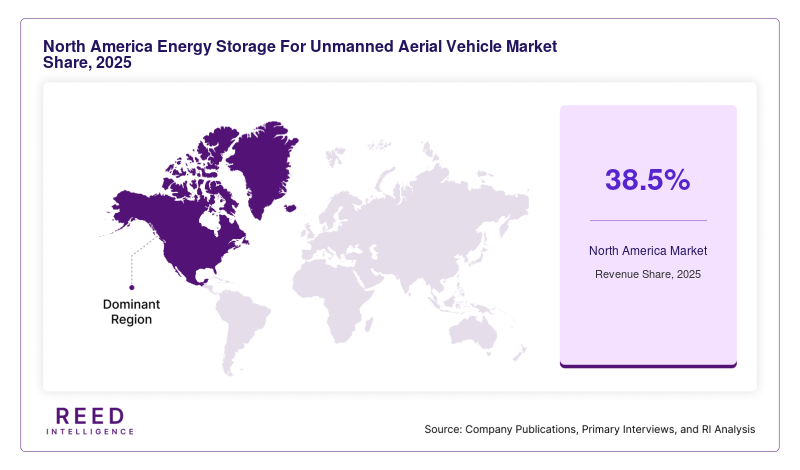
- North America dominated the market with a share of 38.5% in 2025, while Asia Pacific is expected to register the fastest growth at a CAGR of 16.1%.
- Lithium-ion batteries led the type segment with a share of 52.3%, while hydrogen fuel cells are projected to grow at a CAGR of 17.4%.
- Defense applications accounted for the largest share of 46.7%, while commercial logistics is expected to expand at a CAGR of 15.8%.
- The United States recorded market values of USD 1.52 billion in 2024 and USD 1.68 billion in 2025, maintaining its leadership position.
Market Trends
Shift Toward High Energy Density Storage Solutions
A key trend shaping the Energy Storage For Unmanned Aerial Vehicle Market is the increasing focus on high energy density storage technologies. Traditional lithium-ion batteries are being enhanced to deliver improved performance, while alternative solutions such as lithium-sulfur and solid-state batteries are gaining attention. These technologies offer higher energy-to-weight ratios, which are essential for extending UAV flight time without increasing payload. This trend is particularly significant for military and long-range surveillance drones, where endurance is critical.
Integration of Hybrid Energy Systems
Another emerging trend is the adoption of hybrid energy storage systems that combine batteries with fuel cells or supercapacitors. These systems provide a balance between power output and energy efficiency, enabling UAVs to operate for extended periods while maintaining performance stability. Hybrid systems also reduce the risk of energy depletion during critical missions. The trend is gaining traction in commercial applications such as delivery drones and industrial inspection UAVs, where operational continuity is vital.
Market Drivers
Rising Demand for Long-Endurance UAV Operations
The increasing need for extended flight duration in UAV applications is a major driver of the Energy Storage For Unmanned Aerial Vehicle Market. Industries such as defense and surveillance require drones capable of operating for several hours without interruption. This has driven the development of advanced energy storage systems with higher capacity and efficiency. Enhanced endurance reduces the need for frequent recharging or battery replacement, improving operational productivity.
Expansion of Commercial Drone Applications
The rapid expansion of commercial UAV applications, including agriculture monitoring, infrastructure inspection, and last-mile delivery, has significantly contributed to market growth. These applications require reliable energy storage systems that can support consistent performance across varying conditions. The increasing adoption of drones by enterprises has led to higher demand for efficient and durable energy storage technologies.
Market Restraint
High Cost of Advanced Energy Storage Technologies
One of the major restraints in the Energy Storage For Unmanned Aerial Vehicle Market is the high cost associated with advanced energy storage solutions. Technologies such as hydrogen fuel cells and solid-state batteries require significant investment in research, development, and manufacturing. These costs are often passed on to end users, limiting adoption, particularly among small and medium enterprises. Additionally, the lack of large-scale production infrastructure for emerging technologies further contributes to higher prices. The cost factor remains a critical challenge, especially in price-sensitive markets where affordability plays a key role in technology adoption.
Market Opportunities
Development of Next-Generation Battery Technologies
The ongoing research in next-generation battery technologies presents a significant opportunity for the Energy Storage For Unmanned Aerial Vehicle Market. Innovations in solid-state batteries and lithium-sulfur chemistry are expected to deliver improved energy density, safety, and lifecycle performance. These advancements can address current limitations and open new application areas for UAVs.
Growth in Autonomous Delivery Networks
The increasing adoption of autonomous delivery systems offers substantial growth opportunities for energy storage providers. Logistics companies are investing in drone delivery solutions to enhance efficiency and reduce operational costs. This trend is expected to drive demand for high-performance energy storage systems capable of supporting frequent and long-distance flights.
Segmental Analysis
By Type
Lithium-ion batteries dominated the segment with a 52.3% share in 2025, owing to their high energy density, reliability, and widespread availability.
Hydrogen fuel cells are expected to grow at a CAGR of 17.4%, driven by their ability to provide longer flight durations and reduced environmental impact.
By UAV Type
Fixed-wing UAVs accounted for the largest share of 48.6% in 2025, as they are widely used in long-range and high-endurance applications.
Hybrid UAVs are projected to grow at a CAGR of 16.8%, supported by their ability to combine vertical takeoff capabilities with long flight endurance.
By Application
Defense applications dominated with a 46.7% share in 2025, driven by increasing demand for surveillance and reconnaissance drones.
Commercial logistics is expected to grow at a CAGR of 15.8%, fueled by the rise of drone delivery services.
By End-Use
Government and defense sectors held the largest share of 49.2% in 2025, due to high investments in UAV technologies.
Commercial enterprises are anticipated to grow at a CAGR of 15.6%, supported by expanding use cases across industries.
Regional Analysis
North America
North America held a market share of 38.5% in 2025 and is expected to grow at a CAGR of 13.5% during 2026–2034. The region has a well-established UAV ecosystem supported by strong investments in defense and commercial drone technologies.
The United States dominated the regional market due to its advanced defense infrastructure and increasing adoption of UAVs in commercial sectors. The presence of major drone manufacturers and energy storage companies has further strengthened market growth.
Europe
Europe accounted for 24.2% of the market in 2025 and is projected to grow at a CAGR of 13.1%. The region has seen steady adoption of UAVs across industrial and environmental monitoring applications.
Germany emerged as the leading country, driven by its focus on technological innovation and sustainability initiatives. The integration of advanced energy storage systems in UAVs has been supported by strong research and development activities.
Asia Pacific
Asia Pacific captured 21.8% of the market in 2025 and is expected to grow at the fastest CAGR of 16.1%. Rapid industrialization and increasing drone adoption across various sectors have driven market expansion.
China led the region, supported by large-scale manufacturing capabilities and increasing investments in drone technology. The country's focus on innovation has accelerated the development of efficient energy storage solutions.
Middle East & Africa
The Middle East & Africa held a 9.3% market share in 2025 and is expected to grow at a CAGR of 12.6%. The region has witnessed increasing adoption of UAVs for surveillance and infrastructure monitoring.
The United Arab Emirates dominated the market due to its investments in smart technologies and drone-based solutions. The demand for reliable energy storage systems has increased alongside the expansion of UAV applications.
Latin America
Latin America accounted for 6.2% of the market in 2025 and is projected to grow at a CAGR of 12.9%. The region has seen growing adoption of drones in agriculture and environmental monitoring.
Brazil emerged as the leading country, driven by its large agricultural sector and increasing use of UAVs for crop monitoring. The demand for efficient energy storage systems has risen with the expansion of drone usage.
Competitive Landscape
The Energy Storage For Unmanned Aerial Vehicle Market is moderately competitive, with several players focusing on technological innovation and strategic partnerships. Leading companies are investing in advanced battery technologies and hybrid energy systems to enhance product performance.
A market leader, Saft Groupe S.A., has recently introduced advanced lithium-ion battery solutions designed specifically for UAV applications, improving energy efficiency and operational reliability. Other players are focusing on expanding their product portfolios and strengthening their global presence through collaborations and acquisitions.
Key Players List
- Saft Groupe S.A.
- EaglePicher Technologies
- GS Yuasa Corporation
- EnerSys
- Kokam Co., Ltd.
- Panasonic Corporation
- LG Energy Solution
- Tesla, Inc.
- Ballard Power Systems
- Plug Power Inc.
- Intelligent Energy Limited
- Amprius Technologies
- Sion Power Corporation
- QuantumScape Corporation
- BYD Company Limited
Recent Developments
- 2025: Saft Groupe S.A. launched a new UAV battery platform with enhanced lifecycle performance.
- 2025: Ballard Power Systems expanded its hydrogen fuel cell solutions for drone applications.
- 2024: Amprius Technologies introduced high-energy-density silicon anode batteries.
- 2024: Plug Power Inc. partnered with drone manufacturers to integrate hydrogen energy systems.
- 2023: GS Yuasa Corporation developed lightweight lithium-ion batteries for UAVs.
Energy Storage For Unmanned Aerial Vehicle Market Segments
Type
- Lithium-ion Batteries
- Lithium-sulfur Batteries
- Solid-state Batteries
- Hydrogen Fuel Cells
UAV Type
- Fixed-wing
- Rotary-wing
- Hybrid
Application
- Defense
- Commercial
- Industrial
End-Use
- Government & Defense
- Commercial Enterprises
By Region
- North America
- Europe
- APAC
- Middle East and Africa
- LATAM