Energy Storage Systems (ESS) Market Size, Share & Trends Analysis Report By Technology (Battery Energy Storage Systems, Pumped Hydro Storage, Thermal Energy Storage, Flywheel Energy Storage, Other Technologies), By Component (Battery, Power Conversion System, Energy Management System, Thermal Management System, Other Components), By Application (Grid-Scale Storage, Behind-the-Meter Storage, Off-Grid Storage), By End Use (Utilities, Commercial & Industrial, Residential, Renewable Energy Projects)
USD 3950
Energy Storage Systems (ESS) Market Size
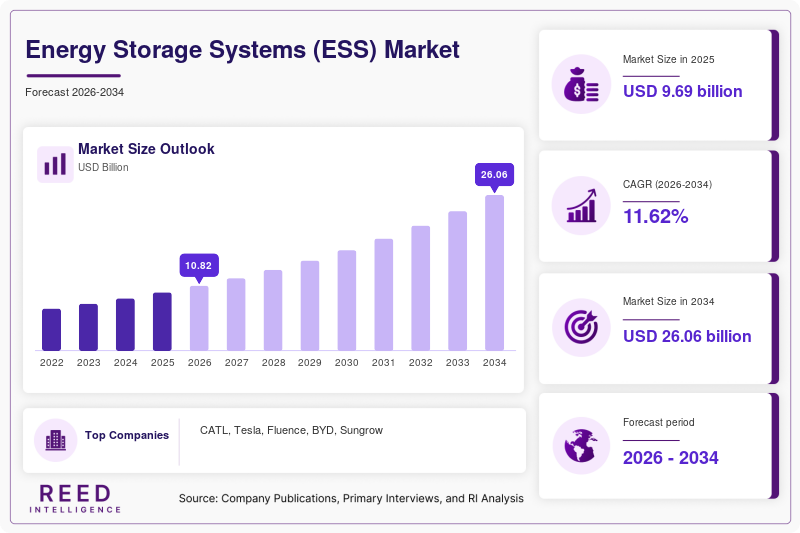
The global energy storage systems (ESS) market size was valued at USD 9.69 billion in 2025 and is projected to grow from USD 10.82 billion in 2026 to USD 26.06 billion by 2034, registering a CAGR of 11.62% during the forecast period from 2026 to 2034.
The Energy Storage Systems Market is moving from a supporting role in electricity networks toward a core flexibility asset for power systems with increasing renewable generation. Battery storage capacity additions reached 108 GW globally in 2025, approximately 40% above 2024, according to the International Energy Agency (IEA). Around 80% of new battery capacity was utility-scale, while the remainder was deployed behind the meter in commercial and residential applications.
The commercial requirement is increasingly connected to the mismatch between when electricity is generated and when it is consumed. Solar generation can create excess electricity during daylight hours, while electricity demand often rises later in the day. Storage allows electricity to be shifted across time, provides balancing services, supports capacity availability, and can reduce congestion on electricity networks. The IEA reports that energy shifting represented more than 90% of new battery-storage projects by primary application in 2025, compared with around 40% in 2015.
Energy Storage Systems (ESS) Market Drivers
Rising Renewable Energy Integration
The expansion of solar and wind generation is increasing the value of energy storage because renewable output does not always coincide with electricity demand. Storage can absorb surplus electricity and discharge it during periods of higher demand, while also providing frequency regulation and other grid services.
The IEA reports that battery storage additions reached 108 GW in 2025, with utility-scale systems accounting for about 87 GW. Around 24 GW of utility-scale additions were co-located with renewable projects.
This creates a direct market mechanism: higher renewable penetration increases the need for flexible resources capable of shifting electricity across hours. Storage developers can therefore participate in energy arbitrage, capacity markets, ancillary services, congestion management, and renewable integration. The increasing duration of projects also reflects this shift; the average duration of utility-scale projects commissioned in 2025 increased to around three hours from approximately two hours in 2023.
Declining Battery Costs
Falling battery costs are improving the economics of utility-scale and distributed energy storage. The IEA estimates that utility-scale battery storage project costs declined by approximately 40% during 2024 to around USD 150/kWh, while lithium-ion battery pack prices declined another 8% in 2025.
Lower system costs reduce the capital required for a given storage capacity and improve the economics of projects that earn revenue through energy shifting, capacity payments, ancillary services, or renewable integration.
The impact is visible in deployment. Global battery-storage additions rose approximately 40% in 2025, while the United States added 19 GW of battery capacity during the year.
Growing Grid Flexibility and Reliability Requirements
Energy systems increasingly require flexible resources that can respond quickly to changes in electricity demand and generation. Battery systems can inject or absorb electricity rapidly, making them suitable for balancing, frequency regulation, capacity provision, and congestion management.
The IEA describes batteries as one of the most versatile flexibility technologies for integrating wind and solar, supporting system security, and potentially deferring some network upgrades.
The requirement extends beyond renewable integration. Electrification of vehicles, heating, industrial processes, and data centers can create new concentrated loads that increase the need for local flexibility. Storage can help manage these demand patterns and provide backup or resilience where grid reliability is a concern.
Energy Storage Systems (ESS) Market Restraints
Grid Connection, Permitting and Revenue Uncertainty
Large energy-storage projects can face lengthy grid-connection and permitting processes. The IEA reports that many utility-scale battery projects experience multi-year delays related to grid connections, planning approvals, and local concerns, including fire safety. Revenue uncertainty can also complicate project financing because storage projects may depend on multiple revenue streams rather than a single long-term contract.
This affects developers through longer development cycles and delayed returns on invested capital. In markets where capacity, ancillary-service, and energy-arbitrage revenues are not sufficiently predictable, financing costs can become an important barrier.
Battery Supply Chain and Safety Requirements
Battery storage systems depend heavily on battery cells, power electronics, thermal management, software, and safety systems. Lithium-ion technology currently dominates battery deployment, with LFP representing around 90% of global battery-storage deployments in 2025.
Concentration in particular battery chemistries and manufacturing regions can expose project developers to supply-chain disruptions, trade measures, material-price changes, and logistics constraints. Safety requirements also add engineering and operating costs because large battery installations require thermal management, monitoring, fire protection, and emergency-response systems.
Energy Storage Systems (ESS) Market Opportunities
Expansion of Long-Duration Energy Storage
Long-duration energy storage provides an opportunity beyond conventional two- to four-hour battery systems. As renewable penetration increases, electricity systems can require storage that shifts energy over longer periods or provides backup during extended periods of low renewable output.
The U.S. Department of Energy has supported pilot programs focused on non-lithium technologies and systems capable of 10 hours or more of discharge. A DOE long-duration storage program received 141 concept papers requesting more than USD 1.5 billion against a USD 100 million funding opportunity, indicating substantial technology-development interest.
Technologies under development include flow batteries, thermal storage, compressed-air systems, hydrogen-based storage, and other mechanical or electrochemical approaches. Commercial adoption will depend on lifetime cost, round-trip efficiency, duration, safety, and the revenue structures available in individual power markets.
Growth of Distributed and Behind-the-Meter Storage
Behind-the-meter storage provides opportunities across residential, commercial, and industrial applications. These systems can reduce peak electricity purchases, provide backup power, improve solar self-consumption, and participate in virtual power plants where market structures allow.
The IEA reported that behind-the-meter battery deployment accelerated in 2025, particularly in markets with high retail electricity prices and supportive regulatory frameworks.
The U.S. Department of Energy also reopened its Beyond the Meter Prize in February 2026, offering USD 3.4 million in cash prizes and USD 800,000 in laboratory vouchers to support consumer-focused behind-the-meter energy-storage solutions.
Segmental Analysis
By Technology
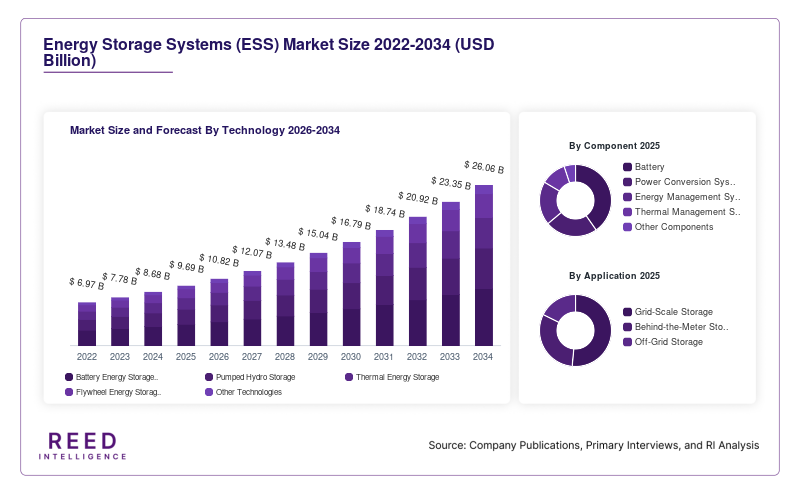
Battery Energy Storage Systems held approximately 72% of the global market in 2025, making them the dominant technology segment. Their position is supported by declining battery costs, fast response capability, modular deployment, and suitability for both utility-scale and distributed applications.
The IEA reports that global battery-storage additions reached 108 GW in 2025, with LFP batteries accounting for around 90% of deployments. Battery systems can serve multiple functions, including energy shifting, frequency regulation, capacity provision, congestion management, and renewable integration.
Pumped Hydro Storage represented approximately 12% of the market in 2025 and remains relevant for large-scale, long-duration storage. Its established infrastructure, long operating life, and ability to support large quantities of stored energy its role in power systems where suitable geography and water resources are available.
Thermal Energy Storage represented approximately 7% of the market in 2025 and is used to shift heating and cooling demand, support industrial processes, and integrate thermal energy with electricity systems. The segment benefits from applications where storing energy in thermal form can be more economical than converting electricity into electrochemical storage.
Flywheel Energy Storage accounted for approximately 4% of the market in 2025. Its high power density, rapid response, and ability to perform frequent charge-discharge cycles make it relevant for frequency regulation, power-quality applications, and short-duration backup.
By Component
Battery components represented approximately 48% of the market in 2025, reflecting their central role in electrochemical storage systems. Cell chemistry, energy density, cycle life, safety, and manufacturing cost directly affect the economics and performance of battery-storage projects.
Power Conversion Systems accounted for approximately 22% of the market in 2025. These systems convert electricity between AC and DC and control how storage assets interact with electricity networks. Their functionality becomes increasingly important as storage participates in grid-support services.
Energy Management Systems represented approximately 15% of the market in 2025. EMS platforms optimize charging and discharging schedules according to electricity prices, renewable output, grid requirements, and storage availability.
Thermal Management Systems accounted for approximately 9% of the market in 2025. Temperature management is particularly important for lithium-ion battery systems because operating temperature influences performance, lifetime, and safety.
By Application
Grid-Scale Storage held approximately 64% of the market in 2025, making it the dominant application. Around 80% of global new battery capacity in 2025 was utility-scale, according to the IEA.
Grid-scale systems are increasingly used for energy shifting, renewable integration, capacity provision, frequency regulation, and congestion management. Energy shifting alone represented more than 90% of new battery-storage projects by primary application in 2025.
Behind-the-Meter Storage represented approximately 24% of the market in 2025 and is projected to be the fastest-growing application at approximately 13.8% CAGR.
The segment includes residential, commercial, and industrial systems located on the customer side of the electricity meter. Adoption is supported by high retail electricity prices, demand-charge management, rooftop solar, backup-power requirements, and virtual-power-plant participation. The IEA reported accelerated behind-the-meter deployment in 2025.
Off-Grid Storage accounted for approximately 12% of the market in 2025. Demand comes from remote communities, telecom infrastructure, mining, agricultural operations, islands, microgrids, and facilities where grid access is limited or unreliable.
By End Use
Utilities represented approximately 55% of the market in 2025, supported by large-scale battery installations used for grid balancing, energy shifting, capacity, renewable integration, and network support.
Commercial & Industrial users accounted for approximately 23% of the market in 2025. Storage can reduce peak electricity costs, provide backup power, improve renewable self-consumption, and support power-quality requirements.
Residential applications represented approximately 14% of the market in 2025. Rooftop solar, backup power, electricity-price management, and virtual power plants are important demand mechanisms.
Renewable Energy Projects accounted for approximately 8% of the market in 2025. Co-located solar-plus-storage and wind-plus-storage projects can shift renewable generation into higher-demand periods and reduce curtailment.
Regional Analysis
North America Energy Storage Systems (ESS) Market
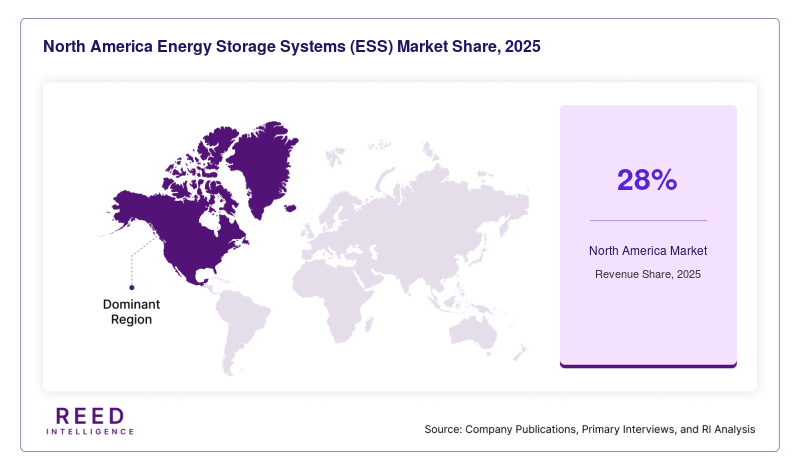
North America held approximately 28% of the global market in 2025 and is projected to grow at approximately 10.9% CAGR through 2034.
The United States is the main regional demand center. EIA data show that U.S. utility-scale battery storage capacity reached 43.6 GW at the end of 2025, with another 8.3 GW added during the first six months of 2026, bringing capacity to nearly 52 GW. Operators reported plans for another 54 GW over the following two and a half years.
For 2026, U.S. developers planned approximately 24 GW of new utility-scale battery capacity, with Texas, California, and Arizona accounting for around 80% of planned additions.
The regional market is supported by renewable-energy integration, capacity requirements, grid congestion, data-center electricity demand, and increasing requirements for flexible generation. The principal constraints are interconnection queues, permitting, project financing, battery supply, and changing policy or incentive structures.
Europe Energy Storage Systems (ESS) Market
Europe represented approximately 20% of the global market in 2025 and is projected to grow at approximately 10.5% CAGR through 2034.
Europe has shifted toward larger utility-scale systems. The IEA reports that European battery additions totaled approximately 6.2 GW in 2025, with utility-scale additions more than doubling to around 4.6 GW.
The region's demand is closely linked to renewable integration, electricity-price volatility, grid balancing, and the need for flexible capacity. Large projects are increasingly being designed for longer durations. The IEA highlights a 1,000 MW/4,000 MWh battery system being built by LEAG and Fluence in Germany.
Germany, the UK, Italy, Spain, and other European electricity markets are developing storage opportunities through capacity mechanisms, ancillary-service markets, renewable integration, and grid-flexibility requirements. Permitting, grid connections, market-design uncertainty, and project economics remain important constraints.
APAC Energy Storage Systems (ESS) Market
APAC held approximately 42% of the global market in 2025, making it the dominant regional market, and is projected to be the fastest-growing region at approximately 13.4% CAGR through 2034.
China is the principal market. The IEA reports that China added more than 63 GW of battery-storage capacity in 2025, accounting for around 60% of global additions.
China's new-type energy-storage capacity reached approximately 145 GW by the end of 2025, with standalone energy storage accounting for 58% of cumulative installations.
India is another important growth market because of expanding solar generation, peak-demand management, and grid modernization. Australia also recorded particularly strong growth, with battery additions approaching 8 GW in 2025, almost nine times the previous year's level.
The region's competitive advantage comes from large battery-manufacturing capacity, strong renewable deployment, major electricity markets, and expanding domestic storage demand. Supply-chain concentration, grid reforms, land availability, and market-specific regulations remain constraints.
Middle East and Africa Energy Storage Systems (ESS) Market
Middle East and Africa represented approximately 5% of the global market in 2025 and is projected to grow at approximately 11.0% CAGR through 2034.
The region is becoming increasingly important for large-scale battery storage. IEA data show that battery-storage additions in the Middle East exceeded 3 GW in 2025, more than three times the previous year's level, driven largely by Saudi Arabia.
Storage is being deployed to support renewable-energy integration, electricity-system flexibility, peak demand, and energy security. Saudi Arabia commissioned a 500 MW/2,000 MWh battery facility in Bisha in 2025, illustrating the movement toward large utility-scale projects.
Africa provides additional opportunities through mini-grids, solar-plus-storage systems, rural electrification, telecom infrastructure, and commercial backup power. Financing availability, grid infrastructure, project bankability, and regulatory frameworks remain important constraints.
LATAM Energy Storage Systems (ESS) Market
LATAM accounted for approximately 5% of the global market in 2025 and is projected to grow at approximately 12.2% CAGR through 2034.
Chile has emerged as an important storage market because batteries can absorb surplus solar generation and shift electricity into evening demand periods. The IEA reports that Chile's battery additions approached 1 GW in 2025.
Brazil is also developing a larger storage opportunity. In August 2026, CATL announced a strategic partnership with Moura to participate in Brazil's Capacity Reserve Auction for Energy Storage. CATL also presented its TENER S system and broader energy-storage portfolio for the Brazilian market.
The region's growth is connected to renewable expansion, transmission constraints, peak-demand management, and the need to reduce renewable curtailment. Regulatory frameworks, financing structures, and evolving electricity-market rules remain important determinants of deployment.
Competitive Landscape
The Energy Storage Systems Market is becoming increasingly competitive across battery manufacturing, system integration, power electronics, software, project development, and long-term operations.
CATL is expanding beyond conventional lithium-ion storage into sodium-ion technology. In June 2026, the company launched the TENER Sodium Energy Storage System and announced that it had invested RMB 5 billion to expand sodium-ion production lines at its Fuding facility, adding 40 GWh of annual capacity. CATL also stated that its Jining base has planned 160 GWh of sodium-ion production capacity.
Tesla continues to expand its utility-scale Megapack platform. Tesla reports more than 58 GWh of Megapack capacity operating globally and deployment across more than 65 countries. The company has also announced Megapack 3 and Megablock production plans, including a Houston Megafactory with planned annual capacity of up to 50 GWh.
Fluence competes through utility-scale storage systems, software, and project integration. Its involvement in the 1,000 MW/4,000 MWh LEAG project in Germany illustrates the increasing scale of European storage installations.
Competition is therefore moving beyond battery-cell cost toward system duration, safety, software, grid integration, manufacturing scale, financing, service networks, and lifecycle performance. Suppliers increasingly need to provide integrated hardware and software rather than individual battery components.
Key Market Players
Recent Market Developments
August 2026 – CATL announced a strategic partnership with Moura in August 2026 to participate in Brazil's Capacity Reserve Auction for Energy Storage. The company also showcased its TENER S system and broader storage ecosystem in São Paulo.
The development is relevant because Brazil is developing market structures for energy-storage capacity, creating an additional commercial pathway for utility-scale storage suppliers.
February 2026 – U.S. DOE Reopens Behind-the-Meter Storage Prize. The U.S. Department of Energy reopened its Beyond the Meter Prize in February 2026 with USD 3.4 million in cash prizes and USD 800,000 in national-laboratory vouchers. The program focuses on integrating behind-the-meter resources and energy-storage systems into consumer-oriented solutions.
Energy Storage Systems (ESS) Market Segments
By Technology
- Battery Energy Storage Systems
- Pumped Hydro Storage
- Thermal Energy Storage
- Flywheel Energy Storage
- Other Technologies
By Component
- Battery
- Power Conversion System
- Energy Management System
- Thermal Management System
- Other Components
By Application
- Grid-Scale Storage
- Behind-the-Meter Storage
- Off-Grid Storage
By End Use
- Utilities
- Commercial & Industrial
- Residential
- Renewable Energy Projects
By Region
- North America
- Europe
- APAC
- Middle East and Africa
- LATAM