Engine Driven Welders Market Size, Share, Demand Report By Product Type (Gasoline Engine Driven Welders, Hybrid Engine Driven Welders, Multi-Process Engine Driven Welders), By Application (Construction & Infrastructure, Oil & Gas, Mining, Renewable Energy), By End Use Industry (Utilities & Renewable Energy, Transportation, Oil & Gas Industry, Mining & Heavy Equipment), By Region & Segment Forecasts, 2026–2034
USD 3950
Market Overview
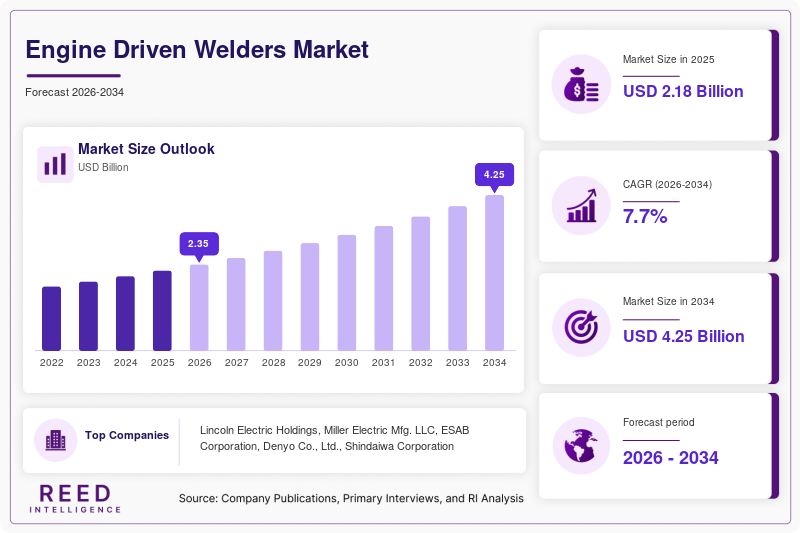
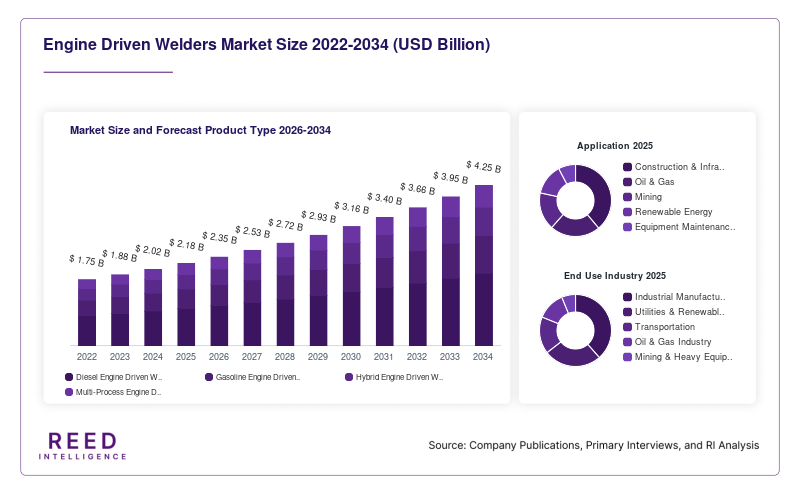
The global Engine Driven Welders Market size was valued at USD 2.18 billion in 2026 and is projected to reach USD 3.96 billion by 2034, expanding at a CAGR of 7.7% during the forecast period from 2026 to 2034. Engine driven welders are widely used in remote construction, oil & gas, mining, infrastructure repair, and utility maintenance applications where stable power access is limited. These machines combine welding functionality with auxiliary power generation, making them suitable for field operations across industrial and commercial environments. Growing investments in pipeline networks, transportation infrastructure, renewable energy projects, and industrial maintenance programs continue to support long-term market expansion across both developed and emerging economies.
The increasing modernization of public infrastructure has emerged as a major global factor driving industry growth. Governments across North America, Asia Pacific, and the Middle East are increasing spending on bridges, highways, energy transmission systems, and industrial facilities. Such projects require portable welding systems capable of operating in harsh environments and remote job sites. In addition, rising adoption of diesel-powered heavy equipment in industrial applications is strengthening demand for high-capacity engine driven welders with improved fuel efficiency and multi-process welding capabilities.
Key Highlights
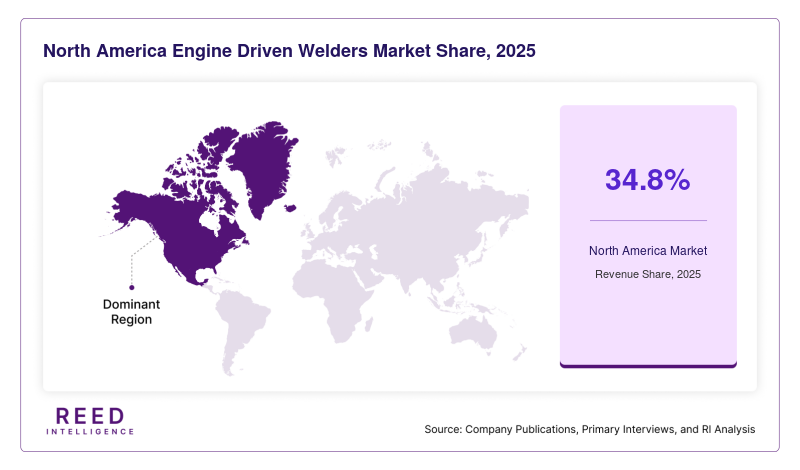
- North America dominated the market with a 34.8% share in 2025.
- Asia Pacific is expected to grow at the fastest CAGR of 9.4% during 2026–2034.
- By product type, diesel engine driven welders accounted for the largest share of 46.7%.
- while hybrid engine driven welders are projected to grow at a CAGR of 10.1%.
- By application, construction and infrastructure led with a 39.6% share.
- whereas renewable energy projects are expected to expand at a CAGR of 10.8%.
- The United States remained the dominant country, with market values of USD 620 million in 2024 and USD 675 million in 2025.
Market Trends
Integration of Smart Monitoring and Fuel-Efficient Technologies
Manufacturers operating in the Engine Driven Welders Market are increasingly integrating digital monitoring systems, automated diagnostics, and fuel optimization technologies into their equipment portfolios. Contractors and industrial operators are seeking machines that reduce downtime and improve productivity in remote locations. Advanced engine driven welders now include remote monitoring interfaces, real-time performance tracking, predictive maintenance alerts, and automated voltage control systems. These features enable fleet managers to monitor fuel consumption, engine performance, and welding efficiency from centralized platforms.
The trend toward fuel-efficient systems is also accelerating due to rising diesel prices and stricter emission regulations in industrial economies. Companies are developing inverter-based engine driven welders with improved energy conversion efficiency and reduced operational noise. Hybrid-powered equipment combining battery support with conventional engines is gaining attention in construction and utility maintenance applications. The integration of telematics and cloud-connected diagnostics is expected to improve operational planning and extend equipment lifecycle across industrial end users.
Rising Demand from Renewable Energy and Utility Infrastructure Projects
The growing development of renewable energy infrastructure is creating strong demand within the Engine Driven Welders Market. Large-scale solar farms, wind turbine installations, hydroelectric projects, and energy transmission networks require portable welding equipment capable of operating in remote and uneven terrain. Engine driven welders are widely used for fabrication, structural assembly, pipeline joining, and maintenance operations during renewable energy construction activities.
Utility companies are also increasing investments in grid modernization and transmission line upgrades to support rising electricity demand. Such projects often involve field-based welding operations where conventional electric welding systems are impractical. The expansion of offshore wind projects and long-distance energy transmission systems is further increasing demand for heavy-duty welding solutions with high output capacity and continuous power generation capability. As governments continue prioritizing clean energy infrastructure, demand for portable industrial welding equipment is expected to rise steadily across both developed and emerging markets.
Market Drivers
Expansion of Global Infrastructure and Industrial Construction Activities
Rapid growth in infrastructure development projects is a major factor driving the Engine Driven Welders Market. Governments and private organizations are investing heavily in transportation networks, industrial plants, oil refineries, bridges, railways, and utility infrastructure. These projects require reliable welding systems for structural fabrication, repair, and maintenance operations in locations without permanent electricity supply. Engine driven welders provide mobility, durability, and consistent performance in outdoor environments, making them suitable for large-scale industrial construction activities.
The rise in urbanization across developing economies is further increasing demand for construction machinery and field welding solutions. Countries in Asia Pacific, the Middle East, and Latin America are expanding industrial manufacturing capacity and transportation infrastructure to support economic growth. Engine driven welders are extensively used by contractors and engineering service providers during pipeline installation, heavy equipment repair, and steel fabrication projects. Continuous investments in industrial modernization are expected to maintain steady equipment demand over the forecast period.
Increasing Oil & Gas Pipeline Maintenance and Mining Operations
The oil & gas sector remains a major consumer within the Engine Driven Welders Market due to the need for continuous pipeline construction and maintenance operations. Pipeline welding projects often occur in remote deserts, offshore zones, mountainous regions, and isolated industrial sites where portable welding systems are essential. Engine driven welders offer independent power generation capability and high welding output suitable for heavy-duty industrial tasks.
Mining activities are also contributing significantly to market growth. Mining companies require rugged welding equipment for equipment maintenance, metal fabrication, and repair operations across harsh operating environments. Expansion of mineral extraction projects in Africa, Australia, and South America is increasing the use of portable industrial welding systems. The need for durable machinery capable of functioning under extreme temperatures and dusty conditions is encouraging industrial operators to adopt advanced engine driven welding equipment with enhanced reliability and operational efficiency.
Market Restraint
High Equipment Costs and Environmental Compliance Challenges
The high initial cost associated with advanced engine driven welders remains a major restraint for market expansion, particularly among small contractors and medium-sized industrial operators. Heavy-duty diesel-powered systems equipped with multi-process welding functionality, inverter technology, and digital monitoring capabilities often involve significant upfront investment. In addition to equipment costs, users must manage expenses related to fuel consumption, engine maintenance, spare parts replacement, and operator training. These financial requirements can limit equipment adoption in price-sensitive markets and smaller industrial projects.
Environmental regulations are also creating operational challenges for manufacturers and end users. Governments in Europe and North America are implementing stricter emission standards for diesel-powered industrial equipment to reduce carbon emissions and air pollution. Compliance with these standards requires manufacturers to invest in cleaner engine technologies, exhaust treatment systems, and fuel-efficient designs, which can further increase production costs. In some urban construction environments, noise restrictions and emission limitations are encouraging contractors to shift toward electric alternatives for smaller applications. These regulatory pressures may restrict growth opportunities for conventional diesel-powered welding equipment in highly regulated regions.
Market Opportunities
Growth Potential in Hybrid and Low-Emission Welding Equipment
The transition toward cleaner industrial technologies is creating significant opportunities within the Engine Driven Welders Market. Industrial operators are increasingly seeking equipment that delivers strong welding performance while reducing fuel consumption and environmental impact. This trend is encouraging manufacturers to develop hybrid engine driven welders that integrate battery storage systems with traditional fuel-powered engines. Such systems can lower operating costs, reduce emissions, and improve efficiency during intermittent welding applications.
Low-emission welding equipment is gaining traction in regions with strict environmental standards, including Europe and North America. Contractors working on government-funded infrastructure projects are prioritizing equipment that complies with sustainability requirements and workplace safety standards. Manufacturers investing in cleaner engine technologies, automated idle control systems, and noise reduction solutions are expected to gain competitive advantages. The shift toward environmentally efficient industrial machinery is likely to open new revenue opportunities across construction, utilities, and energy infrastructure sectors.
Rising Demand Across Emerging Industrial Economies
Emerging economies are presenting strong long-term opportunities for participants in the Engine Driven Welders Market. Countries across Southeast Asia, Africa, and Latin America are witnessing increasing investments in manufacturing facilities, transportation infrastructure, mining operations, and energy projects. Many of these projects are located in remote regions where reliable grid connectivity remains limited, increasing the importance of portable engine driven welding systems.
Industrialization programs initiated by governments in India, Indonesia, Brazil, and several African countries are supporting demand for field-based fabrication and repair equipment. Growing foreign direct investment in industrial development is also encouraging the expansion of local construction and engineering sectors. In addition, increasing adoption of mechanized agricultural and mining equipment is creating secondary demand for maintenance welding solutions. Companies expanding distribution networks and localized manufacturing capabilities in emerging markets are expected to benefit from strong future growth potential.
Segmental Analysis
By Product Type
Diesel engine driven welders accounted for the largest share of the Engine Driven Welders Market in 2024, representing approximately 46.7% of global revenue. These systems remain widely preferred across construction, oil & gas, mining, and heavy industrial applications due to their high power output and operational reliability. Diesel-powered equipment performs effectively in harsh environments and remote work locations where continuous operation is necessary. Contractors and industrial operators favor these systems because they can support multi-process welding applications while also providing auxiliary power generation for additional equipment. Their strong durability and extended operating capacity continue to support widespread adoption across industrial sectors requiring uninterrupted field operations.
Hybrid engine driven welders are expected to register the fastest CAGR of 10.1% during the forecast period due to rising demand for fuel-efficient and low-emission industrial equipment. These systems combine traditional engine power with battery-assisted energy storage, helping reduce fuel consumption and operational noise. Hybrid technology is gaining traction in urban construction projects and environmentally regulated industrial environments where emission control is becoming increasingly important. Manufacturers are also integrating inverter technology and smart energy management systems to improve efficiency and equipment performance. Growing awareness regarding sustainability and operational cost optimization is expected to accelerate adoption of hybrid welding systems across both developed and emerging markets.
By Application
Construction and infrastructure applications dominated the Engine Driven Welders Market in 2024 with a revenue share of 39.6%. Large-scale infrastructure development projects involving bridges, highways, railways, pipelines, and industrial facilities continue to generate strong demand for portable welding systems. Engine driven welders are extensively used in structural steel fabrication, maintenance repair operations, and field construction activities where electrical power availability is limited. Contractors value these systems for their mobility, reliability, and ability to operate under demanding environmental conditions. Government-funded infrastructure modernization programs across North America, Asia Pacific, and the Middle East are expected to sustain strong equipment demand over the coming years.
Renewable energy applications are projected to expand at the fastest CAGR of 10.8% during the forecast period. Increasing investments in solar farms, wind energy facilities, and hydroelectric infrastructure are driving demand for portable industrial welding solutions. Engine driven welders are used extensively during installation and maintenance of energy transmission structures, turbine assemblies, and support frameworks in remote areas. The growth of offshore wind projects and cross-border energy transmission systems is further increasing equipment utilization. Governments worldwide are promoting renewable energy expansion to reduce dependence on fossil fuels, creating favorable conditions for long-term market growth within this application segment.
By End Use Industry
The oil & gas industry represented the dominant end-use segment in the Engine Driven Welders Market during 2024, accounting for nearly 33.9% of total revenue. Pipeline construction, refinery maintenance, offshore exploration, and petrochemical infrastructure projects require reliable portable welding systems capable of operating in isolated and rugged environments. Engine driven welders are widely used for heavy-duty welding operations involving steel pipelines, storage tanks, and industrial processing facilities. The industry’s focus on operational continuity and infrastructure reliability continues to support demand for high-capacity welding systems with durable engine performance and multi-process welding capability.
The utilities and renewable energy sector is expected to witness the fastest CAGR of 9.9% during the forecast period due to increasing investments in electricity transmission and sustainable energy infrastructure. Utility providers are upgrading aging power grids and expanding transmission networks to support rising energy demand. Portable welding equipment is essential for maintenance and installation operations involving transmission towers, substations, and energy infrastructure systems. Renewable energy developers are also increasing deployment of welding systems for wind turbine assembly and solar project construction. The growing emphasis on energy security and clean power generation is expected to strengthen long-term demand across this segment.
Regional Analysis
North America
North America accounted for 34.8% of the global Engine Driven Welders Market in 2025 and continues to maintain a strong position due to high infrastructure spending and extensive industrial maintenance activities. The region is projected to grow at a CAGR of 6.9% during the forecast period. Demand remains strong across construction, oil & gas, mining, and utility sectors where portable welding equipment is essential for remote operations. Government investments in transportation upgrades and energy transmission projects are also supporting long-term equipment demand across the region.
The United States represents the dominant country within North America due to its large industrial base and ongoing infrastructure modernization initiatives. Increasing pipeline maintenance programs and utility grid expansion projects are driving demand for advanced welding systems. Contractors in the country are also adopting fuel-efficient and digitally integrated welding equipment to improve operational productivity. Rising investment in renewable energy infrastructure and industrial automation is further contributing to regional market expansion.
Europe
Europe held a significant share of the Engine Driven Welders Market in 2025 and is expected to expand steadily at a CAGR of 6.5% through 2034. Demand in the region is supported by industrial refurbishment activities, railway modernization programs, and offshore energy projects. Construction companies and engineering contractors across the region require portable welding systems for infrastructure repair and heavy equipment maintenance. The adoption of low-emission industrial machinery is also encouraging manufacturers to introduce cleaner engine technologies within welding equipment portfolios.
Germany emerged as the leading country in the European market due to its advanced manufacturing sector and strong engineering industry. The country continues investing in transportation infrastructure, renewable energy systems, and industrial automation projects. German manufacturers are also focusing on energy-efficient industrial equipment to align with sustainability regulations. Increasing maintenance requirements across aging industrial facilities are creating consistent demand for portable welding systems across multiple industrial sectors.
Asia Pacific
Asia Pacific is projected to register the fastest CAGR of 9.4% in the Engine Driven Welders Market during the forecast period. Rapid urbanization, industrialization, and infrastructure development are driving demand for portable welding equipment across the region. Countries including China, India, Indonesia, and Vietnam are investing heavily in highways, railways, industrial facilities, and energy infrastructure. Engine driven welders are widely used in field construction activities due to their mobility and ability to operate without permanent electricity access.
China remains the dominant country in the regional market because of its large-scale industrial manufacturing capacity and infrastructure investments. Expansion of high-speed rail networks, energy transmission systems, and construction projects continues to support strong equipment demand. In addition, growing shipbuilding activities and heavy industrial fabrication operations are increasing the adoption of high-capacity engine driven welding systems. Rising investments in renewable energy projects are expected to further accelerate regional growth.
Middle East & Africa
The Middle East & Africa region is experiencing stable growth within the Engine Driven Welders Market, supported by oil & gas infrastructure development and mining operations. The market is expected to grow at a CAGR of 7.3% through 2034. Portable welding systems are extensively used for pipeline installation, refinery maintenance, and industrial fabrication activities across remote operational environments. Increasing investments in utility infrastructure and transportation networks are also contributing to equipment demand within the region.
Saudi Arabia leads the regional market due to ongoing investments in industrial diversification and large-scale infrastructure projects. The country continues expanding refinery capacity, pipeline networks, and urban development programs under long-term economic transformation initiatives. Welding equipment demand is also increasing from renewable energy projects and industrial maintenance contractors. Harsh environmental conditions across the region create strong demand for durable and high-performance engine driven welding systems.
Latin America
Latin America is witnessing moderate growth in the Engine Driven Welders Market, with the region projected to expand at a CAGR of 6.8% during the forecast period. Industrial construction projects, mining activities, and utility maintenance operations are supporting equipment demand across several countries. Portable welding systems are widely used in remote mining operations and agricultural equipment repair applications. Governments across the region are also investing in transportation and energy infrastructure modernization to support industrial development.
Brazil represents the largest market in Latin America due to its extensive mining sector and expanding infrastructure investments. The country’s industrial manufacturing and energy industries require portable welding systems for maintenance and fabrication activities. Increasing offshore oil exploration activities are also supporting demand for heavy-duty welding equipment. Growth in agricultural mechanization and rural infrastructure projects is expected to create additional opportunities for engine driven welder manufacturers operating in the region.
Competitive Landscape
The Engine Driven Welders Market is moderately consolidated, with leading manufacturers focusing on product innovation, geographic expansion, and technological upgrades to strengthen competitive positioning. Companies are investing in fuel-efficient engines, inverter-based welding technologies, and smart monitoring capabilities to address changing industrial requirements. Strategic partnerships with construction contractors, utility providers, and industrial distributors are also supporting market penetration across emerging economies.
Lincoln Electric Holdings remains one of the leading participants in the market due to its broad industrial welding portfolio and strong global distribution network. The company recently introduced advanced engine driven welding systems equipped with digital performance monitoring and reduced-emission engine technologies for industrial construction applications. Other major players including Miller Electric, ESAB, Denyo Co., and Shindaiwa are expanding product offerings focused on portability, fuel efficiency, and multi-process welding functionality. Market participants are also increasing investments in aftermarket services, operator training programs, and regional manufacturing facilities to improve customer retention and operational support capabilities.
Key Players
- Lincoln Electric Holdings
- Miller Electric Mfg. LLC
- ESAB Corporation
- Denyo Co., Ltd.
- Shindaiwa Corporation
- Kohler Co.
- Hobart Welding Products
- Fronius International GmbH
- The Toro Company
- AIRMAN Hokuetsu Industries
- Voestalpine Böhler Welding
- Kemppi Oy
- Panasonic Connect Co., Ltd.
- Yanmar Holdings Co., Ltd.
- Genset Generator
Recent Developments
- In February 2026, Lincoln Electric Holdings launched a new low-emission engine driven welder series designed for infrastructure and pipeline construction projects.
- In August 2025, ESAB Corporation expanded its portable welding equipment manufacturing facility to strengthen supply capabilities across Asia Pacific and Latin America.
- In November 2025, Miller Electric Mfg. LLC introduced a digitally connected engine driven welder equipped with remote diagnostics and predictive maintenance features for industrial contractors.
Engine Driven Welders Market Segments
Product Type
- Diesel Engine Driven Welders
- Gasoline Engine Driven Welders
- Hybrid Engine Driven Welders
- Multi-Process Engine Driven Welders
Application
- Construction & Infrastructure
- Oil & Gas
- Mining
- Renewable Energy
- Equipment Maintenance & Repair
End Use Industry
- Industrial Manufacturing
- Utilities & Renewable Energy
- Transportation
- Oil & Gas Industry
- Mining & Heavy Equipment
By Region
- North America
- Europe
- APAC
- Middle East and Africa
- LATAM