Engineered Polymers Electric Charging Infrastructure Market Size, Share, Growth & Forecast Report by Material Type (Polycarbonate, Polyamide, Fluoropolymers, PEEK, Others), Application (Charging Station Housings, Connectors, Thermal Insulation, Cable Management Systems, Protective Enclosures), End-Use (Residential, Commercial, Industrial, Public Fast-Charging Networks), and Regional Outlook 2026–2034
USD 3950
Market Overview
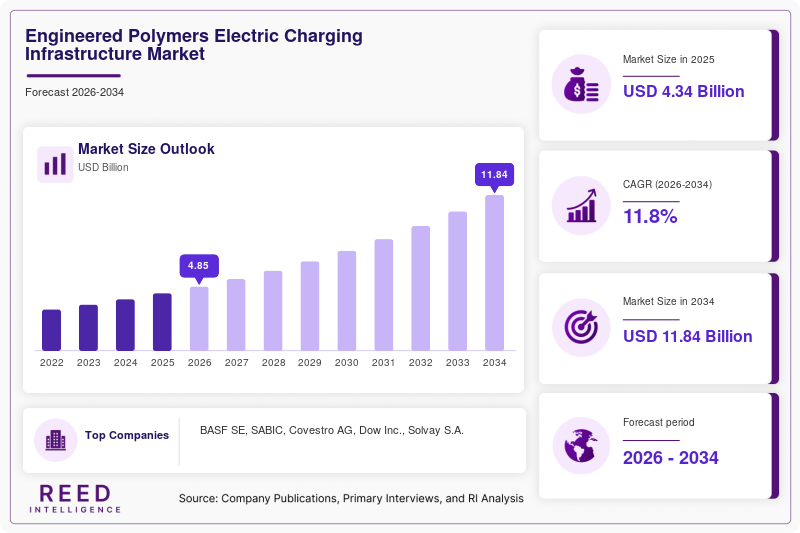
The Engineered Polymers Electric Charging Infrastructure Market is projected to reach USD 4.85 billion in 2026 and is expected to grow to USD 11.92 billion by 2034, registering a CAGR of 11.8% (2026–2034). Growth is primarily driven by increasing deployment of electric vehicle (EV) charging stations globally and the rising use of engineered polymers in high-performance charging components such as insulation housings, connectors, protective casings, and thermal management systems. These materials offer lightweight strength, chemical resistance, and electrical insulation, making them highly suitable for next-generation charging infrastructure.
A major global factor supporting market expansion is the rapid electrification of transportation systems supported by government EV adoption policies and investments in charging networks. Engineered polymers help reduce operational risks in high-voltage environments while improving durability and reducing maintenance costs, which has accelerated their integration into both AC and DC fast-charging stations.
Key Highlights
- North America dominated the market with a 34.5% share in 2025.
- Asia Pacific is expected to grow at the fastest CAGR of 12.6% during 2026–2034.
- By material type, polycarbonate-based polymers accounted for the largest share of 37.8%.
- while fluoropolymers are projected to grow at a CAGR of 13.1%.
- By application, charging station housings led with a 40.2% share, whereas thermal insulation components are expected to expand at a CAGR of 12.9%.
- The United States remained the dominant country, with market values of USD 680 million in 2024 and USD 745 million in 2025.
Market Trends
Rising Adoption of High-Performance Thermoplastics in Fast-Charging Systems
One of the most significant trends in the Engineered Polymers Electric Charging Infrastructure Market is the increasing adoption of high-performance thermoplastics in ultra-fast charging stations. As DC fast chargers generate high thermal loads, manufacturers are shifting toward engineered polymers such as polycarbonate blends, PEEK, and polyamide composites. These materials offer high dielectric strength, flame resistance, and thermal stability, ensuring safe operation under extreme voltage conditions. In addition, they reduce system weight compared to metal-based enclosures, improving installation flexibility. The trend is further supported by the expansion of highway charging corridors and commercial EV fleets requiring rapid charging capabilities. This shift is also encouraging material innovation, with polymer producers developing reinforced compounds to meet evolving performance requirements.
Integration of Smart Polymer-Based Components in Charging Infrastructure
Another emerging trend is the integration of smart polymer-based components embedded with sensors and conductive additives. These advanced engineered polymers are being used in connectors, plugs, and charging interface housings to monitor temperature, wear, and electrical load in real time. This improves predictive maintenance capabilities and reduces downtime in charging networks. The trend aligns with the broader adoption of smart grid technologies and IoT-enabled EV ecosystems. Additionally, self-healing and anti-corrosion polymer coatings are gaining traction, extending infrastructure lifespan in harsh outdoor environments. This innovation is particularly relevant in urban charging hubs where high utilization rates demand durable and low-maintenance infrastructure solutions.
Market Drivers
Rapid Expansion of Electric Vehicle Charging Networks
The rapid global expansion of EV charging networks is a key driver of the Engineered Polymers Electric Charging Infrastructure Market. Governments and private operators are investing heavily in building public and private charging stations to support rising EV adoption. Engineered polymers play a crucial role in ensuring safety, insulation, and durability of these systems. Their ability to withstand electrical stress and environmental exposure makes them essential in both residential and commercial charging setups. As charging infrastructure scales, demand for cost-efficient, high-performance materials continues to increase. Additionally, modular charging station designs are increasingly relying on polymer components to reduce installation complexity and enhance scalability across urban and rural areas.
Increasing Demand for Lightweight and Durable Materials
Another major driver is the growing demand for lightweight yet durable materials in charging infrastructure systems. Engineered polymers offer significant advantages over traditional metals, including corrosion resistance, electrical insulation, and reduced manufacturing costs. These properties make them ideal for outdoor charging stations exposed to varying climatic conditions. The automotive industry's shift toward sustainability is also encouraging material substitution with recyclable and energy-efficient polymers. Furthermore, advancements in polymer engineering have enabled higher load-bearing capacity and improved heat resistance, making them suitable for high-power EV chargers. This has accelerated their adoption across both OEM and aftermarket charging equipment manufacturers.
Market Restraint
Despite strong growth potential, the Engineered Polymers Electric Charging Infrastructure Market faces challenges related to raw material price volatility and performance limitations under extreme operational conditions. Engineered polymers, especially high-performance variants such as fluoropolymers and polyether ether ketone (PEEK), are relatively expensive compared to conventional materials like aluminum or standard plastics. This increases overall infrastructure costs, particularly in large-scale public charging projects.
Additionally, while engineered polymers offer excellent insulation and corrosion resistance, their long-term performance under continuous high-temperature and high-load conditions can sometimes degrade, limiting their suitability in ultra-high-power charging stations. In some cases, mechanical fatigue and UV exposure can also reduce material lifespan. These constraints often force manufacturers to adopt hybrid material systems, increasing design complexity and production costs. Moreover, limited recycling infrastructure for advanced polymers presents sustainability challenges, especially as environmental regulations become stricter. These factors collectively restrain faster adoption in cost-sensitive markets, particularly in developing economies where budget constraints remain a significant barrier to infrastructure expansion.
Market Opportunities
Expansion of Ultra-Fast Charging Infrastructure
The rapid development of ultra-fast charging infrastructure presents a major opportunity for the Engineered Polymers Electric Charging Infrastructure Market. As EV battery capacities increase, demand for high-power charging stations capable of reducing charging time has surged. These systems require advanced materials that can handle high voltage and heat loads efficiently. Engineered polymers, with their superior thermal stability and electrical insulation properties, are increasingly being used in connectors, housings, and cooling components. This creates significant growth potential for material suppliers and infrastructure developers. Additionally, government-backed highway electrification programs are expected to accelerate deployment of fast-charging corridors globally.
Growth in Renewable Energy Integrated Charging Systems
Another key opportunity lies in the integration of EV charging infrastructure with renewable energy systems such as solar and wind power. Engineered polymers are widely used in energy storage interfaces, inverter housings, and smart grid-connected charging units. Their ability to perform reliably in variable environmental conditions makes them suitable for decentralized renewable-powered charging stations. As countries aim for carbon neutrality, hybrid energy charging stations are becoming increasingly common. This transition creates demand for advanced polymer solutions that enhance efficiency, reduce energy loss, and improve system durability across off-grid and microgrid charging networks.
Segmental Analysis
Material Type Segment
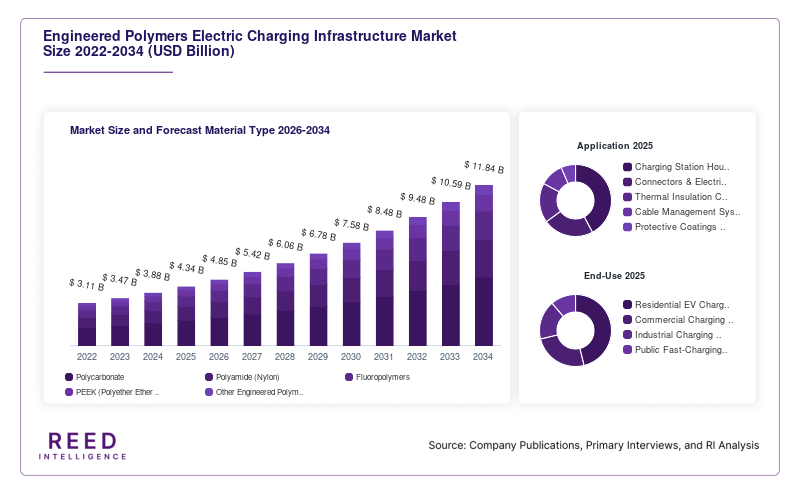
Polycarbonate-based engineered polymers dominated the material type segment with a 2024 share of 38.2%. Their widespread use in charging station housings and protective enclosures is due to high impact resistance, transparency options, and electrical insulation properties. These materials are preferred in both residential and commercial charging setups due to cost-effectiveness and ease of manufacturing. Increasing demand for weather-resistant outdoor charging infrastructure further strengthens their dominance in the global market.
Fluoropolymers represent the fastest-growing subsegment with a CAGR of 13.1%, driven by their exceptional chemical resistance and thermal stability. They are increasingly used in high-voltage connectors and insulation layers in ultra-fast charging stations. Rising demand for high-performance EV charging systems and growing investments in long-distance EV corridors are accelerating adoption of fluoropolymer-based components.
Application Segment
Charging station housings accounted for the largest share of 40.2% in 2024, driven by the need for durable and lightweight protective structures. Engineered polymers are widely used in housing designs due to their resistance to corrosion and environmental degradation. This segment benefits from large-scale deployment of public charging stations globally.
Thermal insulation components are the fastest-growing subsegment with a CAGR of 12.9%, supported by increasing power density in EV chargers. These components are essential for maintaining system safety and efficiency under high load conditions. The rise of ultra-fast charging infrastructure is a key growth driver for this segment.
End-Use Segment
Commercial charging infrastructure held the dominant share of 42.5% in 2024, supported by rapid expansion of public charging networks and fleet electrification programs. Engineered polymers are widely used due to their durability and low maintenance requirements.
Residential charging systems are the fastest-growing segment with a CAGR of 12.2%, driven by increasing home EV adoption. Rising installation of wall-mounted chargers is boosting demand for compact, cost-effective polymer-based components.
Regional Analysis
North America
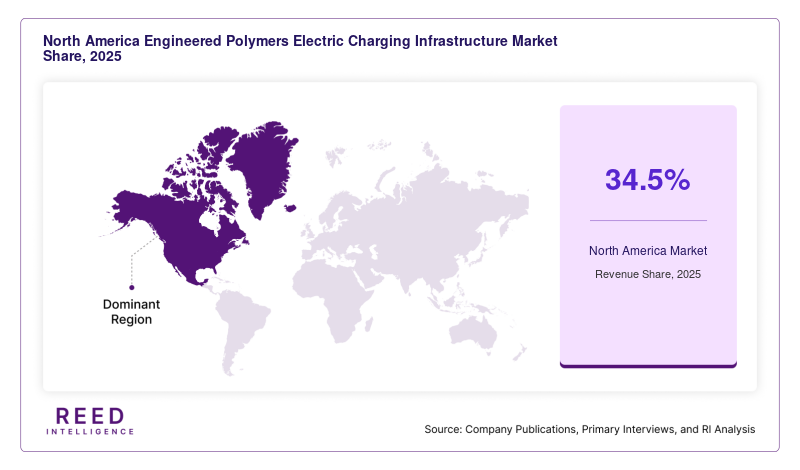
North America accounted for approximately 34.5% of the market share in 2025, with a projected CAGR of 11.4% during 2026–2034. The region benefits from strong EV adoption rates and extensive government funding for charging infrastructure expansion. The presence of advanced material manufacturers also supports regional dominance in engineered polymer innovations for charging systems.
The United States is the leading country in this region, driven by large-scale deployment of highway fast-charging networks and strong investments in smart grid integration. A key growth factor is the increasing collaboration between automotive OEMs and material suppliers to develop high-performance, heat-resistant polymer components for next-generation EV chargers.
Europe
Europe held around 27.8% market share in 2025, with a CAGR of 10.9% (2026–2034). The region’s growth is driven by strict emission regulations and strong EV infrastructure mandates across major economies. High demand for durable and sustainable materials is encouraging engineered polymer adoption.
Germany dominates the European market due to its strong automotive industry and advanced engineering capabilities. A key growth factor is the rapid expansion of urban charging hubs supported by smart city initiatives and renewable energy integration.
Asia Pacific
Asia Pacific accounted for 24.6% share in 2025, expected to grow at the fastest CAGR of 12.6%. Rapid urbanization and EV adoption in China and India are major growth drivers. Increasing investments in public charging infrastructure are also fueling demand.
China leads the region, supported by large-scale government EV subsidies and manufacturing capabilities. A major growth factor is the expansion of high-density urban charging networks requiring cost-efficient polymer-based components.
Middle East & Africa
The Middle East & Africa region held approximately 7.2% market share in 2025, with a projected CAGR of 10.7% during the forecast period. Growth in this region is supported by increasing investments in smart cities and sustainable mobility initiatives. Countries in the Gulf Cooperation Council (GCC) are actively promoting EV adoption and developing supporting infrastructure, which is boosting demand for advanced materials such as engineered polymers.
The United Arab Emirates is the leading country in this region, driven by its focus on innovation and sustainability. A key growth factor is the development of renewable energy-powered EV charging stations in urban areas. These systems require durable and heat-resistant polymer materials capable of performing efficiently in extreme climatic conditions, thereby driving market growth.
Latin America
Latin America accounted for around 5.9% of the market share in 2025 and is expected to grow at a CAGR of 10.3% during 2026–2034. The region is experiencing gradual growth due to increasing awareness of electric mobility and ongoing infrastructure modernization efforts. Governments and private players are investing in charging networks, particularly in urban areas, which is driving demand for engineered polymer components.
Brazil dominates the Latin American market, supported by its expanding EV adoption and urban mobility projects. A key growth factor is the rise of public-private partnerships aimed at developing EV charging infrastructure. These initiatives are creating demand for cost-efficient and durable polymer materials that can support long-term infrastructure development across the region.
Competitive Landscape
The Engineered Polymers Electric Charging Infrastructure Market is moderately consolidated, with leading companies focusing on material innovation, strategic partnerships, and expansion of production capabilities. Key players include BASF SE, SABIC, Covestro AG, Solvay S.A., and Dow Inc. These companies are investing in high-performance polymer development tailored for EV charging applications such as flame-retardant housings and thermally stable connectors.
BASF SE is a leading player, driven by its extensive engineered plastics portfolio. A recent development includes the launch of a new high-durability polyamide series designed specifically for high-voltage EV charging systems, improving thermal resistance and mechanical strength.
Key Players List
Recent Developments
- In 2025, BASF SE introduced a new range of flame-retardant engineered polyamides specifically designed for high-voltage EV charging infrastructure, enhancing thermal stability and electrical insulation in fast-charging environments.
- Covestro AG expanded its production capacity for advanced polycarbonate blends to meet increasing demand from EV charging station manufacturers, particularly for lightweight and impact-resistant enclosures used in outdoor installations.
- SABIC partnered with EV infrastructure developers to create recyclable and sustainable engineered polymer solutions aimed at reducing environmental impact while maintaining performance in charging components.
Engineered Polymers Electric Charging Infrastructure Market Segments
Material Type
- Polycarbonate
- Polyamide (Nylon)
- Fluoropolymers
- PEEK (Polyether Ether Ketone)
- Other Engineered Polymers
Application
- Charging Station Housings
- Connectors & Electrical Interfaces
- Thermal Insulation Components
- Cable Management Systems
- Protective Coatings & Enclosures
End-Use
- Residential EV Charging
- Commercial Charging Stations
- Industrial Charging Infrastructure
- Public Fast-Charging Networks
By Region
- North America
- Europe
- APAC
- Middle East and Africa
- LATAM