Enterprise Email Market Size, Share & Trends Analysis Report By Component (Email Solutions, Email Security, Services), By Deployment (Cloud-Based, On-Premise), By Organization Size (Large Enterprises, Small & Medium Enterprises), By Application (Internal Communication, Customer & Partner Communication, Collaboration & Workflow, Transactional & Automated Email), By End Use (BFSI, IT & Telecommunications, Healthcare, Government & Defense, Retail & E-Commerce, Manufacturing) Forecasts, 2026–2034
USD 3950
Enterprise Email Market Size
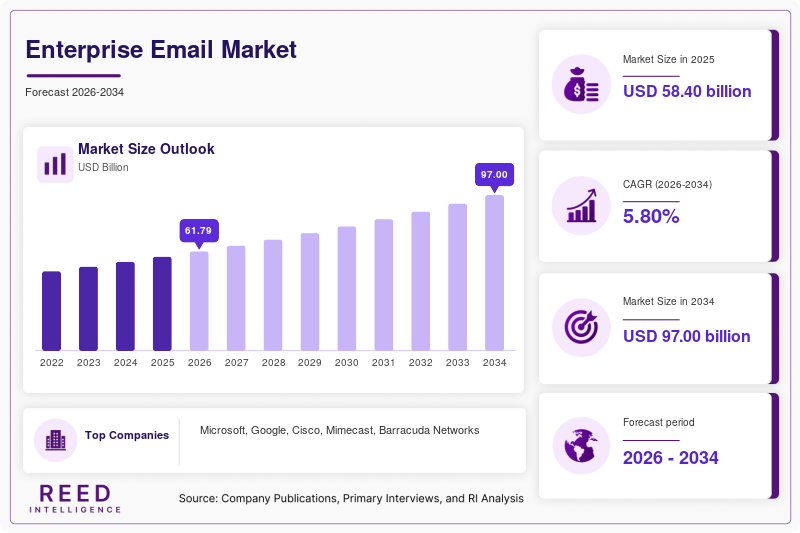
The global enterprise email market size was valued at USD 58.40 billion in 2025 and is projected to grow from USD 61.79 billion in 2026 to USD 97.00 billion by 2034, registering a CAGR of 5.80% during the forecast period from 2026 to 2034.
Enterprise email remains a core business communication layer, but its commercial role is changing. Cloud-hosted mailboxes, integrated security, identity controls, compliance, AI-assisted inbox management, and connections with collaboration and workflow platforms are becoming more important than standalone messaging infrastructure. Microsoft and Google are both embedding AI directly into enterprise email experiences, while security vendors are expanding protection across Microsoft 365 and Google Workspace environments.
Enterprise email has moved from being primarily a mailbox and messaging system toward becoming a managed business-workflow and security platform. Organizations use enterprise email for internal communication, customer and supplier interaction, automated notifications, approvals, scheduling, document exchange, identity verification, and collaboration.
The largest structural change is the continued movement toward cloud-based email. Microsoft Exchange Online has already eliminated Basic Authentication across Exchange Online and requires supported applications to use modern authentication mechanisms, while Microsoft recommends restricting SMTP AUTH to accounts that still require it. This shifts enterprise spending toward cloud administration, identity, migration, security, compliance, archiving, and integration.
Enterprise Email Market Drivers
Cloud migration is replacing legacy enterprise mail infrastructure
The migration from on-premise mail servers to cloud-hosted platforms is one of the strongest structural mechanisms in enterprise email. Maintaining an internal messaging environment requires organizations to manage infrastructure, storage, patching, availability, authentication, backup, disaster recovery and security. Cloud services transfer much of this responsibility to specialized providers while integrating email with identity, collaboration and productivity applications.
Microsoft's Exchange Online architecture increasingly requires modern authentication, while Google Workspace combines business email with cloud storage, collaboration and security administration.
The commercial effect is not simply replacement of an on-premise mailbox with a cloud mailbox. Migration creates additional spending around identity management, data migration, compliance, archiving, security monitoring, backup and integration. Google's Workspace migration tooling and Microsoft's continuing Exchange Online transition demonstrate how migration itself has become an established enterprise-services requirement.
The counterbalance is that mature enterprises may retain hybrid environments because of regulatory requirements, legacy applications or specialized workflows.
Email security is becoming inseparable from enterprise messaging
Enterprise email remains an important route for phishing, credential theft, malware, business-email compromise and ransomware delivery. Verizon's 2026 DBIR identifies phishing as accounting for approximately 15% of breaches in the preceding reporting period.
This risk is changing purchasing behavior. Enterprises increasingly want protection integrated with Microsoft 365 and Google Workspace rather than relying exclusively on perimeter security. Mimecast provides protection across M365, Google Workspace and on-premise email, while Barracuda's 2026 Integrated Email Protection combines threat detection, remediation and message clawback across major cloud-email environments.
The mechanism creates recurring demand for anti-phishing, malware detection, encryption, data-loss prevention, archiving, impersonation protection, authentication controls and security analytics. Email security therefore adds a recurring software and service layer around the underlying mailbox.
AI is increasing the functional value of enterprise email
AI is changing enterprise email from a passive communication repository into an active productivity interface. Google introduced AI Overviews in Gmail in January 2026 for summarizing threads, answering questions and helping users write messages. Microsoft Copilot in Outlook provides inbox prioritization, email triage, rules and drafting functions, with additional agentic mailbox capabilities entering preview in 2026.
Google's September 2026 Gmail update also introduced voice-based conversational search, allowing users to locate important information in their inbox using natural language.
This changes the commercial value proposition. Vendors can monetize AI capabilities through premium subscriptions while enterprises can potentially reduce time spent searching, summarizing, composing and organizing messages. However, AI also increases requirements for data governance, access controls and privacy. Google states that Gemini in Gmail does not use personal emails to train its foundational AI models and processes information for the requested task.
Enterprise Email Market Restraints
Security, privacy and compliance requirements increase implementation complexity
Enterprise email contains contracts, financial information, customer data, employee communications, intellectual property and regulated information. Moving this information into cloud platforms therefore requires organizations to address encryption, retention, eDiscovery, access controls, identity management, data residency and DLP.
Google's enterprise Workspace offering includes capabilities such as S/MIME, DLP, eDiscovery, Vault, context-aware access and enterprise data regions, illustrating how security and compliance have become embedded within enterprise email purchasing decisions.
Microsoft's modern-authentication transition similarly requires organizations to identify legacy applications and update clients or business systems that previously depended on Basic Authentication.
These requirements can increase migration time and professional-services costs, especially for large enterprises with complex legacy environments.
Enterprise email is becoming part of broader productivity-platform competition
Email is increasingly bundled with collaboration, meetings, cloud storage, identity, productivity applications and AI. This benefits large platform vendors but can make standalone email suppliers harder to differentiate.
Microsoft integrates Outlook and Exchange with Microsoft 365, Teams, Entra and Copilot, while Google integrates Gmail with Workspace applications and Gemini.
As a result, organizations may evaluate email as part of a broader workplace-platform decision rather than purchase it independently. This can limit addressable demand for standalone email software and increase switching costs between major ecosystems.
Enterprise Email Market Opportunities
AI-native inbox management and workflow automation
AI is creating an additional value layer around enterprise email. Instead of merely drafting messages, AI systems can summarize conversations, identify priorities, retrieve information, create rules, schedule meetings and potentially execute mailbox actions under user direction.
Microsoft's 2026 Outlook developments include Copilot actions for organizing mail, creating rules, archiving messages and flagging follow-ups. Google has introduced AI Inbox, AI Overviews, conversational Gmail search and Gemini-powered writing and scheduling features.
The opportunity is to turn email into an enterprise workflow interface rather than simply a communication channel. Vendors can expand revenue through AI subscriptions, workflow automation, intelligent search, meeting coordination and integration with CRM, ERP and collaboration applications.
Integrated email security and cyber-resilience
The expansion of AI-assisted attacks creates room for security products that continuously analyze messages after delivery rather than relying only on pre-delivery filtering.
Barracuda's June 2026 launch of Integrated Email Protection illustrates this direction, combining AI-based detection, remediation, post-delivery message clawback and cross-domain signals for Microsoft 365 and Google Workspace environments. Mimecast similarly markets protection against zero-day exploits, phishing, business-email compromise and ransomware across cloud and on-premise environments.
This creates opportunities for managed email security, automated incident response, identity-aware protection, employee-risk analytics and integrated archiving/DLP.
Segmental Analysis
By Component
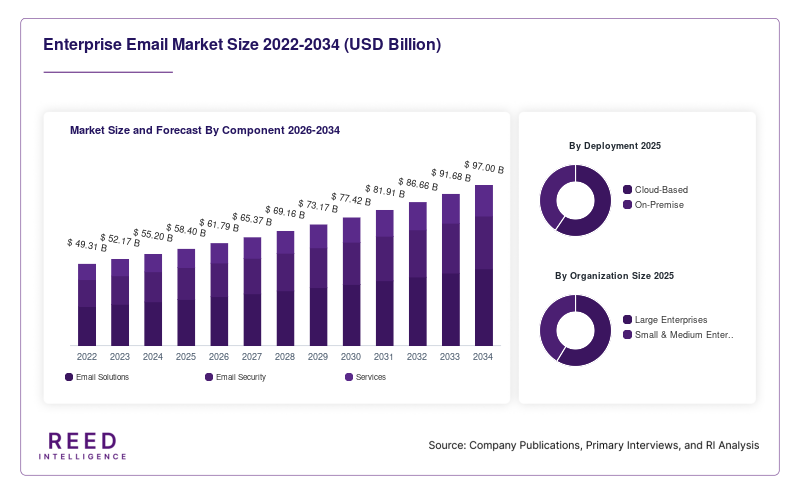
Email Solutions represent approximately 55% of the global market in 2025, reflecting the core requirement for hosted or enterprise-managed mailboxes, administration, storage, collaboration, and productivity integration.
Email Security accounts for approximately 28% and is the fastest-growing component at about 7.1% CAGR. Increasing phishing, business-email compromise, malware and identity attacks are expanding security requirements around the mailbox. Verizon's 2026 DBIR and the continuing expansion of cloud email-security platforms support this demand mechanism.
Services account for approximately 17%, covering migration, implementation, integration, consulting, managed services and administration.
By Deployment
Cloud-Based Enterprise Email represents approximately 76% of the global market in 2025 and is the fastest-growing deployment model at about 6.7% CAGR. Cloud deployment reduces the infrastructure burden on enterprises while connecting email with identity, collaboration, security and AI services. Microsoft Exchange Online and Google Workspace illustrate the dominant cloud-platform model.
On-Premise Email accounts for approximately 24%, supported by organizations with legacy infrastructure, specialized applications, strict control requirements or hybrid architectures. The segment continues to contract relative to cloud deployment but remains relevant among large and regulated enterprises.
By Organization Size
Large Enterprises account for approximately 68% of the global market in 2025, reflecting larger user populations, complex security requirements, extensive compliance needs and higher spending on email management and protection.
Small & Medium Enterprises represent approximately 32% and are the fastest-growing organization-size segment at about 7.2% CAGR. Cloud subscriptions allow smaller organizations to access enterprise email, security and AI without building internal messaging infrastructure. Google explicitly positions Workspace as a platform used by millions of small businesses.
By Application
Internal Communication represents approximately 34% of the global market in 2025, reflecting email's continuing role in employee communication, document exchange, approvals and organizational notifications.
Customer & Partner Communication represents approximately 28%, covering supplier communication, customer service, sales, account management and external business relationships.
Collaboration & Workflow accounts for approximately 23% and is the fastest-growing application at about 7.4% CAGR. AI-assisted email, calendar integration, automated rules, task extraction and connections to other workplace applications are expanding the role of email from messaging into workflow management.
Transactional & Automated Email accounts for approximately 15%, including system-generated notifications, invoices, alerts and application-triggered messages.
By End Use
IT & Telecommunications represents approximately 21% of the global market in 2025, supported by large employee populations, distributed workforces, high security requirements and extensive use of cloud productivity platforms.
BFSI accounts for approximately 18%, reflecting large user bases and stringent requirements for security, retention, auditability and customer communications.
Healthcare represents approximately 15% and is the fastest-growing end-use industry at about 7.5% CAGR, supported by digital communication, distributed care organizations and increasingly strict requirements for protecting sensitive information.
Government & Defense accounts for approximately 13%, with demand shaped by security, sovereignty, retention and controlled-access requirements.
Retail & E-Commerce represents approximately 12%, supported by customer communication, order notifications, marketing, employee communication and supplier coordination.
Manufacturing accounts for approximately 10%, while Other Industries represent approximately 11%.
Regional Analysis
North America Enterprise Email Market
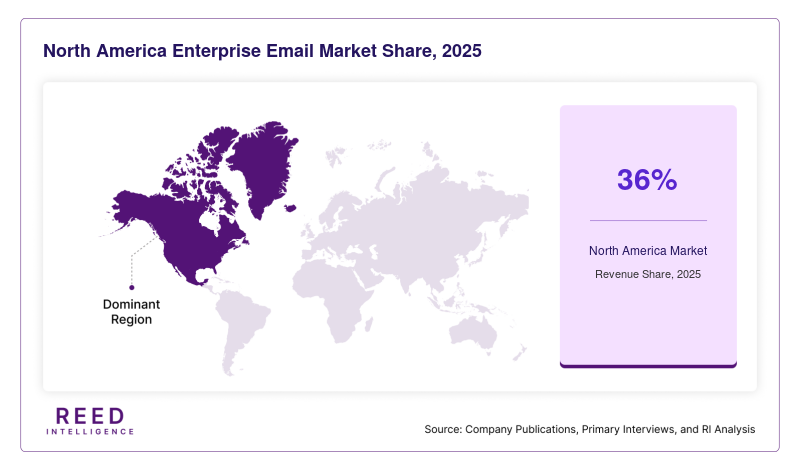
North America represents approximately 36% of the global market in 2025 and is growing at about 5.2% CAGR. The region has a mature cloud-email base, high enterprise software adoption and strong spending on cybersecurity, compliance and workplace productivity.
Microsoft 365 and Google Workspace are major components of enterprise messaging infrastructure, while specialized vendors such as Mimecast and Barracuda provide additional protection around cloud email. Microsoft's Exchange Online environment has already moved away from Basic Authentication, forcing legacy applications to modernize authentication.
The U.S. also has a large installed base of organizations using cloud collaboration and productivity software, making AI-assisted email a significant upgrade pathway. Microsoft is expanding Copilot's capabilities within Outlook, while Google continues adding Gemini capabilities to Gmail.
Purchasing decisions increasingly combine email, identity, endpoint security, DLP, archiving and productivity software. This favors vendors capable of delivering integrated platforms.
The primary constraints are platform maturity and enterprise procurement complexity. Many large organizations already have established Microsoft or Google environments, so incremental spending increasingly comes from security, AI, compliance, migration and specialized services rather than first-time email adoption.
Europe Enterprise Email Market
Europe represents approximately 28% of the global market in 2025 and is growing at about 4.9% CAGR. Demand is supported by enterprise cloud migration, digital workplace adoption, cybersecurity spending and increasingly detailed requirements for data protection and governance.
European enterprises place particular emphasis on data privacy, retention, security controls and data residency. Google Workspace's enterprise offering includes data regions, DLP, eDiscovery, Vault, S/MIME and context-aware access, reflecting the requirements of large organizations operating under strict data-governance frameworks.
AI adoption adds another layer of governance. Google has publicly explained how Gemini in Gmail handles user data and states that personal emails are not used to train its foundational AI models. Such controls matter for organizations evaluating AI-enabled email against internal privacy and compliance requirements.
The European market therefore favors secure cloud email, archiving, identity integration and managed security. The constraint is regulatory and procurement complexity, particularly for multinational organizations operating across several jurisdictions.
APAC Enterprise Email Market
APAC represents approximately 23% of the global market in 2025 and is the fastest-growing region at about 7.3% CAGR. The region combines large employee populations, rapid cloud adoption, expanding digital businesses and increasing cybersecurity requirements.
India, China, Japan, South Korea, Australia and Southeast Asia provide different but complementary demand mechanisms. Mature markets such as Japan and Australia have established enterprise software environments, while developing markets are still moving substantial workloads from on-premise infrastructure toward cloud productivity platforms.
Cloud deployment is particularly important because enterprises can obtain business email, collaboration, storage, identity and security without building large messaging infrastructures. Google's Workspace model combines custom business email with cloud productivity and Gemini capabilities, while Microsoft provides Exchange Online through Microsoft 365.
APAC also has strong potential for AI-enabled email because vendors are adding multilingual assistance, automated search, summarization and workflow capabilities. Google's September 2026 Gmail release added conversational voice search for inbox information.
The key constraint is uneven enterprise IT maturity across countries, along with different data-residency and cybersecurity requirements.
Middle East and Africa Enterprise Email Market
The Middle East and Africa represent approximately 7% of the global market in 2025 and are growing at about 6.6% CAGR. Demand is supported by digital transformation, cloud migration, government modernization, financial services expansion and growing cybersecurity requirements.
Organizations in Gulf markets are increasingly adopting cloud-based workplace platforms as part of broader digital transformation programs, while African enterprises often use cloud email to avoid the infrastructure and maintenance requirements of on-premise messaging.
Email security is becoming particularly important because organizations increasingly operate through cloud platforms and remote access. Microsoft and Google both incorporate security controls directly into enterprise email services, while specialist providers add phishing, malware, impersonation and post-delivery protection.
The commercial opportunity is strongest in cloud migration, managed email security, identity integration and compliance services. The main constraint is uneven connectivity, IT spending and cybersecurity maturity between countries.
LATAM Enterprise Email Market
LATAM represents approximately 6% of the global market in 2025 and is growing at about 6.3% CAGR. Cloud-based enterprise email adoption is supported by digitalization among banks, retailers, professional-services companies, manufacturers and technology businesses.
The region's market mechanism is primarily migration from legacy or locally managed messaging environments toward cloud productivity platforms. Cloud email can reduce the need for dedicated infrastructure and provide access to integrated collaboration, storage and security tools.
Security is an important secondary spending category because organizations increasingly depend on email for financial transactions, customer communication and business operations. Vendors are therefore expanding phishing protection, authentication, DLP and threat-response capabilities around cloud mailboxes.
The principal limitations are differences in enterprise IT budgets, cloud readiness and regulatory environments across individual countries. Larger businesses and multinational organizations remain the main buyers of advanced enterprise email and security capabilities.
Competitive Landscape
The enterprise email market is concentrated around large workplace-platform providers, with a second competitive layer consisting of email-security, archiving, migration and managed-service companies.
Microsoft competes through Exchange Online, Outlook and Microsoft 365, with Copilot increasingly embedded into email workflows. Its 2026 Outlook capabilities include prioritization, triage, rule creation and AI-assisted drafting. Microsoft's decision to eliminate Basic Authentication also strengthens the migration path toward modern identity controls.
Google competes through Gmail and Google Workspace, combining business email with cloud productivity, security and Gemini AI. In 2026 Google expanded AI-assisted inbox management, email summarization, writing, scheduling and conversational search.
Specialist security providers compete around the layer that sits between the enterprise mailbox and the broader cybersecurity environment. Mimecast focuses on advanced email security across Microsoft 365, Google Workspace and on-premise environments, while Barracuda launched Integrated Email Protection in June 2026 with AI-driven detection and automated remediation.
Key Market Players
- Microsoft
- Cisco
- Mimecast
- Barracuda Networks
- Proofpoint
- Zoho
- OpenText
- Amazon Web Services
- HCLSoftware
- Trend Micro
- Sophos
Recent Market Developments
- September 2026 – Google launched new voice capabilities in Gmail. Gmail Live enables conversational search of inbox information, extending AI from message composition and summarization into natural-language email retrieval.
- August 2026 – Microsoft expanded Copilot email coaching in Outlook. Copilot can provide feedback while users draft, edit and format emails and can apply selected suggestions directly to messages.
Enterprise Email Market Segments
By Component
- Email Solutions
- Email Security
- Services
By Deployment
- Cloud-Based
- On-Premise
By Organization Size
- Large Enterprises
- Small & Medium Enterprises
By Application
- Internal Communication
- Customer & Partner Communication
- Collaboration & Workflow
- Transactional & Automated Email
By End Use
- BFSI
- IT & Telecommunications
- Healthcare
- Government & Defense
- Retail & E-Commerce
- Manufacturing
- Other Industries
By Region
- North America
- Europe
- APAC
- Middle East and Africa
- LATAM