Environmental Disinfection Robot Market Size, Share & Demand Report By Type (UV-C Disinfection Robots, Hydrogen Peroxide Vapor Robots, Autonomous Mobile Robots), By Application (Healthcare Facilities, Transportation & Logistics, Commercial Spaces, Industrial Facilities), By End-Use (Hospitals, Clinics, Commercial Buildings, Public Infrastructure) By Region & Segment Forecasts, 2026–2034
USD 3950
Market Overview
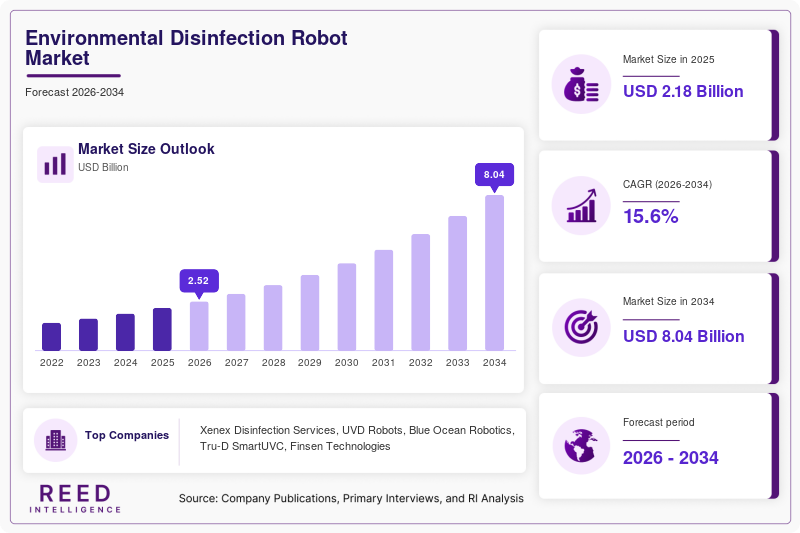
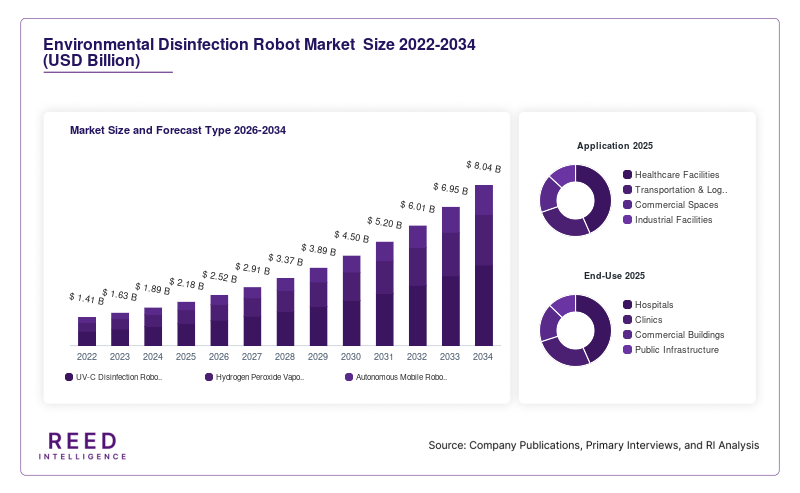
The Environmental Disinfection Robot Market size was valued at USD 2.18 billion in 2026 and is projected to reach approximately USD 6.95 billion by 2034, expanding at a CAGR of 15.6% during the forecast period of 2026–2034. The market has evolved from niche healthcare applications to broader adoption across transportation hubs, commercial buildings, and public infrastructure. These robots use technologies such as ultraviolet (UV-C) light, hydrogen peroxide vapor, and electrostatic spraying to eliminate pathogens efficiently, reducing reliance on manual labor while improving sanitation outcomes.
One global factor supporting market growth is the increased emphasis on infection prevention and hygiene management following widespread public health concerns. Governments, healthcare institutions, and private organizations have prioritized automation in sanitation processes to ensure consistent disinfection standards. This shift has led to increased investments in robotics and artificial intelligence-enabled cleaning systems, further strengthening the adoption of environmental disinfection robots across multiple industries
Key Highlights
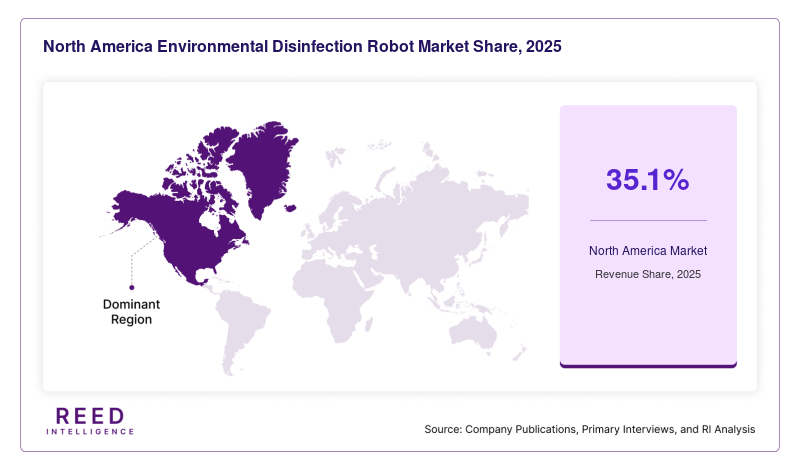
- North America dominated the market with a 35.1% share in 2025.
- Asia Pacific is expected to grow at the fastest CAGR of 17.3% during 2026–2034.
- By type, UV-C disinfection robots accounted for the largest share of 42.6%, while autonomous mobile robots are projected to grow at a CAGR of 18.1%.
- By application, healthcare facilities led with a 48.3% share, whereas transportation and logistics hubs are expected to expand at a CAGR of 16.9%.
- The United States remained the dominant country, with market values of USD 620 million in 2024 and USD 690 million in 2025.
Market Trends
Integration of Artificial Intelligence and IoT in Disinfection Robots
The integration of artificial intelligence and Internet of Things technologies is transforming the Environmental Disinfection Robot Market. Manufacturers are embedding advanced sensors, mapping capabilities, and real-time data analytics into robotic systems to improve navigation and efficiency. AI-enabled robots can identify high-risk contamination zones, optimize cleaning routes, and adjust disinfection intensity based on environmental conditions. IoT connectivity allows centralized monitoring and predictive maintenance, reducing downtime and improving operational efficiency. This trend is particularly evident in large facilities such as airports and hospitals where consistent sanitation is critical. As organizations seek smarter and more adaptive cleaning solutions, AI and IoT integration is expected to play a key role in enhancing robot performance and expanding use cases.
Expansion Beyond Healthcare into Commercial and Public Spaces
Another notable trend is the growing deployment of disinfection robots beyond traditional healthcare settings into commercial and public environments. Retail stores, hotels, educational institutions, and corporate offices are increasingly adopting robotic disinfection systems to maintain hygiene standards and build customer confidence. The pandemic accelerated awareness regarding cleanliness in shared spaces, prompting facility managers to invest in automated solutions. These robots offer scalability, repeatability, and cost efficiency compared to manual cleaning processes. Additionally, advancements in compact and mobile designs have made robots more suitable for diverse environments. As demand for continuous and visible sanitation increases, this trend is expected to drive broader market penetration.
Market Drivers
Rising Demand for Infection Control in Healthcare Facilities
The increasing demand for infection control in healthcare facilities is a major driver of the Environmental Disinfection Robot Market. Hospitals and clinics face constant pressure to reduce hospital-acquired infections, which can lead to extended patient stays and higher healthcare costs. Disinfection robots provide consistent and thorough cleaning, minimizing human error and ensuring compliance with hygiene protocols. The ability to operate autonomously also reduces exposure risks for healthcare workers. With growing patient volumes and strict regulatory requirements, healthcare providers are investing in advanced disinfection technologies. This demand is further supported by government initiatives promoting infection prevention measures, making healthcare facilities a key growth segment for the market.
Labor Shortages and Need for Operational Efficiency
Labor shortages in cleaning and sanitation services are driving the adoption of automated disinfection solutions. Many industries face challenges in hiring and retaining cleaning staff, especially for high-risk environments requiring specialized training. Disinfection robots address this issue by automating repetitive and labor-intensive tasks, allowing organizations to optimize workforce allocation. These robots can operate continuously, improving productivity and reducing operational costs over time. Additionally, automation ensures consistent cleaning quality, which is difficult to achieve with manual processes. As businesses focus on efficiency and cost control, the demand for robotic disinfection systems is expected to rise steadily.
Market Restraint
High Initial Investment and Maintenance Costs
One of the primary restraints in the Environmental Disinfection Robot Market is the high initial investment required for procurement and deployment. Advanced disinfection robots equipped with AI, sensors, and autonomous navigation systems can be expensive, limiting adoption among small and medium-sized enterprises. In addition to acquisition costs, ongoing maintenance, software updates, and training expenses further increase the total cost of ownership. These financial barriers can deter organizations with limited budgets from adopting robotic solutions. For example, smaller healthcare facilities and educational institutions may rely on traditional cleaning methods due to cost constraints. This restraint impacts market penetration, particularly in developing regions where budget allocation for advanced technologies is limited.
Market Opportunities
Growing Adoption in Emerging Economies
Emerging economies present significant growth opportunities for the Environmental Disinfection Robot Market. Rapid urbanization, increasing healthcare infrastructure, and rising awareness of hygiene standards are driving demand for advanced sanitation solutions. Governments in these regions are investing in smart city initiatives and public health infrastructure, creating favorable conditions for the adoption of disinfection robots. Additionally, the expanding middle-class population is increasing demand for clean and safe public spaces, encouraging businesses to adopt automated cleaning technologies. As manufacturing costs decrease and local production capabilities improve, disinfection robots are becoming more accessible in these markets, offering strong growth potential.
Technological Advancements and Product Innovation
Continuous technological advancements are creating new opportunities for market expansion. Innovations such as hybrid disinfection systems combining UV-C and chemical methods, improved battery life, and enhanced mobility are making robots more efficient and versatile. Manufacturers are also focusing on user-friendly interfaces and customizable solutions to meet specific industry needs. For instance, robots designed for narrow spaces or high-traffic areas are gaining popularity in commercial environments. These advancements not only improve performance but also reduce operational complexity, making robots more appealing to a wider range of users. As innovation continues, the market is expected to witness the introduction of more advanced and cost-effective solutions.
Segmental Analysis
By Type
UV-C disinfection robots dominated the Environmental Disinfection Robot Market in 2024, accounting for a share of approximately 42.6%. These robots are widely used due to their effectiveness in eliminating bacteria and viruses without the use of chemicals. Their ability to provide quick and efficient disinfection makes them suitable for healthcare facilities, laboratories, and public spaces. The growing demand for chemical-free cleaning solutions has further increased their adoption. Additionally, advancements in UV-C technology, such as improved safety features and automation, have enhanced their performance and usability.
Autonomous mobile robots are expected to be the fastest-growing subsegment, with a projected CAGR of 18.1% during the forecast period. These robots offer advanced navigation capabilities, allowing them to operate independently in complex environments. The increasing demand for automation and efficiency is driving their adoption across various industries. Their ability to perform multiple tasks, including mapping and monitoring, makes them a preferred choice for large facilities. As technology continues to evolve, autonomous mobile robots are expected to gain significant traction.
By Application
Healthcare facilities dominated the application segment in 2024, holding a market share of 48.3%. The need for strict infection control measures and the increasing prevalence of hospital-acquired infections have driven the adoption of disinfection robots in this sector. These robots provide consistent and thorough cleaning, reducing the risk of contamination and improving patient safety. The growing patient population and increasing healthcare expenditures further support the demand for advanced disinfection solutions.
Transportation and logistics hubs are projected to be the fastest-growing application segment, with a CAGR of 16.9%. The high volume of passenger traffic and the need for continuous sanitation in these environments are driving the adoption of disinfection robots. Airports, रेलवे stations, and bus terminals are increasingly deploying robotic solutions to maintain hygiene standards and ensure passenger safety. The expansion of transportation infrastructure is expected to further boost this segment’s growth.
By End-Use
Hospitals dominated the end-use segment in 2024, accounting for a significant share of the market. The need for advanced infection control solutions and the availability of financial resources have driven the adoption of disinfection robots in hospitals. These institutions prioritize patient safety and compliance with regulatory standards, making robotic solutions an essential part of their operations. The increasing focus on automation and efficiency further supports this trend.
Commercial facilities are expected to be the fastest-growing end-use segment, with a CAGR of 17.5%. The growing emphasis on hygiene in workplaces, retail stores, and hospitality sectors is driving the adoption of disinfection robots. Businesses are investing in automated solutions to enhance customer confidence and maintain clean environments. The expansion of commercial infrastructure and increasing awareness of sanitation standards are expected to drive this segment’s growth.
Regional Analysis
North America
North America accounted for approximately 35.1% of the Environmental Disinfection Robot Market share in 2025 and is projected to grow at a CAGR of 14.2% during the forecast period. The region benefits from advanced healthcare infrastructure, high adoption of automation technologies, and strong investment in research and development. The presence of key market players and early adoption of robotic solutions further contribute to market growth. Increasing focus on infection prevention and workplace safety continues to drive demand across various sectors.
The United States dominates the regional market due to its well-established healthcare system and high awareness of hygiene standards. A unique growth factor in the country is the integration of disinfection robots in large-scale public infrastructure such as airports and transit systems. This adoption is supported by government initiatives and funding for smart infrastructure projects, enhancing the market’s growth trajectory.
Europe
Europe held a market share of around 27.4% in 2025 and is expected to grow at a CAGR of 13.8% through 2034. The region’s growth is driven by stringent regulatory standards related to hygiene and workplace safety. Increasing investments in healthcare infrastructure and automation technologies are also contributing to market expansion. Countries across Europe are adopting robotic solutions to improve efficiency and maintain high sanitation standards.
Germany leads the European market, supported by its strong manufacturing base and focus on technological innovation. A unique growth factor in Germany is the integration of robotics in industrial and commercial cleaning applications. The country’s emphasis on Industry 4.0 and automation is driving the adoption of advanced disinfection robots across various sectors.
Asia Pacific
Asia Pacific is expected to grow at the fastest CAGR of 17.3% during the forecast period, with a market share of 22.8% in 2025. Rapid urbanization, expanding healthcare infrastructure, and increasing awareness of hygiene are key factors driving growth in the region. Governments are investing in smart city initiatives and public health systems, creating opportunities for the adoption of disinfection robots.
China dominates the Asia Pacific market due to its large population and strong manufacturing capabilities. A unique growth factor in China is the rapid deployment of disinfection robots in public spaces such as transportation hubs and shopping centers. This widespread adoption is supported by government initiatives promoting automation and technological innovation.
Middle East & Africa
The Middle East & Africa region accounted for approximately 8.2% of the market share in 2025 and is projected to grow at a CAGR of 12.9%. The region’s growth is driven by increasing investments in healthcare infrastructure and rising awareness of hygiene standards. Countries are adopting advanced technologies to improve sanitation in public spaces and healthcare facilities.
The United Arab Emirates is the leading country in the region, with significant investments in smart city projects. A unique growth factor is the use of disinfection robots in luxury hospitality and tourism sectors. The focus on maintaining high standards of cleanliness in hotels and public spaces is driving the adoption of robotic solutions.
Latin America
Latin America held a market share of around 6.5% in 2025 and is expected to grow at a CAGR of 13.1% during the forecast period. The region is witnessing increasing adoption of automated cleaning solutions due to rising awareness of hygiene and infection control. Investments in healthcare infrastructure and urban development are supporting market growth.
Brazil dominates the Latin American market, driven by its large population and expanding healthcare sector. A unique growth factor in Brazil is the adoption of disinfection robots in educational institutions and public facilities. This trend is supported by government initiatives aimed at improving public health and sanitation standards.
Competitive Landscape
The Environmental Disinfection Robot Market is moderately competitive, with several established players and emerging companies competing for market share. Leading companies focus on product innovation, strategic partnerships, and geographic expansion to strengthen their positions. The market leader has maintained its position by offering a diverse portfolio of advanced disinfection robots and investing in research and development. Recent developments include the launch of AI-enabled robots with enhanced navigation and real-time monitoring capabilities.
Companies are also focusing on collaborations with healthcare providers and commercial organizations to expand their customer base. The introduction of cost-effective solutions and customized products is helping companies cater to a wider range of industries. As competition intensifies, innovation and differentiation are expected to play a key role in shaping the market landscape.
Key Players List
- Xenex Disinfection Services
- UVD Robots
- Blue Ocean Robotics
- Tru-D SmartUVC
- Finsen Technologies
- TMiRob
- Nevoa Inc.
- Avidbots Corp.
- OTSAW Digital
- Mediland Enterprise
- Skytron LLC
- Bioquell
- Cleanfix Reinigungssysteme
- SoftBank Robotics
- Gaussian Robotics
Recent Developments
- A leading company launched a next-generation UV-C disinfection robot with enhanced safety sensors and AI-based navigation in 2025.
- A robotics firm partnered with a major airport authority to deploy autonomous disinfection robots across terminals.
- A technology provider introduced a hybrid disinfection system combining UV-C and electrostatic spraying for improved efficiency.
Environmental Disinfection Robot Market Segments
Type
- UV-C Disinfection Robots
- Hydrogen Peroxide Vapor Robots
- Autonomous Mobile Robots
Application
- Healthcare Facilities
- Transportation & Logistics
- Commercial Spaces
- Industrial Facilities
End-Use
- Hospitals
- Clinics
- Commercial Buildings
- Public Infrastructure
By Region
- North America
- Europe
- APAC
- Middle East and Africa
- LATAM