Environmental Noise Measurement Market Size, Share & Demand Report By Equipment Type (Sound Level Meters, Noise Dosimeters, Acoustic Calibrators, Sensors and Detectors, Cloud-Based Monitoring Software), By Application (Industrial Noise Monitoring, Transportation Noise Monitoring, Construction Site Monitoring, Smart City Environmental Monitoring, Residential and Community Monitoring), By End Use (Government and Municipal Agencies, Industrial Facilities, Environmental Consulting Firms, Transportat
USD 3950
Market Overview
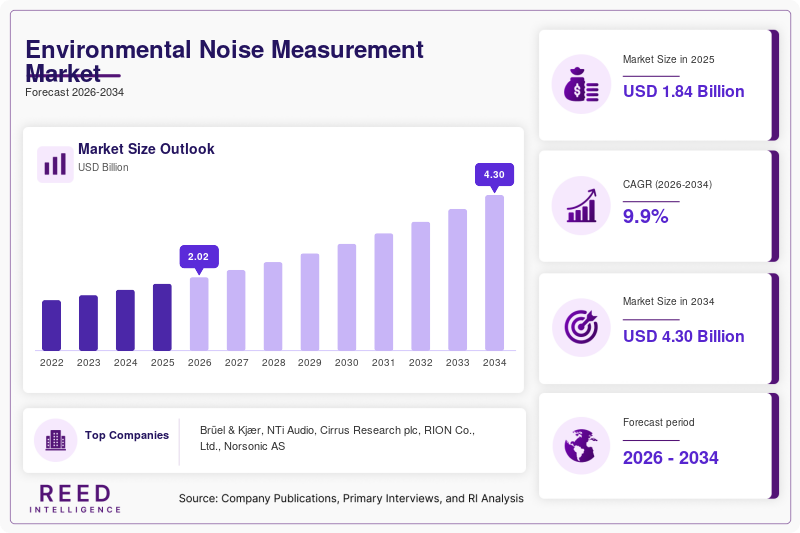
The global Environmental Noise Measurement Market size was valued at USD 1.84 billion in 2026 and is projected to reach USD 3.91 billion by 2034, expanding at a CAGR of 9.9% during the forecast period. The market is gaining steady momentum due to rising urbanization, industrial expansion, and stricter environmental compliance standards across developed and emerging economies. Governments and municipal authorities are increasing investments in smart monitoring systems to reduce noise pollution generated by transportation infrastructure, manufacturing plants, mining operations, airports, and construction activities. Environmental agencies are also implementing stricter regulations related to occupational safety and community health, creating sustained demand for advanced noise monitoring equipment and software platforms.
The integration of wireless connectivity, cloud-based analytics, and IoT-enabled acoustic sensors has improved the efficiency of real-time environmental monitoring. Industries are increasingly adopting automated monitoring systems to improve compliance reporting and reduce manual inspection costs. In addition, smart city development projects across Asia Pacific, Europe, and North America are encouraging the deployment of connected environmental monitoring solutions that include air quality, vibration, and noise measurement technologies.
Key Highlights
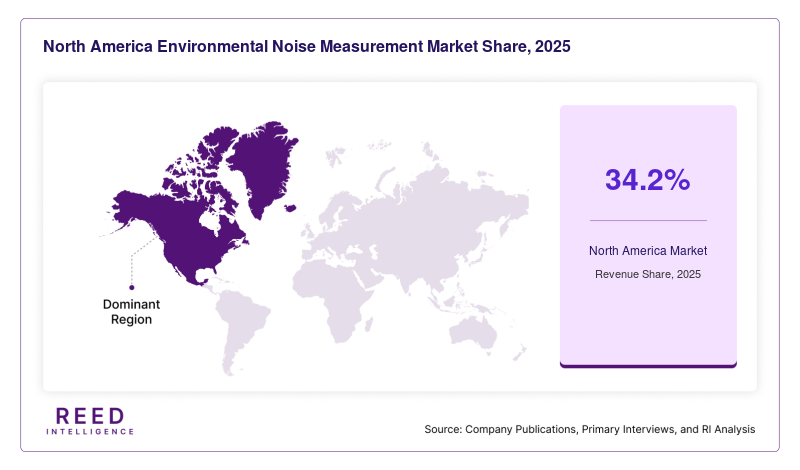
- North America dominated the market with a 34.2% share in 2025, while Asia Pacific is expected to grow at the fastest CAGR of 11.2% during 2026–2034.
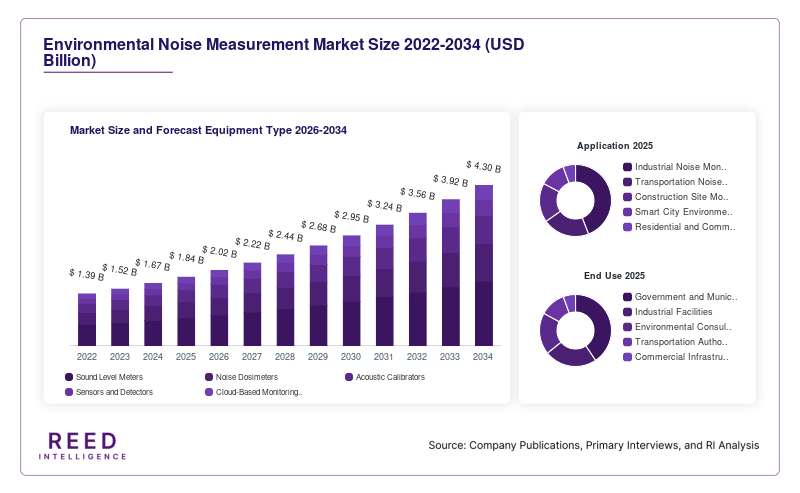
- By equipment type, sound level meters accounted for the largest share of 39.4%, while cloud-based monitoring software is projected to grow at a CAGR of 12.7%.
- By application, industrial noise monitoring led with a 42.1% share, whereas smart city environmental monitoring is expected to expand at a CAGR of 12.1%.
- The United States remained the dominant country, with market values of USD 620 million in 2024 and USD 685 million in 2025.
Market Trends
Expansion of Smart City Noise Monitoring Infrastructure
Smart city projects are increasingly incorporating environmental noise measurement systems into integrated urban management platforms. Municipal governments are deploying connected acoustic sensors near highways, airports, railway networks, and densely populated residential districts to improve urban planning and public health management. Real-time monitoring capabilities allow authorities to identify high-noise zones, analyze long-term sound exposure patterns, and implement mitigation strategies such as traffic rerouting or sound barrier installation. The growing use of AI-powered analytics and cloud-connected platforms is also improving predictive maintenance and operational efficiency. These developments are encouraging technology vendors to introduce compact wireless devices with remote calibration and advanced data visualization features.
Urban transportation modernization projects across Europe and Asia Pacific are further supporting demand for continuous environmental noise monitoring systems. Public infrastructure operators increasingly require centralized software platforms that combine data from multiple sensor locations into unified dashboards. This trend is creating opportunities for integrated hardware and software providers capable of delivering scalable monitoring ecosystems.
Rising Adoption of Portable and Wireless Monitoring Devices
Portable environmental noise measurement devices are witnessing increased demand from construction companies, industrial facilities, and environmental consulting firms. Organizations prefer lightweight wireless systems because they improve mobility, reduce installation complexity, and support faster field deployment. Portable systems are particularly useful for temporary monitoring applications such as construction site assessments, event management, and transportation infrastructure upgrades.
Manufacturers are introducing battery-efficient devices with Bluetooth, Wi‑Fi, and cellular connectivity to support remote monitoring and automated reporting. Integration with mobile applications has simplified data collection and analysis, enabling users to access real-time information directly from smartphones and tablets. These technological improvements are helping companies reduce operational costs while improving compliance management. In addition, the shift toward subscription-based monitoring software is encouraging businesses to adopt flexible environmental monitoring solutions without large upfront infrastructure investments.
Market Drivers
Increasing Environmental Regulations and Occupational Safety Standards
Governments across multiple regions are implementing stricter environmental noise control regulations to reduce health risks associated with prolonged exposure to high sound levels. Industrial facilities, transportation authorities, airports, and construction companies are required to monitor and document environmental noise emissions to maintain regulatory compliance. Regulatory bodies are also introducing periodic reporting frameworks that encourage organizations to deploy continuous monitoring systems instead of conducting occasional manual inspections.
Occupational safety regulations are another major factor supporting market growth. Employers are under pressure to improve workplace safety conditions in manufacturing plants, mining sites, and heavy industrial facilities where excessive noise exposure can affect employee health and productivity. Environmental noise measurement equipment helps organizations identify hazardous sound levels and implement corrective measures. As a result, businesses are increasingly investing in advanced sound monitoring devices equipped with automated alerts, cloud storage, and remote reporting capabilities.
Growth in Transportation and Infrastructure Development Projects
Rapid infrastructure expansion is generating higher demand for environmental noise measurement solutions across transportation and construction sectors. Governments are investing heavily in highways, airports, metro rail systems, ports, and industrial corridors to support economic development and urban mobility. These projects often require continuous environmental impact assessments, including acoustic monitoring, to comply with planning regulations and community safety standards.
Construction activities in urban areas frequently generate complaints related to excessive noise pollution, encouraging project developers to adopt continuous monitoring systems. Transportation authorities are also implementing permanent acoustic monitoring stations along rail corridors and airport zones to evaluate noise exposure levels in nearby residential communities. The increasing scale of infrastructure modernization programs across Asia Pacific and the Middle East is creating long-term opportunities for manufacturers offering rugged outdoor monitoring systems designed for large-scale deployment.
Market Restraint
High Initial Investment and Calibration Complexity
The Environmental Noise Measurement Market faces challenges related to high equipment costs and calibration requirements. Advanced environmental monitoring systems often require precision sensors, data acquisition hardware, wireless communication modules, and cloud-based analytics platforms, resulting in significant upfront investment. Small and medium-sized enterprises may delay adoption due to budget limitations, especially in developing economies where environmental compliance enforcement remains inconsistent.
Calibration and maintenance requirements also create operational complexity for end users. Environmental noise measurement systems must maintain high accuracy levels to meet regulatory standards, requiring regular calibration and technical servicing. Organizations operating large monitoring networks may face additional expenses associated with sensor replacement, software updates, and data management infrastructure. In remote industrial locations, maintaining system reliability can become difficult because of harsh environmental conditions and limited technical support availability.
The lack of standardized regulatory frameworks across certain emerging economies further limits adoption. Some businesses continue relying on manual monitoring methods or outsourced environmental assessments instead of investing in permanent monitoring infrastructure. These factors may slow market penetration among cost-sensitive end users, particularly in smaller industrial operations and municipal agencies with limited environmental monitoring budgets.
Market Opportunities
Integration of AI and Predictive Analytics in Monitoring Systems
The incorporation of artificial intelligence and predictive analytics into environmental monitoring platforms is creating new opportunities for technology providers. AI-enabled systems can analyze large acoustic datasets to identify abnormal sound patterns, predict equipment failures, and optimize environmental compliance management. These advanced capabilities are becoming increasingly valuable for industrial facilities and smart city operators seeking automated monitoring solutions.
Predictive analytics can help transportation authorities estimate future noise exposure trends based on traffic density, infrastructure expansion, and seasonal variations. Software developers are also integrating machine learning algorithms that classify sound sources and reduce false alerts generated by environmental interference. Such innovations improve operational efficiency while supporting faster decision-making processes. As organizations increasingly prioritize digital transformation, demand for intelligent environmental monitoring platforms is expected to increase steadily throughout the forecast period.
Expansion of Environmental Monitoring in Emerging Economies
Emerging economies present substantial growth opportunities due to rapid industrialization, urban population growth, and increasing environmental awareness. Countries across Southeast Asia, Latin America, and the Middle East are strengthening environmental regulations to improve public health and align with international sustainability standards. Governments are investing in smart infrastructure and industrial modernization programs that require integrated environmental monitoring capabilities.
Rising foreign direct investment in manufacturing and transportation infrastructure is also contributing to market expansion in emerging regions. Industrial parks, logistics hubs, and energy projects increasingly require environmental impact assessments before project approval. This trend is encouraging engineering firms and environmental consultants to adopt advanced acoustic monitoring solutions. Local authorities are additionally investing in community-based monitoring programs to address rising public concerns regarding urban noise pollution. These developments are expected to create long-term opportunities for both global manufacturers and regional technology providers.
Segmental Analysis
By Equipment Type
Sound level meters represented the dominant subsegment within the Environmental Noise Measurement Market in 2024, accounting for approximately 39.4% of global revenue. These devices remain widely adopted across industrial facilities, construction sites, airports, and transportation infrastructure projects because they provide accurate real-time sound level analysis. Portable and handheld sound level meters are particularly popular among environmental consultants and occupational safety professionals due to their ease of use and mobility. Continuous technological improvements in sensor sensitivity, battery efficiency, and wireless connectivity have further enhanced the performance of these devices. Regulatory agencies and industrial operators continue to prefer certified sound level meters for compliance monitoring and workplace safety assessments. Their broad applicability across temporary and permanent monitoring applications has maintained their leading position within the equipment category.
Cloud-based monitoring software is projected to register the fastest CAGR of 12.7% during the forecast period due to rising demand for centralized environmental data management and real-time analytics capabilities. Organizations are increasingly adopting cloud-enabled software platforms because they simplify remote monitoring, automated reporting, and predictive analysis. These systems allow users to aggregate acoustic data from multiple sensor locations into unified dashboards, improving operational visibility and decision-making efficiency. Municipal authorities and industrial operators are also integrating cloud platforms with broader environmental management systems that monitor air quality, vibration, and weather conditions. The growth of IoT infrastructure and wireless communication networks is accelerating software adoption, particularly in smart city projects and large-scale industrial facilities where real-time environmental intelligence is essential.
By Application
Industrial noise monitoring accounted for the largest share of the Environmental Noise Measurement Market in 2024, contributing approximately 42.1% of total revenue. Manufacturing plants, mining operations, oil and gas facilities, and power generation sites require continuous acoustic monitoring to comply with occupational safety standards and environmental regulations. Industrial operators increasingly rely on automated monitoring systems to reduce manual inspection costs and improve reporting accuracy. Rising awareness regarding workplace safety and employee health has also encouraged companies to implement comprehensive acoustic monitoring programs. Many industrial organizations are integrating environmental monitoring systems with operational management software to improve efficiency and support predictive maintenance strategies. The continued expansion of manufacturing and heavy industrial activities in emerging economies is expected to sustain demand for industrial monitoring solutions.
Smart city environmental monitoring is expected to witness the fastest growth, expanding at a CAGR of 12.1% during the forecast period. Urban authorities are deploying connected acoustic monitoring systems to manage transportation-related noise pollution and improve urban planning strategies. Smart city platforms increasingly integrate environmental noise measurement with traffic management, public safety, and air quality monitoring systems to provide comprehensive environmental intelligence. The growing adoption of IoT sensors, AI-based analytics, and cloud connectivity is improving the scalability and efficiency of urban monitoring networks. Public investments in digital infrastructure modernization are creating opportunities for technology providers offering integrated environmental monitoring ecosystems. Increasing public awareness regarding urban health and sustainability is also accelerating the implementation of continuous environmental noise assessment programs.
By End Use
Government and municipal agencies represented the dominant end-use segment in 2024, accounting for nearly 37.8% of total market revenue. Public authorities are major users of environmental noise measurement systems because they are responsible for implementing and enforcing environmental regulations across transportation corridors, residential zones, and industrial districts. Municipal agencies are increasingly investing in permanent acoustic monitoring networks to support urban planning and community health initiatives. Demand is particularly strong in cities experiencing rapid population growth and transportation infrastructure expansion. Governments are also adopting digital monitoring platforms that provide centralized access to environmental data for policy development and regulatory enforcement. Long-term investments in smart city programs and sustainable infrastructure projects continue to strengthen demand from public sector organizations.
Environmental consulting firms are projected to grow at the fastest CAGR of 11.6% during the forecast period due to increasing demand for outsourced environmental assessment services. Consulting firms support industrial operators, construction companies, and infrastructure developers by conducting environmental impact studies and regulatory compliance assessments. Rising infrastructure development activities and stricter environmental approval requirements are expanding the need for specialized consulting expertise. Many consulting firms are investing in advanced portable monitoring systems and cloud-based analytics platforms to improve project efficiency and data accuracy. The growing complexity of environmental regulations across emerging economies is also encouraging businesses to rely on third-party environmental specialists. As sustainability reporting becomes more important for corporations and public infrastructure projects, environmental consulting firms are expected to play an increasingly significant role in market expansion.
Regional Analysis
North America
North America accounted for 34.2% of the global Environmental Noise Measurement Market share in 2025 and continues to represent a mature and technologically advanced regional market. The region is expected to expand at a CAGR of 8.8% during the forecast period due to ongoing investments in smart infrastructure and environmental compliance systems. Strong regulatory oversight from environmental and occupational safety agencies encourages industrial facilities and transportation operators to maintain continuous acoustic monitoring capabilities. High adoption of IoT-enabled sensors and cloud-based monitoring software further supports regional market expansion.
The United States remains the dominant country in North America because of extensive transportation infrastructure, advanced industrial operations, and high environmental compliance spending. Airports, highway authorities, and construction companies increasingly deploy permanent monitoring stations to reduce community noise exposure and improve regulatory reporting efficiency. Growth is additionally supported by the expansion of smart city initiatives in metropolitan areas, where municipal authorities are integrating environmental noise monitoring into connected urban management systems.
Europe
Europe held a significant share of the Environmental Noise Measurement Market in 2025 and is projected to grow at a CAGR of 8.9% through 2034. Regional growth is supported by strong environmental sustainability policies and comprehensive noise pollution regulations implemented across the European Union. Transportation authorities and industrial operators are increasingly adopting automated environmental monitoring systems to comply with community health standards and urban planning requirements. Demand for integrated environmental monitoring platforms is particularly strong in countries with dense urban populations and extensive railway infrastructure.
Germany continues to dominate the European market due to its advanced manufacturing sector and strict industrial safety regulations. The country has made substantial investments in transportation modernization projects that require continuous acoustic monitoring near urban residential zones. Growth is also supported by increasing adoption of smart factory technologies, where environmental monitoring systems are integrated with industrial automation platforms to improve workplace safety and operational efficiency.
Asia Pacific
Asia Pacific is expected to register the fastest CAGR of 11.2% during the forecast period due to rapid urbanization, industrialization, and infrastructure development activities. Governments across the region are investing heavily in metro rail projects, airports, highways, and industrial corridors, creating strong demand for environmental monitoring technologies. Rising population density in major cities has increased public awareness regarding noise pollution, encouraging authorities to implement stricter environmental standards and continuous monitoring programs.
China represents the dominant country within Asia Pacific because of its extensive industrial base and large-scale infrastructure development initiatives. The country is rapidly expanding smart city programs that integrate acoustic monitoring systems with traffic management and environmental protection platforms. Growth is additionally supported by rising investments in renewable energy projects, manufacturing facilities, and urban transportation systems that require ongoing environmental impact assessments.
Middle East & Africa
The Middle East & Africa Environmental Noise Measurement Market is experiencing moderate but consistent growth, supported by expanding infrastructure investments and industrial diversification programs. The regional market is projected to grow at a CAGR of 8.1% during the forecast period. Governments are increasingly implementing environmental standards for construction activities, transportation projects, and energy infrastructure developments. Demand for outdoor monitoring systems is rising as countries seek to improve environmental sustainability and public health management.
Saudi Arabia remains the leading country in the regional market due to major urban development projects and transportation infrastructure expansion. Large-scale construction activities associated with economic diversification strategies are increasing the need for environmental impact monitoring and compliance reporting. Investments in smart city initiatives and industrial zones are also supporting demand for integrated monitoring systems capable of operating under harsh environmental conditions.
Latin America
Latin America accounted for a smaller but steadily expanding share of the global Environmental Noise Measurement Market in 2025 and is expected to grow at a CAGR of 7.9% through 2034. Regional growth is supported by rising environmental awareness and increasing investments in transportation infrastructure modernization. Governments and municipal authorities are gradually implementing stricter environmental monitoring requirements for construction projects, industrial facilities, and mining operations.
Brazil dominates the Latin American market due to its large industrial sector and ongoing urban infrastructure projects. The country has experienced increasing public concern regarding transportation and industrial noise pollution in densely populated cities. Growth is further supported by mining and energy sector activities that require regular environmental assessments and workplace safety monitoring. Expanding investments in urban mobility projects are also encouraging the deployment of long-term acoustic monitoring systems.
Competitive Landscape
The Environmental Noise Measurement Market remains moderately fragmented, with international and regional manufacturers competing through product innovation, software integration, and strategic partnerships. Companies are increasingly focusing on wireless connectivity, AI-enabled analytics, and cloud-based monitoring capabilities to strengthen their competitive positioning. Market participants are also investing in compact portable devices and long-term outdoor monitoring systems designed for industrial and smart city applications.
Brüel & Kjær continues to maintain a leading position in the market due to its extensive product portfolio, strong distribution network, and advanced acoustic measurement technologies. The company recently introduced upgraded cloud-connected environmental monitoring solutions designed for continuous urban and industrial noise assessment. Other major companies are expanding their presence through acquisitions, software development partnerships, and regional distribution agreements.
Key Players
- Brüel & Kjær
- NTi Audio
- Cirrus Research plc
- RION Co., Ltd.
- Norsonic AS
- 3M Company
- Svantek
- Larson Davis
- Casella Inc.
- ACOEM Group
- Testo SE & Co. KGaA
- Pulsar Instruments
- Extech Instruments
- Siemens AG
- Honeywell International Inc.
Recent Developments
- In February 2026, Brüel & Kjær launched an AI-enabled environmental noise analytics platform designed for large-scale smart city monitoring applications.
- In August 2025, ACOEM Group expanded its wireless acoustic monitoring portfolio with solar-powered outdoor monitoring stations for transportation infrastructure projects.
- In November 2025, NTi Audio introduced portable cloud-connected sound level meters featuring automated compliance reporting and mobile application integration.
- In March 2026, Svantek partnered with a transportation infrastructure operator to deploy continuous environmental monitoring systems across urban rail corridors.
Environmental Noise Measurement Market Segments
Equipment Type
- Sound Level Meters
- Noise Dosimeters
- Acoustic Calibrators
- Sensors and Detectors
- Cloud-Based Monitoring Software
Application
- Industrial Noise Monitoring
- Transportation Noise Monitoring
- Construction Site Monitoring
- Smart City Environmental Monitoring
- Residential and Community Monitoring
End Use
- Government and Municipal Agencies
- Industrial Facilities
- Environmental Consulting Firms
- Transportation Authorities
- Commercial Infrastructure Operators
By Region
- North America
- Europe
- APAC
- Middle East and Africa
- LATAM