Enzyme Stabilizer Market Size, Share Demand Report By Type (Protein-Based Stabilizers, Polymer-Based Stabilizers, Sugar-Based Stabilizers, Salt-Based Stabilizers, Other Stabilizers), By Form (Liquid Stabilizers, Powder Stabilizers, Granular Stabilizers), By End-Use Industry (Pharmaceuticals, Food and Beverage, Detergents, Industrial Biotechnology, Agriculture, Diagnostics, Other End-Use Industries) By Region & Segment Forecasts, 2026–2034
USD 3950
Market Overview
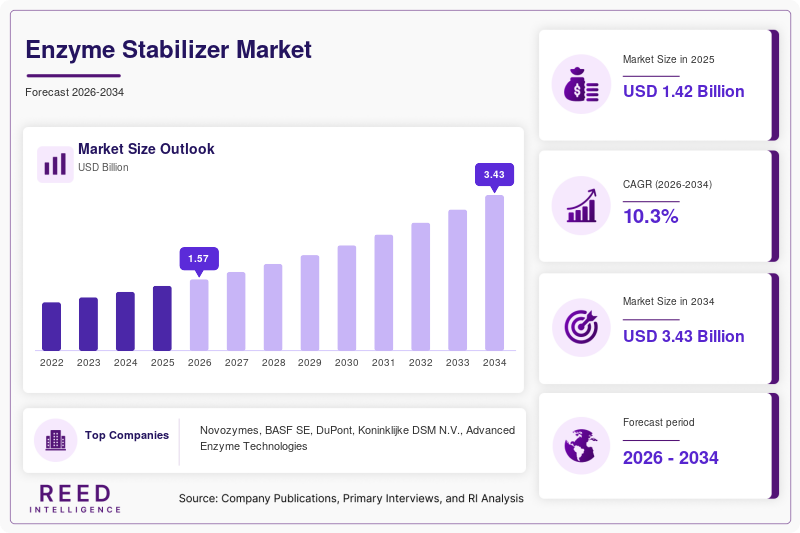
The global Enzyme Stabilizer Market size was valued at USD 1.42 billion in 2026 and is projected to reach USD 3.11 billion by 2034, expanding at a CAGR of 10.3% during the forecast period from 2026 to 2034. The market is experiencing steady expansion due to rising enzyme applications across pharmaceuticals, food processing, detergents, biotechnology, and animal nutrition industries. Enzyme stabilizers are widely used to maintain enzyme activity, extend shelf life, and improve operational efficiency in industrial processes. Increasing dependence on biocatalysts in industrial manufacturing has accelerated the need for reliable stabilization technologies that can withstand temperature fluctuations, pH changes, and long-term storage conditions.
The growing focus on sustainable manufacturing and green chemistry has supported the wider adoption of enzyme-based processing systems globally. Industrial manufacturers are replacing conventional chemical catalysts with enzymes to reduce waste generation, improve energy efficiency, and comply with environmental standards. This shift has directly increased demand for advanced stabilizing compounds such as polyols, sugars, salts, proteins, and synthetic polymers that preserve enzyme performance during transportation and production cycles. In addition, biotechnology investments in emerging economies and expanding research in precision fermentation have strengthened market penetration across both developed and developing regions.
Key Highlights
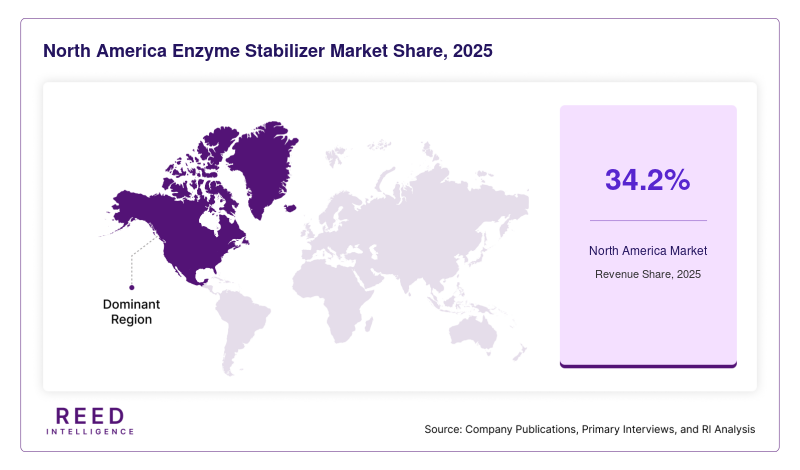
- North America dominated the market with a 34.2% share in 2025.
- Asia Pacific is expected to grow at the fastest CAGR of 11.6% during 2026–2034.
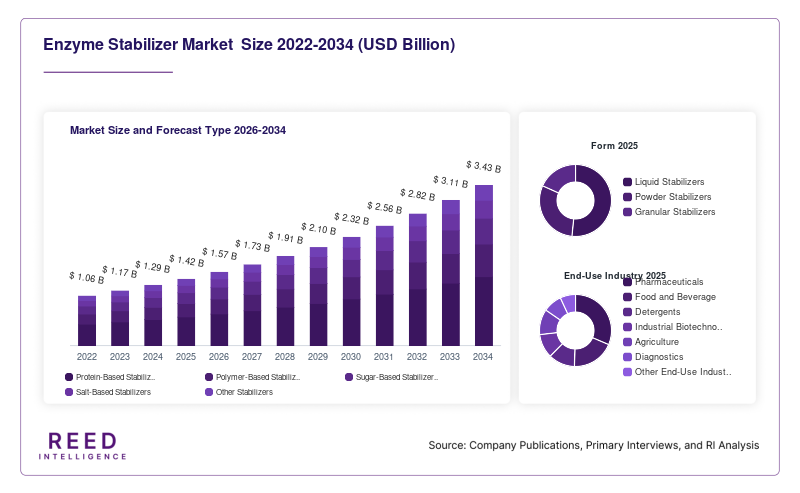
- By type, protein-based stabilizers accounted for the largest share of 37.8%, while polymer-based stabilizers are projected to grow at a CAGR of 12.1%.
- By form, liquid stabilizers led with a 58.4% share, whereas powder stabilizers are expected to expand at a CAGR of 11.4%.
- By end-use industry, pharmaceuticals dominated with a 32.6% share, while food and beverage applications are forecast to grow at a CAGR of 11.8%. The United States remained the dominant country, with market values of USD 420 million in 2024 and USD 468 million in 2025.
Market Trends
Expansion of precision fermentation and biopharmaceutical manufacturing
The rapid growth of precision fermentation and biologics manufacturing has emerged as a major trend shaping the Enzyme Stabilizer Market. Biopharmaceutical companies are increasingly using enzymes in vaccine production, recombinant protein synthesis, diagnostics, and cell culture applications. These processes require stable enzyme performance under highly controlled conditions, creating strong demand for advanced stabilizer systems. Manufacturers are developing multifunctional stabilizers that improve thermal resistance, oxidation control, and long-term storage capabilities. The expansion of biologics pipelines in North America, Europe, and Asia Pacific has encouraged suppliers to introduce pharmaceutical-grade stabilizers that comply with regulatory standards. Growing investments in biosimilar production facilities and contract manufacturing organizations are also contributing to market expansion.
Another factor supporting this trend is the increasing use of enzyme stabilization technologies in precision fermentation for alternative proteins and specialty ingredients. Food technology companies are using enzymes to produce dairy alternatives, functional proteins, and nutritional compounds through microbial fermentation. Stable enzyme activity is essential to ensure consistent yields and process efficiency during large-scale production. As the alternative protein sector expands globally, demand for highly efficient stabilizers is expected to increase steadily across commercial biotechnology applications.
Rising demand for sustainable industrial processing technologies
Industrial manufacturers are increasingly adopting environmentally responsible production methods, creating strong demand for enzyme-based processing and stabilization solutions. Enzymes are now widely used in detergents, textiles, paper processing, agriculture, and biofuel production because they reduce energy usage and minimize harmful chemical discharge. This transition has accelerated the need for stabilizers that maintain enzyme activity during harsh industrial operations involving heat exposure, varying pH conditions, and prolonged storage periods. Companies are investing in eco-friendly stabilizer formulations made from biodegradable compounds and renewable raw materials to align with sustainability goals.
The detergent industry has become a major contributor to this trend as manufacturers develop concentrated formulations requiring stable enzyme functionality over extended shelf lives. Textile and leather processing facilities are also replacing conventional chemical treatments with enzyme-assisted processing methods to reduce water consumption and improve environmental performance. Government regulations encouraging cleaner manufacturing practices across Europe and Asia Pacific have further strengthened adoption rates. As industries continue focusing on carbon reduction strategies and sustainable operations, demand for durable and efficient enzyme stabilization systems is projected to rise significantly.
Market Drivers
Increasing enzyme utilization across pharmaceutical and healthcare applications
The expanding use of enzymes in pharmaceutical production and healthcare applications is a major driver supporting the growth of the Enzyme Stabilizer Market. Enzymes are increasingly utilized in drug development, molecular diagnostics, therapeutic formulations, and vaccine manufacturing due to their catalytic efficiency and specificity. However, enzymes are highly sensitive to environmental factors such as heat, humidity, and pH fluctuations. Stabilizers help preserve enzymatic activity and improve storage stability, making them essential components in pharmaceutical processing. Rising investments in biotechnology research and increasing production of biologic drugs have accelerated the adoption of advanced stabilization systems.
Healthcare laboratories and diagnostic centers are also increasing their use of stabilized enzyme reagents in clinical testing kits and molecular assays. The growing prevalence of chronic diseases and infectious conditions has increased global diagnostic testing volumes, directly supporting demand for stable enzyme formulations. Pharmaceutical companies are additionally focusing on extending product shelf life to improve global distribution efficiency, especially in regions with limited cold-chain infrastructure. These factors collectively continue to strengthen long-term market demand for enzyme stabilizers across healthcare and pharmaceutical industries.
Growth of processed food and industrial biotechnology industries
The rapid expansion of processed food manufacturing and industrial biotechnology operations has significantly contributed to the development of the Enzyme Stabilizer Market. Food processing companies increasingly use enzymes for baking, dairy processing, brewing, starch conversion, and juice clarification. Stable enzyme performance is essential for maintaining product quality, flavor consistency, and operational efficiency in large-scale production facilities. Enzyme stabilizers help protect catalytic activity during storage and transportation, allowing manufacturers to reduce product waste and improve production reliability.
Industrial biotechnology has also witnessed substantial growth due to increasing demand for sustainable bio-based production systems. Enzymes are now widely applied in biofuel production, waste management, textile treatment, and agricultural processing. Stabilizers enable these enzymes to remain functional under variable industrial conditions, including high temperatures and long operational cycles. Emerging economies are investing heavily in industrial biotechnology infrastructure to support domestic manufacturing and export competitiveness. This industrial transition toward bio-based processing methods is expected to maintain strong growth momentum for enzyme stabilizer manufacturers throughout the forecast period.
Market Restraint
High formulation complexity and storage sensitivity affecting product adoption
One of the primary restraints limiting the growth of the Enzyme Stabilizer Market is the complexity associated with enzyme stabilization formulations and storage management. Enzymes are biologically sensitive molecules that can lose functionality when exposed to moisture, temperature fluctuations, oxidation, or contamination during transportation and storage. Developing stabilizers that are compatible with different enzyme classes while maintaining catalytic efficiency is a technically demanding process. Manufacturers often require extensive research, formulation testing, and validation procedures before commercial deployment, increasing production costs and extending product development timelines.
The challenge becomes more significant in pharmaceutical and industrial applications where enzymes operate under highly specific environmental conditions. Some stabilization agents may interfere with downstream processing or alter enzyme activity during manufacturing operations. Small and medium-sized companies often face difficulties investing in advanced stabilization technologies because of high research expenses and specialized infrastructure requirements. In addition, cold-chain dependency for certain stabilized enzyme formulations increases logistical costs in developing regions. For example, food processing facilities in tropical climates may experience reduced enzyme efficiency due to inconsistent storage conditions, limiting large-scale adoption. These operational challenges continue to restrain market penetration in cost-sensitive industries.
Market Opportunities
Growing demand for enzyme stabilization in alternative protein production
The increasing global demand for alternative proteins presents a significant opportunity for the Enzyme Stabilizer Market. Food technology companies are rapidly expanding the production of plant-based proteins, cultivated meat ingredients, and fermentation-derived nutritional compounds. Enzymes play a vital role in improving texture, flavor development, protein modification, and fermentation efficiency during these manufacturing processes. Stable enzymatic performance is essential for maintaining consistent product quality and reducing production variability in commercial-scale facilities.
As alternative protein producers scale operations, they require highly reliable stabilizers capable of preserving enzyme functionality during transportation, storage, and prolonged manufacturing cycles. The expansion of vegan and flexitarian consumer preferences in North America, Europe, and Asia Pacific has accelerated investment in food biotechnology infrastructure. Enzyme stabilizer manufacturers have an opportunity to develop customized formulations specifically designed for protein fermentation and next-generation food processing systems. The emergence of precision nutrition products and functional food ingredients is expected to create additional demand for specialized stabilization technologies in the coming years.
Increasing adoption of enzyme technologies in agricultural biotechnology
Agricultural biotechnology is emerging as another important opportunity area for enzyme stabilizer manufacturers. Modern farming systems increasingly use enzymes in animal feed additives, soil treatment formulations, crop protection products, and biomass conversion processes. Enzyme-based agricultural products help improve nutrient absorption, increase crop productivity, and support environmentally sustainable farming practices. However, agricultural environments often involve exposure to fluctuating temperatures, moisture levels, and extended storage conditions, making stabilization essential for product performance.
Governments and agricultural organizations are promoting sustainable farming techniques to reduce chemical fertilizer dependency and improve soil health. This shift has encouraged agritech companies to expand research into bio-based agricultural inputs, including enzyme-enhanced products. Enzyme stabilizers capable of maintaining activity under outdoor storage and transportation conditions are becoming increasingly important for commercial agriculture. Developing regions with expanding livestock production and agricultural modernization programs are expected to provide long-term growth opportunities for suppliers offering cost-effective and durable stabilization technologies.
Segmental Analysis
By Type
Protein-based stabilizers accounted for the largest share of the Enzyme Stabilizer Market in 2024, representing 37.8% of total revenue. These stabilizers are widely used because they effectively protect enzyme structures against denaturation, aggregation, and thermal degradation. Pharmaceutical and biotechnology companies extensively utilize protein stabilizers in biologics manufacturing, diagnostic kits, and vaccine development processes where maintaining enzymatic activity is critical. Their compatibility with sensitive biological systems has supported widespread adoption across healthcare applications. Food processing companies also prefer protein-based stabilizers in enzyme-assisted dairy, brewing, and bakery operations because they help maintain product consistency and operational efficiency. The increasing use of enzymes in therapeutic and molecular diagnostic applications has further strengthened the commercial importance of protein-derived stabilization technologies across global markets.
Polymer-based stabilizers are projected to register the fastest CAGR of 12.1% during the forecast period due to their superior resistance to temperature fluctuations and long-term storage conditions. These stabilizers are increasingly utilized in industrial biotechnology, detergents, textiles, and biofuel applications where enzymes are exposed to harsh operational environments. Synthetic and biodegradable polymers help improve enzyme durability, minimize oxidation risks, and extend shelf life during transportation and manufacturing. Manufacturers are also investing in advanced polymer engineering technologies to develop multifunctional stabilizers capable of supporting high-performance industrial processing systems. Growing adoption of industrial enzymes in emerging economies and increasing demand for sustainable manufacturing methods are expected to accelerate the use of polymer-based stabilization solutions throughout the forecast period.
By Form
Liquid stabilizers dominated the Enzyme Stabilizer Market in 2024 with a revenue share of 58.4% owing to their ease of application and compatibility with large-scale industrial processing systems. Liquid formulations are extensively used in pharmaceutical manufacturing, detergents, food processing, and biotechnology applications because they allow rapid mixing and uniform enzyme distribution during production. Companies prefer liquid stabilizers for continuous manufacturing operations where process efficiency and dosage accuracy are important. These stabilizers also support cold-chain storage systems commonly used in healthcare and diagnostic industries. The growing adoption of enzyme-based detergents and industrial cleaning products has further strengthened demand for liquid stabilization technologies. In addition, liquid stabilizers are widely utilized in fermentation processes because they enable faster integration with biocatalytic systems during large-scale production operations.
Powder stabilizers are anticipated to witness the fastest CAGR of 11.4% during the forecast period due to their longer shelf life and improved transportation efficiency. Powder formulations are increasingly preferred in regions with limited refrigeration infrastructure because they remain stable under varying environmental conditions. Food ingredient manufacturers and agricultural biotechnology companies are adopting powdered stabilizers to reduce logistical costs and simplify storage management. Freeze-drying technologies and encapsulation techniques have improved the performance of powder-based stabilization systems, enabling wider adoption across industrial applications. Pharmaceutical companies are also investing in powdered enzyme formulations for diagnostic kits and therapeutic applications requiring extended shelf stability. Rising international trade in enzyme products and increasing demand for portable industrial formulations are expected to support strong growth for powder stabilizers.
By End-Use Industry
The pharmaceutical industry held the largest share of the Enzyme Stabilizer Market in 2024, accounting for 32.6% of global revenue. Pharmaceutical manufacturers rely heavily on enzymes for vaccine production, biologic drug development, molecular diagnostics, and therapeutic formulations. Stabilizers are essential for preserving enzymatic activity during manufacturing, transportation, and storage, particularly for temperature-sensitive biologic products. Increasing global demand for advanced healthcare solutions and rising investment in biotechnology research have significantly contributed to segment growth. Diagnostic laboratories and research institutions are also increasing their use of stabilized enzyme reagents in molecular testing procedures. The rapid expansion of biosimilar development programs and contract pharmaceutical manufacturing services has further strengthened demand for high-performance stabilization technologies across the pharmaceutical industry.
The food and beverage industry is projected to register the fastest CAGR of 11.8% throughout the forecast period due to increasing use of enzymes in processed food manufacturing and beverage production. Enzymes are widely applied in baking, dairy processing, brewing, fruit juice clarification, and starch conversion operations to improve texture, flavor, and production efficiency. Stabilizers help maintain enzymatic activity during transportation and prolonged storage, reducing production losses and ensuring product consistency. Rising consumption of convenience foods and functional beverages in emerging economies has accelerated demand for enzyme-assisted food processing systems. Manufacturers are also focusing on clean-label production methods and sustainable processing technologies, which is encouraging greater utilization of stabilized enzyme formulations across commercial food manufacturing facilities.
Regional Analysis
North America
North America accounted for the largest share of the Enzyme Stabilizer Market in 2025, representing 34.2% of global revenue. The regional market is expected to expand at a CAGR of 9.7% during the forecast period due to the strong presence of pharmaceutical manufacturers, biotechnology firms, and industrial enzyme producers. Demand for advanced stabilization technologies remains high across healthcare diagnostics, biologics manufacturing, and food processing industries. Companies in the region continue investing in research and development activities to improve enzyme shelf life, optimize processing efficiency, and support large-scale industrial applications.
The United States remained the dominant contributor to regional revenue generation due to its extensive biotechnology ecosystem and high healthcare expenditure. Rising production of biologic drugs and molecular diagnostic kits has accelerated demand for pharmaceutical-grade enzyme stabilizers. In addition, the country’s growing alternative protein sector has created strong demand for stabilized fermentation enzymes. Investments in precision fermentation facilities and industrial biotechnology research continue to support long-term market expansion across the United States.
Europe
Europe held a substantial share of the global Enzyme Stabilizer Market in 2025 and is projected to witness consistent growth through 2034 at a CAGR of 9.2%. The region benefits from strong regulatory support for sustainable industrial manufacturing and widespread adoption of enzyme-assisted processing technologies. Food and beverage manufacturers across Europe increasingly use enzymes for dairy processing, brewing, and bakery applications, creating stable demand for advanced stabilizer systems. Pharmaceutical research activities and biologics manufacturing capacity expansion also continue to contribute to regional market development.
Germany emerged as the dominant country within the European market due to its strong chemical manufacturing sector and advanced biotechnology infrastructure. The country has experienced increasing adoption of enzyme-based processing systems in industrial production and environmental applications. German manufacturers are also investing in eco-friendly stabilizer formulations aligned with strict environmental regulations. The expansion of industrial biotechnology programs and growing demand for sustainable manufacturing processes remain major growth factors supporting market development across the country.
Asia Pacific
Asia Pacific is anticipated to register the fastest CAGR of 11.6% during the forecast period, supported by rapid industrialization, expanding biotechnology investments, and growing food processing industries. The region accounted for a significant portion of global demand in 2025 as manufacturers increased enzyme utilization across pharmaceuticals, textiles, detergents, and agricultural biotechnology applications. Countries within the region are actively investing in domestic biomanufacturing capabilities to reduce dependence on imported industrial chemicals and support export-oriented production.
China dominated the Asia Pacific market due to its large-scale industrial biotechnology sector and expanding pharmaceutical manufacturing base. The country has witnessed strong growth in enzyme production facilities serving detergent, food processing, and biofuel industries. Government initiatives supporting biotechnology innovation and sustainable industrial development have accelerated investment in advanced stabilization technologies. Rising consumer demand for processed foods and healthcare products has also contributed to increased utilization of stabilized enzymes across multiple industries in China.
Middle East & Africa
The Middle East & Africa market represented a smaller but steadily growing portion of the global Enzyme Stabilizer Market in 2025. The regional market is projected to grow at a CAGR of 8.6% through 2034 due to increasing investment in food processing, healthcare infrastructure, and industrial biotechnology projects. Governments in several countries are focusing on economic diversification strategies that encourage domestic manufacturing and biotechnology development. Demand for stabilized enzymes is gradually increasing in detergent manufacturing, pharmaceutical applications, and agricultural biotechnology sectors.
Saudi Arabia emerged as the leading country within the region due to growing investment in industrial diversification and healthcare expansion programs. The country is supporting biotechnology research initiatives aimed at improving domestic pharmaceutical production and food security. Increased adoption of enzyme-assisted industrial processing in water treatment and food manufacturing has created additional demand for stabilization technologies. Expansion of cold-chain logistics and industrial infrastructure is also helping improve market accessibility across Saudi Arabia.
Latin America
Latin America demonstrated moderate growth in the Enzyme Stabilizer Market during 2025 and is expected to continue expanding at a CAGR of 8.9% during the forecast period. Growth in the region is supported by rising food processing activities, expanding agricultural biotechnology applications, and increasing use of industrial enzymes in biofuel production. Manufacturers are gradually adopting stabilized enzyme formulations to improve production efficiency and reduce operational waste in industrial processing environments.
Brazil remained the dominant country in the regional market due to its strong agricultural sector and growing bioethanol production industry. The country extensively uses industrial enzymes in sugar processing, biofuel manufacturing, and animal feed applications. Rising investment in sustainable agricultural technologies has accelerated demand for stable enzyme formulations capable of operating under tropical storage conditions. Expansion of domestic pharmaceutical manufacturing and processed food consumption is also contributing to market growth in Brazil.
Competitive Landscape
The Enzyme Stabilizer Market is moderately consolidated, with leading companies focusing on product innovation, biotechnology partnerships, and regional expansion strategies to strengthen market positioning. Major participants are investing in advanced stabilization technologies capable of supporting pharmaceutical, food processing, and industrial biotechnology applications. Companies are also prioritizing sustainable formulations and customized stabilization systems tailored for specific enzyme classes and operational environments.
Novozymes remains one of the leading companies in the market due to its extensive enzyme portfolio and strong industrial biotechnology presence. The company has recently expanded its research initiatives focused on advanced stabilization systems for sustainable industrial processing and food biotechnology applications. BASF SE, DuPont, Koninklijke DSM N.V., and Advanced Enzyme Technologies are also actively strengthening their product portfolios through strategic collaborations and manufacturing expansion activities.
Competitive intensity is increasing as biotechnology companies and specialty chemical manufacturers introduce multifunctional stabilizers with improved thermal resistance and shelf-life performance. Regional players are targeting cost-sensitive markets by developing economical formulations for food processing and agricultural applications. The growing importance of biologics manufacturing and alternative protein production is expected to encourage additional innovation and strategic investment across the competitive landscape during the forecast period.
Key Players
- Novozymes
- BASF SE
- DuPont
- Koninklijke DSM N.V.
- Advanced Enzyme Technologies
- Kerry Group
- Amano Enzyme Inc.
- Chr. Hansen Holding A/S
- AB Enzymes
- Associated British Foods plc
- Enzyme Development Corporation
- Roche Holding AG
- Codexis Inc.
- Specialty Enzymes & Probiotics
- BioCatalysts Limited
Recent Developments
- In February 2025, Novozymes introduced a new enzyme stabilization platform designed for precision fermentation and alternative protein manufacturing applications.
- In August 2025, BASF SE expanded its biotechnology research facility in Germany to develop sustainable polymer-based enzyme stabilizers for industrial processing industries.
- In January 2026, DuPont announced a strategic partnership with a pharmaceutical contract manufacturing company to develop customized enzyme stabilization solutions for biologics production.
- In October 2025, Advanced Enzyme Technologies launched a powder-based stabilization system targeting agricultural biotechnology and animal nutrition applications.
- In March 2026, Koninklijke DSM N.V. expanded its food biotechnology portfolio with new liquid enzyme stabilizers designed for dairy and beverage processing operations.
Enzyme Stabilizer Market Segments
Type
- Protein-Based Stabilizers
- Polymer-Based Stabilizers
- Sugar-Based Stabilizers
- Salt-Based Stabilizers
- Other Stabilizers
Form
- Liquid Stabilizers
- Powder Stabilizers
- Granular Stabilizers
End-Use Industry
- Pharmaceuticals
- Food and Beverage
- Detergents
- Industrial Biotechnology
- Agriculture
- Diagnostics
- Other End-Use Industries
By Region
- North America
- Europe
- APAC
- Middle East and Africa
- LATAM