Eosinophilic Granulomatosis with Polyangiitis Treatment Market Size, Share & Demand Report By Drug Class (Corticosteroids, Immunosuppressants, Biologics), By Route of Administration (Oral, Injectable), By End-Use (Hospitals, Specialty Clinics, Others), By Region & Segment Forecasts, 2026–2034
USD 3950
Market Overview
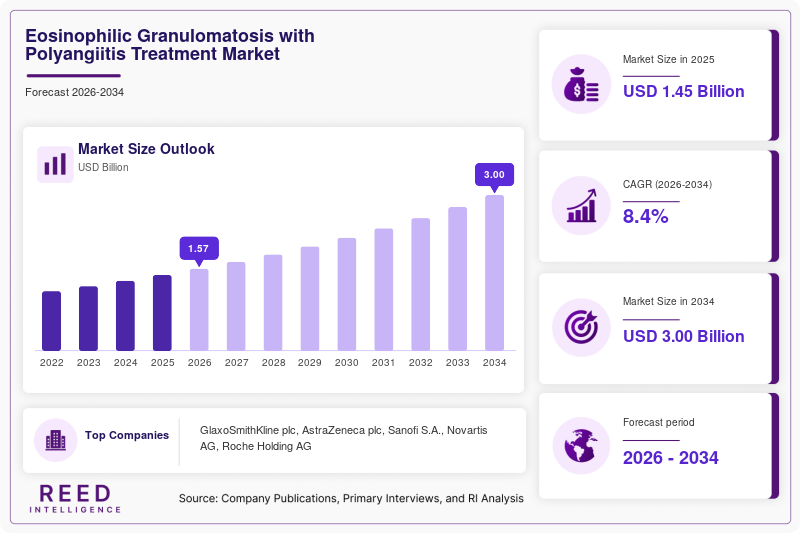
The global Eosinophilic Granulomatosis with Polyangiitis Treatment Market size was valued at approximately USD 1.45 billion in 2026 and is projected to reach USD 2.78 billion by 2034, expanding at a CAGR of 8.4% during the forecast period (2026–2034). The market reflects steady growth driven by increasing diagnosis rates of rare autoimmune disorders and the gradual shift toward targeted biologic therapies. Improvements in diagnostic tools and awareness among healthcare providers have led to earlier detection, which supports treatment demand across developed and emerging regions.
A key global factor supporting market growth is the increasing adoption of biologics and immunosuppressive therapies that offer improved clinical outcomes compared to conventional corticosteroids. Pharmaceutical companies are investing in monoclonal antibodies that specifically target eosinophilic pathways, enabling better disease management and reduced relapse rates. This shift toward precision medicine has enhanced patient outcomes and encouraged long-term therapy adherence, which in turn contributes to revenue expansion in the market.
Key Highlights
- North America dominated the market with a 35.6% share in 2025.
- Asia Pacific is expected to grow at the fastest CAGR of 10.8% during 2026–2034.
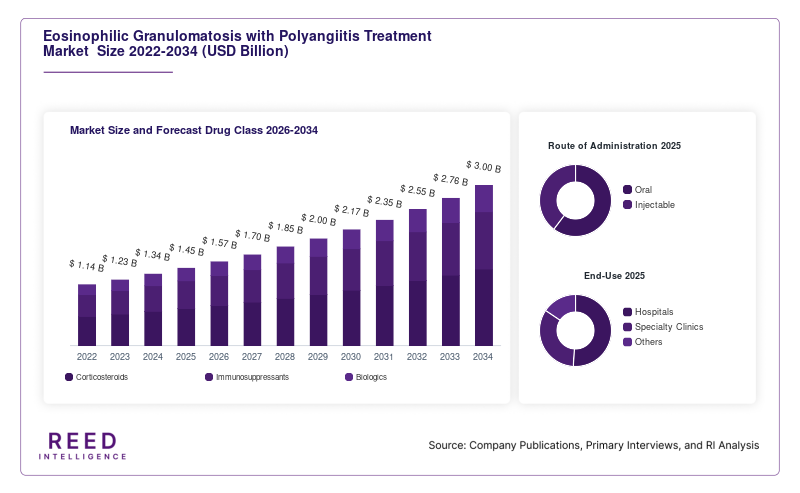
- By drug class, corticosteroids accounted for the largest share of 42.3%, while biologics are projected to grow at a CAGR of 11.6%.
- By route of administration, oral therapies led with a 48.1% share, whereas injectable therapies are expected to expand at a CAGR of 10.9%.
- The United States remained the dominant country, with market values of USD 520 million in 2024 and USD 575 million in 2025.
Market Trends
Increasing adoption of targeted biologic therapies
The treatment landscape for eosinophilic granulomatosis with polyangiitis is evolving with the rising adoption of targeted biologic therapies. These therapies focus on specific immune pathways, particularly interleukin-5 (IL-5), which plays a critical role in eosinophil activation. The introduction of monoclonal antibodies has enabled clinicians to reduce dependency on systemic corticosteroids, thereby minimizing long-term side effects such as osteoporosis and diabetes. This trend is particularly evident in developed healthcare systems where reimbursement frameworks support the use of advanced therapies. Furthermore, ongoing clinical trials are expanding the potential indications of biologics, which is expected to increase their penetration in the market over the forecast period.
Rising emphasis on early diagnosis and personalized treatment
Healthcare systems are placing greater emphasis on early diagnosis and personalized treatment strategies for rare autoimmune diseases. Advances in diagnostic imaging, biomarker identification, and genetic profiling are helping clinicians identify eosinophilic granulomatosis with polyangiitis at earlier stages. Early detection improves treatment outcomes and reduces the risk of severe organ damage. Personalized treatment plans, which consider patient-specific disease severity and comorbidities, are becoming more common. This trend is driving demand for a broader range of therapies, including immunosuppressants and biologics, thereby contributing to the expansion of the overall market.
Market Drivers
Growing prevalence and improved diagnosis of rare autoimmune diseases
The increasing prevalence of rare autoimmune diseases, including eosinophilic granulomatosis with polyangiitis, is a key driver of market growth. Although the condition remains relatively uncommon, improved diagnostic capabilities have led to a higher number of confirmed cases. Healthcare providers are becoming more aware of the disease's symptoms, such as asthma, sinusitis, and peripheral neuropathy, leading to more accurate and timely diagnoses. This has resulted in a growing patient pool requiring long-term treatment. Additionally, advancements in laboratory testing and imaging technologies have enhanced diagnostic precision, supporting sustained demand for therapeutic interventions.
Advancements in drug development and regulatory support
Pharmaceutical innovation is playing a significant role in driving the market forward. Companies are investing in research and development to create novel therapies with improved efficacy and safety profiles. Regulatory agencies are also supporting the development of orphan drugs by offering incentives such as fast-track approvals, tax credits, and extended market exclusivity. These policies encourage manufacturers to focus on rare diseases, leading to a more robust pipeline of treatments. The availability of new drugs not only improves patient outcomes but also expands the market by offering additional therapeutic options.
Market Restraint
High treatment costs and limited accessibility
One of the primary challenges in the Eosinophilic Granulomatosis with Polyangiitis Treatment Market is the high cost associated with advanced therapies, particularly biologics. These treatments can be expensive due to complex manufacturing processes and stringent regulatory requirements. As a result, access to these therapies is often limited in low- and middle-income countries where healthcare budgets are constrained. Even in developed regions, reimbursement policies may not fully cover the cost of long-term treatment, placing a financial burden on patients. This limitation affects treatment adherence and can lead to suboptimal clinical outcomes. For example, patients may rely on less expensive corticosteroids despite their long-term side effects, which can hinder the adoption of newer therapies.
Market Opportunities
Expansion in emerging markets with improving healthcare infrastructure
Emerging economies present significant growth opportunities for the market due to improving healthcare infrastructure and increasing healthcare expenditure. Countries in Asia Pacific, Latin America, and the Middle East are investing in modernizing their healthcare systems, which includes better diagnostic facilities and access to specialized treatments. As awareness of rare diseases increases in these regions, more patients are likely to be diagnosed and treated. Pharmaceutical companies are also expanding their presence in these markets through partnerships and distribution agreements, which will further support market growth over the forecast period.
Development of combination therapies and pipeline innovations
The development of combination therapies represents another promising opportunity for market expansion. Combining biologics with immunosuppressants or corticosteroids can enhance treatment efficacy and reduce relapse rates. Research is also focusing on identifying new molecular targets that can be used to develop next-generation therapies. A strong pipeline of drugs in various stages of clinical trials indicates potential for future market growth. These innovations are expected to improve patient outcomes and provide more treatment options, thereby increasing market penetration and revenue generation.
Segmental Analysis
By Drug Class
Corticosteroids dominated the Eosinophilic Granulomatosis with Polyangiitis Treatment Market in 2024, accounting for approximately 42.3% of the total market share. These drugs are widely used as first-line therapy due to their effectiveness in reducing inflammation and controlling symptoms. Their affordability and widespread availability make them a preferred choice, particularly in developing regions. Despite the emergence of advanced therapies, corticosteroids continue to play a crucial role in disease management. However, long-term use is associated with significant side effects, which has led to increasing interest in alternative treatments.
Biologics are expected to be the fastest-growing subsegment, with a projected CAGR of 11.6% during the forecast period. The growth of this segment is driven by the increasing adoption of targeted therapies that offer improved efficacy and safety profiles. Biologics specifically target immune pathways involved in the disease, reducing the risk of relapse and minimizing side effects. Ongoing research and development activities are expected to expand the range of available biologics, further supporting market growth.
By Route of Administration
Oral therapies accounted for the largest share of the market in 2024, representing approximately 48.1% of total revenue. These therapies are preferred due to their ease of administration and high patient compliance. Oral corticosteroids and immunosuppressants are commonly prescribed for long-term disease management. The convenience of oral administration makes it suitable for outpatient care, which is a significant advantage in managing chronic conditions.
Injectable therapies are projected to grow at the fastest CAGR of 10.9% during the forecast period. This growth is driven by the increasing use of biologics, which are typically administered via injection. Injectable therapies offer targeted treatment and improved clinical outcomes, making them an attractive option for patients with severe disease. The development of user-friendly injection devices is also enhancing patient acceptance and supporting the growth of this segment.
By End-Use
Hospitals dominated the market in 2024, accounting for approximately 51.4% of total revenue. Hospitals are the primary point of care for patients with eosinophilic granulomatosis with polyangiitis, particularly during the initial diagnosis and treatment phases. They offer access to specialized healthcare professionals and advanced diagnostic tools, which are essential for effective disease management. The presence of multidisciplinary teams in hospitals further supports comprehensive patient care.
Specialty clinics are expected to be the fastest-growing subsegment, with a CAGR of 9.8% during the forecast period. The growth of this segment is driven by the increasing demand for specialized care and personalized treatment plans. Specialty clinics focus on managing rare diseases and offer tailored therapies that improve patient outcomes. The growing number of such clinics, particularly in developed regions, is expected to support market expansion.
Regional Analysis
North America
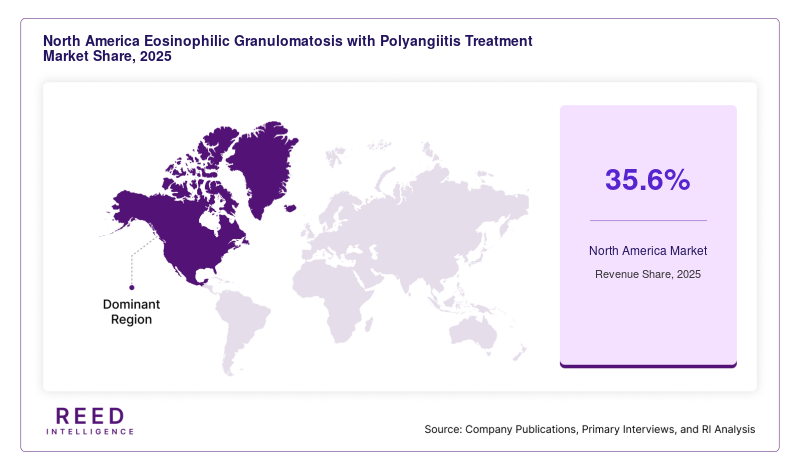
North America held the largest share of the Eosinophilic Granulomatosis with Polyangiitis Treatment Market in 2025, accounting for approximately 35.6% of global revenue. The region is expected to maintain its dominance, growing at a CAGR of 7.9% during the forecast period. The presence of advanced healthcare infrastructure, high awareness levels, and strong reimbursement systems contribute to market growth. Additionally, the availability of cutting-edge biologic therapies supports higher adoption rates compared to other regions.
The United States remains the dominant country in North America, driven by a well-established pharmaceutical industry and significant investment in research and development. A unique growth factor in the region is the strong presence of patient advocacy groups, which promote early diagnosis and access to treatment. These organizations collaborate with healthcare providers and policymakers to improve disease management and expand treatment accessibility.
Europe
Europe accounted for a significant share of the global market in 2025, supported by well-developed healthcare systems and increasing adoption of advanced therapies. The region is projected to grow at a CAGR of 7.5% during the forecast period. Countries such as Germany, the United Kingdom, and France are leading contributors, driven by strong government support for rare disease research and treatment.
Germany stands out as the dominant country in the European market due to its robust healthcare infrastructure and high healthcare spending. A unique growth factor in Europe is the presence of centralized healthcare systems that facilitate the adoption of standardized treatment protocols. This ensures consistent patient care and supports the widespread use of innovative therapies across the region.
Asia Pacific
Asia Pacific is expected to witness the fastest growth in the market, with a projected CAGR of 10.8% during the forecast period. The region accounted for a smaller share in 2025 but is rapidly expanding due to increasing healthcare investments and rising awareness of rare diseases. Countries such as China, Japan, and India are key contributors to market growth.
Japan emerges as the dominant country in the Asia Pacific region, supported by advanced healthcare infrastructure and strong government initiatives for rare disease management. A unique growth factor is the increasing adoption of precision medicine, which is driving demand for targeted therapies. This trend is expected to significantly boost market growth in the region.
Middle East & Africa
The Middle East & Africa region accounted for a modest share of the global market in 2025 and is projected to grow at a CAGR of 6.9% during the forecast period. Market growth is supported by gradual improvements in healthcare infrastructure and increasing awareness of rare diseases. However, limited access to advanced therapies remains a challenge.
Saudi Arabia is the dominant country in this region, driven by government investments in healthcare modernization. A unique growth factor is the increasing number of specialized healthcare centers focusing on rare diseases. These centers are improving diagnosis and treatment capabilities, which is expected to support market growth in the coming years.
Latin America
Latin America held a moderate share of the global market in 2025 and is expected to grow at a CAGR of 7.2% during the forecast period. The region is benefiting from improving healthcare access and increasing awareness of autoimmune diseases. Brazil and Mexico are the primary contributors to market growth.
Brazil is the dominant country in Latin America, supported by a growing healthcare sector and increasing government initiatives to improve disease management. A unique growth factor is the expansion of public healthcare programs, which are improving access to treatment for a larger patient population. This is expected to drive market growth in the region.
Competitive Landscape
The Eosinophilic Granulomatosis with Polyangiitis Treatment Market is characterized by the presence of several established pharmaceutical companies focusing on the development of innovative therapies. The competitive landscape is shaped by strategic collaborations, product launches, and ongoing research initiatives. Companies are investing in biologics and targeted therapies to gain a competitive edge and expand their market presence.
One of the leading players in the market is GlaxoSmithKline plc, which has a strong portfolio of biologic therapies targeting eosinophilic disorders. The company recently expanded its research pipeline by initiating clinical trials for next-generation monoclonal antibodies. Other major players are also focusing on developing novel treatments and improving existing therapies to enhance patient outcomes. The competitive environment is expected to intensify as new entrants enter the market with innovative solutions.
Key Players
- GlaxoSmithKline plc
- AstraZeneca plc
- Sanofi S.A.
- Novartis AG
- Roche Holding AG
- Pfizer Inc.
- Bristol-Myers Squibb Company
- Eli Lilly and Company
- Johnson & Johnson
- Merck & Co., Inc.
- Takeda Pharmaceutical Company Limited
- Amgen Inc.
- Teva Pharmaceutical Industries Ltd.
- Boehringer Ingelheim GmbH
- AbbVie Inc.
Recent Developments
- A leading pharmaceutical company initiated a Phase III clinical trial for a novel biologic targeting IL-5 pathways to improve treatment outcomes.
- A strategic collaboration between two biotech firms was announced to develop combination therapies for rare autoimmune diseases.
- Regulatory authorities approved an expanded indication for an existing biologic drug, enabling its use in treating eosinophilic granulomatosis with polyangiitis.
Eosinophilic Granulomatosis with Polyangiitis Treatment Market Segments
Drug Class
- Corticosteroids
- Immunosuppressants
- Biologics
Route of Administration
- Oral
- Injectable
End-Use
- Hospitals
- Specialty Clinics
- Others
By Region
- North America
- Europe
- APAC
- Middle East and Africa
- LATAM