Epichlorohydrin Rubber Market Size, Share & Demand Report By Type (Copolymer Epichlorohydrin Rubber, Terpolymer Epichlorohydrin Rubber), By Application (Automotive Components, Industrial Hoses, Seals and Gaskets, Wire and Cable, Adhesives and Coatings, Others), By End-Use Industry (Automotive, Industrial Manufacturing, Oil and Gas, Aerospace, Construction, Electrical and Electronics, Others), By Region & Segment Forecasts, 2026–2034
USD 3950
Market Overview
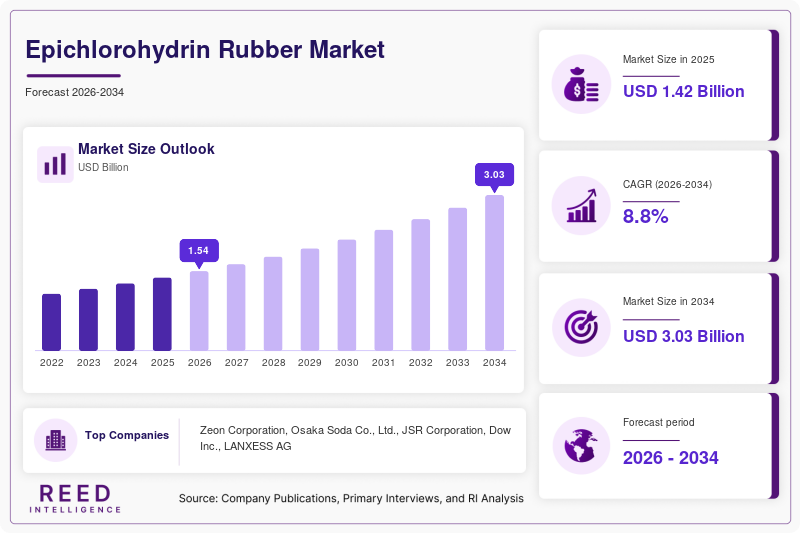
The global Epichlorohydrin Rubber Market was valued at USD 1.42 billion in 2026 and is projected to reach USD 2.78 billion by 2034, expanding at a CAGR of 8.8% during the forecast period. Epichlorohydrin rubber, commonly used in automotive fuel systems, industrial hoses, sealing products, and vibration control components, continues to gain traction due to its resistance to oil, fuel, ozone, and heat. Manufacturers across transportation and industrial sectors are increasingly adopting advanced elastomer compounds that improve operational efficiency and product durability. The growing demand for lightweight and fuel-efficient vehicles has also accelerated the adoption of high-performance synthetic rubber materials in automotive manufacturing.
A major global factor supporting market growth is the rapid expansion of electric and hybrid vehicle production. Automotive manufacturers are integrating durable elastomer materials that can withstand aggressive fluids, high temperatures, and extended operating cycles. Epichlorohydrin rubber has emerged as a preferred material for seals, gaskets, diaphragms, and tubing applications because of its low fuel permeability and flexibility under extreme conditions. In addition, stricter environmental regulations regarding fuel emissions and leakage prevention are encouraging the use of advanced rubber compounds across developed and emerging economies.
Key Highlights
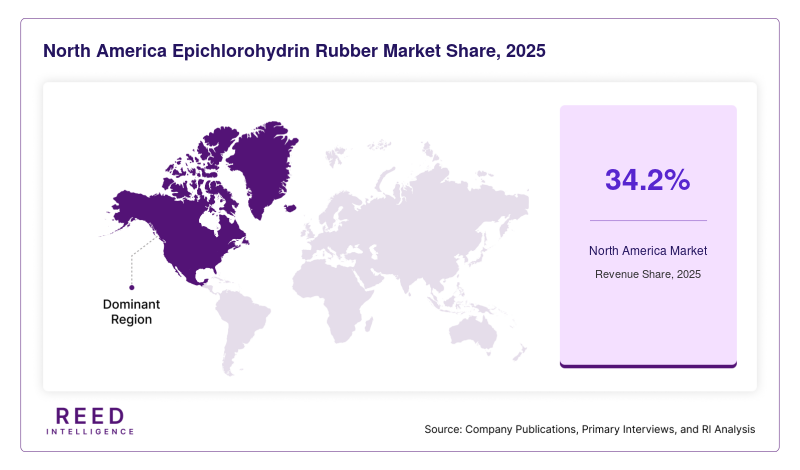
- North America dominated the market with a 34.2% share in 2025.
- Asia Pacific is expected to grow at the fastest CAGR of 10.9% during 2026–2034.
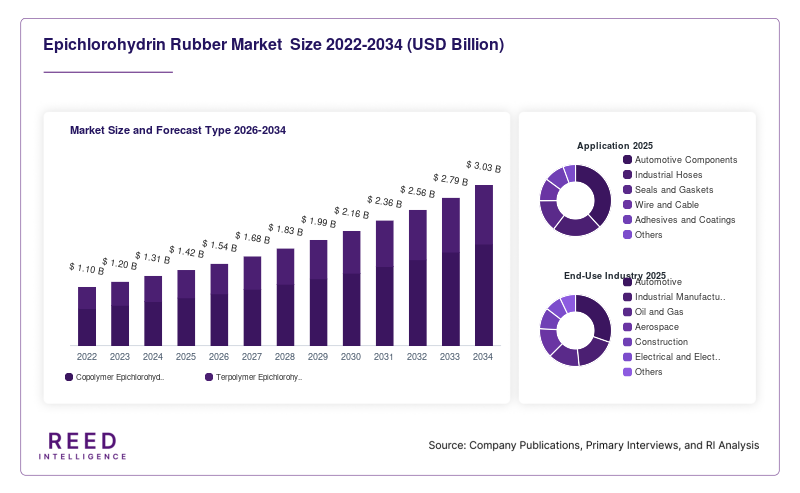
- By type, copolymer epichlorohydrin rubber accounted for the largest share of 57.6%.
- while terpolymer epichlorohydrin rubber is projected to grow at a CAGR of 10.8%.
- By application, automotive components led with a 46.1% share.
- whereas industrial hoses are expected to expand at a CAGR of 10.4%.
- The United States remained the dominant country, with market values of USD 418 million in 2024 and USD 456 million in 2025.
Market Trends
Expansion of Electric Mobility and Advanced Fuel Systems
The global automotive industry is undergoing a transition toward electric mobility, hybrid transportation systems, and low-emission vehicle technologies. This transition is creating consistent demand for advanced elastomer materials with strong chemical resistance and thermal stability. Epichlorohydrin rubber is increasingly used in fuel system components, charging infrastructure seals, cable protection systems, and thermal management assemblies. Vehicle manufacturers are seeking materials that can improve long-term performance while reducing maintenance costs and system leakage. The market is also witnessing increased adoption of lightweight elastomer compounds in commercial vehicles and heavy-duty transport applications. Demand for high-performance sealing materials in battery cooling systems and hydrogen-powered vehicles is expected to support further market expansion over the next decade.
Rising Preference for High-Performance Industrial Elastomers
Industrial manufacturers are increasingly replacing conventional rubber materials with engineered elastomers that offer superior resistance to oil, heat, and chemical exposure. Epichlorohydrin rubber is gaining attention in industrial processing plants, petrochemical operations, and heavy machinery manufacturing because of its ability to maintain flexibility under demanding conditions. The market is experiencing steady innovation in polymer blending technologies that improve durability and reduce operational downtime. Industrial equipment manufacturers are also focusing on extending component life cycles, which is driving the use of high-quality synthetic rubber products. Growing investments in industrial automation and energy infrastructure projects across Asia Pacific and the Middle East are further accelerating demand for advanced elastomer-based components.
Market Drivers
Increasing Automotive Production and Fuel Efficiency Standards
The rising production of passenger vehicles, commercial trucks, and hybrid transportation systems continues to support the growth of the Epichlorohydrin Rubber Market. Automotive manufacturers are prioritizing advanced materials that reduce fuel permeability, improve thermal resistance, and enhance operational reliability. Epichlorohydrin rubber is widely used in seals, gaskets, fuel hoses, diaphragms, and air management systems because it performs effectively under high-temperature and oil-rich environments. Regulatory authorities across North America and Europe are implementing stricter fuel efficiency and emission standards, encouraging automakers to adopt premium elastomer materials. Expanding automotive manufacturing hubs in China, India, Mexico, and Southeast Asia are also contributing to long-term market demand for high-performance synthetic rubber products.
Growth of Industrial Processing and Chemical Manufacturing Sectors
Rapid industrialization across emerging economies is creating significant demand for durable elastomer materials used in chemical processing equipment, industrial machinery, and fluid transfer systems. Epichlorohydrin rubber offers excellent resistance to chemicals, solvents, and environmental degradation, making it suitable for industrial applications exposed to aggressive operating conditions. Petrochemical facilities, mining operations, and manufacturing plants are increasingly using advanced rubber compounds to improve safety and reduce maintenance frequency. The expansion of oil and gas infrastructure projects in the Middle East and Latin America is further strengthening demand for industrial sealing solutions. Continuous investments in infrastructure modernization and automation technologies are expected to support market growth throughout the forecast period.
Market Restraint
Volatility in Raw Material Prices and Production Costs
The Epichlorohydrin Rubber Market faces challenges associated with fluctuating raw material prices and increasing production costs. Epichlorohydrin is derived from petrochemical feedstocks, making the industry vulnerable to variations in crude oil prices and supply chain disruptions. Manufacturers often experience pressure on profit margins when feedstock costs rise sharply or transportation expenses increase. In addition, environmental regulations related to chemical processing and waste management have increased compliance costs for producers operating in developed economies. Small and medium-scale manufacturers face difficulties in maintaining consistent pricing while competing with larger integrated producers. The market also encounters competition from alternative elastomers such as nitrile rubber and fluorocarbon rubber in certain industrial applications. These factors can limit adoption among cost-sensitive industries and create uncertainty for long-term investment planning.
Market Opportunities
Development of Sustainable and Low-Emission Elastomer Solutions
Sustainability initiatives are creating new opportunities for manufacturers operating in the Epichlorohydrin Rubber Market. Governments and industrial buyers are increasingly focusing on environmentally responsible materials that support emission reduction and recycling objectives. Producers are investing in cleaner manufacturing technologies, energy-efficient production methods, and advanced polymer formulations with lower environmental impact. The growing adoption of electric vehicles and renewable energy systems is encouraging the use of elastomers with improved durability and reduced maintenance requirements. Companies that develop bio-based additives, recyclable rubber compounds, and low-emission processing technologies are expected to gain competitive advantages. The trend toward sustainable industrial production is likely to create additional revenue streams for innovative material suppliers during the forecast period.
Expansion of Industrial Infrastructure in Emerging Economies
Emerging economies across Asia Pacific, Latin America, and the Middle East are investing heavily in industrial infrastructure, transportation systems, and energy projects. These investments are increasing demand for durable sealing products, hoses, gaskets, and vibration control components manufactured using advanced elastomer materials. Epichlorohydrin rubber is becoming increasingly important in industrial machinery, fluid transfer systems, and chemical processing equipment because of its resistance to heat and oil exposure. Rapid urbanization and manufacturing expansion in countries such as India, Indonesia, Vietnam, Brazil, and Saudi Arabia are generating new business opportunities for regional and global suppliers. Strategic partnerships with local distributors and industrial equipment manufacturers are expected to strengthen market penetration and accelerate future growth.
Segmental Analysis
By Type
Copolymer epichlorohydrin rubber accounted for the largest share of 57.6% in 2024 due to its balanced combination of oil resistance, low-temperature flexibility, and cost efficiency. The material is widely used in automotive fuel hoses, seals, gaskets, and industrial tubing applications where reliable performance under varying environmental conditions is essential. Manufacturers prefer copolymer grades because they offer improved processing characteristics and compatibility with different additives used in industrial production. The automotive industry remains the largest consumer of copolymer epichlorohydrin rubber as vehicle manufacturers continue to focus on fuel efficiency and reduced emissions. Industrial equipment producers also utilize this material in fluid handling systems and vibration control components because of its durability and long service life under demanding operational conditions.
By Application
Automotive components represented the dominant application segment with a 46.1% market share in 2024. The segment includes fuel hoses, seals, diaphragms, gaskets, air ducts, and vibration dampening systems used in passenger and commercial vehicles. Automotive manufacturers increasingly rely on epichlorohydrin rubber because of its low fuel permeability, oil resistance, and ability to maintain flexibility under extreme temperatures. Growing production of hybrid and electric vehicles is further increasing the need for advanced elastomer materials capable of supporting efficient thermal management systems and durable sealing applications. Vehicle manufacturers are also focusing on lightweight materials that improve fuel efficiency without compromising operational safety. Expanding automotive production across Asia Pacific and North America continues to strengthen the demand outlook for this segment.
By End-Use Industry
The automotive industry held the largest share of the Epichlorohydrin Rubber Market in 2024, accounting for approximately 48.3% of total revenue. Vehicle manufacturers continue to increase the use of advanced elastomer materials in fuel delivery systems, sealing components, thermal insulation products, and emission control technologies. Epichlorohydrin rubber is valued for its resistance to fuels, oils, and heat, which helps improve the long-term reliability of automotive systems. The transition toward electric mobility is also influencing material selection strategies, with manufacturers prioritizing lightweight and durable compounds that support battery cooling systems and high-performance sealing requirements. Increasing production of commercial vehicles and heavy-duty transportation equipment across emerging economies further contributes to strong market demand within this end-use segment.
Regional Analysis
North America
North America accounted for 34.2% of the global Epichlorohydrin Rubber Market in 2025 and is expected to expand at a CAGR of 7.9% during the forecast period. The region benefits from a strong automotive manufacturing base, advanced industrial infrastructure, and high demand for premium elastomer materials. Manufacturers across the United States and Canada are increasingly adopting high-performance rubber compounds in fuel systems, industrial seals, and emission control applications. Investments in electric vehicle production and automation technologies continue to strengthen market demand across multiple industries.
The United States remains the dominant country in the regional market due to its extensive automotive and chemical manufacturing industries. A major growth factor is the rising integration of advanced sealing systems in electric and hybrid vehicles. Automotive suppliers are focusing on materials that improve fuel efficiency and operational durability under extreme conditions.
Europe
Europe held a significant share of the Epichlorohydrin Rubber Market in 2025 and is projected to grow at a CAGR of 7.6% through 2034. The region continues to witness stable demand from automotive, aerospace, and industrial equipment sectors. European manufacturers are emphasizing advanced elastomer technologies that support emission reduction targets and long-term product performance. Regulatory frameworks promoting environmentally responsible manufacturing are encouraging companies to develop cleaner production processes and energy-efficient industrial systems using durable rubber materials.
Germany dominates the European market due to its strong automotive engineering capabilities and advanced industrial manufacturing ecosystem. A key growth factor is the increasing adoption of fuel-efficient and electric vehicles equipped with sophisticated sealing technologies. German automotive manufacturers are investing in lightweight materials and durable elastomer compounds to improve vehicle reliability and reduce maintenance requirements. .
Asia Pacific
Asia Pacific represented a substantial portion of the global market in 2025 and is expected to register the fastest CAGR of 10.9% during the forecast period. The region benefits from rapid industrialization, expanding automotive production, and growing investments in infrastructure development. China, India, Japan, and South Korea are increasing consumption of advanced elastomer materials used in industrial machinery, transportation systems, and energy applications. Rising urbanization and manufacturing expansion are creating strong demand for cost-effective and durable rubber products across multiple end-use sectors.
China remains the leading country in the Asia Pacific market due to its large-scale manufacturing industry and extensive automotive production capacity. One important growth factor is the country’s focus on electric vehicle manufacturing and industrial modernization initiatives. Chinese manufacturers are increasing investments in advanced polymer technologies and localized supply chains to strengthen production efficiency.
Middle East & Africa
The Middle East & Africa market is experiencing moderate growth and is projected to expand at a CAGR of 8.1% between 2026 and 2034. Demand is increasing across oil and gas operations, industrial processing facilities, and infrastructure projects requiring durable sealing and hose materials. The region’s harsh operating environments create demand for elastomers capable of resisting heat, oil exposure, and chemical degradation. Growing investments in industrial diversification and petrochemical development are supporting the adoption of advanced rubber compounds in industrial applications.
Saudi Arabia dominates the regional market due to its strong petrochemical industry and large-scale industrial investments. A unique growth factor is the expansion of downstream chemical processing facilities under national industrial diversification programs.
Latin America
Latin America accounted for a smaller but steadily growing share of the Epichlorohydrin Rubber Market in 2025 and is expected to record a CAGR of 7.4% through 2034. Industrial expansion, mining activities, and infrastructure modernization projects are supporting regional demand for advanced elastomer materials. Manufacturers are increasingly adopting synthetic rubber products in industrial hoses, sealing systems, and automotive components to improve durability and operational reliability. Economic recovery in several countries is also encouraging investments in manufacturing and transportation industries.
Competitive Landscape
The Epichlorohydrin Rubber Market is moderately consolidated, with several global and regional manufacturers competing through product innovation, capacity expansion, and strategic partnerships. Leading companies are investing in advanced polymer research to improve thermal resistance, flexibility, and environmental performance. Market participants are also strengthening distribution networks and regional manufacturing capabilities to support growing demand from automotive and industrial customers.
Zeon Corporation remains a leading player in the market due to its extensive product portfolio, strong research capabilities, and established presence across Asia, North America, and Europe. The company continues to focus on advanced elastomer solutions for automotive and industrial applications. Recent developments in the market include production capacity expansion projects, new sustainable elastomer formulations, and strategic collaborations with automotive component manufacturers. Other major companies are emphasizing low-emission manufacturing technologies and customized rubber solutions designed for high-performance industrial applications. Competitive intensity is expected to increase further as emerging regional manufacturers expand production capabilities and target fast-growing industrial sectors.
Key Players
- Zeon Corporation
- Osaka Soda Co., Ltd.
- JSR Corporation
- Dow Inc.
- LANXESS AG
- Kumho Petrochemical Co., Ltd.
- Tosoh Corporation
- Shin-Etsu Chemical Co., Ltd.
- Exxon Mobil Corporation
- ARLANXEO Holding B.V.
- Denka Company Limited
- Sibur International GmbH
- LG Chem Ltd.
- China National Petroleum Corporation
- Versalis S.p.A.
Recent Developments
- Zeon Corporation announced an expansion of its specialty elastomer production capacity in Asia to support increasing demand from electric vehicle manufacturers in 2025.
- LANXESS AG introduced a new low-emission elastomer processing technology designed to improve sustainability performance in industrial rubber manufacturing operations in 2024.
- Kumho Petrochemical Co., Ltd. entered a strategic partnership with automotive component suppliers to develop advanced sealing materials for hybrid and electric vehicles in 2025.
Epichlorohydrin Rubber Market Segments
Type
- Copolymer Epichlorohydrin Rubber
- Terpolymer Epichlorohydrin Rubber
Application
- Automotive Components
- Industrial Hoses
- Seals and Gaskets
- Wire and Cable
- Adhesives and Coatings
- Others
End-Use Industry
- Automotive
- Industrial Manufacturing
- Oil and Gas
- Aerospace
- Construction
- Electrical and Electronics
- Others
By Region
- North America
- Europe
- APAC
- Middle East and Africa
- LATAM