Epistaxis Market Size, Share & Demand Report By Product Type (Nasal Packing Devices, Absorbable Hemostatic Agents, Cauterization Devices), By Treatment Type (Anterior Epistaxis Treatment, Posterior Epistaxis Treatment), By End-Use (Hospitals, Ambulatory Surgical Centers, ENT Clinics) By Region & Segment Forecasts, 2025–2034
USD 3950
Market Overview
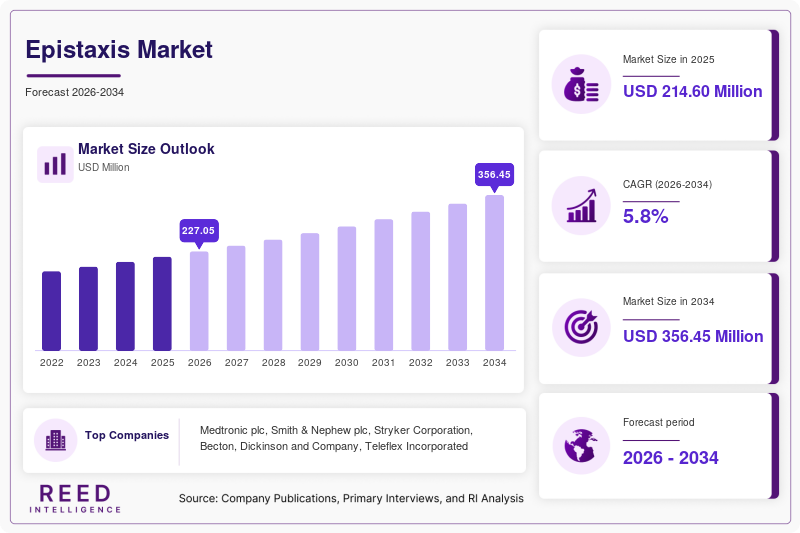
The Epistaxis Market size was valued at USD 214.6 million in 2025 and is projected to reach USD 352.4 million by 2033, registering a CAGR of 5.8% during the forecast period (2025–2034). The market growth reflects the rising incidence of nasal bleeding disorders and increasing adoption of medical devices and treatment procedures designed to manage epistaxis effectively. Epistaxis, commonly known as nosebleed, occurs due to rupture of blood vessels in the nasal mucosa and often requires medical intervention when severe or recurrent. Healthcare providers increasingly utilize specialized nasal packing devices, cauterization techniques, and hemostatic agents to control bleeding and prevent recurrence.
One global factor supporting the growth of the Epistaxis Market is the expanding healthcare infrastructure and improved access to emergency care services across developing economies. Hospitals and ambulatory surgical centers are increasingly equipped with advanced ENT treatment solutions that enable rapid diagnosis and management of epistaxis cases. Additionally, the growing elderly population worldwide has contributed to the increased prevalence of epistaxis episodes, particularly among individuals with hypertension, blood disorders, or anticoagulant therapy. These demographic and healthcare improvements have strengthened the overall market outlook.
Key Highlights
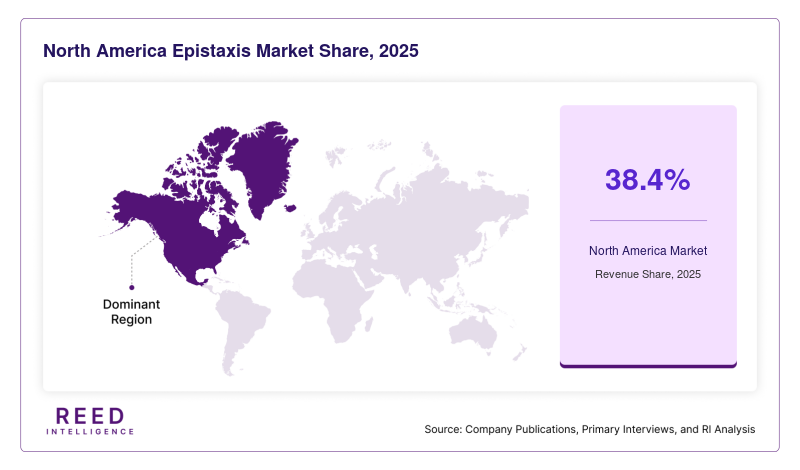
- North America dominated the Epistaxis Market with a 38.4% share in 2025, while Asia Pacific is projected to grow at the fastest CAGR of 6.7% during the forecast period.
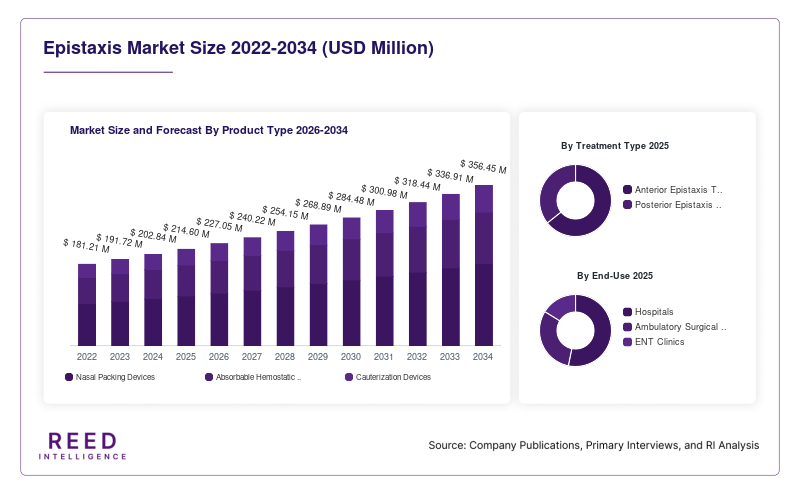
- By product type, nasal packing devices held the largest share of 46.3% in 2025, while absorbable hemostatic agents are projected to grow at a CAGR of 6.9%.
- By treatment type, anterior epistaxis treatment accounted for 62.5% of market share in 2025, while posterior epistaxis treatment is expected to grow at a CAGR of 6.3%.
- The United States represented the dominant country, with the Epistaxis Market valued at USD 67.8 million in 2025 and estimated to reach USD 71.2 million in 2026.
Market Trends
Increasing Adoption of Absorbable Nasal Packing Materials
One significant trend influencing the Epistaxis Market is the growing adoption of absorbable nasal packing materials for managing nosebleeds. Traditional nasal packing methods often require removal after bleeding control, which can cause patient discomfort and increase infection risk. New absorbable materials dissolve gradually within the nasal cavity, eliminating the need for removal procedures. Healthcare providers increasingly prefer these solutions as they simplify treatment workflows and improve patient experience.
Manufacturers are developing advanced biomaterials that provide effective hemostasis while reducing irritation to nasal tissues. These innovations have encouraged healthcare facilities to shift toward absorbable nasal packing products, supporting steady market expansion.
Integration of Minimally Invasive ENT Treatment Techniques
Another notable trend shaping the Epistaxis Market is the integration of minimally invasive treatment techniques in ENT procedures. Technologies such as endoscopic cauterization and advanced hemostatic agents allow clinicians to control bleeding with improved precision. Minimally invasive approaches reduce hospital stays and improve treatment outcomes for patients with recurrent epistaxis.
Healthcare providers are increasingly adopting these procedures in hospital settings and ambulatory surgical centers, contributing to the growing demand for specialized epistaxis treatment devices and consumables.
Market Drivers
Rising Prevalence of Nasal Bleeding Disorders
A key driver supporting the Epistaxis Market growth is the increasing prevalence of nasal bleeding disorders. Epistaxis is commonly associated with environmental conditions, respiratory infections, allergies, and chronic health issues such as hypertension. The growing number of patients experiencing nasal bleeding episodes has increased demand for effective treatment solutions within healthcare systems.
Healthcare providers frequently encounter epistaxis cases in emergency departments and ENT clinics, leading to greater adoption of specialized treatment products such as nasal packing devices, cauterization tools, and hemostatic agents. As patient awareness and access to healthcare services improve globally, diagnosis and treatment rates for epistaxis are expected to increase.
Expansion of ENT Treatment Facilities
The expansion of ENT (ear, nose, and throat) treatment facilities has also supported the growth of the Epistaxis Market. Hospitals and specialized clinics have increasingly integrated ENT care units capable of diagnosing and treating nasal disorders. These facilities utilize advanced diagnostic tools and treatment devices that enhance clinical efficiency.
The establishment of ambulatory surgical centers focusing on ENT procedures has further improved access to epistaxis treatment. As healthcare systems continue expanding ENT care capabilities, demand for epistaxis management devices and treatment solutions will increase.
Market Restraints
Limited Awareness of Advanced Treatment Options
One major restraint affecting the Epistaxis Market is the limited awareness of advanced treatment options in certain regions. Many patients experiencing mild or moderate nosebleeds rely on home remedies or basic medical care rather than specialized ENT treatments. This practice reduces the number of cases receiving advanced medical interventions.
In some healthcare systems, epistaxis management remains limited to conventional nasal packing techniques rather than newer absorbable materials or minimally invasive procedures. The lack of training and equipment in smaller healthcare facilities can also restrict adoption of advanced epistaxis treatment devices.
Additionally, variations in healthcare reimbursement policies for ENT procedures may influence the adoption rate of newer treatment solutions. Limited awareness among patients and healthcare providers in certain regions may therefore slow the growth of the Epistaxis Market despite technological advancements in treatment methods.
Market Opportunities
Development of Advanced Hemostatic Biomaterials
One emerging opportunity within the Epistaxis Market is the development of advanced hemostatic biomaterials designed to control bleeding more effectively. Research and development activities in biomaterials science have led to the creation of innovative products capable of accelerating blood clot formation and improving treatment efficiency.
Manufacturers investing in these technologies may introduce products that offer improved biocompatibility and faster absorption rates. These advancements can enhance patient comfort and reduce treatment complexity in clinical environments.
Expansion of Telehealth and Remote ENT Consultation
Another opportunity in the Epistaxis Market is the expansion of telehealth services and remote ENT consultations. Digital healthcare platforms enable patients to consult specialists regarding recurring nosebleeds and receive guidance on appropriate treatment options. Telemedicine services can support early diagnosis and referral for specialized epistaxis treatment when necessary.
Healthcare providers integrating telehealth solutions into ENT care may improve patient management and expand access to medical guidance, indirectly supporting demand for epistaxis treatment devices and products.
Segmental Analysis
By Product Type
The nasal packing devices segment dominated the Epistaxis Market in 2025, accounting for 46.3% of total market share. These devices are widely used in clinical settings to control bleeding by applying pressure inside the nasal cavity. Traditional and inflatable nasal packing products are commonly utilized in hospitals and emergency departments for treating moderate to severe nosebleeds.
The absorbable hemostatic agents segment will grow at the fastest CAGR of 6.9% during the forecast period. These agents are designed to promote rapid blood clot formation while gradually dissolving within the nasal cavity. Healthcare providers will increasingly adopt these products due to their convenience and reduced need for follow-up removal procedures.
By Treatment Type
The anterior epistaxis treatment segment accounted for the largest share of 62.5% in 2025. Anterior epistaxis occurs in the front part of the nasal cavity and represents the majority of nosebleed cases. Healthcare providers typically manage these cases using nasal packing devices, cauterization procedures, or topical hemostatic agents.
The posterior epistaxis treatment segment is projected to grow at a CAGR of 6.3% during the forecast period. Posterior nosebleeds originate deeper within the nasal cavity and often require specialized treatment methods. Hospitals and ENT specialists will increasingly utilize advanced treatment techniques to manage these more complex cases.
By End-Use
The hospitals segment dominated the Epistaxis Market with a 54.2% share in 2025. Hospitals frequently handle emergency epistaxis cases and maintain access to specialized treatment equipment. Emergency departments and ENT units within hospitals utilize nasal packing devices, cauterization tools, and hemostatic agents to manage severe nosebleeds.
The ambulatory surgical centers segment will grow at the fastest CAGR of 6.5% during the forecast period. These centers offer outpatient ENT procedures, including treatment for recurrent epistaxis. Increasing preference for outpatient care and shorter treatment durations will contribute to the growth of this segment.
Regional Analysis
North America
North America accounted for 38.4% of the global Epistaxis Market share in 2025, and the region is expected to grow at a CAGR of 5.2% during the forecast period. The region maintained significant demand for epistaxis treatment solutions due to the widespread availability of specialized ENT healthcare services. Hospitals and emergency departments frequently encounter epistaxis cases and maintain access to advanced treatment devices.
The United States dominated the regional market due to its established healthcare infrastructure and high level of medical technology adoption. Hospitals and ambulatory surgical centers across the country utilize advanced nasal packing products and hemostatic agents to manage epistaxis cases effectively. The presence of specialized ENT clinics has also supported stable demand for treatment devices within the country.
Europe
Europe held 26.7% of the global Epistaxis Market in 2025 and is projected to grow at a CAGR of 5.4% between 2025 and 2034. The region has a well-developed healthcare system and widespread access to ENT specialists capable of diagnosing and managing nasal bleeding conditions. Healthcare facilities across the region continue integrating advanced treatment products for improved clinical outcomes.
Germany represented the leading country in the regional market. The country’s extensive hospital network and advanced ENT treatment capabilities supported consistent demand for epistaxis management devices. Healthcare providers in Germany frequently utilize advanced nasal packing solutions and cauterization techniques for treating severe nosebleeds.
Asia Pacific
Asia Pacific represented 23.5% of the global Epistaxis Market in 2025 and will grow at the fastest CAGR of 6.7% during the forecast period. The region’s healthcare systems have expanded significantly, leading to improved access to ENT treatment services. Increasing healthcare expenditure and rising patient awareness have contributed to greater diagnosis and treatment rates.
China remained the dominant country in the regional market due to the rapid expansion of hospital infrastructure and growing adoption of modern ENT treatment technologies. Hospitals across urban areas have increasingly adopted specialized devices for managing nasal bleeding conditions, contributing to regional market growth.
Middle East & Africa
The Middle East & Africa accounted for 6.1% of the global Epistaxis Market share in 2025 and will expand at a CAGR of 4.9% during the forecast period. The regional market has gradually developed due to increasing investments in healthcare infrastructure and hospital development.
Saudi Arabia emerged as the dominant country in the regional market. The government’s investment in healthcare modernization has improved access to specialized medical services, including ENT care. Hospitals and medical centers increasingly utilize modern treatment solutions for managing epistaxis cases.
Latin America
Latin America represented 5.3% of the global Epistaxis Market share in 2025 and will grow at a CAGR of 5.9% during the forecast period. Healthcare systems across the region have gradually expanded access to specialized ENT treatment services.
Brazil dominated the regional market due to its large healthcare network and growing number of ENT specialists. Hospitals and medical centers across the country provide treatment for nasal bleeding disorders using specialized medical devices and hemostatic agents.
Competitive Landscape
The Epistaxis Market is characterized by the presence of medical device manufacturers specializing in ENT treatment products and hemostatic technologies. Companies operating in the market focus on developing advanced nasal packing devices, absorbable materials, and hemostatic agents designed to improve clinical outcomes.
Among key players, Medtronic plc has maintained a strong position due to its extensive medical device portfolio and research capabilities in ENT technologies. The company has expanded its product offerings in hemostatic solutions used for surgical and nasal bleeding control. Recent developments include the introduction of improved absorbable nasal packing materials designed to enhance patient comfort and reduce treatment complexity.
Other companies operating in the market focus on expanding distribution networks and strengthening partnerships with healthcare institutions to maintain stable market presence.
Key Players
- Medtronic plc
- Smith & Nephew plc
- Stryker Corporation
- Becton, Dickinson and Company
- Teleflex Incorporated
- Pfizer Inc.
- Baxter International Inc.
- HemCon Medical Technologies
- Summit Medical Group
- Medline Industries, LP
- Boston Medical Products Inc.
- Olympus Corporation
- Integra LifeSciences Holdings Corporation
- Johnson & Johnson
- Cook Medical
Recent Developments
- In 2024, Medtronic introduced an improved absorbable nasal packing material designed for epistaxis management.
- In 2023, Teleflex expanded its ENT device portfolio with upgraded nasal tampon products.
- In 2024, Smith & Nephew enhanced its hemostatic biomaterial research for surgical bleeding control.
- In 2025, Baxter International strengthened distribution partnerships for hemostatic agents used in ENT procedures.
- In 2023, Boston Medical Products launched new nasal packing devices for hospital emergency departments.
Epistaxis Market Segments
By Product Type
- Nasal Packing Devices
- Absorbable Hemostatic Agents
- Cauterization Devices
By Treatment Type
- Anterior Epistaxis Treatment
- Posterior Epistaxis Treatment
By End-Use
- Hospitals
- Ambulatory Surgical Centers
- ENT Clinics
By Region
- North America
- Europe
- APAC
- Middle East and Africa
- LATAM