Epithelial Cell Culture Media Market Size, Share Demand Report By Product Type (Serum-Based Media, Serum-Free Media, Growth Factor-Enriched Media, Synthetic & Defined Media), By Application (Drug Discovery, Regenerative Medicine, Cancer Research, Stem Cell Research), By End-User (Pharmaceutical & Biotechnology Companies, Academic Research Institutes, CROs, Hospitals & Diagnostics) By Region & Segment Forecasts, 2026–2034
USD 3950
Market Overview
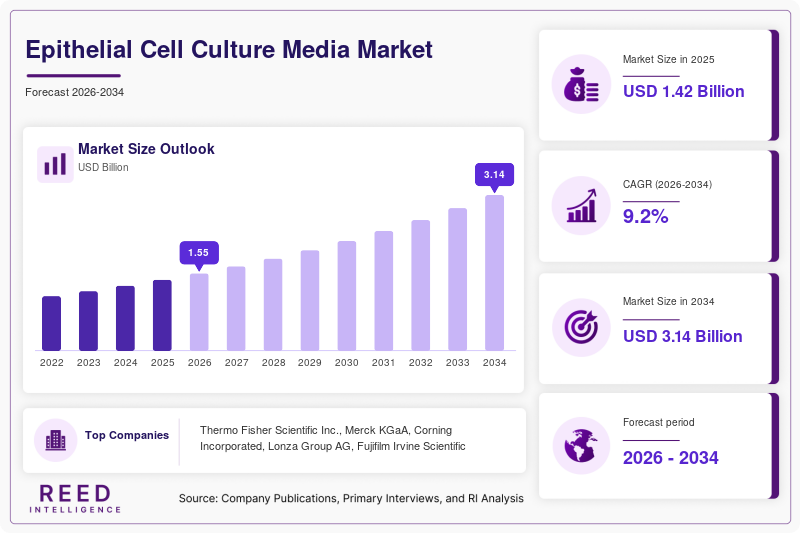
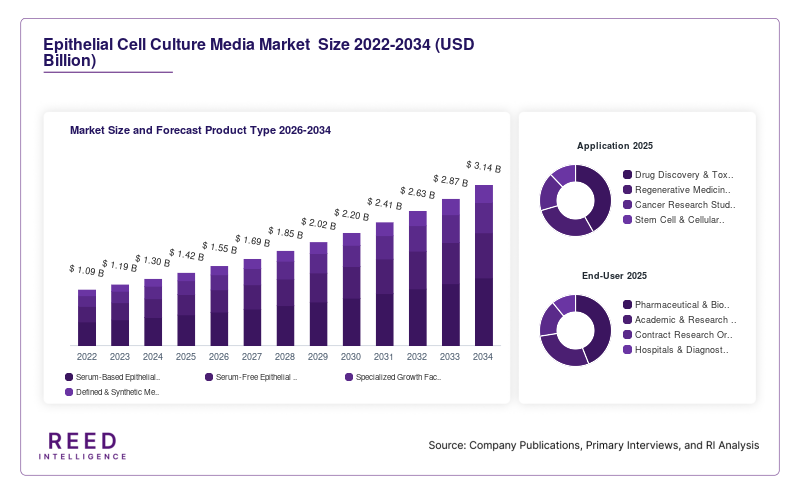
The Epithelial Cell Culture Media Market size was valued at USD 1.42 billion in 2026 and is projected to reach USD 2.88 billion by 2034, expanding at a CAGR of 9.2% during the forecast period (2026–2034). The market growth is primarily supported by the rising global demand for advanced cell-based research models in drug discovery, toxicology testing, and regenerative medicine. Increasing adoption of in vitro epithelial models as alternatives to animal testing has further strengthened market expansion across pharmaceutical and biotechnology sectors.
Epithelial cell culture media plays a critical role in maintaining and proliferating epithelial cells in controlled laboratory environments. These media are widely used in cancer research, infectious disease modeling, tissue engineering, and personalized medicine. The growing focus on precision medicine and biologics development has significantly increased reliance on optimized epithelial growth media formulations.The Epithelial Cell Culture Media Market has also benefited from rapid advancements in stem cell research and 3D cell culture technologies. Pharmaceutical companies are increasingly adopting serum-free and chemically defined media to improve reproducibility and reduce variability in experimental outcomes. Additionally, increasing investments in biotechnology research infrastructure and expanding clinical trial pipelines have contributed to sustained market growth.
Key Highlights
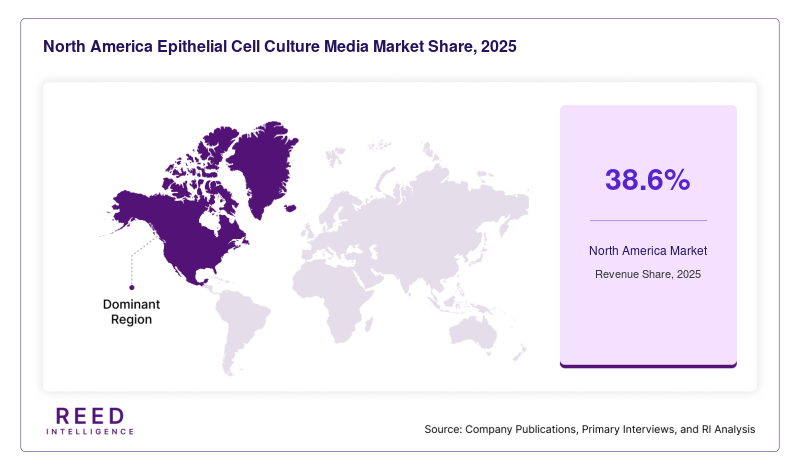
- North America held the largest share of 38.6% in the Epithelial Cell Culture Media Market in 2025, while Asia Pacific is expected to grow at the fastest CAGR of 10.4% during 2026–2034.
- By product type, serum-based epithelial culture media accounted for 41.3% of the market in 2025, while serum-free media is projected to grow at a CAGR of 10.7%.
- By application, cancer research dominated with a 34.9% share in 2025, while regenerative medicine applications are expected to expand at a CAGR of 11.1%.
- By end-use, pharmaceutical & biotechnology companies led the market with a 46.2% share in 2025, while academic & research institutes are expected to grow fastest.
- The United States represented the dominant country market, valued at USD 412 million in 2024 and USD 447 million in 2025.
Market Trends
Rising Adoption of 3D Cell Culture and Organoid Models
The shift from traditional 2D cell cultures to 3D epithelial models and organoid systems is reshaping the Epithelial Cell Culture Media Market. Researchers are increasingly using advanced culture systems that mimic in vivo tissue architecture more accurately. This trend is increasing demand for specialized epithelial media formulations designed to support complex cell differentiation and long-term viability.
Transition Toward Chemically Defined and Serum-Free Media
Another major trend is the increasing preference for chemically defined and serum-free epithelial culture media. These formulations reduce batch variability, enhance experimental reproducibility, and comply with regulatory standards in pharmaceutical research. Manufacturers are investing in next-generation media formulations tailored for specific epithelial cell types and disease models.
Market Drivers
Expansion of Drug Discovery and Biopharmaceutical Research
The growing global pipeline of biologics and targeted therapies has significantly increased demand for epithelial cell-based testing systems. Pharmaceutical companies rely on epithelial models to evaluate drug absorption, toxicity, and efficacy. This increasing use of in vitro testing platforms is a key driver for the Epithelial Cell Culture Media Market.
Rising Demand for Regenerative Medicine and Tissue Engineering
Regenerative medicine applications, including wound healing, skin grafting, and organ regeneration, are driving increased use of epithelial cell culture systems. The need for high-quality epithelial media that supports cell proliferation and differentiation is growing as regenerative therapies move toward clinical commercialization.
Market Restraint
High Cost and Complexity of Specialized Media Formulations
The Epithelial Cell Culture Media Market faces challenges due to the high cost of advanced media formulations. Serum-free and chemically defined media require complex manufacturing processes and strict quality control, increasing production costs. Smaller research laboratories may face budget constraints, limiting widespread adoption.
Market Opportunities
Expansion of Personalized Medicine Research
The growing focus on personalized medicine presents significant opportunities for epithelial culture media providers. Patient-derived epithelial cell models are increasingly used to study individualized drug responses, creating demand for highly customized and disease-specific culture media formulations.
Growth in Emerging Biotechnology Hubs
Emerging biotechnology ecosystems in Asia Pacific and Latin America are expected to create new growth opportunities. Increasing government funding, expansion of research infrastructure, and rising clinical trial activity are supporting demand for epithelial cell culture products in these regions.
Segmental Analysis
By Product Type
The Epithelial Cell Culture Media Market is segmented into serum-based media, serum-free media, chemically defined media, and specialty epithelial media formulations.
Serum-based media held the largest share of 41.3% in 2025 due to its widespread use in routine cell culture applications and cost-effectiveness. These media continue to be preferred in academic research settings and basic biological studies.
Serum-free media is projected to register the fastest CAGR of 10.7% during the forecast period. Growth is driven by increasing demand for reproducible experimental conditions and regulatory compliance in pharmaceutical research. Serum-free formulations eliminate variability associated with animal-derived components, making them ideal for clinical and industrial applications.
Chemically defined media are gaining traction in advanced research environments, particularly in regenerative medicine and stem cell research. Specialty epithelial media formulations are also being developed for disease-specific applications such as cancer and infectious disease modeling.
By Application
The market is segmented into cancer research, regenerative medicine, drug discovery & toxicity testing, infectious disease research, and others.
Cancer research dominated the segment with a 34.9% share in 2025 due to extensive use of epithelial cell models in tumor biology and oncology drug screening. These models help researchers understand tumor microenvironments and therapeutic responses.
Regenerative medicine is expected to grow at the fastest CAGR of 11.1% during 2026–2034. Increasing demand for tissue engineering, wound healing therapies, and organ regeneration research is driving this segment. Epithelial cells play a critical role in tissue repair, making specialized culture media essential.
Drug discovery and toxicity testing also accounted for a significant share due to the pharmaceutical industry's reliance on in vitro testing systems. Infectious disease research is expanding rapidly due to growing interest in respiratory and viral disease modeling.
By End-Use
The Epithelial Cell Culture Media Market is segmented into pharmaceutical & biotechnology companies, academic & research institutes, contract research organizations (CROs), and others.
Pharmaceutical & biotechnology companies dominated with a 46.2% share in 2025 due to extensive use of epithelial models in drug development pipelines. These organizations rely heavily on advanced cell culture systems for preclinical testing.
Academic & research institutes are projected to grow at a notable CAGR due to increasing funding for biomedical research and rising adoption of advanced laboratory technologies.
CROs are expanding their use of epithelial cell culture media as outsourcing trends in drug development continue to rise, enabling faster and cost-efficient research workflows.
By Distribution Channel
Distribution channels include direct sales, distributors, and online scientific platforms.
Direct sales held the largest share in 2025 due to strong supplier-client relationships between media manufacturers and pharmaceutical companies. Customized media solutions are often delivered through direct contracts.
Online scientific platforms are expected to grow at the fastest rate due to increasing digital procurement practices in research laboratories. These platforms simplify ordering and comparison of specialized laboratory products.
Regional Analysis
North America
North America accounted for 38.6% of the Epithelial Cell Culture Media Market in 2025 and is projected to grow at a CAGR of 8.6% during 2026–2034. The region’s dominance is driven by strong pharmaceutical R&D investments and the presence of leading biotechnology companies. The United States leads the regional market due to its advanced research infrastructure and high adoption of cell-based drug discovery platforms.
Europe
Europe held a market share of 27.4% in 2025 and is expected to expand at a CAGR of 8.8% during the forecast period. The region benefits from strong academic research networks and supportive regulatory frameworks for alternative testing methods. Germany represents the leading country market due to its robust biotechnology and pharmaceutical research ecosystem.
Asia Pacific
Asia Pacific captured 22.1% of the market share in 2025 and is forecast to grow at the fastest CAGR of 10.4% during 2026–2034. Rising investments in life sciences research and increasing clinical trial activities are driving growth. China dominates the region due to expanding biotech manufacturing capabilities and government support for biomedical research.
Middle East & Africa
The Middle East & Africa accounted for 6.3% of the market share in 2025 and is expected to grow at a CAGR of 7.9% during the forecast period. Growth is supported by increasing healthcare research investments and expanding academic collaborations. Israel leads the regional market due to its advanced biomedical research sector.
Latin America
Latin America represented 5.6% of the Epithelial Cell Culture Media Market in 2025 and is projected to grow at a CAGR of 8.1% during 2026–2034. Brazil dominates the region due to growing pharmaceutical research activity and increasing biotechnology investments.
Competitive Landscape
The Epithelial Cell Culture Media Market is moderately consolidated, with key players focusing on product innovation, media optimization, and expansion of bioprocessing solutions. Companies are investing in serum-free and chemically defined media formulations to meet evolving research requirements.
Thermo Fisher Scientific leads the market with a strong portfolio of cell culture media products and global distribution networks. The company recently expanded its epithelial cell media line with enhanced serum-free formulations for regenerative medicine applications.
Merck KGaA, Lonza Group, Cytiva (Danaher Corporation), and STEMCELL Technologies are also key players. Merck KGaA focuses on expanding its life sciences portfolio, while Lonza emphasizes customized cell culture solutions for pharmaceutical clients. Cytiva is strengthening its bioprocessing technologies, and STEMCELL Technologies continues to innovate in specialized cell culture systems.
Key Players List
- Thermo Fisher Scientific
- Merck KGaA
- Lonza Group
- Cytiva (Danaher Corporation)
- STEMCELL Technologies
- Corning Incorporated
- Sartorius AG
- Fujifilm Irvine Scientific
- PromoCell GmbH
- HiMedia Laboratories
- ATCC (American Type Culture Collection)
- Takara Bio Inc.
- Bio-Techne Corporation
- Miltenyi Biotec
- Cell Biologics Inc.
Recent Developments
- In 2025, Thermo Fisher Scientific launched an advanced serum-free epithelial media formulation optimized for regenerative medicine applications.
- Merck KGaA expanded its cell culture media production facility to meet growing global demand.
- Lonza Group introduced customized epithelial media solutions for personalized drug screening applications.
- Cytiva enhanced its bioprocessing portfolio with new epithelial cell expansion technologies.
- STEMCELL Technologies developed specialized media for 3D epithelial organoid culture systems.
Epithelial Cell Culture Media Market Segments
Product Type
- Serum-Based Epithelial Media
- Serum-Free Epithelial Media
- Specialized Growth Factor-Enriched Media
- Defined & Synthetic Media Formulations
Application
- Drug Discovery & Toxicology Testing
- Regenerative Medicine & Tissue Engineering
- Cancer Research Studies
- Stem Cell & Cellular Biology Research
End-User
- Pharmaceutical & Biotechnology Companies
- Academic & Research Institutes
- Contract Research Organizations (CROs)
- Hospitals & Diagnostic Laboratories
Distribution Channel
- Direct Sales
- Online Scientific Suppliers
- Third-Party Distributors
- Laboratory Supply Retailers
By Region
- North America
- Europe
- APAC
- Middle East and Africa
- LATAM