Epoxy Active Diluent Market Size, Share & Demand Report By Type (Monofunctional Active Diluents, Difunctional Active Diluents, Multifunctional Active Diluents), By Application (Coatings, Adhesives, Composites, Sealants), By End-Use Industry (Construction, Automotive, Electrical & Electronics, Aerospace, Marine) By Region & Segment Forecasts, 2025–2034
USD 3950
Market Overview
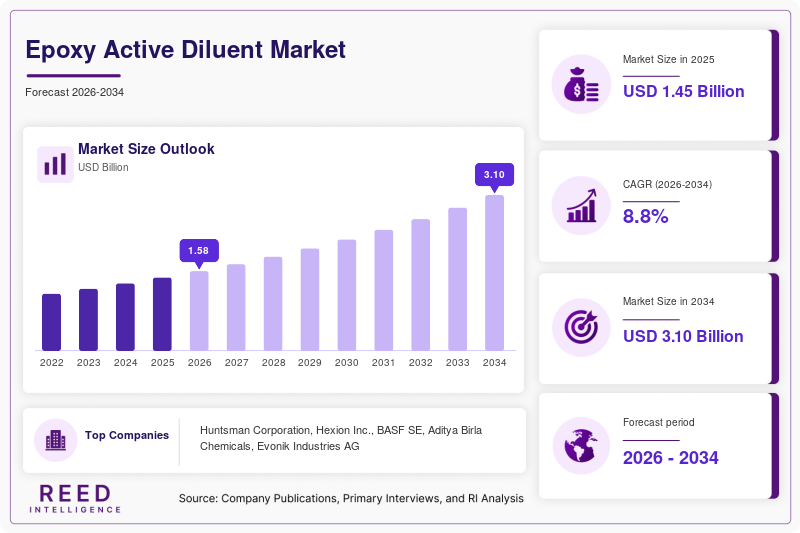
The Epoxy Active Diluent Market size is estimated at approximately USD 1.45 billion, rising to around USD 1.55 billion in 2026. The market is projected to reach nearly USD 3.05 billion by 2034, expanding at a compound annual growth rate (CAGR) of about 8.8% during the forecast period from 2025 to 2034.
One of the primary growth factors is the increasing use of epoxy systems in infrastructure development, particularly in emerging economies where large-scale construction activities are underway. Epoxy active diluents play a key role in improving the application efficiency of coatings, adhesives, and composites used in bridges, roads, and industrial flooring. Another significant factor is the rising adoption of lightweight composite materials in the automotive and aerospace sectors. Active diluents enable better resin infusion and curing performance, which is critical for producing durable and lightweight components.
Key Highlights
- The market is projected to grow from USD 1.45 billion in 2025 to USD 3.05 billion by 2034. This growth reflects increasing adoption of epoxy systems across multiple industrial applications.
- The market is expected to register a CAGR of approximately 8.8% during 2025–2034. Consistent expansion is supported by rising demand for high-performance materials and advanced formulations.
- Strong demand from construction, automotive, and renewable energy sectors is driving market growth. These industries rely on epoxy active diluents for enhanced durability, strength, and processing efficiency.
- There is an increasing focus on low-viscosity and environmentally compliant formulations. This trend is driven by regulatory pressure and the need for sustainable and safer chemical solutions.
Market Trends
Shift Toward Bio-Based and Sustainable Diluents
A notable trend in the epoxy active diluent market is the increasing shift toward bio-based and sustainable alternatives. Manufacturers are investing in the development of diluents derived from renewable feedstocks such as plant oils and natural fatty acids. This transition is driven by tightening environmental regulations and growing consumer awareness regarding sustainable materials. Bio-based active diluents offer reduced environmental impact while maintaining comparable performance characteristics. Industries such as coatings and adhesives are adopting these solutions to align with green building standards and eco-label certifications. As sustainability becomes a key purchasing criterion, companies are expected to expand their portfolios with renewable and low-toxicity formulations.
Advancements in High-Performance Formulations
Another emerging trend is the development of advanced epoxy formulations that incorporate multifunctional active diluents to enhance performance characteristics. These next-generation diluents are designed to improve properties such as chemical resistance, thermal stability, and mechanical strength. Industries like aerospace, electronics, and wind energy are increasingly demanding high-performance materials that can withstand extreme conditions. Manufacturers are focusing on tailoring diluent structures to achieve specific performance outcomes, including faster curing times and improved adhesion. This trend is also supported by advancements in material science and polymer chemistry, enabling the creation of customized solutions for specialized industrial applications.
Market Drivers
Rising Demand in Construction and Infrastructure Development
The rapid expansion of construction activities worldwide is a major driver for the epoxy active diluent market. Epoxy systems are widely used in coatings, adhesives, sealants, and flooring applications due to their durability and resistance to environmental factors. Active diluents play a crucial role in improving the application properties of these systems, making them easier to handle and apply. With increasing investments in infrastructure projects such as highways, bridges, and commercial buildings, the demand for epoxy-based materials is rising steadily. Developing regions are particularly contributing to this growth, as governments focus on urbanization and modernization initiatives.
Growing Adoption in Automotive and Lightweight Composites
The automotive industry is increasingly adopting epoxy-based composites to reduce vehicle weight and improve fuel efficiency. Active diluents enhance the processing and performance of these composites by reducing viscosity and enabling better fiber wetting. This is particularly important in the production of structural components and parts used in electric vehicles. As automakers aim to meet stringent emission regulations, the demand for lightweight materials is expected to increase. Epoxy active diluents support this transition by enabling the efficient manufacturing of high-strength, lightweight components with improved mechanical properties.
Market Restraint
Health and Environmental Concerns Associated with Chemical Exposure
One of the key restraints in the epoxy active diluent market is the potential health and environmental risks associated with certain chemical formulations. Some conventional active diluents are derived from petrochemical sources and may contain components that pose risks such as skin irritation, respiratory issues, and environmental toxicity. Regulatory bodies in various regions are imposing stricter guidelines on the use of hazardous chemicals, which can limit the adoption of certain products. For example, industries operating in regions with stringent environmental policies may face challenges in complying with safety standards, leading to increased production costs. This restraint is encouraging manufacturers to invest in safer alternatives, but the transition may require significant research and development efforts and could impact short-term profitability.
Market Opportunities
Expansion in Renewable Energy Applications
The growing adoption of renewable energy, particularly wind power, presents a significant opportunity for the epoxy active diluent market. Wind turbine blades are primarily made using epoxy-based composites that require precise viscosity control for efficient manufacturing. Active diluents help achieve this by improving resin flow and curing characteristics. As countries invest in clean energy infrastructure to reduce carbon emissions, the demand for durable and high-performance materials is increasing. This trend is expected to create long-term growth opportunities for manufacturers of epoxy active diluents, especially those offering specialized formulations for large-scale composite applications.
Increasing Demand for Advanced Electronics and Electrical Systems
The rapid advancement of electronics and electrical systems is another key opportunity for the market. Epoxy resins are widely used in encapsulation, insulation, and circuit board applications due to their excellent electrical properties. Active diluents enhance the processability and performance of these materials, making them suitable for complex electronic components. With the proliferation of consumer electronics, electric vehicles, and smart devices, the demand for high-performance epoxy systems is growing. This creates opportunities for manufacturers to develop innovative diluent solutions tailored to the specific requirements of the electronics industry.
Segmental Analysis
By Type
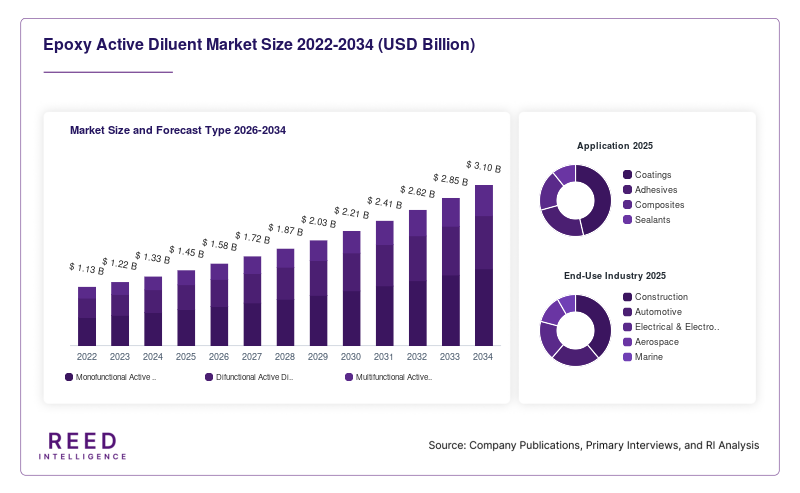
Monofunctional active diluents dominated the market in 2024, accounting for approximately 48% of the total share. These diluents are widely used due to their ability to significantly reduce viscosity while maintaining adequate performance characteristics. They are commonly applied in coatings, adhesives, and sealants where ease of application is critical. Monofunctional diluents also offer cost advantages, making them suitable for large-scale industrial applications. Their compatibility with various epoxy systems further contributes to their widespread adoption across multiple industries.
Multifunctional active diluents are expected to be the fastest-growing segment, with a projected CAGR of around 9.5% during the forecast period. These diluents enhance cross-linking density, resulting in improved mechanical strength, chemical resistance, and thermal stability. Industries such as aerospace and electronics are increasingly adopting multifunctional diluents for high-performance applications. The growing demand for advanced materials with superior properties is driving the adoption of this segment.
By Application
Coatings emerged as the dominant application segment in 2024, holding a market share of approximately 42%. Epoxy coatings are widely used in industrial flooring, protective coatings, and marine applications due to their durability and resistance to corrosion. Active diluents play a critical role in improving the flow and application properties of these coatings. The increasing demand for protective coatings in infrastructure and industrial sectors continues to support the growth of this segment.
Composites are anticipated to be the fastest-growing application segment, with a CAGR of about 10.1% during the forecast period. The rising use of epoxy-based composites in automotive, aerospace, and wind energy industries is driving this growth. Active diluents enhance resin infusion and curing processes, making them essential for composite manufacturing. The shift toward lightweight and high-strength materials further accelerates the demand for this segment.
By End-Use Industry
The construction industry dominated the market in 2024, accounting for nearly 38% of the total share. Epoxy active diluents are extensively used in construction applications such as flooring, coatings, and adhesives. Their ability to improve workability and performance makes them suitable for large-scale infrastructure projects. The growing demand for durable and cost-effective building materials continues to drive the adoption of epoxy systems in this sector.
The electrical & electronics industry is expected to be the fastest-growing segment, with a CAGR of approximately 9.8% during the forecast period. The increasing use of epoxy resins in electronic components and devices is a key growth factor. Active diluents enhance the processability and performance of these materials, making them suitable for advanced applications. The rapid expansion of the electronics industry further supports this growth.
Regional Analysis
North America
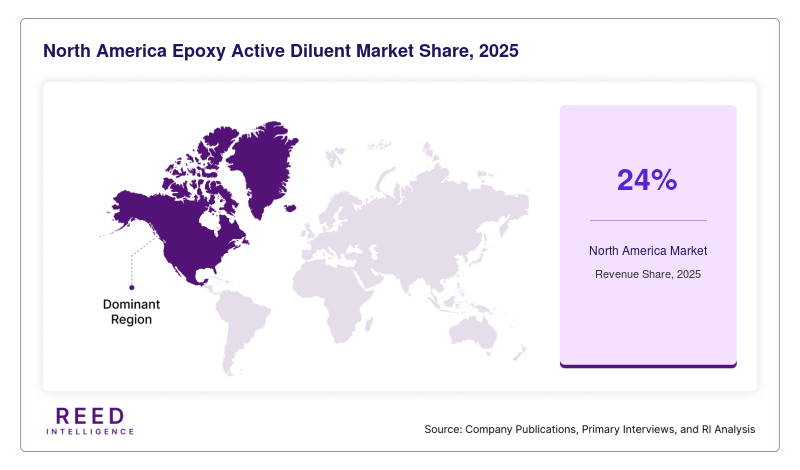
North America accounted for approximately 24% of the epoxy active diluent market share in 2025 and is expected to grow at a CAGR of around 7.9% during the forecast period. The region benefits from a well-established industrial base and strong demand from sectors such as construction, automotive, and aerospace. The presence of advanced manufacturing technologies and a focus on innovation further support market growth across the United States and Canada.
The United States dominates the regional market due to its extensive use of epoxy-based materials in infrastructure and industrial applications. A key growth factor is the increasing investment in renewable energy projects, particularly wind energy installations. This drives the demand for high-performance epoxy composites and associated diluents.
Europe
Europe held a market share of approximately 22% in 2025 and is projected to grow at a CAGR of about 7.6% through 2034. The region’s growth is driven by stringent environmental regulations and a strong focus on sustainable materials. Countries across Europe are increasingly adopting eco-friendly epoxy formulations, which boosts the demand for advanced active diluents.
Germany is the leading country in the European market, supported by its robust automotive and manufacturing sectors. A unique growth factor is the region’s emphasis on green building practices, which encourages the use of low-VOC and sustainable epoxy systems in construction and coatings applications.
Asia Pacific
Asia Pacific dominated the global market with a share of nearly 34% in 2025 and is expected to register the fastest CAGR of approximately 10.2% during the forecast period. Rapid industrialization, urbanization, and infrastructure development are key drivers of growth in this region. Countries such as China, India, and Japan are major contributors to market expansion.
China leads the Asia Pacific market due to its large-scale manufacturing and construction activities. A significant growth factor is the increasing demand for wind energy and electric vehicles, which require high-performance epoxy materials. This drives the consumption of active diluents across multiple industries.
Middle East & Africa
The Middle East & Africa region accounted for around 10% of the market share in 2025 and is projected to grow at a CAGR of 7.2% over the forecast period. Growth in this region is supported by expanding construction projects and increasing investments in infrastructure development, particularly in Gulf countries.
Saudi Arabia is a dominant market within the region, driven by large-scale infrastructure and industrial projects. A unique growth factor is the rising adoption of advanced coatings and materials in oil & gas applications, which require durable and chemically resistant epoxy systems.
Latin America
Latin America held approximately 10% of the market share in 2025 and is expected to grow at a CAGR of about 7.4% through 2034. The region’s growth is driven by increasing industrial activities and gradual expansion of the construction sector. Demand for epoxy-based materials is rising in both residential and commercial applications.
Brazil is the leading country in Latin America, supported by its growing construction and automotive industries. A key growth factor is the increasing use of epoxy coatings in infrastructure projects, which enhances durability and reduces maintenance costs over time.
Competitive Landscape
The epoxy active diluent market is moderately fragmented, with several global and regional players competing based on product innovation, pricing strategies, and distribution networks. Key companies are focusing on developing advanced formulations that meet evolving industry requirements, particularly in terms of performance and environmental compliance. Strategic partnerships, mergers, and acquisitions are also common as companies aim to expand their market presence and strengthen their product portfolios.
A leading player in the market is Huntsman Corporation, which offers a wide range of epoxy solutions and continues to invest in research and development. A recent development includes the introduction of low-viscosity and sustainable diluent formulations aimed at reducing environmental impact. Other major companies are also focusing on expanding their production capacities and enhancing their global distribution networks to meet increasing demand across various industries.
Key Players List
- Huntsman Corporation
- Hexion Inc.
- BASF SE
- Aditya Birla Chemicals
- Evonik Industries AG
- Kukdo Chemical Co., Ltd.
- Atul Ltd.
- Cardolite Corporation
- Olin Corporation
- Gabriel Performance Products
- Nagase ChemteX Corporation
- Adeka Corporation
- Leuna-Harze GmbH
- Arkema S.A.
- Cargill Incorporated
Recent Developments
- In 2024, Huntsman Corporation introduced a new range of bio-based epoxy active diluents to support sustainable material solutions.
- In 2023, Hexion Inc. expanded its production capacity for specialty epoxy resins and diluents to meet rising global demand.
- In 2024, BASF SE launched advanced multifunctional diluents designed for high-performance coatings and composite applications.
Epoxy Active Diluent Market Segments
Type
- Monofunctional Active Diluents
- Difunctional Active Diluents
- Multifunctional Active Diluents
Application
- Coatings
- Adhesives
- Composites
- Sealants
End-Use Industry
- Construction
- Automotive
- Electrical & Electronics
- Aerospace
- Marine
By Region
- North America
- Europe
- APAC
- Middle East and Africa
- LATAM