Epoxy Glass Market Size, Share & Demand Report By Product Type (Epoxy Glass Laminates, Woven Epoxy Glass Composites, Molded Epoxy Glass Components, Epoxy Glass Sheets), By Application (Electrical Insulation, Printed Circuit Boards, Structural Components, Industrial Equipment, Transportation Systems), By End-Use Industry (Electronics and Electrical Manufacturing, Aerospace and Defense, Automotive, Renewable Energy, Construction and Infrastructure, Industrial Machinery), By Region & Segment Foreca
USD 3950
Market Overview
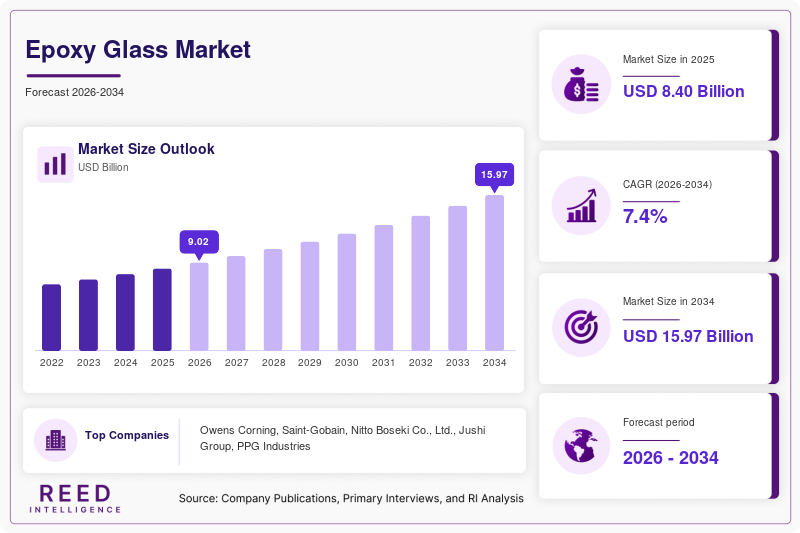
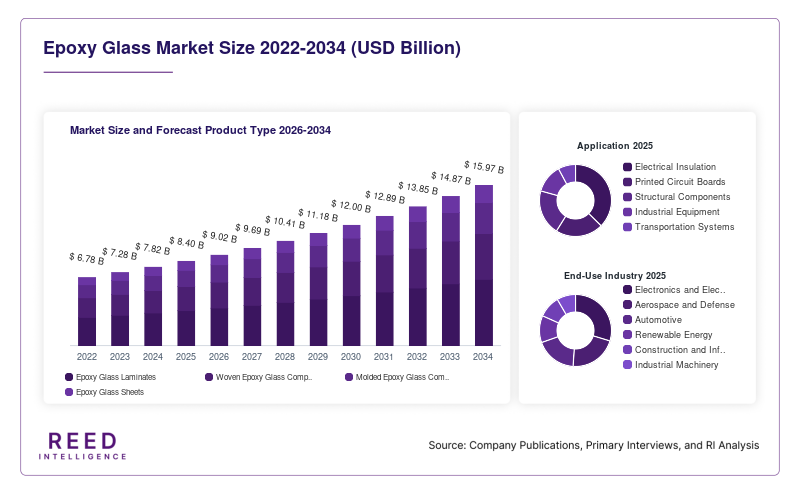
The global Epoxy Glass Market size was valued at approximately USD 8.4 billion in 2026 and is projected to reach nearly USD 14.9 billion by 2034, expanding at a CAGR of 7.4% during the forecast period from 2026 to 2034. Epoxy glass materials are widely used in electrical insulation, printed circuit boards, aerospace structures, automotive components, industrial machinery, and renewable energy systems due to their high mechanical strength, thermal stability, corrosion resistance, and electrical insulation properties. The market continues to benefit from increasing industrial automation and the rising use of lightweight composite materials across manufacturing sectors. Demand from electronics and electrical industries has remained particularly strong because epoxy glass laminates are extensively integrated into high-performance circuit boards and insulation systems.
The growth of renewable energy infrastructure has also created new opportunities for epoxy glass manufacturers. Wind turbine blades, solar panel insulation systems, and energy storage equipment increasingly require durable composite materials capable of operating under demanding environmental conditions. In addition, the expansion of electric vehicle manufacturing and advanced transportation systems has accelerated the use of epoxy glass composites in lightweight structural applications. Manufacturers are focusing on advanced resin formulations and recyclable composite technologies to improve operational efficiency and sustainability performance.
Key Highlights
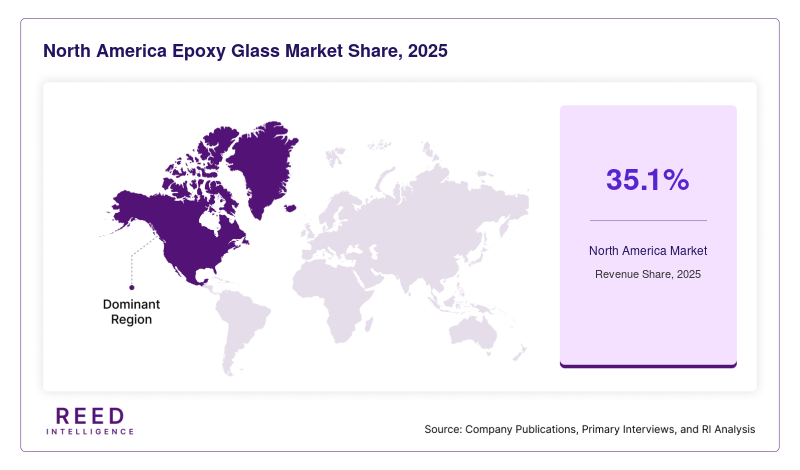
- North America dominated the market with a 35.1% share in 2025, while Asia Pacific is expected to grow at the fastest CAGR of 9.1% during 2026–2034.
- By product type, epoxy glass laminates accounted for the largest share of 39.4%, while woven epoxy glass composites are projected to grow at a CAGR of 8.8%.
- By application, electrical insulation led with a 42.6% share, whereas printed circuit boards are expected to expand at a CAGR of 9.3%.
- By end-use industry, electronics and electrical manufacturing accounted for the largest share of 37.9%, while renewable energy is projected to grow at a CAGR of 9.7%.
- The United States remained the dominant country, with market values of USD 1.84 billion in 2024 and USD 1.96 billion in 2025.
Market Trends
Increasing Integration of Epoxy Glass Materials in Electric Vehicles
The automotive sector is witnessing a rapid transition toward electric mobility, and this shift is significantly influencing the Epoxy Glass Market. Electric vehicles require lightweight and thermally stable materials to improve energy efficiency and battery performance. Epoxy glass composites are increasingly used in battery insulation systems, lightweight structural parts, electrical housings, and thermal management applications. Automakers are prioritizing advanced composite materials that can reduce vehicle weight while maintaining high mechanical strength and durability. As electric vehicle production continues to expand across Asia Pacific, Europe, and North America, demand for epoxy glass materials is expected to rise steadily.
Manufacturers are also developing flame-retardant and high-temperature-resistant epoxy glass products to meet strict automotive safety standards. The expansion of electric charging infrastructure and smart mobility systems is further supporting market demand. In addition, growing investments in autonomous vehicle technologies are encouraging the use of advanced electronic systems that depend heavily on epoxy glass laminates for insulation and circuit board protection. These trends are strengthening long-term growth prospects for epoxy glass suppliers globally.
Rising Demand for High-Performance Printed Circuit Boards
The growing adoption of advanced electronics and digital communication technologies is increasing the need for high-performance printed circuit boards, creating substantial opportunities for epoxy glass manufacturers. Epoxy glass laminates are widely used in multilayer circuit boards because they provide excellent electrical insulation, dimensional stability, and heat resistance. The expansion of 5G infrastructure, cloud computing systems, industrial automation equipment, and consumer electronics manufacturing is accelerating the demand for advanced circuit board materials.
Electronics manufacturers are focusing on miniaturized and high-density electronic devices, which require reliable substrate materials capable of supporting high-frequency operations. Epoxy glass materials are becoming increasingly important in servers, telecommunications equipment, smart appliances, and industrial sensors. Furthermore, defense electronics and aerospace communication systems are driving demand for premium-grade epoxy glass laminates with enhanced durability and thermal performance. This trend is expected to continue as digital transformation initiatives expand across industrial and commercial sectors.
Market Drivers
Expansion of Renewable Energy Infrastructure
The global transition toward renewable energy systems is a major factor supporting the growth of the Epoxy Glass Market. Wind energy projects, solar power systems, and battery storage facilities require durable composite materials capable of withstanding demanding environmental conditions. Epoxy glass composites are commonly used in wind turbine blades, electrical insulation systems, and structural components because they offer high strength, corrosion resistance, and thermal stability. Governments across several countries are increasing investments in renewable energy capacity to achieve long-term sustainability targets, which is creating sustained demand for epoxy glass products.
The modernization of electrical grids and the expansion of energy transmission infrastructure are also contributing to market growth. Epoxy glass insulation materials are widely integrated into transformers, switchgear systems, and high-voltage electrical equipment. In addition, industrial operators are increasingly adopting lightweight and maintenance-resistant composite materials to improve operational efficiency. As renewable energy deployment accelerates globally, manufacturers are expected to increase production capacities and introduce advanced epoxy glass formulations tailored for energy applications.
Growth in Aerospace and Defense Manufacturing
Aerospace and defense industries continue to generate significant demand for epoxy glass materials due to their lightweight properties and superior mechanical performance. Aircraft manufacturers are increasingly replacing conventional metal components with advanced composites to reduce fuel consumption and improve structural efficiency. Epoxy glass composites are extensively used in aircraft interiors, insulation systems, structural reinforcements, and electronic assemblies. Rising air passenger traffic and ongoing aircraft fleet modernization programs are supporting steady market expansion.
Defense modernization initiatives are also increasing the use of advanced composite materials in radar systems, military communication equipment, and protective structures. Governments are allocating higher defense budgets for advanced surveillance and aerospace technologies, which is positively influencing epoxy glass consumption. In addition, space exploration programs and satellite manufacturing projects are creating new opportunities for high-performance epoxy glass laminates and insulation materials. The growing need for durable and lightweight materials across aerospace applications is expected to strengthen market demand throughout the forecast period.
Market Restraint
Volatility in Raw Material Prices and Manufacturing Costs
Fluctuating prices of raw materials used in epoxy resin production remain a major challenge for the Epoxy Glass Market. Epoxy resins and fiberglass materials are heavily dependent on petrochemical derivatives, making manufacturers vulnerable to changing crude oil prices and supply chain disruptions. Variations in transportation costs, energy prices, and global trade conditions can significantly impact production expenses and profit margins. Smaller manufacturers often face operational difficulties because they have limited purchasing power and reduced flexibility in managing long-term supply contracts.
Environmental regulations related to chemical processing and emissions management are also increasing manufacturing costs for epoxy glass producers. Companies are required to invest in advanced waste management systems, emission reduction technologies, and sustainable production methods to comply with evolving regulatory standards. These additional operational expenses can limit market expansion, particularly in price-sensitive regions. For example, several small and medium-sized composite manufacturers in developing economies have experienced slower production growth due to rising resin procurement costs and stricter environmental compliance requirements. Such challenges may temporarily affect product affordability and reduce adoption across low-margin industrial applications.
Market Opportunities
Development of Sustainable and Recyclable Composite Materials
The increasing emphasis on sustainability and environmental responsibility is creating new opportunities for innovation in the Epoxy Glass Market. Manufacturers are investing in recyclable epoxy resin systems, bio-based composites, and low-emission production technologies to align with evolving environmental standards. Industries such as automotive, aerospace, and construction are seeking sustainable alternatives that can reduce carbon footprints without compromising material performance. This transition is encouraging the development of next-generation epoxy glass products with improved recyclability and lifecycle efficiency.
Research institutions and material science companies are collaborating to develop advanced resin formulations capable of supporting circular economy initiatives. Governments are also offering incentives for sustainable manufacturing practices and green infrastructure development, which is expected to accelerate market adoption. In addition, large electronics manufacturers are increasingly integrating eco-friendly composite materials into product designs to meet corporate sustainability goals. These developments are expected to create long-term growth opportunities for companies capable of offering environmentally responsible epoxy glass solutions.
Increasing Industrial Automation and Smart Manufacturing Investments
The rapid adoption of industrial automation technologies is creating substantial opportunities for epoxy glass manufacturers across multiple sectors. Automated manufacturing systems, robotics, industrial sensors, and smart electrical equipment require durable insulation materials and advanced circuit board components that can operate under high temperatures and demanding industrial conditions. Epoxy glass laminates are widely used in industrial control panels, automation equipment, and precision electronic assemblies due to their electrical and mechanical reliability.
Smart factories and Industry 4.0 initiatives are encouraging investments in connected machinery and high-performance electronics, particularly in Asia Pacific and North America. The growing deployment of industrial robotics in automotive manufacturing, semiconductor production, and logistics operations is increasing the need for advanced insulation materials and structural composites. Furthermore, rising investments in data centers and cloud computing infrastructure are contributing to demand for high-quality circuit board materials. These industrial transformation trends are expected to strengthen long-term opportunities for epoxy glass suppliers worldwide.
Segmental Analysis
By Product Type
Epoxy glass laminates accounted for the largest share of the global market in 2024, representing approximately 39.4% of total revenue. These laminates are widely used in electrical insulation systems, industrial panels, transformers, and printed circuit boards because they offer high mechanical strength and excellent thermal resistance. The segment continues to benefit from rising demand across electronics manufacturing and industrial automation sectors. Manufacturers prefer epoxy glass laminates due to their dimensional stability, moisture resistance, and long operational lifespan under demanding industrial conditions. Increasing investments in data centers, electrical infrastructure, and communication systems are further supporting segment expansion. In addition, aerospace and defense industries are integrating epoxy glass laminates into structural and electronic applications that require lightweight yet durable materials. Growing adoption across energy distribution systems and industrial machinery manufacturing is expected to maintain the segment’s leading position during the forecast period.
By Application
Electrical insulation emerged as the dominant application segment in 2024, accounting for nearly 42.6% of the global Epoxy Glass Market share. Epoxy glass materials are widely utilized in transformers, switchgear systems, generators, motors, and high-voltage electrical equipment due to their excellent dielectric properties and thermal stability. The expansion of industrial electrification projects and modernization of power transmission networks are major factors supporting demand. Rapid urbanization and increasing electricity consumption across developing economies are also driving investments in advanced electrical infrastructure. Furthermore, the integration of renewable energy systems into national grids has increased the need for durable insulation materials capable of operating under high thermal and mechanical stress conditions. Industrial operators prefer epoxy glass insulation products because they reduce maintenance requirements and improve operational reliability. The segment is expected to maintain strong growth as global investments in power distribution and industrial automation continue to increase.
By End-Use Industry
The electronics and electrical manufacturing segment held the largest share of the global Epoxy Glass Market in 2024, accounting for approximately 37.9% of total revenue. The segment benefits from extensive use of epoxy glass laminates and composites in printed circuit boards, electrical insulation systems, semiconductor equipment, and industrial control devices. The continuous expansion of consumer electronics production and industrial digitalization initiatives is supporting strong demand for high-performance composite materials. Manufacturers require durable and thermally stable materials capable of supporting high-speed electronic operations and advanced electrical systems. In addition, the growing popularity of smart appliances, wearable devices, and connected industrial equipment is increasing the consumption of epoxy glass substrates across electronics manufacturing facilities. The rising number of semiconductor fabrication plants and data center investments worldwide is also contributing to segment growth. These factors are expected to sustain the leading position of the electronics and electrical manufacturing industry throughout the forecast period.
Regional Analysis
North America
North America accounted for approximately 35.1% of the global Epoxy Glass Market share in 2025 and is expected to maintain a stable growth trajectory during the forecast period. The regional market is projected to expand at a CAGR of 6.8% from 2026 to 2034 due to strong demand from aerospace, electronics, renewable energy, and industrial automation sectors. Advanced manufacturing capabilities and the presence of major composite material suppliers continue to support regional market development. In addition, increasing investments in electric vehicle infrastructure and semiconductor manufacturing facilities are contributing to sustained demand for epoxy glass laminates and insulation materials.
Europe
Europe represented nearly 27.4% of the global Epoxy Glass Market share in 2025 and is anticipated to grow at a CAGR of 6.9% during the forecast period. The region benefits from strong automotive manufacturing activity, expanding renewable energy projects, and increasing industrial electrification initiatives. European industries are emphasizing lightweight composite materials to improve energy efficiency and reduce environmental impact. The market is also supported by rising demand for high-performance insulation materials across railway infrastructure, aerospace engineering, and industrial machinery sectors.
Asia Pacific
Asia Pacific held approximately 24.8% of the global Epoxy Glass Market share in 2025 and is expected to record the fastest CAGR of 9.1% during 2026–2034. Rapid industrialization, rising electronics manufacturing activity, and increasing infrastructure investments are major factors driving regional market growth. Countries across the region are expanding production capacities for consumer electronics, semiconductors, automotive components, and renewable energy systems. The growing middle-class population and urbanization trends are also increasing demand for electronic products and advanced industrial equipment.
Middle East & Africa
The Middle East & Africa region accounted for nearly 6.5% of the global Epoxy Glass Market share in 2025 and is projected to grow at a CAGR of 6.3% over the forecast period. The market is gradually expanding due to increasing investments in energy infrastructure, industrial development projects, and transportation modernization programs. Countries in the region are focusing on improving manufacturing capabilities and diversifying their economies beyond traditional oil and gas industries. Demand for durable insulation materials and composite structures is rising across construction, utilities, and industrial processing sectors.
Latin America
Latin America represented approximately 6.2% of the global Epoxy Glass Market share in 2025 and is expected to grow at a CAGR of 6.5% during the forecast period. The region is benefiting from rising industrialization, increasing renewable energy investments, and expanding automotive production activities. Manufacturers are gradually adopting advanced composite materials to improve product durability and operational efficiency. The development of regional electronics assembly operations and infrastructure modernization projects is also supporting demand for epoxy glass laminates and insulation materials.
Competitive Landscape
The Epoxy Glass Market is moderately fragmented, with several global and regional manufacturers competing on the basis of product quality, technological innovation, pricing strategies, and distribution capabilities. Leading companies are investing in advanced resin technologies, sustainable composite solutions, and capacity expansion projects to strengthen their market presence. Strategic partnerships with electronics manufacturers, automotive companies, and renewable energy developers are becoming increasingly important for long-term growth.
Owens Corning remained one of the leading companies in the market due to its extensive fiberglass and composite materials portfolio. The company has focused on expanding its advanced insulation and industrial composite product offerings to address growing demand from renewable energy and electrical infrastructure sectors. Other major companies are emphasizing research and development activities aimed at improving thermal resistance, flame retardancy, and recyclability of epoxy glass products.
Key Players
- Owens Corning
- Saint-Gobain
- Nitto Boseki Co., Ltd.
- Jushi Group
- PPG Industries
- Hexcel Corporation
- Gurit Holding AG
- SGL Carbon
- Isola Group
- AGY Holding Corp.
- China Beihai Fiberglass Co., Ltd.
- Johns Manville
- Taishan Fiberglass Inc.
- Mitsubishi Chemical Group
- Solvay SA
Recent Developments
- In February 2026, Owens Corning announced the expansion of its composite materials production facility to increase supply capacity for renewable energy and electrical insulation applications.
- In September 2025, Hexcel Corporation introduced a new high-temperature epoxy glass composite solution designed for aerospace electronic systems and lightweight structural components.
- In June 2025, Toray Industries, Inc. partnered with an automotive electronics manufacturer to develop advanced epoxy glass substrates for electric vehicle battery systems.
- In January 2026, Saint-Gobain launched a sustainable epoxy glass insulation product line developed with reduced-emission manufacturing technology.
Epoxy Glass Market Segments
Product Type
- Epoxy Glass Laminates
- Woven Epoxy Glass Composites
- Molded Epoxy Glass Components
- Epoxy Glass Sheets
Application
- Electrical Insulation
- Printed Circuit Boards
- Structural Components
- Industrial Equipment
- Transportation Systems
End-Use Industry
- Electronics and Electrical Manufacturing
- Aerospace and Defense
- Automotive
- Renewable Energy
- Construction and Infrastructure
- Industrial Machinery
By Region
- North America
- Europe
- APAC
- Middle East and Africa
- LATAM