Equity Crowdfunding Market Size, Share & Trends Analysis Report by Investor Type, Platform Type, Investment Type, End-User, and Region, Forecasts, 2026–2034
USD 3950
Equity Crowdfunding Market Size
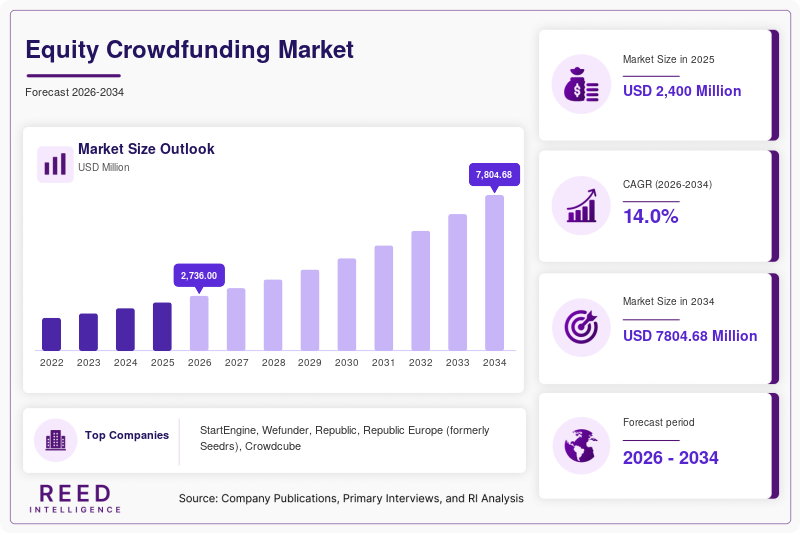
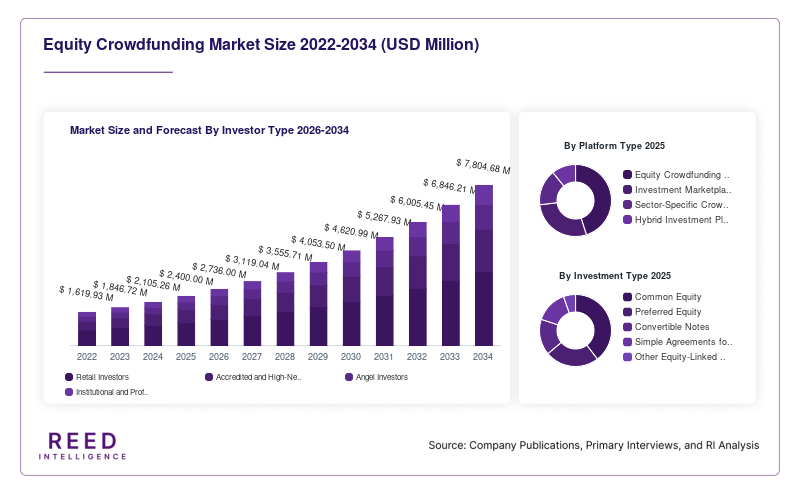
The global equity crowdfunding market size was valued at USD 2,400 million in 2025 and is projected to grow from USD 2,736 million in 2026 to USD 7,804.68 million by 2034, registering a CAGR of 14.0% during the forecast period from 2026 to 2034.
The equity crowdfunding market enables startups, early-stage businesses, and growing private companies to raise capital from multiple investors through online platforms in exchange for equity or equity-linked ownership interests. Unlike reward-based or donation-based crowdfunding, equity crowdfunding allows participants to invest in a business and potentially benefit from its future financial performance. The market connects businesses seeking capital with individual investors and, in some cases, professional or institutional investors.
Equity crowdfunding platforms support fundraising activities such as investor onboarding, campaign presentation, investment processing, regulatory documentation, and communication between companies and investors. Depending on the jurisdiction and platform model, offerings may be subject to investor eligibility requirements, fundraising limits, disclosure obligations, and restrictions on the resale of securities. These factors shape platform operations and influence the accessibility of investment opportunities.
Equity Crowdfunding Market Drivers
Demand for alternative business financing: Equity crowdfunding provides eligible companies with another route to raise capital, potentially complementing conventional lending, angel investment, and venture capital.
Digitalization of financial services: Online platforms simplify campaign discovery, investor registration, documentation, payment processing, and communication, supporting participation across digital channels.
Interest in private-company investment: Some investors seek exposure to early-stage companies and potential long-term business growth, although outcomes and returns are uncertain.
Startup ecosystem development: The formation of new businesses and demand for growth capital create opportunities for platforms that connect companies with suitable investors.
Equity Crowdfunding Market Restraints
High investment risk: Early-stage companies may fail, and investors can lose some or all of their invested capital.
Limited investment liquidity: Equity in privately held companies may be difficult to sell, and a clear exit opportunity may not arise for many years.
Regulatory complexity: Securities laws, fundraising limits, disclosure rules, and investor eligibility requirements vary across markets and can increase compliance costs.
Information asymmetry and trust concerns: Investors may have limited access to independently verified information about private companies, making due diligence and transparent disclosures particularly important.
Equity Crowdfunding Market Opportunities
Expansion into underserved fundraising markets: Platforms can serve eligible small businesses and startups that have difficulty obtaining financing through conventional channels.
Improved screening and transparency tools: Technology-assisted verification, standardized disclosures, and investor education can improve the fundraising process and help users understand risks.
Cross-border platform partnerships: Partnerships can expand campaign reach where permitted by local securities laws and investor eligibility requirements.
Sector-focused investment platforms: Platforms specializing in areas such as climate technology, healthcare, consumer businesses, or industrial innovation can develop tailored investor communities and campaign expertise.
Equity Crowdfunding Market Segmental Analysis
By Investor Type
Retail investors participate through eligible online investment platforms, often with relatively modest individual investment amounts. Their participation allows companies to approach a broad pool of potential shareholders rather than relying exclusively on a small number of traditional funding sources. Investor confidence depends on clear campaign information, platform accessibility, risk disclosures, and the perceived credibility of the business seeking funds.
Accredited investors, high-net-worth individuals, angel investors, and professional investors may participate in offerings subject to the relevant jurisdiction's rules. They can bring investment experience, sector knowledge, and business networks to fundraising campaigns. However, a definitive global market-share percentage and comparable CAGR for each investor category could not be established from the available evidence. The dominant segment depends on the geography and investor definitions used in individual market studies.
By Platform Type
Equity crowdfunding platforms specialize in facilitating securities offerings by eligible businesses. Their services may include campaign hosting, investor registration, payment coordination, investor communications, and regulatory documentation. Investment marketplace platforms can provide broader access to private-company securities and may support additional investment products or secondary-market services where permitted.
Sector-specific platforms focus on selected industries or investor communities, while hybrid platforms combine crowdfunding with other private-market investment services. Competition depends on platform reputation, campaign quality, investor reach, operating costs, and the strength of compliance procedures. No independently verified global share or CAGR was available to establish a definitive leading platform category.
By Investment Type
Common equity and preferred equity provide ownership interests with rights that depend on the terms of each offering. Preferred equity may include specific economic or governance rights, while common equity typically has a different position in the company's capital structure. Investors need to review the terms of the securities rather than assume that all equity crowdfunding investments provide equivalent rights.
Convertible notes and SAFEs are used by some private companies to structure investment before a future equity financing or other contractual trigger. Their conversion conditions, repayment provisions, valuation terms, and investor rights differ. The investment structure available to a company depends on the platform and applicable laws. A reliable numerical comparison of global market shares or growth rates by security type was not available.
By End-User
Startups and early-stage companies use equity crowdfunding to seek funding for product development, market entry, hiring, and other business activities. A campaign can also introduce a business to potential customers and supporters. However, fundraising success depends on investor demand, the company's disclosures, campaign execution, valuation, and broader financing conditions.
Small and medium-sized enterprises and growth-stage companies may use crowdfunding to complement other funding sources. Social enterprises and mission-driven businesses can also seek investors who are interested in their commercial model or stated objectives. These groups have different funding requirements and risk profiles, so a consistent global ranking by share or CAGR cannot be confirmed without a defined market dataset.
By Industry Vertical
Technology and software businesses can use equity crowdfunding to finance product development, customer acquisition, and expansion. Consumer brands may use campaigns to engage existing customers and supporters, while healthcare and life-sciences businesses can seek capital for product development or commercialization, subject to the additional risks and regulatory requirements associated with their activities.
Renewable energy, clean technology, food and beverage, manufacturing, and other sectors may also use equity crowdfunding. Sector demand varies with capital requirements, investor interest, business maturity, and the availability of alternative financing. A definitive dominant industry vertical and its exact global market share could not be established from the supplied market estimates alone.
Equity Crowdfunding Market Regional Analysis
North America Equity Crowdfunding Market
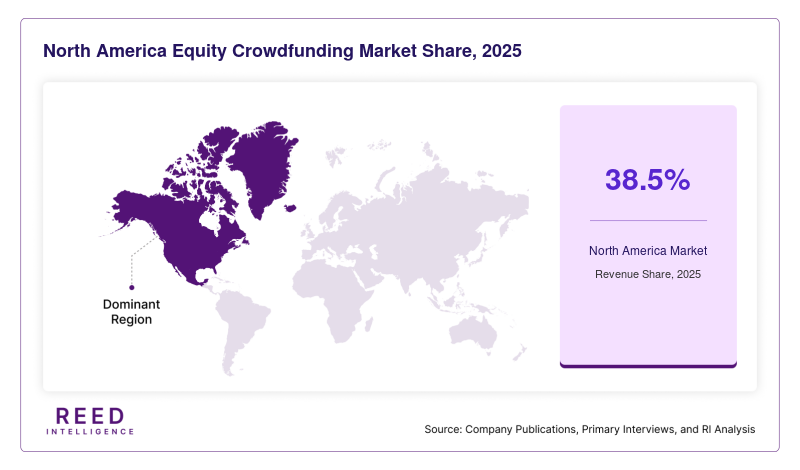
North America dominated the global equity crowdfunding platforms market in 2025, accounting for approximately 38.5% of global revenue. The United States is a major contributor, supported by a developed startup ecosystem, digital financial services, established online investment platforms, and regulatory frameworks for securities-based fundraising. Canada also contributes through its startup financing ecosystem and online investment services.
Europe Equity Crowdfunding Market
Europe has an established equity crowdfunding ecosystem, with platforms connecting startups and growing businesses with individual and professional investors. The United Kingdom and several European markets support online fundraising through platform-based investment services. Regulatory frameworks, including the European Union's crowdfunding service provider rules for covered activities, influence platform authorization, investor protections, and cross-border operations.
Market opportunities include technology startups, consumer businesses, healthcare ventures, and other eligible companies seeking alternatives to conventional financing. Platform growth also depends on investor confidence, transparent disclosures, campaign quality, and the ability to operate within applicable securities regulations. A directly comparable regional market-share percentage for the exact equity crowdfunding market definition used in this report could not be independently verified.
Asia Pacific Equity Crowdfunding Market
Asia Pacific's equity crowdfunding market is shaped by expanding digital financial services, startup activity, internet access, and demand for alternative financing. Countries such as Australia, India, Japan, and Singapore have distinct regulatory frameworks and investment ecosystems, influencing which platforms and offering structures are permitted. The region's large and diverse business base provides opportunities for digital fundraising services tailored to local companies and investors.
Potential growth areas include technology ventures, consumer brands, clean technology, and small businesses seeking capital. Investor awareness, platform credibility, regulatory clarity, and access to suitable investment opportunities will influence adoption. A consistent numerical market share and region-specific CAGR for the exact equity crowdfunding market covered by the supplied forecast were not available from a directly comparable source.
Latin America Equity Crowdfunding Market
Latin America's equity crowdfunding market is influenced by startup development, digital financial services, and demand for financing beyond traditional bank lending and venture capital. Online platforms can connect eligible businesses with investors, while digital onboarding and payment technology may simplify participation. Market conditions differ across countries according to securities regulations, investor participation, and the availability of established platforms.
Opportunities include funding for early-stage businesses, consumer companies, and technology ventures. Platforms must also address investor education, information transparency, liquidity limitations, and compliance with local securities requirements. A reliable numerical regional share and CAGR for the defined equity crowdfunding market could not be confirmed from the available comparable evidence.
Middle East & Africa Equity Crowdfunding Market
The Middle East & Africa equity crowdfunding market includes diverse fintech environments, startup ecosystems, and investment regulations. Digital investment platforms can provide eligible businesses with alternative capital-raising channels, while entrepreneurship initiatives and expanding digital financial services may support market development. Platform operations and investor participation depend on local licensing requirements and the securities frameworks in individual countries.
Equity Crowdfunding Market Competitive Landscape
The equity crowdfunding market includes specialist crowdfunding platforms, broader private-investment marketplaces, regulated intermediaries, and technology providers supporting investment transactions. Competition is based on investor reach, platform reputation, campaign quality, regulatory compliance, fee structures, customer support, and the availability of suitable fundraising opportunities.
Platforms also differentiate themselves through investment products, investor eligibility criteria, issuer support, secondary-market functionality, and tools for managing shareholder records. The competitive environment varies by jurisdiction because companies cannot offer every security type or fundraising structure in every market. Established brands may benefit from investor familiarity and operational experience, while smaller platforms can focus on specific industries, regions, or founder communities.
Key Market Players
- StartEngine
- Wefunder
- Republic
- Republic Europe (formerly Seedrs)
- Crowdcube
- Fundable
- Netcapital
- MicroVentures
- OurCrowd
- Companisto
Equity Crowdfunding Market Recent Developments
July , 2026 – StartEngine launches a new Regulation A offering. StartEngine Crowdfunding disclosed in its quarterly SEC filing that it launched a new Regulation A raise on July 21, 2026. The filing states that the offering included a maximum of 38 million shares at USD 1.60 per share. This is a documented fundraising development in the securities-crowdfunding ecosystem, although a Regulation A offering is distinct from an offering under Regulation Crowdfunding.
May , 2026 – Wefunder updates its eligibility and requirements guidance. Wefunder updated its guidance on eligible company structures and industries, explaining that supported structures include C corporations, LLCs, and public benefit corporations, subject to platform and other requirements. The update illustrates how platform eligibility policies shape the businesses able to seek capital through online fundraising.
Equity Crowdfunding Market Segments
By Investor Type
- Retail Investors
- Accredited and High-Net-Worth Investors
- Angel Investors
- Institutional and Professional Investors
By Platform Type
- Equity Crowdfunding Platforms
- Investment Marketplace Platforms
- Sector-Specific Crowdfunding Platforms
- Hybrid Investment Platforms
By Investment Type
- Common Equity
- Preferred Equity
- Convertible Notes
- Simple Agreements for Future Equity (SAFEs)
- Other Equity-Linked Securities
By End-User
- Startups and Early-Stage Companies
- Small and Medium-Sized Enterprises (SMEs)
- Growth-Stage Companies
- Social Enterprises and Mission-Driven Businesses
By Region
- North America
- Europe
- APAC
- Middle East and Africa
- LATAM