Erdosteine Market Size, Share & Demand Report By Dosage Form (Capsules, Tablets, Oral Suspensions), By Application (Chronic Obstructive Pulmonary Disease (COPD), Bronchitis, Bronchiectasis, Others), By Distribution Channel (Hospital Pharmacies, Retail Pharmacies, Online Pharmacies), By End-User (Hospitals, Clinics, Homecare Settings), By Region & Segment Forecasts, 2025–2034
USD 3950
Market Overview
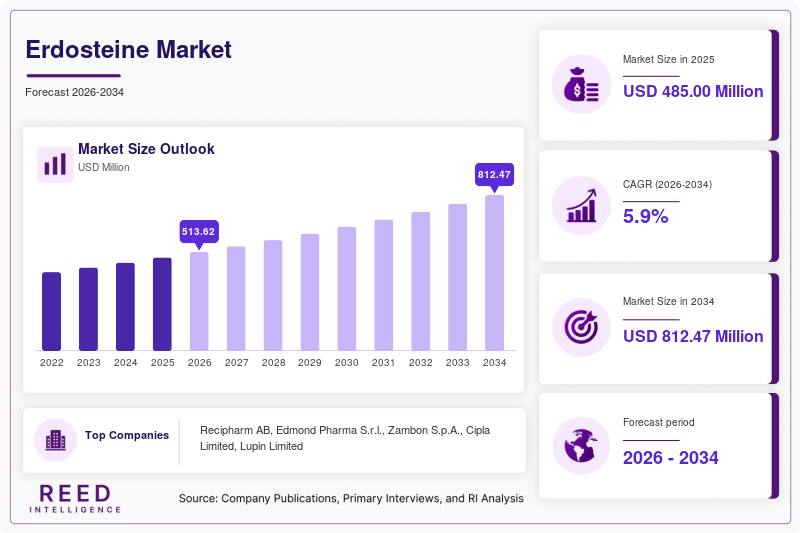
The global Erdosteine Market size was valued at approximately USD 485 million in 2025 and is projected to reach USD 812 million by 2034, expanding at a compound annual growth rate (CAGR) of 5.9% during the forecast period (2025–2034). Erdosteine, a mucolytic agent widely used for the treatment of respiratory disorders such as chronic obstructive pulmonary disease (COPD) and bronchitis, continues to gain traction due to its antioxidant and anti-inflammatory properties.
A major global factor supporting market growth is the increasing prevalence of chronic respiratory diseases driven by urbanization, air pollution, and aging populations. Rising exposure to environmental pollutants and smoking-related complications has significantly contributed to the demand for effective mucolytic therapies, positioning erdosteine as a preferred treatment option in both developed and emerging markets.
Key Highlights
- Europe dominated the market with a 34.2% share in 2025, while Asia Pacific is expected to register the fastest CAGR of 6.8%.
- By dosage form, capsules held the leading share of 41.5%, whereas oral suspensions are projected to grow at a CAGR of 6.5%.
- By application, COPD accounted for the highest share at 38.7%, while bronchiectasis is expected to grow at a CAGR of 6.7%.
- Italy, the dominant country, recorded market values of USD 72 million in 2025 and is estimated to reach USD 75 million in 2026.
Market Trends
Rising Adoption of Combination Therapies
The Erdosteine Market is witnessing increasing adoption of combination therapies where erdosteine is prescribed alongside bronchodilators and corticosteroids. This trend is driven by the need for comprehensive management of chronic respiratory conditions. Combination therapies improve treatment outcomes by addressing multiple symptoms simultaneously, including mucus viscosity, airway inflammation, and oxidative stress. Healthcare providers are increasingly recommending such integrated approaches to reduce hospitalization rates and improve patient quality of life.
Expansion of Generic Drug Manufacturing
Another key trend shaping the market is the expansion of generic drug production, particularly in emerging economies. As patents expire and regulatory pathways become streamlined, generic manufacturers are entering the market with cost-effective alternatives. This has significantly increased accessibility, especially in regions with limited healthcare budgets. The growing presence of local pharmaceutical companies is also intensifying competition, leading to price optimization and wider distribution networks, thereby supporting the overall market growth.
Market Drivers
Increasing Prevalence of Respiratory Disorders
The rising incidence of respiratory conditions such as COPD, asthma, and chronic bronchitis is a major driver of the Erdosteine Market. Factors such as air pollution, occupational hazards, and smoking habits have contributed to a growing patient population globally. Erdosteine’s dual action as a mucolytic and antioxidant makes it a preferred therapeutic option, supporting its widespread adoption.
Growing Geriatric Population
The expanding elderly population is another significant growth driver. Aging individuals are more susceptible to respiratory illnesses due to weakened immune systems and declining lung function. This demographic trend has increased the demand for long-term respiratory treatments, including erdosteine-based therapies, thereby contributing to market expansion.
Market Restraint
Availability of Alternative Therapies
One of the primary challenges faced by the Erdosteine Market is the availability of alternative mucolytic agents and advanced respiratory therapies. Drugs such as acetylcysteine and ambroxol are widely used and often preferred due to established clinical familiarity and broader availability.
Additionally, advancements in biologics and targeted therapies for respiratory conditions have introduced new treatment options that may limit the adoption of traditional mucolytics. Physicians may opt for these alternatives based on patient-specific conditions, efficacy profiles, and cost considerations.
Regulatory differences across regions and varying approval timelines also impact market penetration. In some countries, limited awareness among healthcare providers regarding the benefits of erdosteine further restricts its uptake.
These factors collectively pose a challenge to the sustained growth of the market, particularly in regions with strong competition from established therapies.
Market Opportunities
Expansion in Emerging Markets
Emerging economies present significant growth opportunities for the Erdosteine Market due to improving healthcare infrastructure and rising healthcare expenditure. Countries in Asia Pacific, Latin America, and the Middle East are witnessing increased access to diagnostic and treatment facilities. This creates a favorable environment for the adoption of erdosteine-based therapies, particularly in underserved populations.
Development of Advanced Drug Formulations
The development of innovative drug delivery systems and formulations offers another promising opportunity. Pharmaceutical companies are investing in improved oral suspensions, effervescent tablets, and pediatric-friendly formulations to enhance patient compliance. Such advancements not only expand the target patient base but also improve treatment adherence, thereby driving market growth.
Segmental Analysis
By Dosage Form
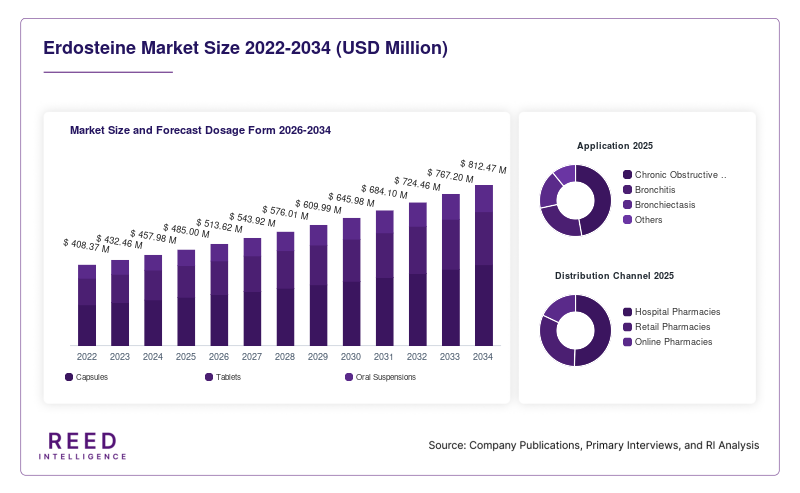
Capsules dominated the Erdosteine Market in 2025, accounting for a share of 41.5%. Their popularity is attributed to ease of administration, longer shelf life, and widespread availability across pharmacies and hospitals.
Oral suspensions are expected to grow at the fastest CAGR of 6.5% during the forecast period. Their growth will be driven by increasing demand for pediatric and geriatric-friendly formulations. These liquid forms offer improved patient compliance, especially among individuals who have difficulty swallowing tablets or capsules.
By Application
COPD was the leading application segment, holding a 38.7% share in 2025. The high prevalence of COPD and the effectiveness of erdosteine in reducing exacerbations have supported its dominance.
Bronchiectasis is projected to be the fastest-growing segment, with a CAGR of 6.7%. Increasing diagnosis rates and growing awareness of this chronic condition will drive demand for targeted mucolytic treatments, including erdosteine.
By Distribution Channel
Hospital pharmacies accounted for the largest share of 46.2% in 2025, as most prescriptions for erdosteine are issued in clinical settings. The availability of specialist consultations in hospitals has contributed to this dominance.
Online pharmacies are expected to witness the fastest growth, with a CAGR of 7.1%. The expansion of e-commerce platforms and growing consumer preference for home delivery services will support this segment’s growth.
By End-User
Hospitals dominated the market with a share of 49.8% in 2025, driven by the high volume of respiratory disease treatments conducted in these settings.
Homecare settings are anticipated to grow at the fastest CAGR of 6.6%. The increasing trend of managing chronic conditions at home and the availability of convenient drug formulations will drive this segment.
Regional Analysis
North America
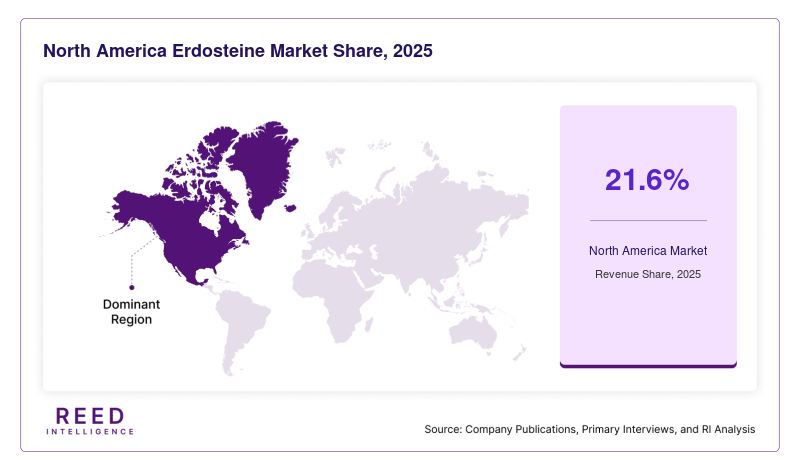
North America accounted for 21.6% of the Erdosteine Market share in 2025 and is expected to grow at a CAGR of 5.4% during the forecast period. The region’s growth is supported by well-established healthcare systems and high awareness of respiratory disease management.
The United States dominated the regional market due to increasing healthcare spending and strong demand for prescription respiratory drugs. The country’s growth is influenced by the rising burden of chronic respiratory diseases and a focus on preventive healthcare measures.
Europe
Europe held the largest market share of 34.2% in 2025 and is projected to grow at a CAGR of 5.6%. The region benefits from widespread adoption of erdosteine in clinical practice and strong regulatory support for respiratory therapies.
Italy emerged as the dominant country, driven by its high prescription rate of mucolytic drugs and strong presence of pharmaceutical manufacturers specializing in respiratory treatments. The country’s established clinical guidelines favor the use of erdosteine in COPD management.
Asia Pacific
Asia Pacific represented 26.8% of the market share in 2025 and is anticipated to grow at the fastest CAGR of 6.8%. Rapid urbanization, increasing pollution levels, and expanding healthcare access are key factors supporting regional growth.
China dominated the region due to its large patient population and growing pharmaceutical manufacturing sector. Government initiatives to improve healthcare infrastructure and increase drug accessibility are contributing to market expansion.
Middle East & Africa
The Middle East & Africa accounted for 9.1% of the market share in 2025 and is expected to grow at a CAGR of 5.2%. The region’s growth is driven by improving healthcare facilities and increasing awareness of respiratory diseases.
Saudi Arabia led the market due to its investments in healthcare modernization and rising demand for effective respiratory treatments. The country’s focus on reducing the burden of chronic diseases supports the adoption of erdosteine.
Latin America
Latin America held an 8.3% market share in 2025 and is projected to grow at a CAGR of 5.5%. Increasing healthcare expenditure and expanding pharmaceutical distribution networks are key growth factors.
Brazil dominated the regional market due to its large population base and growing access to healthcare services. Government initiatives to improve public health infrastructure have contributed to increased availability of respiratory medications.
Competitive Landscape
The Erdosteine Market is moderately fragmented, with a mix of global and regional pharmaceutical companies competing through product differentiation and pricing strategies. Key players focus on expanding their product portfolios and strengthening distribution networks.
Recipharm AB is considered a market leader, leveraging its strong manufacturing capabilities and strategic partnerships. The company recently expanded its production capacity to meet rising global demand for respiratory drugs.
Other prominent players are actively investing in research and development to introduce improved formulations and enhance therapeutic efficacy. Collaborations, licensing agreements, and regional expansions remain common strategies among market participants to strengthen their market position.
Key Players List
- Recipharm AB
- Edmond Pharma S.r.l.
- Alitair Pharmaceuticals Inc.
- Lupin Limited
- Cipla Limited
- Zambon S.p.A.
- Glenmark Pharmaceuticals Ltd.
- Dr. Reddy’s Laboratories Ltd.
- Sun Pharmaceutical Industries Ltd.
- Torrent Pharmaceuticals Ltd.
- Teva Pharmaceutical Industries Ltd.
- Mylan N.V.
- Aurobindo Pharma Limited
- Hetero Drugs Ltd.
- Intas Pharmaceuticals Ltd.
Recent Developments
- In 2024, Recipharm AB expanded its respiratory drug manufacturing facility in Europe to increase erdosteine production capacity.
- In 2024, Cipla Limited launched a new pediatric oral suspension formulation targeting emerging markets.
- In 2023, Lupin Limited entered into a distribution agreement to strengthen its presence in Latin America.
- In 2023, Zambon S.p.A. focused on clinical research to explore new therapeutic indications for erdosteine.
- In 2024, Glenmark Pharmaceuticals introduced cost-effective generic variants to enhance accessibility in Asia Pacific.
Erdosteine Market Segments
Dosage Form
- Capsules
- Tablets
- Oral Suspensions
Application
- Chronic Obstructive Pulmonary Disease (COPD)
- Bronchitis
- Bronchiectasis
- Others
Distribution Channel
- Hospital Pharmacies
- Retail Pharmacies
- Online Pharmacies
End-User
- Hospitals
- Clinics
- Homecare Settings
By Region
- North America
- Europe
- APAC
- Middle East and Africa
- LATAM