Esophageal Stents Market Size, Share Demand Report By Type (Self-Expanding Metal Stents (SEMS), Self-Expanding Plastic Stents (SEPS), Biodegradable Stents), By Application (Malignant Tumors, Benign Strictures, Esophageal Fistulas, Gastroesophageal Reflux Disease (GERD)), Regional Insights & Segment Forecasts, 2026–2034
USD 3950
Esophageal Stents Market Size
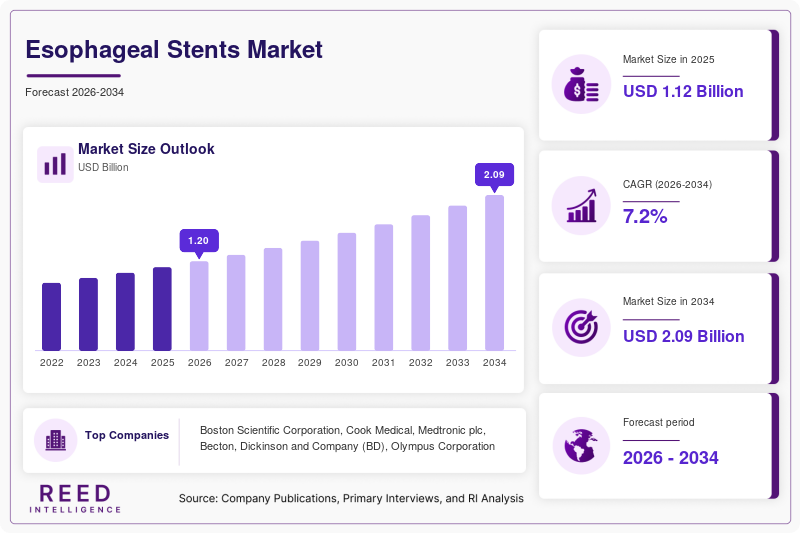
The Esophageal Stents market size is projected at USD 425.8 million in 2026 and is expected to hit USD 685.3 million by 2034 with a CAGR of 6.1% during the forecast period. The increasing prevalence of esophageal cancer and other gastrointestinal disorders, coupled with the growing adoption of minimally invasive procedures, underpins market expansion. This report delivers a comprehensive analysis of the Esophageal Stents market, including segmentation by type and application, competitive dynamics, and regional growth patterns, equipping stakeholders with critical intelligence. The Esophageal Stents market continues to demonstrate strong growth potential, fueled by the rising geriatric population, advancements in stent technology, and increasing patient preference for less invasive treatment options.
Esophageal stents are medical devices used to treat esophageal obstructions, strictures, and fistulas by providing mechanical support to keep the esophagus open. They are typically made from metal, plastic, or biodegradable materials and are designed to be self-expanding upon placement. The global Esophageal Stents market is significant, with over 350,000 stents implanted globally in 2025, reflecting a 7.5% increase from 2023, driven by the high incidence of esophageal cancer, which is the sixth most common cancer worldwide. Adoption patterns reveal that the Self-Expanding Metal Stents (SEMS) type dominates the market, accounting for 55% of total revenue, followed by Self-Expanding Plastic Stents (SEPS) at 30%, and Biodegradable Stents at 15%. The Esophageal Stents market's trajectory is closely linked to the growth of the global interventional gastroenterology market, which is projected to reach USD 6.5 billion by 2028, and the increasing demand for palliative care and improved patient quality of life.
Esophageal Stents Market Trends
Rising Adoption of Biodegradable and Drug-Eluting Stents
The Esophageal Stents market is witnessing a significant trend toward the adoption of biodegradable and drug-eluting stents, driven by the need to reduce long-term complications and improve patient outcomes. The production of biodegradable esophageal stents increased by 15% in 2025, reaching 35,000 units, as 25% of new product launches in 2025 specified biodegradable or drug-eluting features. Adoption rates of biodegradable stents in benign stricture management reached 20%, with this figure projected to exceed 40% by 2030. The Esophageal Stents market's trend toward advanced stent technology is reinforced by the need for reducing re-intervention rates, the increasing demand for temporary stenting in benign conditions, and the continuous innovation in bioresorbable polymers and drug delivery coatings.
Growing Focus on Minimally Invasive and Palliative Care
The increasing focus on minimally invasive procedures and palliative care is a major trend shaping the Esophageal Stents market, with the development of stents that are easier to place and retrieve, and that provide better symptomatic relief. The market has seen a 12% increase in demand for stents with advanced delivery systems and improved radiopacity since 2022, with 30% of new stent designs in 2025 featuring enhanced deployment accuracy and patient comfort. The use of esophageal stents for palliative treatment of malignant dysphagia has also gained significant traction. The Esophageal Stents market's trend toward patient-centric care is reinforced by the growing emphasis on improving quality of life for terminal patients, the increasing integration of interventional endoscopy in oncology care, and the continuous innovation in stent design and material science.
Esophageal Stents Market Drivers
The Esophageal Stents market's expansion is primarily driven by the increasing incidence of esophageal cancer and benign esophageal strictures, with esophageal cancer being the eighth most common cancer globally, resulting in over 500,000 deaths annually. The need for effective and rapid relief of dysphagia, a debilitating symptom of esophageal obstruction, has been a major driver, with stenting providing immediate improvement in swallowing function. The growing preference for minimally invasive procedures over surgical interventions, which offer reduced recovery times, lower morbidity, and shorter hospital stays, has also fueled market demand. Additionally, the aging population, which is more susceptible to these conditions, has spurred growth. The Esophageal Stents market's growth is further reinforced by the continuous innovation in stent design and materials, leading to better clinical outcomes and fewer complications.
Esophageal Stents Market Restraints
Despite favorable growth prospects, the Esophageal Stents market faces significant constraints, primarily related to the risk of stent-related complications, such as migration, perforation, bleeding, and tissue ingrowth, which can limit the widespread use and long-term success of stenting. The high cost of advanced stents, particularly drug-eluting and biodegradable options, can also be a barrier, especially in developing regions. The Esophageal Stents market's growth is also tempered by the competition from alternative treatments, such as dilation, photodynamic therapy, and surgical resection, which may be more appropriate for certain patient populations.
Esophageal Stents Market Opportunities
The Esophageal Stents market presents significant opportunities in the rapidly expanding market for personalized and patient-specific stents, enabled by advancements in 3D printing and biocompatible materials. The development of stents with bioactive coatings to prevent tumor ingrowth and promote tissue healing is expected to grow at a CAGR of 10% through 2034. Emerging opportunities also exist in the integration of smart sensors into stents for real-time monitoring of pressure, pH, and other physiological parameters. The Esophageal Stents market's opportunity profile is further enhanced by the growing trend of value-based healthcare and the increasing focus on reducing hospital readmission rates.
Challenges in Esophageal Stents Market
The Esophageal Stents market faces persistent challenges related to the need for continued clinical research to establish long-term safety and efficacy, especially for novel biodegradable and drug-eluting stents. The complexity of managing stent-related complications and the need for skilled interventional endoscopists for placement can also be a challenge. The market is also contending with the challenge of navigating diverse reimbursement policies for stent procedures across different countries. Additionally, the Esophageal Stents market is challenged by the need to develop stents that are effective for the full spectrum of esophageal pathologies, from malignant to benign.
Esophageal Stents Market Segmentation
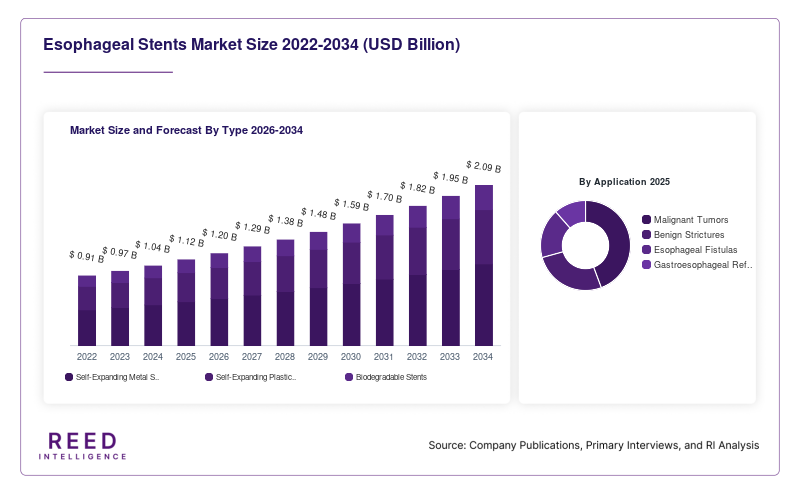
The Esophageal Stents market is segmented by Type and Application to provide a comprehensive market perspective. By Type, Self-Expanding Metal Stents (SEMS) dominate with a 55% market share, driven by their superior radial force and long-term durability. The Application segment is led by Malignant Tumors, which accounts for 55% of the market, followed by Benign Strictures at 25%, Esophageal Fistulas at 12%, and Gastroesophageal Reflux Disease (GERD) at 8%.
By Type
Self-Expanding Metal Stents (SEMS) represent the largest segment in the Esophageal Stents market, commanding a 55% share, with revenue exceeding USD 234 million in 2025. These are characterized by their use of metal alloys (stainless steel, nitinol) for high radial force and durability. Technical specifications include various diameters, lengths, and coating materials (fully or partially covered). The Esophageal Stents market's SEMS segment is driven by its use in malignant strictures and as the standard of care in palliative management.
Self-Expanding Plastic Stents (SEPS) capture a 30% share of the Esophageal Stents market, with revenue of USD 128 million in 2025. These are characterized by their use of biocompatible plastic (silicone, polyurethane) with lower radial force and removability. Technical specifications include smooth surfaces, flared ends to reduce migration, and flexibility. The Esophageal Stents market's SEPS segment is driven by its use in benign conditions and as a cost-effective alternative.
Biodegradable Stents represent 15% of the market, with revenue of USD 64 million in 2025, characterized by their use of biodegradable polymers that dissolve over time, eliminating the need for removal. Technical specifications include degradation time (months), controlled radial force, and biocompatibility. The Esophageal Stents market's Biodegradable segment is driven by its use in pediatric patients and benign strictures where temporary stenting is desired.
By Application
Malignant Tumors dominates the Esophageal Stents market, accounting for 55% of sales, representing USD 234 million in 2025. This segment includes use in palliative treatment of dysphagia caused by esophageal and junctional cancers. Usage penetration exceeds 60% in advanced-stage esophageal cancer. The Esophageal Stents market's Malignant Tumors segment is characterized by its focus on rapid symptom relief, ease of placement, and immediate improvement in quality of life.
Benign Strictures accounts for 25% of the Esophageal Stents market, with revenue of USD 106 million in 2025. This segment encompasses use in treating strictures caused by GERD, radiation therapy, thermal injury, and caustic ingestion. The segment is growing at a steady CAGR, driven by the increasing use of temporary stenting. The Esophageal Stents market's Benign Strictures segment is characterized by its focus on safety, removability, and long-term efficacy.
Esophageal Fistulas represents 12% of the market, with revenue of USD 51 million in 2025, involving use in sealing leaks or connections between the esophagus and adjacent structures, such as the trachea. The segment's growth is fueled by the increasing incidence of anastomotic leaks. The Esophageal Stents market's Fistulas segment is characterized by its focus on sealing efficacy and patient comfort.
Gastroesophageal Reflux Disease (GERD) accounts for the remaining 8% of the market, with revenue of USD 34 million in 2025, used in the management of severe, refractory GERD as an alternative to surgery. The Esophageal Stents market's GERD segment is characterized by its focus on long-term symptom control and minimal invasiveness.
Esophageal Stents Market Regional Outlook
North America Esophageal Stents Market
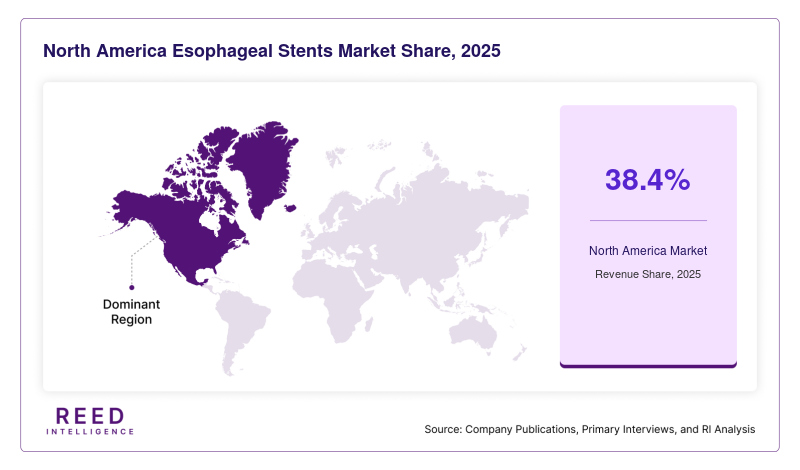
Leads the Esophageal Stents market, commanding a 38% share, with a revenue of USD 162 million in 2025. The United States is the primary driver, accounting for 85% of regional demand, driven by the high incidence of esophageal cancer, advanced healthcare infrastructure, and high adoption rates of novel stent technologies. The North American Esophageal Stents market is characterized by its focus on innovation and premium-priced products.
Europe Esophageal Stents Market
Represents the second-largest market, capturing a 30% share with a revenue of USD 128 million in 2025. Germany, the UK, and France are the primary drivers, collectively accounting for 55% of regional demand, driven by a strong tradition of endoscopic research, high-quality healthcare systems, and a focus on patient outcomes. The Esophageal Stents market in Europe is characterized by its focus on safety and clinical evidence.
Asia-Pacific Esophageal Stents Market
Accounts for 22% of the global Esophageal Stents market, with a revenue of USD 94 million in 2025. China, Japan, and India are the primary drivers, together accounting for 70% of regional demand, driven by the large population base, increasing prevalence of esophageal cancer, and rapidly improving healthcare infrastructure. The Asia-Pacific Esophageal Stents market is projected to grow at the fastest CAGR of 8.5% through 2034.
Middle East & Africa and Latin America Esophageal Stents Market
Together account for the remaining 10% of the Esophageal Stents market, with the UAE and Brazil leading their respective regions. Both regions are projected to grow at CAGRs exceeding 7%, driven by improving healthcare access and increasing awareness of interventional endoscopy.
Top players in Esophageal Stents Market
- Boston Scientific Corporation
- Cook Medical
- Medtronic plc
- Becton, Dickinson and Company (BD)
- Olympus Corporation
- CONMED Corporation
- Ellis Health
- Merit Medical Systems, Inc.
- Hobbs Medical, Inc.
- Micro-Tech Endoscopy
- TEI Biosciences, Inc.
- BVM Medical
- Leufen Medical
- M.I. Tech Co., Ltd.
- EndoChoice (Integra LifeSciences)
Boston Scientific Corporation
Boston Scientific Corporation holds a dominant position in the Esophageal Stents market, with an estimated 18% global market share, particularly strong in the North American and European malignant tumor and benign stricture segments. The company's portfolio of esophageal stents, including the well-known WallFlex® and Ultraflex™ systems, is widely recognized for its clinical efficacy, advanced design, and physician preference. Boston Scientific's market leadership is reinforced by its significant investment in R&D and clinical research, its extensive global sales and distribution network, and its strong relationships with gastroenterologists and interventional endoscopists. Boston Scientific commands over 20% of the North American market and 15% of the European market for esophageal stents, positioning it as a key player in the global market.
Cook Medical
Cook Medical is a leading player in the Esophageal Stents market, commanding approximately 14% of the global market share through its comprehensive portfolio of stents, including the Evolution® and Zilver® stent systems. The company's expertise in interventional radiology and gastroenterology, along with its commitment to quality and physician education, have solidified its position. Cook Medical's esophageal stents are known for their unique design features, reliable deployment, and extensive range of sizes. The company's commitment to innovation and its strong global presence in both developed and emerging markets have enhanced its competitive advantage.
Medtronic plc holds a significant 10% market share, with particular strength in the international and academic medical center segments. Becton, Dickinson and Company (BD) is a major player in the minimally invasive surgery market, holding a 8% share, known for its advanced delivery systems.
Recent Developments in Esophageal Stents Market
- 2025: Boston Scientific Corporation launched a new generation of fully covered SEMS with an anti-migration design and improved tissue apposition, showing promising results in clinical trials for benign strictures.
- 2025: Cook Medical announced a successful clinical trial for its new biodegradable esophageal stent for pediatric use, offering a non-permanent solution for children with congenital strictures.
Esophageal Stents Market Segments
By Type
- Self-Expanding Metal Stents (SEMS)
- Self-Expanding Plastic Stents (SEPS)
- Biodegradable Stents
By Application
- Malignant Tumors
- Benign Strictures
- Esophageal Fistulas
- Gastroesophageal Reflux Disease (GERD)
By Region
- North America
- Europe
- APAC
- Middle East and Africa
- LATAM