Esterquat Market Size, Share Demand Report By Type (Triethanolamine-based Esterquats, Methyl Ester-based Esterquats), By Application (Fabric Softeners, Personal Care Products, Industrial Cleaning), By End-Use (Household, Industrial & Institutional) By Region & Segment Forecasts, 2026–2034
USD 3950
Esterquat Market Overview
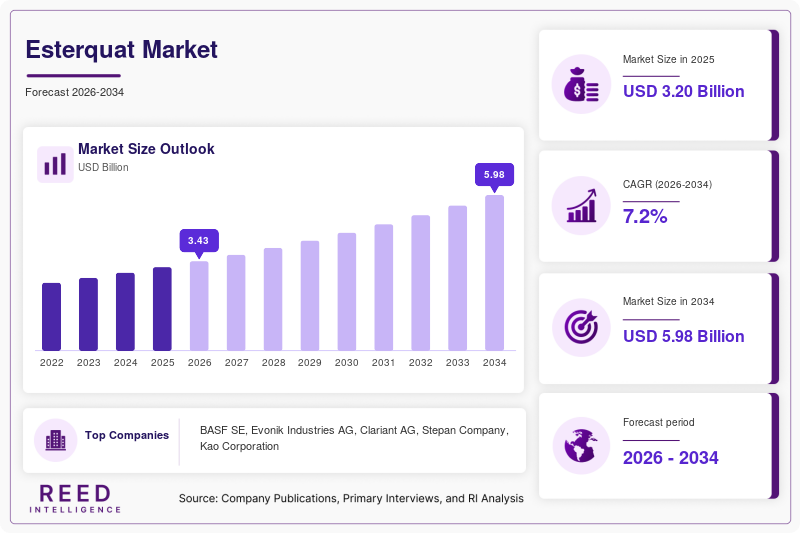
The Esterquat Market size was valued at approximately USD 3.2 billion in 2026 and is projected to reach USD 5.6 billion by 2034, expanding at a CAGR of 7.2% during 2026–2034. Esterquats, widely used as biodegradable cationic surfactants, are gaining traction due to their application in fabric softeners, hair conditioners, and personal care formulations. Their ability to deliver softness, conditioning, and anti-static properties while maintaining environmental compatibility has positioned them as a preferred alternative to conventional quaternary ammonium compounds.
A key global factor supporting market growth is the rising demand for sustainable and eco-friendly chemicals across consumer goods industries. Regulatory frameworks promoting biodegradable ingredients, especially in Europe and North America, are accelerating the transition toward esterquats. Additionally, increasing consumer awareness about product safety and environmental impact has encouraged manufacturers to incorporate renewable-based surfactants in their formulations.
Key Highlights
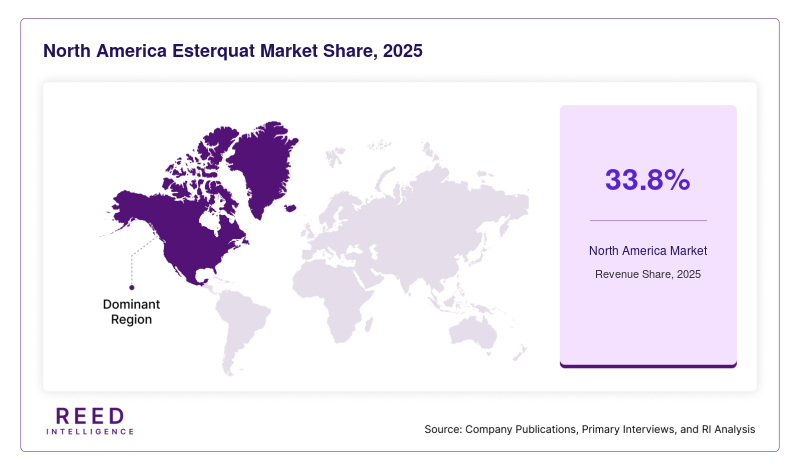
- North America dominated the market with a 33.8% share in 2025.
- Asia Pacific is expected to grow at the fastest CAGR of 8.4% during 2026–2034.
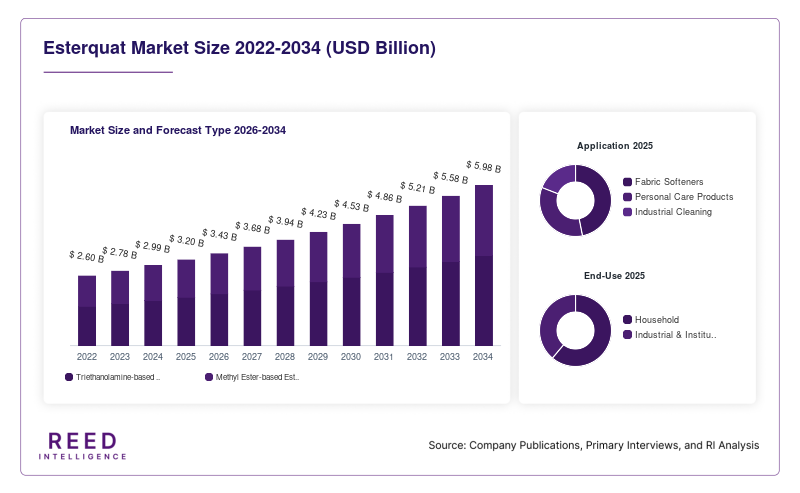
- By type, triethanolamine-based esterquats accounted for the largest share of 41.2%.
- while methyl ester-based variants are projected to grow at a CAGR of 8.9%.
- By application, fabric softeners led with a 45.6% share, whereas personal care products are expected to expand at a CAGR of 8.7%.
- The United States remained the dominant country, with market values of USD 520 million in 2024 and USD 565 million in 2025.
Market Trends
Shift Toward Bio-Based and Sustainable Surfactants
The Esterquat Market is increasingly influenced by the transition toward bio-based raw materials and sustainable chemical formulations. Manufacturers are focusing on plant-derived fatty acids and renewable feedstocks to produce esterquats that align with environmental regulations and consumer expectations. This trend is driven by stringent policies limiting the use of non-biodegradable surfactants and the growing demand for green household and personal care products. Brands are emphasizing eco-label certifications and biodegradable content to differentiate their offerings. As a result, investments in research and development are increasing to enhance product performance without compromising sustainability. This trend is expected to strengthen as regulatory frameworks evolve and consumers continue to prioritize environmentally responsible purchasing decisions.
Expansion in Personal Care and Cosmetic Applications
Esterquats are gaining significant traction in the personal care and cosmetics sector due to their conditioning and emulsifying properties. Their use in hair conditioners, creams, and lotions is expanding as formulators seek ingredients that offer mildness and improved sensory performance. The trend is supported by rising disposable incomes and growing consumer interest in premium personal care products. Additionally, the demand for sulfate-free and gentle formulations has encouraged the use of esterquats as alternative conditioning agents. Companies are introducing customized esterquat grades tailored for specific cosmetic applications, enhancing their functionality and stability. This expansion is expected to continue as innovation in personal care formulations accelerates globally.
Market Drivers
Increasing Demand for Fabric Care Products
The growing consumption of fabric care products is a major driver for the Esterquat Market. Fabric softeners, which rely heavily on esterquats for their softening and anti-static properties, are witnessing increased demand due to rising urbanization and improved living standards. Consumers are seeking products that enhance fabric feel and longevity, driving manufacturers to adopt advanced surfactants. Additionally, the expansion of the textile and apparel industry contributes to higher usage of fabric conditioners. Emerging economies are experiencing strong demand growth as awareness about fabric care benefits increases. This trend is expected to sustain market expansion as households continue to prioritize convenience and quality in laundry care solutions.
Regulatory Support for Biodegradable Chemicals
Government regulations promoting environmentally friendly chemicals are significantly driving the adoption of esterquats. Regulatory bodies across various regions are imposing restrictions on non-biodegradable surfactants, encouraging the use of safer alternatives. Esterquats, known for their biodegradability and lower toxicity, comply with these standards, making them a preferred choice for manufacturers. This regulatory push has led to increased investments in production capacity and innovation. Companies are aligning their product portfolios with sustainability goals to remain competitive. As environmental regulations become more stringent globally, the demand for esterquats is expected to rise steadily, reinforcing their role in sustainable chemical formulations.
Market Restraint
Fluctuating Raw Material Prices and Supply Chain Constraints
One of the key challenges in the Esterquat Market is the volatility in raw material prices, particularly those derived from natural oils and fatty acids. These feedstocks are influenced by agricultural output, climatic conditions, and geopolitical factors, leading to price fluctuations that impact production costs. Manufacturers often face difficulties in maintaining stable pricing, which can affect profit margins and market competitiveness. Additionally, supply chain disruptions, including transportation delays and limited availability of raw materials, further complicate production planning.
This restraint has a notable impact on small and medium-sized manufacturers who may lack the financial flexibility to absorb cost fluctuations. For instance, a sudden increase in palm oil prices can significantly raise the cost of esterquat production, forcing companies to either increase product prices or reduce margins. Such challenges can slow market growth and limit adoption in price-sensitive regions. Addressing these issues requires strategic sourcing, diversification of raw materials, and investment in alternative feedstocks to ensure long-term stability.
Market Opportunities
Growth in Emerging Markets
Emerging economies present significant growth opportunities for the Esterquat Market due to increasing urbanization, rising disposable incomes, and expanding middle-class populations. Countries in Asia Pacific, Latin America, and parts of Africa are witnessing a surge in demand for household and personal care products. This creates a favorable environment for esterquat adoption in fabric softeners and cosmetic formulations. Manufacturers are expanding their distribution networks and establishing local production facilities to cater to these markets. Additionally, the growing awareness of hygiene and personal grooming is driving demand for high-quality products, further boosting market potential. This opportunity is expected to contribute significantly to overall market growth during the forecast period.
Innovation in Industrial and Institutional Cleaning Applications
The use of esterquats in industrial and institutional cleaning applications is an emerging opportunity. These surfactants offer effective cleaning performance along with environmental compatibility, making them suitable for use in commercial cleaning products. Industries such as hospitality, healthcare, and food processing are increasingly adopting eco-friendly cleaning solutions to meet regulatory requirements and sustainability goals. Esterquats are being incorporated into formulations for disinfectants, surface cleaners, and specialty cleaning agents. Continuous innovation in product formulations and performance enhancement is expected to expand their application scope. This opportunity is likely to drive market diversification and create new revenue streams for manufacturers.
Segmental Analysis
By Type
Triethanolamine-based esterquats dominated the Esterquat Market, accounting for approximately 41.2% share in 2024. These esterquats are widely used due to their excellent conditioning properties and compatibility with various formulations. They offer a balance between performance and cost, making them suitable for large-scale applications such as fabric softeners and personal care products. Their ability to provide softness, anti-static effects, and improved fabric feel has contributed to their widespread adoption. Additionally, advancements in production technology have enhanced their efficiency and reduced environmental impact. Manufacturers continue to invest in improving product quality to maintain their market position.
Methyl ester-based esterquats are the fastest-growing subsegment, projected to expand at a CAGR of 8.9% during the forecast period. The growth is driven by their superior biodegradability and environmental compatibility. These esterquats are derived from renewable sources, aligning with sustainability trends and regulatory requirements. Their use in eco-friendly formulations is increasing, particularly in regions with strict environmental standards. Additionally, ongoing research and development efforts are improving their performance characteristics, making them suitable for a wider range of applications. This growth reflects the industry’s shift toward sustainable and high-performance surfactants.
By Application
Fabric softeners held the largest share of the Esterquat Market in 2024, accounting for approximately 45.6%. Esterquats are essential components in fabric softeners due to their ability to enhance softness and reduce static cling. The increasing demand for high-quality laundry care products has driven the adoption of esterquats in this segment. Consumers are seeking products that provide long-lasting fragrance and improved fabric feel, encouraging manufacturers to use advanced surfactants. Additionally, the growth of the textile industry supports demand for fabric softeners. This segment is expected to maintain its dominance due to consistent consumer demand.
Personal care products represent the fastest-growing application segment, with a projected CAGR of 8.7%. The growth is driven by increasing demand for hair conditioners, lotions, and creams that offer improved conditioning and emulsification properties. Esterquats are preferred in these formulations due to their mildness and compatibility with other ingredients. The rising trend of premium and natural personal care products is further supporting growth. Manufacturers are developing specialized esterquat formulations tailored for cosmetic applications. This segment is expected to witness significant expansion as consumer preferences evolve.
By End-Use
The household sector dominated the Esterquat Market in 2024, accounting for approximately 48.3% share. This segment includes applications such as fabric softeners and cleaning products used in residential settings. The increasing adoption of modern laundry practices and the demand for convenience-driven products have contributed to the growth of this segment. Consumers are prioritizing product quality and performance, leading to higher demand for esterquat-based formulations. Additionally, the expansion of retail and e-commerce channels has made these products more accessible. The household sector is expected to remain a key contributor to market growth.
The industrial and institutional sector is the fastest-growing end-use segment, projected to expand at a CAGR of 8.1%. The growth is driven by increasing demand for effective and eco-friendly cleaning solutions in commercial settings. Industries such as healthcare, hospitality, and food processing are adopting esterquat-based products to meet hygiene standards and regulatory requirements. The focus on sustainability and environmental compliance is encouraging the use of biodegradable surfactants. Manufacturers are developing specialized products for industrial applications, enhancing their performance and efficiency. This segment is expected to provide significant growth opportunities for the market.
Regional Analysis
North America
North America held a significant share of the Esterquat Market, accounting for approximately 33.8% in 2025, with a projected CAGR of 6.8% during 2026–2034. The region’s growth is driven by strong demand for eco-friendly household and personal care products. Regulatory frameworks supporting biodegradable chemicals further contribute to market expansion. The presence of established manufacturers and advanced production technologies enhances the region’s market position. Increasing consumer awareness regarding sustainability is also influencing product adoption.
The United States dominates the regional market due to its large consumer base and high demand for premium fabric care products. A key growth factor is the increasing adoption of sustainable formulations by major consumer goods companies. These companies are investing in research and development to introduce innovative esterquat-based products. Additionally, the expansion of e-commerce channels is facilitating easier access to a wide range of household and personal care products, supporting market growth.
Europe
Europe accounted for a notable share of the Esterquat Market in 2025 and is expected to grow at a CAGR of 7.0% during the forecast period. The region is characterized by strict environmental regulations that promote the use of biodegradable surfactants. This has led to widespread adoption of esterquats across various applications. The presence of leading chemical manufacturers and a strong focus on sustainability further support market growth.
Germany is the dominant country in the European market, driven by its advanced chemical industry and emphasis on innovation. A unique growth factor is the implementation of stringent environmental policies that encourage the use of eco-friendly ingredients. Manufacturers in the country are focusing on developing high-performance esterquats that meet regulatory standards. This has positioned Germany as a key contributor to regional market growth.
Asia Pacific
Asia Pacific is the fastest-growing region in the Esterquat Market, with a projected CAGR of 8.4% during 2026–2034. The region’s growth is fueled by rapid urbanization, increasing population, and rising demand for consumer goods. Expanding manufacturing capabilities and cost advantages also contribute to market expansion. Countries in the region are witnessing increased adoption of fabric softeners and personal care products.
China dominates the Asia Pacific market due to its large population and strong manufacturing base. A key growth factor is the increasing demand for affordable and high-quality household products. The country’s growing middle class is driving consumption of fabric care and personal care products. Additionally, government initiatives promoting sustainable manufacturing practices are encouraging the adoption of esterquats.
Middle East & Africa
The Middle East & Africa region is experiencing steady growth in the Esterquat Market, with a projected CAGR of 6.5% during the forecast period. The market is driven by increasing demand for cleaning and personal care products in urban areas. Rising awareness about hygiene and sanitation is also contributing to growth. The region’s expanding hospitality and healthcare sectors further support market demand.
Saudi Arabia is the dominant country in this region, supported by its growing consumer goods industry. A unique growth factor is the increasing investment in infrastructure and urban development, which drives demand for cleaning products. The adoption of modern lifestyles and improved living standards are also influencing market growth. Manufacturers are focusing on expanding their presence in the region to capitalize on emerging opportunities.
Latin America
Latin America holds a moderate share in the Esterquat Market and is expected to grow at a CAGR of 6.9% during 2026–2034. The region’s growth is driven by increasing consumer spending on household and personal care products. Economic development and urbanization are contributing to higher demand for fabric softeners and cosmetic products. The market is also supported by the expansion of retail networks.
Brazil is the leading country in the Latin American market, driven by its large population and growing consumer base. A key growth factor is the increasing awareness of personal hygiene and fabric care. The country’s expanding middle class is driving demand for premium products. Additionally, local manufacturers are investing in product innovation to meet evolving consumer preferences, supporting market growth.
Competitive Landscape
The Esterquat Market is moderately consolidated, with several global and regional players competing based on product innovation, quality, and sustainability. Leading companies are focusing on expanding their product portfolios and investing in research and development to enhance performance and environmental compatibility. Strategic partnerships, mergers, and acquisitions are common strategies to strengthen market presence.
A key leader in the market is BASF SE, which has a strong portfolio of sustainable surfactants and a global distribution network. The company recently introduced a new range of biodegradable esterquats designed for high-performance fabric care applications. Other major players are also focusing on innovation and capacity expansion to meet growing demand. The competitive landscape is characterized by continuous advancements in technology and a strong emphasis on sustainability, which is expected to shape the market’s future.
Key Players List
- BASF SE
- Evonik Industries AG
- Clariant AG
- Stepan Company
- Kao Corporation
- Solvay SA
- Croda International Plc
- Lubrizol Corporation
- Akzo Nobel N.V.
- Huntsman Corporation
- Galaxy Surfactants Ltd.
- Pilot Chemical Company
- Italmatch Chemicals S.p.A.
- Innospec Inc.
- KLK Oleo
Recent Developments
- In 2025, BASF SE launched a new biodegradable esterquat product line aimed at improving fabric conditioning performance.
- In 2024, Evonik Industries expanded its production capacity for esterquats to meet rising global demand.
- In 2025, Clariant AG introduced a sustainable esterquat formulation derived from renewable raw materials for personal care applications.
Esterquat Market Segments
Type
- Triethanolamine-based Esterquats
- Methyl Ester-based Esterquats
Application
- Fabric Softeners
- Personal Care Products
- Industrial Cleaning
End-Use
- Household
- Industrial & Institutional
By Region
- North America
- Europe
- APAC
- Middle East and Africa
- LATAM