Ethoxylated Bisphenol A Market Size, Share Demand Report By Type (Liquid EBPA, Solid EBPA), By Application (Epoxy Resins, Coatings, Adhesives, Sealants), By End-Use (Construction, Electronics, Automotive, Industrial Manufacturing), By Distribution Channel (Direct Sales, Distributors) By Region & Segment Forecasts, 2026–2034
USD 3950
Market Overview
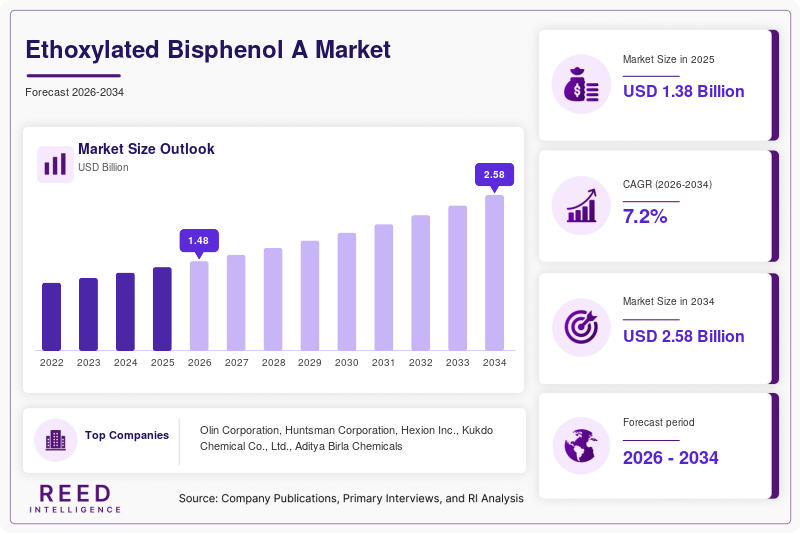
The Ethoxylated Bisphenol A Market size was valued at USD 1.38 billion in 2026 and is projected to reach USD 2.41 billion by 2034, expanding at a CAGR of 7.2% during the forecast period (2026–2034). The market is witnessing steady expansion due to the increasing use of ethoxylated bisphenol A (EBPA) in epoxy resins, coatings, adhesives, and electronic materials. Its chemical stability, flexibility, and enhanced performance characteristics make it a preferred intermediate in industrial formulations.
A key global factor supporting the growth of the Ethoxylated Bisphenol A Market is the rapid expansion of the construction and electronics sectors. The growing demand for durable coatings, high-performance adhesives, and advanced composites has significantly increased the consumption of EBPA across multiple end-use industries.
Key Highlights
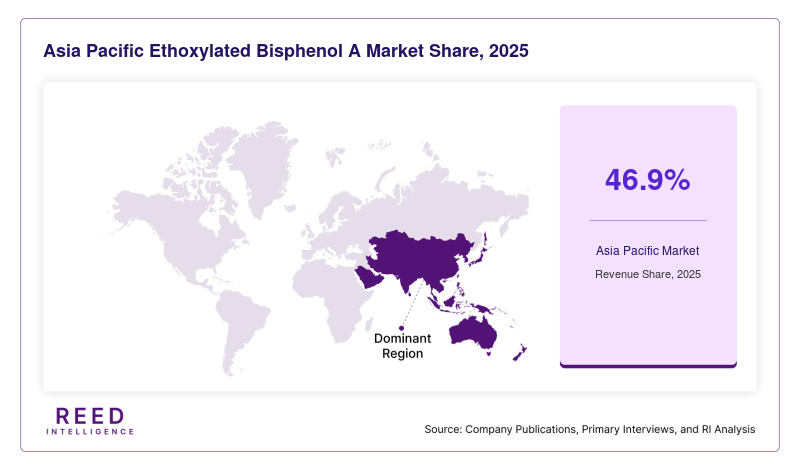
- Dominant region: Asia Pacific held 46.9% market share in 2025, while North America is projected to grow fastest at a CAGR of 7.8% (2026–2034).
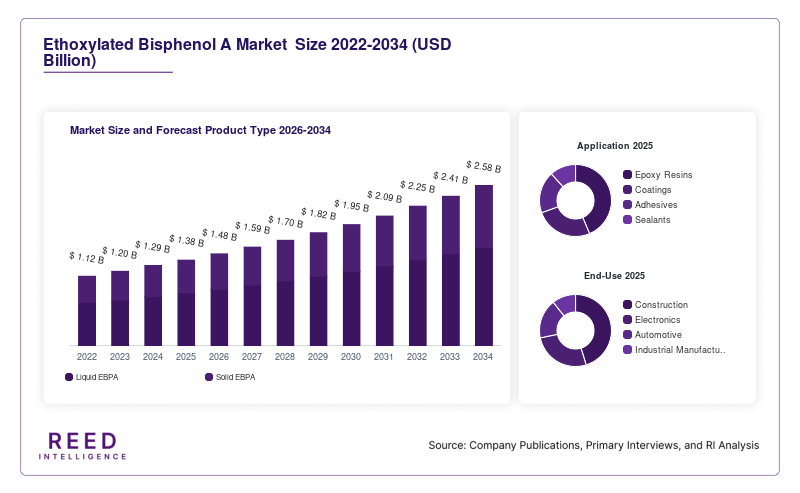
- Leading subsegments: Liquid EBPA dominated the type segment with 62.7% share in 2025, while solid EBPA is expected to grow fastest at a CAGR of 7.5%.
- Application insights: Epoxy resins accounted for 44.3% share in 2025, while coatings are projected to grow at a CAGR of 7.9%.
- End-use insights: Construction sector held 39.6% share in 2025, while electronics industry is expected to grow at a CAGR of 8.2%.
- Dominant country: China market was valued at USD 312 million in 2024 and USD 338 million in 2025.
Market Trends
Increasing Demand for High-Performance Epoxy Systems
The use of ethoxylated bisphenol A in epoxy resin formulations is expanding due to its ability to enhance flexibility, adhesion, and chemical resistance. This trend is particularly significant in industrial coatings and advanced composites.
Shift Toward Environmentally Compliant Formulations
Manufacturers are focusing on developing formulations that meet regulatory standards related to chemical safety and environmental impact. This includes optimizing EBPA usage to reduce emissions and improve sustainability profiles.
Market Drivers
Growth in Construction and Infrastructure Development
The increasing number of infrastructure projects globally is driving demand for coatings, adhesives, and sealants. EBPA-based materials are widely used in construction applications, supporting market growth.
Rising Demand in Electronics Manufacturing
The expansion of the electronics industry is contributing to increased consumption of EBPA in circuit boards, encapsulation materials, and protective coatings. Its thermal and chemical stability makes it suitable for electronic applications.
Market Restraint
Regulatory Concerns Regarding Chemical Safety
Stringent regulations related to bisphenol-based compounds pose challenges for manufacturers. Compliance with evolving environmental and health standards may limit market growth.
Market Opportunities
Development of Advanced Composite Materials
The growing demand for lightweight and durable composite materials in automotive and aerospace industries presents opportunities for EBPA-based formulations.
Expansion in Emerging Industrial Markets
Rapid industrialization in developing regions is creating new opportunities for EBPA manufacturers to expand their presence and cater to increasing demand.
Segmental Analysis
By Type
The Ethoxylated Bisphenol A Market is segmented into liquid EBPA and solid EBPA.
- Dominant Subsegment: Liquid EBPA held 62.7% share in 2025 due to ease of handling and widespread use in industrial formulations.
- Fastest-Growing Subsegment: Solid EBPA is expected to grow at a CAGR of 7.5%, driven by its application in high-performance materials.
By Application
The market includes epoxy resins, coatings, adhesives, and sealants.
- Dominant Subsegment: Epoxy resins accounted for 44.3% share in 2025 due to their extensive use in coatings and composites.
- Fastest-Growing Subsegment: Coatings are projected to grow at a CAGR of 7.9%, supported by demand for protective and decorative applications.
By End-Use
Segments include construction, electronics, automotive, and industrial manufacturing.
- Dominant Subsegment: Construction sector held 39.6% share in 2025 due to high demand for coatings and adhesives.
- Fastest-Growing Subsegment: Electronics industry is expected to grow at a CAGR of 8.2%, driven by increasing production of electronic devices.
By Distribution Channel
The market is segmented into direct sales and distributors.
- Dominant Subsegment: Direct sales accounted for 63.5% share in 2025 due to strong supplier relationships with industrial buyers.
- Fastest-Growing Subsegment: Distributors are projected to grow at a CAGR of 7.1%, supported by expanding supply chains.
Regional Analysis
Asia Pacific
Asia Pacific accounted for 46.9% of the Ethoxylated Bisphenol A Market share in 2025. The region is expected to grow at a CAGR of 7.1% during 2026–2034. China dominated the region due to strong industrial manufacturing and expanding construction activities.
North America
North America held 21.8% market share in 2025 and is projected to grow at the fastest CAGR of 7.8%. The United States dominated the region due to advanced electronics manufacturing and infrastructure development.
Europe
Europe represented 18.6% share in 2025 and is anticipated to grow at a CAGR of 6.9%. Germany led the region, supported by a strong automotive and industrial base.
Middle East & Africa
The region captured 6.5% market share in 2025 and is expected to grow at a CAGR of 6.6%. Saudi Arabia dominated due to increasing construction investments.
Latin America
Latin America accounted for 6.2% share in 2025 and is forecast to grow at a CAGR of 6.8%. Brazil led the region, driven by industrial expansion and infrastructure projects.
Competitive Landscape
The Ethoxylated Bisphenol A Market is moderately competitive, with key players focusing on product innovation, regulatory compliance, and capacity expansion. Olin Corporation is recognized as a leading player, leveraging its strong expertise in epoxy materials and chemical manufacturing. The company recently expanded its production capabilities to meet growing demand from construction and electronics sectors.
Other prominent players include Huntsman Corporation, Hexion Inc., Kukdo Chemical Co., Ltd., and Aditya Birla Chemicals. These companies are investing in research and development to enhance product performance and meet regulatory standards. Strategic collaborations and expansions are helping players strengthen their market presence.
Manufacturers are also focusing on sustainable practices and efficient production processes to address environmental concerns. Competitive strategies are centered on improving product quality, expanding distribution networks, and developing advanced formulations.
Key Players List
- Olin Corporation
- Huntsman Corporation
- Hexion Inc.
- Kukdo Chemical Co., Ltd.
- Aditya Birla Chemicals
- Dow Inc.
- BASF SE
- Mitsubishi Chemical Group
- Solvay S.A.
- Arkema S.A.
- SABIC
- LG Chem Ltd.
- Evonik Industries AG
- Nan Ya Plastics Corporation
- Chang Chun Group
Recent Developments
- In 2025, Olin Corporation expanded its epoxy resin production capacity.
- Huntsman Corporation introduced new EBPA-based formulations for coatings applications.
- Hexion Inc. invested in advanced manufacturing technologies to improve efficiency.
- Kukdo Chemical Co., Ltd. expanded its presence in Asia Pacific markets.
- Aditya Birla Chemicals focused on developing sustainable chemical solutions.
Ethoxylated Bisphenol A Market Segments
Product Type
- Liquid EBPA
- Solid EBPA
Application
- Epoxy Resins
- Coatings
- Adhesives
- Sealants
End-Use
- Construction
- Electronics
- Automotive
- Industrial Manufacturing
Distribution Channel
- Direct Sales
- Distributors
By Region
- North America
- Europe
- APAC
- Middle East and Africa
- LATAM