Ethoxylated Sorbitan Esters Market Size, Share & Demand Report By Product Type (Polysorbate 20, Polysorbate 40, Polysorbate 60, Polysorbate 80), By Application (Pharmaceuticals, Cosmetics & Personal Care, Food & Beverages, Industrial Applications), By End-Use Industry (Healthcare, Consumer Goods, Chemical Processing), By Region & Segment Forecasts, 2026–2034
USD 3950
Market Overview
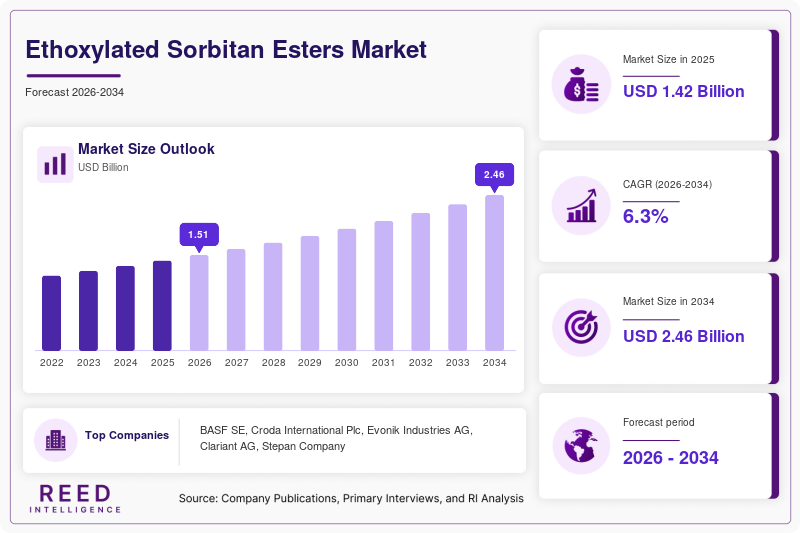
The global Ethoxylated Sorbitan Esters Market size was valued at USD 1.42 billion in 2026 and is projected to reach USD 2.31 billion by 2034, expanding at a CAGR of 6.3% during the forecast period from 2026 to 2034. The market is witnessing steady expansion due to increasing demand for non-ionic surfactants across pharmaceuticals, cosmetics, food emulsification, and industrial formulations. Ethoxylated sorbitan esters, commonly known as polysorbates, are widely used as emulsifiers, stabilizers, and solubilizing agents because of their excellent compatibility with active ingredients and strong formulation stability across diverse applications.
One of the major global factors supporting market growth is the rising shift toward biocompatible and safe excipients in pharmaceutical and personal care formulations. Regulatory agencies and healthcare manufacturers are increasingly emphasizing ingredient safety, non-toxicity, and biodegradability, which has strengthened adoption of ethoxylated sorbitan esters in drug delivery systems and cosmetic formulations. Additionally, growing consumption of processed food and functional beverages is encouraging food manufacturers to use advanced emulsifiers for improved texture, stability, and shelf life. Rising investments in healthcare infrastructure across emerging economies further accelerate product demand across end-use industries.
Key Highlights
- North America dominated the market with a 34.2% share in 2025, while Asia Pacific is expected to grow at the fastest CAGR of 11.2% during 2026–2034.
- By product type, Polysorbate 80 accounted for the largest share of 38.5%, while Polysorbate 20 is projected to grow at a CAGR of 10.6%.
- By application, pharmaceuticals led with a 41.3% share, whereas cosmetics & personal care is expected to expand at a CAGR of 11.4%.
- By end-use, healthcare accounted for a 39.8% share, while personal care & cosmetics is projected to grow at a CAGR of 11.2%.
- The United States remained the dominant country, with market values of USD 470 million in 2024 and USD 510 million in 2025.
Market Trends
Rising Shift Toward Bio-Based and Sustainable Surfactants
The Ethoxylated Sorbitan Esters Market is increasingly influenced by the global transition toward bio-based, renewable, and environmentally friendly surfactants. Manufacturers are focusing on sourcing plant-derived sorbitan and reducing dependency on petrochemical feedstocks to align with sustainability targets. This shift is being driven by stricter environmental regulations in North America and Europe, as well as rising consumer preference for clean-label and non-toxic ingredients. Companies are investing in green chemistry technologies, enzymatic synthesis methods, and eco-friendly production processes to enhance product sustainability. In addition, traceability and certification systems are becoming critical differentiators, allowing brands to demonstrate responsible sourcing practices. This trend is particularly strong in premium personal care and pharmaceutical applications, where ingredient transparency is a key purchasing factor.
Increasing Adoption in Advanced Drug Formulation Systems
Another major trend shaping the Ethoxylated Sorbitan Esters Market is their increasing integration into advanced pharmaceutical drug delivery systems. These esters play a critical role in enhancing solubility, stability, and bioavailability of active pharmaceutical ingredients, particularly in injectable formulations, biologics, and lipid-based drug delivery systems. Pharmaceutical companies are increasingly using polysorbates in complex formulations that require high emulsification performance and compatibility with sensitive molecules. The growth of biologics and specialty drugs is further amplifying demand for high-purity excipients. Technological advancements in formulation science, such as nanoemulsions and controlled-release systems, are also supporting broader usage. This trend is strengthening the position of ethoxylated sorbitan esters as essential functional excipients in modern drug development pipelines.
Market Drivers
Expanding Demand from Personal Care and Cosmetic Industry
The growing personal care and cosmetics industry is a major driver of the Ethoxylated Sorbitan Esters Market. These compounds are widely used as emulsifiers in creams, lotions, serums, shampoos, and skincare products due to their excellent ability to stabilize oil-water systems. Rising consumer awareness regarding skincare, grooming, and wellness has led to increased product diversification by cosmetic brands. The shift toward multifunctional and dermatologically safe formulations has further boosted demand for polysorbates. Additionally, clean beauty trends and the preference for mild, non-irritating ingredients are encouraging manufacturers to replace synthetic emulsifiers with safer alternatives such as ethoxylated sorbitan esters. Rapid expansion of premium skincare brands and e-commerce-based cosmetic companies continues to strengthen global consumption.
Rising Pharmaceutical and Biopharmaceutical Production
Another key driver is the increasing global pharmaceutical and biopharmaceutical production. Ethoxylated sorbitan esters are widely used in oral, topical, and injectable formulations as stabilizers and solubilizers. The rise in chronic diseases, aging populations, and demand for advanced therapeutics has significantly increased drug development activities. Pharmaceutical manufacturers rely on these esters to improve drug delivery efficiency and formulation stability, especially in biologics and vaccine production. Government initiatives supporting healthcare infrastructure expansion in emerging economies are further boosting pharmaceutical manufacturing capacity. Moreover, continuous advancements in formulation technologies are enabling higher adoption of pharmaceutical-grade excipients, strengthening long-term demand for ethoxylated sorbitan esters across global healthcare systems.
Market Restraint
Volatility in Raw Material Supply and Production Costs
The Ethoxylated Sorbitan Esters Market faces challenges due to fluctuations in raw material availability and production costs. Key inputs such as sorbitol and ethylene oxide are influenced by agricultural output, petrochemical pricing, and global supply chain disruptions. These fluctuations directly impact manufacturing costs and profit margins for producers. Seasonal variations, geopolitical factors, and transportation constraints further add to supply uncertainty. Additionally, compliance with stringent quality standards in pharmaceutical and food applications increases production complexity and cost intensity. Smaller manufacturers often struggle to maintain stable pricing structures, limiting their competitiveness in highly regulated markets. This volatility can slow market expansion, particularly in price-sensitive regions.
Market Opportunities
Expansion in Emerging Healthcare and Consumer Markets
Emerging economies present significant growth opportunities for the Ethoxylated Sorbitan Esters Market. Countries across Asia Pacific, Latin America, and the Middle East are witnessing rising disposable incomes, urbanization, and increasing awareness of preventive healthcare. This has led to greater consumption of dietary supplements, cosmetic products, and functional foods. Expanding pharmaceutical manufacturing industries in India, China, and Brazil are further increasing demand for high-quality excipients. Retail infrastructure improvements, including pharmacy chains and e-commerce platforms, are improving product accessibility. Governments are also promoting healthcare awareness programs, which encourage the use of safe and effective formulation ingredients. These factors collectively create a strong long-term growth opportunity for global surfactant manufacturers.
Innovation in Green Chemistry and Product Formulation Technologies
Another major opportunity lies in innovation driven by green chemistry and advanced formulation technologies. Manufacturers are investing in sustainable production processes, including bio-based feedstocks and energy-efficient synthesis methods. Research in enzymatic processing and low-impact chemical pathways is enabling the development of environmentally friendly ethoxylated sorbitan esters. In addition, advancements in nanoemulsion systems, encapsulation technologies, and controlled-release formulations are expanding application possibilities. These innovations are particularly valuable in pharmaceuticals and personal care industries, where performance and safety are critical. Companies focusing on sustainable and high-performance product portfolios are expected to gain strong competitive advantages in global markets.
Segmental Analysis
By Product Type
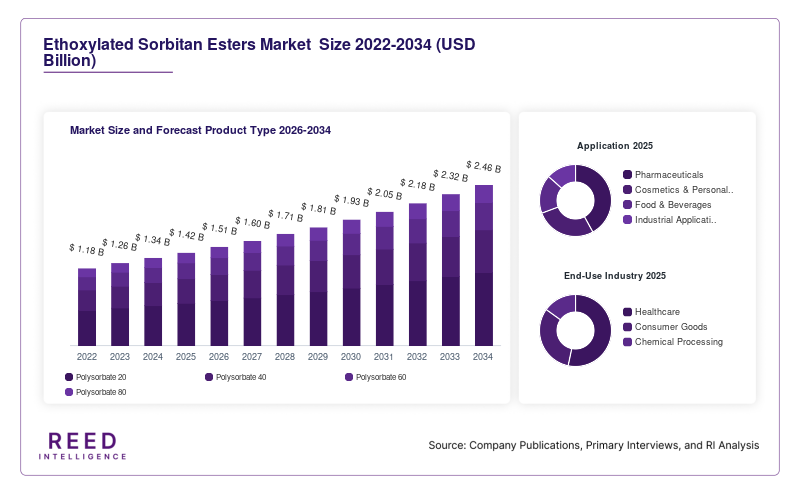
Polysorbate 80 accounted for the dominant share of 38.5% in 2024 within the Ethoxylated Sorbitan Esters Market. The segment maintains strong demand because of its extensive application in pharmaceutical formulations, cosmetics, food processing, and industrial products. Pharmaceutical companies widely use Polysorbate 80 in injectable drugs, vaccines, and biologics because of its excellent emulsifying and stabilizing properties. The compound also supports improved solubility and bioavailability of active pharmaceutical ingredients, making it highly valuable in advanced drug delivery systems. In cosmetic formulations, it is used to stabilize creams, lotions, and cleansing products. Food manufacturers also incorporate the ingredient into emulsified products to improve texture and shelf stability. Rising investment in pharmaceutical research and biologics production continues to strengthen segment demand. Increasing preference for high-performance excipients and multifunctional emulsifiers further supports market leadership. Regulatory approval across major global healthcare markets also contributes significantly to the widespread use of Polysorbate 80.
Polysorbate 20 is projected to witness the fastest growth, expanding at a CAGR of 10.6% during the forecast period. The segment is benefiting from increasing demand for mild and skin-friendly emulsifiers in premium cosmetic and personal care products. Cosmetic manufacturers are increasingly using Polysorbate 20 in serums, facial cleansers, moisturizers, and hair care formulations because of its compatibility with sensitive skin applications. Rising consumer awareness regarding ingredient safety and clean-label beauty products is also supporting demand growth. In addition, skincare brands are launching multifunctional products that require stable and lightweight emulsification systems. The pharmaceutical industry is further contributing to segment expansion through increasing use in topical formulations and oral drug delivery systems. Growing e-commerce sales of premium skincare products are improving consumer accessibility worldwide. Manufacturers are also investing in sustainable and bio-based production methods to align with environmental regulations. Continuous innovation in personal care formulations is expected to drive long-term growth for Polysorbate 20.
By Application
Pharmaceutical applications held the leading share of 41.3% in 2024 due to the extensive use of ethoxylated sorbitan esters in injectable drugs, vaccines, oral formulations, and biologic therapies. These compounds function as essential solubilizers, stabilizers, and emulsifiers that improve formulation consistency and active ingredient performance. The increasing prevalence of chronic diseases and rising demand for specialty therapeutics are accelerating pharmaceutical manufacturing activities globally. Biopharmaceutical companies rely heavily on pharmaceutical-grade polysorbates to maintain stability in protein-based formulations and complex biologic drugs. In addition, rising vaccine production and development of advanced drug delivery systems are contributing significantly to demand growth. Regulatory agencies continue to support the use of high-quality excipients that meet strict purity and safety standards. Expanding healthcare infrastructure in emerging economies is also increasing pharmaceutical production capacities. Continuous investment in biotechnology and biologics research further strengthens the pharmaceutical segment’s dominant position in the global market.
Cosmetics & personal care is expected to emerge as the fastest-growing application segment, registering a CAGR of 11.4% during the forecast period. The segment is witnessing rapid expansion because consumers increasingly prefer premium skincare, haircare, and multifunctional cosmetic products. Ethoxylated sorbitan esters are widely used in creams, lotions, makeup products, shampoos, and cleansing solutions because they improve texture, product stability, and ingredient compatibility. The global clean beauty movement is encouraging manufacturers to adopt safer and biodegradable emulsifiers in cosmetic formulations. Rising demand for anti-aging and dermatologically tested skincare products is also contributing to market growth. Social media marketing and influencer-driven beauty trends are increasing product awareness among younger consumers. In addition, online beauty retail platforms are enabling international cosmetic brands to expand into emerging markets. Manufacturers are continuously investing in formulation innovation and sustainable ingredient sourcing to attract environmentally conscious consumers. Growing disposable income and lifestyle changes continue to support long-term segment expansion.
By End-Use Industry
The healthcare industry accounted for the dominant share of 39.8% in 2024 within the Ethoxylated Sorbitan Esters Market. The segment’s leadership is primarily supported by extensive usage in pharmaceutical manufacturing, biologics production, and clinical nutrition formulations. Ethoxylated sorbitan esters are widely incorporated into injectable formulations, oral medicines, vaccines, and topical therapeutic products because of their ability to improve stability and emulsification performance. The increasing prevalence of chronic diseases and rising healthcare expenditure are accelerating pharmaceutical production activities worldwide. Hospitals and healthcare providers are also contributing to demand through greater utilization of advanced clinical formulations and specialized therapeutic products. In addition, rapid expansion of biotechnology research and biologics development is increasing the requirement for high-purity pharmaceutical excipients. Regulatory support for safe and efficient drug formulation ingredients further strengthens market demand. Continuous innovation in healthcare delivery systems and advanced therapeutics is expected to maintain the segment’s dominant position over the forecast period.
Personal care & cosmetics is projected to record the fastest CAGR of 11.2% during the forecast period due to increasing consumer focus on skincare, beauty, and wellness products. Cosmetic manufacturers are heavily investing in premium formulations that require stable and multifunctional emulsifiers capable of improving product texture and performance. Ethoxylated sorbitan esters are widely used in moisturizers, serums, sunscreens, shampoos, and facial cleansers because of their compatibility with sensitive skin formulations. Rising urbanization and growing disposable income are increasing consumer spending on premium personal care products, particularly in Asia Pacific and Latin America. In addition, the expansion of digital beauty platforms and social media-driven marketing campaigns is significantly improving product visibility. Consumers are increasingly demanding clean-label, dermatologically tested, and environmentally friendly cosmetic products, encouraging greater adoption of bio-based emulsifiers. Continuous innovation in anti-aging and wellness-focused skincare solutions is further supporting strong segment growth globally.
Regional Analysis
North America
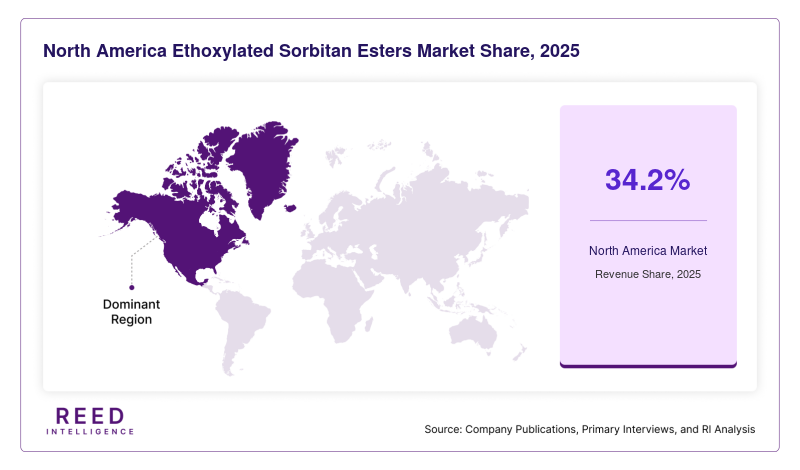
North America accounted for 34.2% of the global Ethoxylated Sorbitan Esters Market share in 2025 and is projected to expand at a CAGR of 5.9% during 2026–2034. The region maintains a strong market position because of advanced pharmaceutical manufacturing capabilities and rising demand for specialty surfactants in personal care products. Consumers increasingly prefer safe and high-performance emulsifiers in skincare and healthcare formulations. Strong regulatory oversight regarding ingredient safety and product quality also supports consistent demand across industries. In addition, the region benefits from extensive research activities related to biologics and injectable drug development. Large-scale investments in cosmetic innovation and premium wellness products continue to accelerate market expansion. Increasing adoption of clean-label formulations is also influencing manufacturers to use biodegradable and non-toxic surfactants. The presence of multinational pharmaceutical and cosmetic companies further strengthens regional demand. Technological advancements in formulation science are contributing to long-term market growth across North America.
The United States remains the dominant country within the North American market due to its strong pharmaceutical sector and large consumer base for skincare and wellness products. One unique factor supporting growth is the increasing use of advanced drug delivery technologies in biologics and specialty therapeutics. Pharmaceutical companies are incorporating pharmaceutical-grade polysorbates into injectable and lipid-based formulations to improve product stability and bioavailability. The country also experiences strong demand from premium cosmetic brands focusing on multifunctional and dermatologically safe formulations. Expansion of e-commerce beauty platforms and wellness subscription services is further increasing product accessibility. Regulatory support for high-quality excipients and clean-label cosmetic ingredients is encouraging product innovation. In addition, rising healthcare expenditure and aging populations continue to support demand for pharmaceutical and personal care applications. Growing investment in biotechnology research also contributes significantly to market expansion across the United States.
Europe
Europe represented a significant share of the Ethoxylated Sorbitan Esters Market in 2025 and is expected to grow at a CAGR of 5.8% throughout the forecast period. The regional market is supported by increasing demand for environmentally friendly surfactants and clean-label cosmetic ingredients. Consumers across major European economies are becoming more conscious regarding ingredient transparency, sustainability, and product safety. Strict environmental and chemical regulations are encouraging manufacturers to adopt bio-based emulsifiers and advanced production technologies. The pharmaceutical sector also contributes significantly to regional demand due to increasing biologics development and clinical formulation activities. Personal care companies are expanding their premium skincare product portfolios, creating consistent demand for non-ionic surfactants. In addition, Europe benefits from strong research capabilities and innovation in specialty chemicals. The presence of established cosmetic and pharmaceutical industries continues to support market growth. Growing adoption of sustainable manufacturing practices is further strengthening long-term demand across the region.
Germany dominates the European market because of its strong chemical manufacturing infrastructure and advanced pharmaceutical industry. A unique growth factor supporting the country’s market expansion is the rapid adoption of sustainable formulation standards within personal care and healthcare sectors. German manufacturers are increasingly focusing on replacing conventional synthetic surfactants with biodegradable alternatives to meet environmental compliance requirements. The country also benefits from significant investments in research related to pharmaceutical excipients and cosmetic formulation technologies. Rising demand for premium skincare products among consumers further supports market growth. In addition, Germany’s well-developed industrial base enables efficient large-scale production of specialty chemicals and emulsifiers. Pharmaceutical companies are increasingly using high-purity polysorbates in vaccine and biologic manufacturing processes. Strong export capabilities and technological expertise continue to position Germany as a leading contributor to regional market development.
Asia Pacific
Asia Pacific accounted for 26.3% of the global Ethoxylated Sorbitan Esters Market in 2025 and is projected to record the fastest CAGR of 11.2% during 2026–2034. Rapid industrialization, increasing healthcare awareness, and rising disposable incomes are driving market growth throughout the region. Demand for pharmaceutical excipients, skincare products, and processed food ingredients is increasing significantly across urban populations. Expanding cosmetic manufacturing activities in China, Japan, South Korea, and India are contributing strongly to regional consumption. The growing pharmaceutical sector is also accelerating adoption of high-performance emulsifiers in drug formulation processes. In addition, rising awareness regarding preventive healthcare and skincare routines among middle-income consumers is supporting market expansion. E-commerce platforms are improving accessibility to premium cosmetic and wellness products across developing economies. Government initiatives promoting domestic pharmaceutical manufacturing are also encouraging production growth. Continuous industrial investment and population growth are expected to sustain long-term regional demand.
China remains the dominant country in the Asia Pacific market due to its large-scale pharmaceutical production capacity and rapidly expanding cosmetic industry. One unique growth factor supporting market expansion is the increasing domestic demand for premium skincare and wellness products among urban consumers. Chinese cosmetic manufacturers are heavily investing in advanced emulsification technologies to improve product quality and performance. In addition, the country’s growing biologics and pharmaceutical sectors are increasing the use of pharmaceutical-grade polysorbates in injectable formulations. Rising healthcare expenditure and government support for local pharmaceutical manufacturing continue to strengthen industrial growth. The expansion of online beauty and healthcare retail channels is also contributing to higher product penetration. Consumers are increasingly preferring safe and multifunctional cosmetic ingredients, encouraging broader adoption of non-ionic surfactants. Strong export capabilities and continuous industrial modernization further reinforce China’s position as the regional market leader.
Middle East & Africa
The Middle East & Africa Ethoxylated Sorbitan Esters Market is gradually expanding and is expected to grow at a CAGR of 7.3% during the forecast period. Increasing healthcare investments and growing awareness regarding personal wellness are contributing to rising demand for pharmaceutical and cosmetic formulations. Consumers are becoming more aware of skincare, healthcare supplements, and quality cosmetic ingredients, particularly in Gulf countries. The region is also experiencing growth in pharmaceutical manufacturing activities and hospital infrastructure development. International cosmetic and wellness brands are increasing their presence through retail partnerships and online distribution channels. In addition, increasing urbanization and rising disposable income levels are encouraging greater spending on personal care products. The demand for stable and safe emulsifiers is also increasing in food and beverage processing industries. Expansion of organized retail networks continues to improve product availability across urban centers. Government-led healthcare modernization initiatives are further supporting long-term market development.
Saudi Arabia remains the dominant country within the region because of strong healthcare spending and increasing demand for premium wellness products. One unique growth factor supporting the market is the growing popularity of fitness and lifestyle improvement programs promoted through national wellness initiatives. Consumers participating in health-focused programs are increasingly purchasing skincare products, supplements, and pharmaceutical formulations containing advanced emulsifiers. The country is also investing heavily in healthcare infrastructure and pharmaceutical manufacturing capabilities to reduce dependency on imports. Expansion of premium cosmetic retail stores and online marketplaces is further improving consumer access to high-quality products. Rising awareness regarding ingredient safety and product performance is encouraging adoption of pharmaceutical-grade and cosmetic-grade surfactants. International manufacturers are also increasing partnerships with regional distributors to strengthen market penetration. Continuous economic diversification efforts are expected to support stable industrial growth in the coming years.
Latin America
Latin America accounted for 5.4% of the global Ethoxylated Sorbitan Esters Market share in 2025 and is projected to grow at a CAGR of 6.6% through 2034. Market growth is driven by increasing pharmaceutical production, rising cosmetic consumption, and expanding awareness regarding preventive healthcare. Consumers are showing greater interest in skincare products and wellness formulations that incorporate safe and high-performance emulsifiers. The region is also witnessing increasing investments in pharmaceutical infrastructure and local chemical manufacturing capabilities. Cosmetic companies are introducing affordable premium skincare products to target middle-income consumers. Retail pharmacy chains and e-commerce platforms are improving product accessibility across major urban markets. Rising urbanization and changing lifestyle patterns continue to support growth in personal care product demand. In addition, increasing healthcare awareness campaigns are encouraging adoption of wellness and healthcare-related formulations. Continuous industrial development is expected to contribute to long-term regional market expansion.
Brazil remains the dominant country in the Latin American market due to its strong cosmetics industry and expanding pharmaceutical manufacturing sector. One unique growth factor driving market growth is the increasing popularity of premium skincare and beauty products among younger consumers. Brazilian cosmetic brands are heavily investing in innovative formulations that require advanced emulsifiers and stabilizers. The country also benefits from strong retail distribution networks and growing online beauty commerce platforms. Pharmaceutical companies are expanding production capacities to meet increasing domestic demand for healthcare products. Rising consumer preference for clean-label and dermatologically safe ingredients is encouraging wider adoption of ethoxylated sorbitan esters. Social media marketing and influencer-driven beauty trends are further supporting product penetration. Increasing foreign investment in the healthcare and cosmetics industries continues to strengthen Brazil’s position within the regional market.
Competitive Landscape
The Ethoxylated Sorbitan Esters Market is moderately consolidated, with global chemical and specialty ingredient companies focusing on innovation, sustainability, and capacity expansion. Key players include BASF SE, Croda International Plc, Evonik Industries AG, Clariant AG, Stepan Company, and Solvay SA. BASF SE remains a leading company due to its strong emulsifier portfolio, advanced production technologies, and global distribution network. The company continues to invest in sustainable surfactant solutions and pharmaceutical-grade excipients to strengthen its market position.
Recent developments include expansion of bio-based surfactant production facilities, strategic collaborations with pharmaceutical companies for high-purity excipient development, and increased investment in green chemistry technologies. Companies are also focusing on supply chain optimization and traceability systems to meet rising demand for transparency in end-use industries.
Key Players
- BASF SE
- Croda International Plc
- Evonik Industries AG
- Clariant AG
- Stepan Company
- Solvay SA
- Kao Corporation
- Lubrizol Corporation
- Dow Inc.
- Ashland Global Holdings
- Galaxy Surfactants Ltd
- NOF Corporation
- Seppic SA
- Gattefossé
- INOLEX Inc.
Recent Developments
- In March 2026, BASF SE expanded its pharmaceutical-grade surfactant production capacity in Europe to support rising demand for high-purity excipients in biologics and injectable drug formulations.
- In August 2025, Croda International Plc launched a new sustainable emulsifier line based on renewable feedstocks aimed at improving environmental performance in personal care formulations.
- In January 2026, Evonik Industries AG announced a strategic partnership with a global pharmaceutical company to develop advanced solubilizing agents for next-generation drug delivery systems.
- In October 2025, Stepan Company introduced enhanced purification technology for polysorbates, improving product stability and reducing impurity levels for pharmaceutical applications.
Ethoxylated Sorbitan Esters Market Segments
Product Type
- Polysorbate 20
- Polysorbate 40
- Polysorbate 60
- Polysorbate 80
Application
- Pharmaceuticals
- Cosmetics & Personal Care
- Food & Beverages
- Industrial Applications
End-Use Industry
- Healthcare
- Consumer Goods
- Chemical Processing
By Region
- North America
- Europe
- APAC
- Middle East and Africa
- LATAM