Ethyl Linalool Market Size, Share Demand Report By Product Type (Synthetic Ethyl Linalool, Bio-Based Ethyl Linalool), By Application (Fragrances and Perfumes, Personal Care Formulations, Household Care Products, Flavor Applications), By End Use (Cosmetics and Personal Care, Household Care, Food and Flavor Manufacturers, Specialty Chemical Users), By Region & Segment Forecasts, 2026–2034
USD 3950
Market Overview
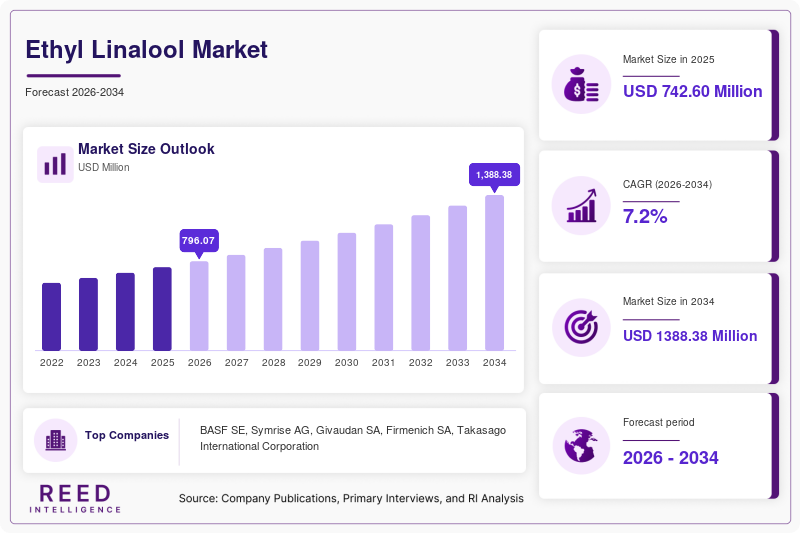
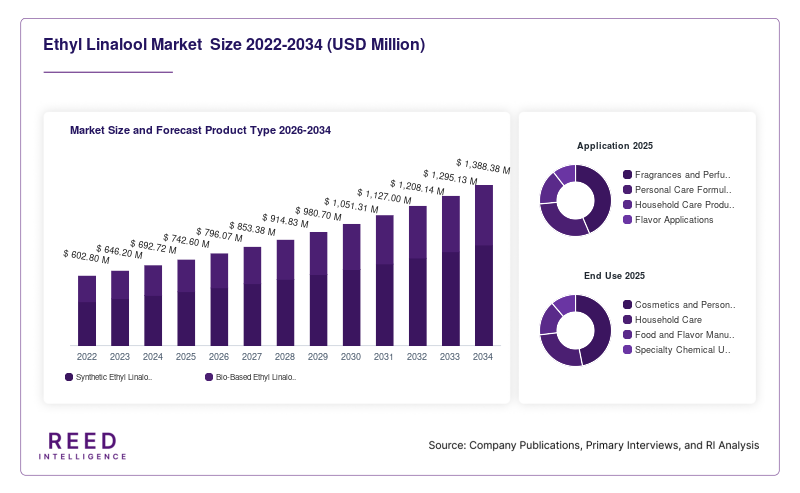
The global Ethyl Linalool Market size was valued at USD 742.6 million in 2026 and is projected to reach USD 1.29 billion by 2034, expanding at a CAGR of 7.2% during the forecast period (2026–2034). Market growth has been supported by rising demand for aroma ingredients across fragrances, personal care, and flavor formulations. A major global factor supporting expansion has been the steady growth in consumer products containing specialty fragrance compounds, particularly in premium personal care and household formulations.
Ethyl linalool is widely used as a fragrance intermediate and aroma chemical due to its floral and fresh scent characteristics. It is used across perfumes, deodorants, soaps, detergents, air care products, and selected flavor systems. Demand has grown as manufacturers continue expanding fragrance complexity and formulation stability in both premium and mass-market products.
Key Highlights
- Europe held the dominant regional share of 33.1% in 2025, while Asia Pacific is projected to record the fastest CAGR of 8.5% through 2034.
- By type, synthetic ethyl linalool held the leading share of 68.4% in 2025, while bio-based ethyl linalool is projected to grow at 8.9% CAGR.
- By application, fragrances and perfumes represented the dominant share of 42.7% in 2025, while personal care formulations are projected to expand at 8.1% CAGR.
- By end use, cosmetics and personal care held the leading share of 46.9% in 2025, while household care products are projected to grow at 7.8% CAGR.
- Germany, the dominant country, was valued at USD 84.2 million in 2024 and USD 88.1 million in 2025.
Market Trends
Rising Demand for Bio-Based Aroma Ingredients
A major trend in the Ethyl Linalool Market is increasing demand for bio-based aroma ingredients. Manufacturers are expanding development of naturally aligned fragrance compounds to support evolving formulation preferences and ingredient sourcing strategies. This trend has supported innovation in plant-derived and fermentation-linked ingredient pathways.
Growth in Premium Fragrance Formulations
Another notable trend is the rising use of ethyl linalool in premium fragrance blends. Demand has increased for ingredients supporting layered scent profiles and longer-lasting formulations. This trend has expanded the role of specialty aroma compounds in differentiated consumer products.
Market Drivers
Expanding Demand from Personal Care Products
Growing use of fragrance compounds in personal care products has been a major driver for the Ethyl Linalool Market. Increased production of scented skin care, hair care, and hygiene products has supported broader ingredient demand.
Rising Use in Household Care Formulations
Increasing use of aroma ingredients in household care products has also supported market growth. Ethyl linalool demand has benefited from formulation use in detergents, air care products, and surface care applications.
Market Restraint
Regulatory Pressure on Fragrance Ingredients
A major restraint in the Ethyl Linalool Market is regulatory scrutiny related to ingredient safety and formulation compliance. Evolving standards can increase development costs and affect formulation flexibility.
Market Opportunities
Expansion in Fine Fragrance Innovation
Fine fragrance product development presents an emerging opportunity. Demand for differentiated scent architectures is expected to support broader use of specialty aroma ingredients.
Growth in Functional Home Care Products
Functional home care products create another opportunity as fragrance ingredients increasingly support sensory positioning in performance-oriented formulations.
Segmental Analysis
By Type
Synthetic Ethyl Linalool Dominated the Market
Synthetic ethyl linalool accounted for 68.4% share in 2025. Its dominance was supported by cost efficiency, supply consistency, and broad formulation use across fragrance applications.
Bio-Based Ethyl Linalool Will Grow Faster
Bio-based ethyl linalool is projected to grow at 8.9% CAGR through 2034. Growth will be supported by evolving sourcing preferences and demand for differentiated aroma ingredients.
By Application
Fragrances and Perfumes Led Demand
Fragrances and perfumes represented 42.7% share in 2025. This segment maintained leadership due to broad ingredient use in scent formulation.
Personal Care Formulations Will Expand Faster
Personal care formulations are projected to grow at 8.1% CAGR. Growth will be supported by expanding use of fragrance ingredients in skin and hygiene products.
By End Use
Cosmetics and Personal Care Held the Largest Share
Cosmetics and personal care accounted for 46.9% share in 2025. Their leadership reflected broad demand from fragrance-intensive consumer products.
Household Care Products Will Record Higher Growth
Household care products are projected to grow at 7.8% CAGR through 2034. Growth will be supported by increasing fragrance complexity in home care formulations.
By Purity
Standard Purity Grade Dominated
Standard purity grades held 57.6% share in 2025. Leadership was supported by wide use in established formulation systems.
High Purity Grade Will Grow Faster
High purity grade products are projected to expand at 8.0% CAGR. Growth will be supported by premium formulation requirements and specialty fragrance applications.
By Distribution Channel
Direct Supply Agreements Led the Market
Direct supply agreements represented 45.3% share in 2025. Large buyers continued to favor direct sourcing for supply reliability and formulation support.
Specialty Chemical Distributors Will Grow Faster
Specialty chemical distributors are projected to grow at 7.7% CAGR. Growth will be supported by expanding access to customized aroma ingredient portfolios.
Regional Analysis
North America
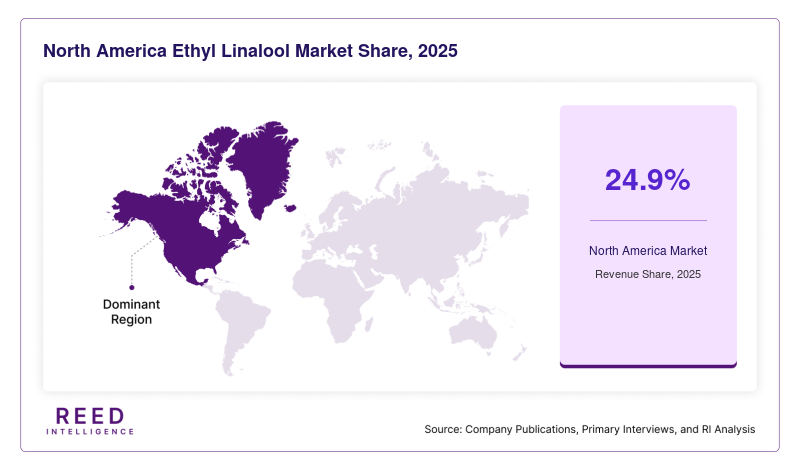
North America accounted for 24.9% of the Ethyl Linalool Market in 2025. The region benefited from demand across personal care and household product manufacturing. The market is projected to grow at a CAGR of 6.7% through 2034. The United States remained the dominant country due to strong fragrance ingredient demand in consumer product manufacturing.
Europe
Europe represented 33.1% share of the Ethyl Linalool Market in 2025. Demand was supported by established fragrance formulation industries and specialty ingredient production. The region is expected to expand at 6.6% CAGR. Germany remained the dominant country due to strong aroma chemical manufacturing and innovation activity.
Asia Pacific
Asia Pacific held 25.6% share in 2025 and is projected to register the fastest CAGR of 8.5% during the forecast period. Growth will be supported by expanding personal care manufacturing and rising demand for fragrance ingredients. China remained the dominant country due to broad growth in consumer goods production.
Middle East & Africa
Middle East & Africa accounted for 8.3% share in 2025. The market was supported by increasing use of fragrance ingredients in consumer product formulations. The region is projected to grow at 7.3% CAGR through 2034. United Arab Emirates remained the dominant country due to growing demand linked to fragrance-oriented consumer products.
Latin America
Latin America captured 8.1% share in 2025. Demand was driven by personal care product growth and rising use of fragrance ingredients. The region is forecast to grow at 7.1% CAGR. Brazil remained the dominant country due to expanding cosmetics production supporting ingredient demand.
Competitive Landscape
The Ethyl Linalool Market remains moderately competitive, with global aroma chemical manufacturers competing through product purity, fragrance formulation support, and specialty ingredient innovation. Companies continue to focus on sustainable sourcing strategies, bio-based product development, and broader application support across consumer product markets.
BASF remained a leading participant due to its broad aroma ingredient portfolio and established global supply network. A recent development included expansion of specialty fragrance ingredient offerings designed to support premium formulation requirements.
Other major participants including Symrise, Givaudan, Firmenich, and Takasago continue investing in aroma compound development, regional expansion, and differentiated sensory ingredient solutions. Competition is also increasing from regional producers focused on cost-competitive supply and application-specific ingredient offerings. Manufacturers are strengthening focus on specialty grades, regulatory alignment, and innovation supporting evolving fragrance formulation trends.
Key Players List
- BASF SE
- Symrise AG
- Givaudan SA
- Firmenich SA
- Takasago International Corporation
- International Flavors & Fragrances Inc.
- Sensient Technologies Corporation
- Mane SA
- Robertet Group
- Treatt Plc
- Privi Speciality Chemicals Ltd.
- Eternis Fine Chemicals Ltd.
- Zhejiang NHU Co. Ltd.
- Tokyo Chemical Industry Co. Ltd.
- Augustus Oils Ltd.
Recent Developments
- Manufacturers introduced higher purity ethyl linalool grades for premium fragrance applications.
- Several companies expanded bio-based aroma ingredient development programs.
- Product launches focused on specialty fragrance compounds for layered scent formulations.
- Producers increased investment in sustainable sourcing initiatives for aroma chemical inputs.
- Companies expanded formulation support services targeting personal care manufacturers.
- Regional suppliers broadened production capacity to support growing demand in emerging markets.
- Aroma ingredient suppliers introduced updated solutions for household care product formulations.
- Companies increased research activity around specialty fragrance performance enhancement.
- Several participants expanded distribution partnerships to improve ingredient access.
- Manufacturers introduced differentiated aroma ingredient portfolios targeting premium consumer products.
- Producers launched updated regulatory-compliant ingredient solutions for evolving formulation standards.
Ethyl Linalool Market Segments
Product Type
- Synthetic Ethyl Linalool
- Bio-Based Ethyl Linalool
Application
- Fragrances and Perfumes
- Personal Care Formulations
- Household Care Products
- Flavor Applications
End Use
- Cosmetics and Personal Care
- Household Care
- Food and Flavor Manufacturers
- Specialty Chemical Users
Distribution Channel
- Direct Supply Agreements
- Specialty Chemical Distributors
- Online Chemical Platforms
- Regional Ingredient Traders
By Region
- North America
- Europe
- APAC
- Middle East and Africa
- LATAM