Ethylene Bis Stearamide Market Size, Share Demand Report By Type (Amide-Based EBS, Modified EBS), By Application (Plastics, Rubber, Coatings & Inks, Others), By End-Use Industry (Packaging, Automotive, Construction, Consumer Goods, Others), By Region & Segment Forecasts, 2025–2034
USD 3950
Market Overview
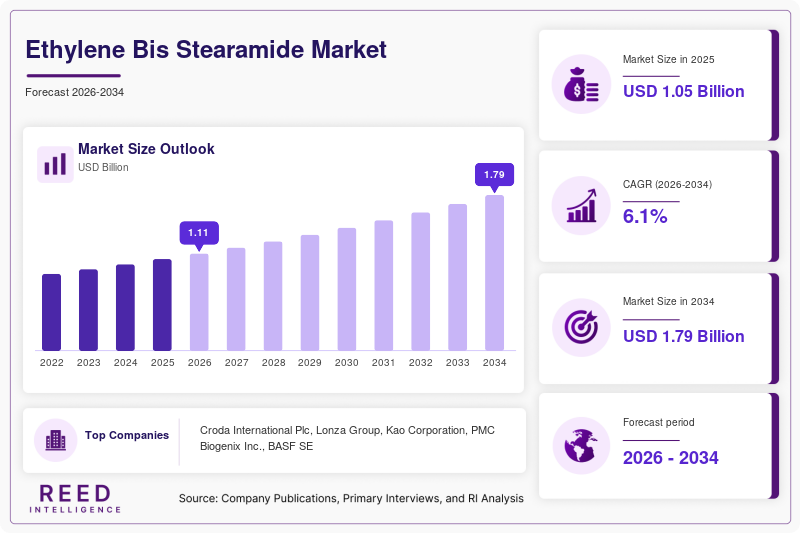
The global Ethylene Bis Stearamide Market size was valued at approximately USD 1.05 billion in 2025 and is estimated to reach USD 1.12 billion in 2026. Over the forecast period from 2025 to 2034, the market is projected to grow at a compound annual growth rate (CAGR) of 6.1%, reaching nearly USD 1.85 billion by 2034. This growth trajectory reflects increasing industrial demand and expanding applications in plastics, rubber, coatings, and personal care formulations.
One of the key growth factors driving the market is the rising demand for high-performance additives in polymer processing. Ethylene bis stearamide (EBS) improves flow properties, reduces friction, and enhances surface finish, making it an essential additive in plastic manufacturing. As industries seek higher productivity and product quality, the demand for efficient processing aids continues to increase.
Key Highlights
- Market size reached USD 1.05 billion in 2025 and is expected to grow to USD 1.12 billion in 2026.
This growth reflects steady demand across key industrial applications and consistent expansion in manufacturing activities. - The market is projected to reach approximately USD 1.85 billion by 2034.
This long-term growth outlook highlights increasing adoption across plastics, coatings, and specialty chemical sectors. - The market is expected to register a CAGR of 6.1% during the forecast period from 2025 to 2034.
This consistent growth rate indicates stable demand supported by industrial expansion and technological advancements. - Rising demand from plastics and packaging industries is a key factor driving market expansion.
EBS is widely used to improve processing efficiency and surface quality in plastic-based products.
Market Trends
Increasing Adoption in Biodegradable and Sustainable Plastics
A notable trend in the Ethylene Bis Stearamide Market is the growing use of EBS in biodegradable and sustainable plastic formulations. As environmental concerns intensify, manufacturers are shifting toward eco-friendly materials that maintain performance standards while reducing environmental impact. EBS is increasingly used as a processing aid in bio-based polymers, helping improve dispersion and surface quality without compromising biodegradability. This trend is particularly strong in regions with strict environmental regulations, where companies are actively investing in green material innovation. The ability of EBS to enhance the processability of renewable polymers positions it as a valuable additive in sustainable manufacturing.
Expansion of High-Performance Coatings and Inks Applications
Another emerging trend is the increasing utilization of EBS in coatings, inks, and surface treatments. The compound acts as a slip agent and anti-blocking additive, improving the performance and finish of coatings used in industrial and commercial applications. With the growth of digital printing, flexible packaging, and specialty coatings, the demand for high-quality additives is rising. EBS enhances abrasion resistance and reduces friction, making it suitable for advanced coating technologies. This trend is gaining traction as manufacturers seek materials that provide both functional and aesthetic improvements, particularly in packaging and consumer goods sectors.
Market Drivers
Growth in Plastic Processing Industry
The expansion of the global plastic processing industry is a major driver of the Ethylene Bis Stearamide Market. EBS is widely used as a lubricant and dispersing agent in polymer manufacturing, helping improve flow characteristics and reduce processing time. As industries such as packaging, electronics, and consumer goods continue to grow, the demand for efficient processing additives is increasing. EBS enables manufacturers to achieve better product consistency and surface finish, which is essential for high-quality plastic products. This growing reliance on advanced additives is expected to sustain market growth over the forecast period.
Rising Demand from Automotive and Industrial Applications
The automotive and industrial sectors are contributing significantly to the demand for EBS-based additives. In automotive manufacturing, EBS is used in plastic components to improve durability, reduce friction, and enhance thermal stability. As vehicle production increases globally, particularly in emerging markets, the demand for high-performance materials is rising. Similarly, industrial applications such as rubber processing and metal coatings benefit from the lubricating properties of EBS. The need for materials that can withstand harsh conditions while maintaining performance is driving adoption across these sectors.
Market Restraint
Volatility in Raw Material Prices and Environmental Concerns
One of the key restraints affecting the Ethylene Bis Stearamide Market is the volatility in raw material prices. EBS is derived from fatty acids and ethylene diamine, both of which are subject to fluctuations in supply and pricing. These fluctuations can impact production costs and profit margins for manufacturers, creating uncertainty in the market. Additionally, environmental concerns related to chemical additives are prompting stricter regulations, particularly in developed regions. Compliance with these regulations may require additional investment in research and development, increasing operational costs. For example, manufacturers in Europe are required to meet stringent chemical safety standards, which can limit the use of certain additives. This combination of cost pressures and regulatory challenges may hinder market growth to some extent.
Market Opportunities
Emerging Demand in Developing Economies
Developing economies present significant growth opportunities for the Ethylene Bis Stearamide Market. Rapid industrialization and urbanization in regions such as Asia Pacific and Latin America are driving demand for plastics, rubber, and coatings. As manufacturing activities expand, the need for efficient processing additives is increasing. Governments in these regions are also investing in infrastructure and industrial development, further boosting demand for high-performance materials. Companies that establish a strong presence in these markets can benefit from rising consumption and favorable economic conditions.
Innovation in Specialty Additives and Customized Solutions
Another major opportunity lies in the development of specialty additives and customized EBS formulations. As industries become more specialized, there is a growing need for tailored solutions that meet specific performance requirements. Manufacturers are investing in research to develop advanced EBS variants with enhanced properties such as improved thermal stability, compatibility, and dispersion. These innovations can open new application areas and increase market penetration. The ability to offer customized solutions can also provide a competitive advantage, enabling companies to cater to niche markets and strengthen customer relationships.
Segmental Analysis
By Type
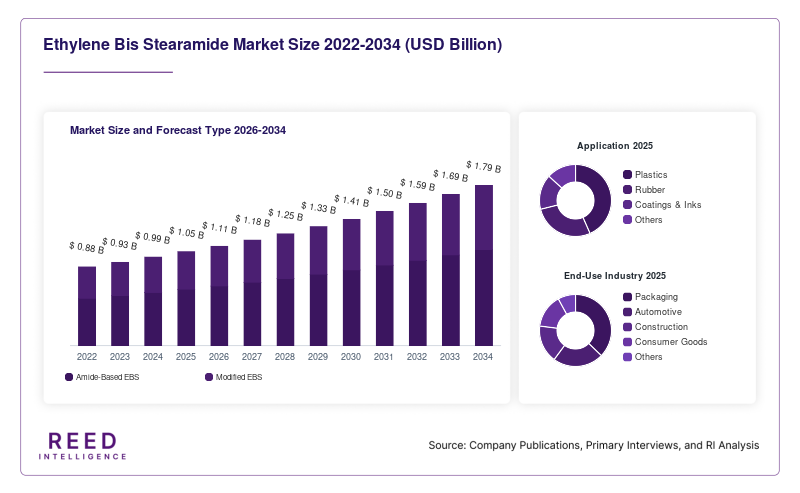
The amide-based EBS segment dominated the market in 2024, accounting for approximately 62% of the total share. This dominance is attributed to its superior lubricating and dispersing properties, which make it suitable for a wide range of applications. Amide-based EBS is widely used in plastics and rubber processing, where it enhances flow characteristics and reduces friction. The segment’s strong performance is also supported by its compatibility with various polymer systems, making it a preferred choice among manufacturers.
The modified EBS segment is expected to be the fastest-growing, with a CAGR of 6.8% during the forecast period. Growth in this segment is driven by increasing demand for customized additives that meet specific performance requirements. Modified EBS offers enhanced properties such as improved thermal stability and dispersion, making it suitable for advanced applications. The growing focus on innovation and product differentiation is expected to drive demand in this segment.
By Application
The plastics segment held the largest share in 2024, accounting for around 55% of the market. EBS is extensively used in plastic processing as a lubricant and release agent, improving surface finish and reducing production defects. The segment’s dominance is driven by the widespread use of plastics in packaging, automotive, and consumer goods industries. Increasing demand for high-quality plastic products is further supporting growth in this segment.
The coatings and inks segment is projected to grow at the fastest CAGR of 6.5% over the forecast period. Growth is driven by the increasing use of EBS as a slip agent and anti-blocking additive in coatings. The expansion of the printing and packaging industries is also contributing to demand. Manufacturers are focusing on developing high-performance coatings, which is expected to drive adoption of EBS in this segment.
By End-Use Industry
The packaging industry dominated the market in 2024, accounting for approximately 48% of the total share. The high demand for plastic packaging materials is a key factor driving this segment. EBS is used to improve the processability and durability of packaging products, making it an essential additive. The growth of e-commerce and increasing consumption of packaged goods are further supporting demand.
The automotive industry is expected to be the fastest-growing segment, with a CAGR of 6.7%. Growth is driven by increasing vehicle production and the demand for high-performance materials. EBS is used in automotive components to enhance durability and reduce friction. The shift toward lightweight materials and improved fuel efficiency is also contributing to the growth of this segment.
Regional Analysis
North America
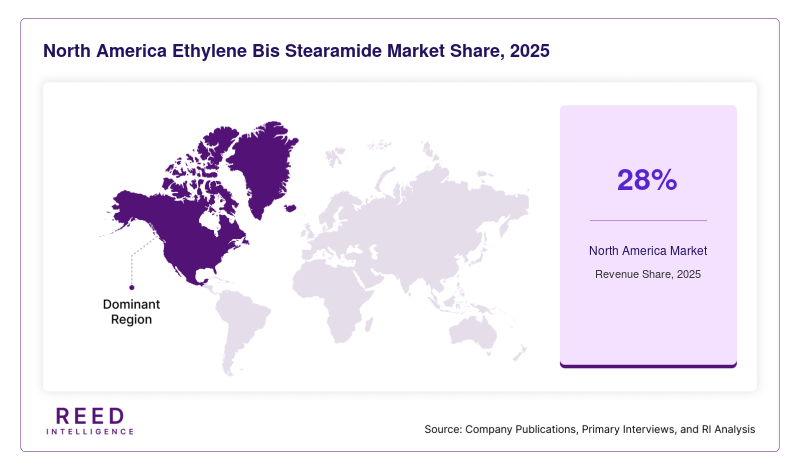
North America accounted for a significant share of the Ethylene Bis Stearamide Market in 2025, contributing approximately 28% of global revenue. The region is expected to grow at a CAGR of around 5.5% during the forecast period. Strong demand from the plastics and packaging industries, coupled with advanced manufacturing capabilities, is supporting market growth. The presence of established players and continuous technological advancements further contribute to the region’s stable market position.
The United States dominates the North American market, driven by its well-developed industrial base and high demand for specialty chemicals. A key growth factor in the country is the increasing adoption of advanced polymer processing technologies. Manufacturers are focusing on improving production efficiency and product quality, which is driving the use of EBS as a processing aid. This trend is expected to sustain demand in the coming years.
Europe
Europe held a market share of approximately 24% in 2025 and is projected to grow at a CAGR of 5.2% through 2034. The region’s growth is influenced by stringent environmental regulations and a strong focus on sustainable materials. Industries are increasingly adopting eco-friendly additives, which is driving demand for EBS in biodegradable plastic formulations.
Germany is the leading market in Europe, supported by its robust automotive and industrial sectors. A unique growth factor in the country is the emphasis on high-quality engineering and material innovation. Manufacturers are investing in advanced additives to enhance product performance and meet regulatory standards. This focus on quality and sustainability is expected to drive continued demand for EBS.
Asia Pacific
Asia Pacific dominated the Ethylene Bis Stearamide Market in 2025, accounting for nearly 32% of global share, and is expected to grow at a CAGR of 7.2%. Rapid industrialization, expanding manufacturing activities, and increasing demand for plastics and rubber products are key factors driving growth in the region.
China is the dominant country in Asia Pacific, driven by its large-scale manufacturing sector. A major growth factor is the country’s expanding packaging industry, which is fueled by rising consumer demand and e-commerce growth. The need for high-quality plastic materials is increasing, boosting the demand for EBS as a processing additive.
Middle East & Africa
The Middle East & Africa region accounted for around 8% of the market share in 2025 and is expected to grow at a CAGR of 6.0%. The region’s growth is supported by increasing industrialization and investments in infrastructure development. Demand for plastics and coatings is rising, particularly in construction and packaging applications.
Saudi Arabia is a key market in the region, benefiting from its strong petrochemical industry. A unique growth factor is the availability of raw materials, which supports local production of chemical additives. This advantage is helping manufacturers reduce costs and expand their market presence.
Latin America
Latin America held a market share of approximately 8% in 2025 and is projected to grow at a CAGR of 5.8%. The region’s growth is driven by increasing demand for plastic products and expanding industrial activities. Economic development and rising consumer spending are also contributing to market expansion.
Brazil leads the Latin American market, supported by its growing manufacturing sector. A key growth factor is the increasing demand for packaging materials in the food and beverage industry. As consumption of packaged goods rises, the need for efficient processing additives such as EBS is also increasing.
Competitive Landscape
The Ethylene Bis Stearamide Market is moderately fragmented, with several global and regional players competing based on product quality, innovation, and pricing strategies. Leading companies are focusing on expanding their product portfolios and investing in research and development to enhance performance characteristics. Strategic collaborations and capacity expansions are also common approaches adopted by market participants.
One of the leading players in the market is Croda International Plc, which has a strong presence in specialty chemicals and additives. The company recently introduced a new range of high-performance EBS products designed for advanced polymer applications. Other key players are also investing in sustainable solutions to meet evolving regulatory requirements and customer preferences. The competitive environment is expected to remain dynamic, with companies focusing on innovation and market expansion.
Key Players List
- Croda International Plc
- Lonza Group
- Kao Corporation
- PMC Biogenix Inc.
- BASF SE
- Clariant AG
- Evonik Industries AG
- Fine Organic Industries Ltd.
- Struktol Company of America
- Akzo Nobel N.V.
- Arkema S.A.
- LANXESS AG
- Huntsman Corporation
- Mitsubishi Chemical Group
- Nouryon
Recent Developments
- In 2024, a major chemical manufacturer expanded its production capacity for EBS in Asia Pacific to meet rising regional demand.
- In 2025, a leading company launched a bio-based EBS variant aimed at sustainable plastic applications.
- In 2025, several market players entered strategic partnerships to develop advanced additives for high-performance coatings and polymers.
Ethylene Bis Stearamide Market Segments
Type
- Amide-Based EBS
- Modified EBS
Application
- Plastics
- Rubber
- Coatings & Inks
- Others
End-Use Industry
- Packaging
- Automotive
- Construction
- Consumer Goods
- Others
By Region
- North America
- Europe
- APAC
- Middle East and Africa
- LATAM