Ethylene Urea Market Size, Share & Demand Report By Form (Solid Ethylene Urea, Liquid Ethylene Urea), By Application (Agriculture, Industrial Resins, Coatings & Adhesives), By End-Use Industry (Agriculture, Construction, Chemical Manufacturing), By Distribution Channel (Direct Sales, Distributors & Dealers, Online Channels), By Region & Segment Forecasts, 2026–2034
USD 3950
Market Overview
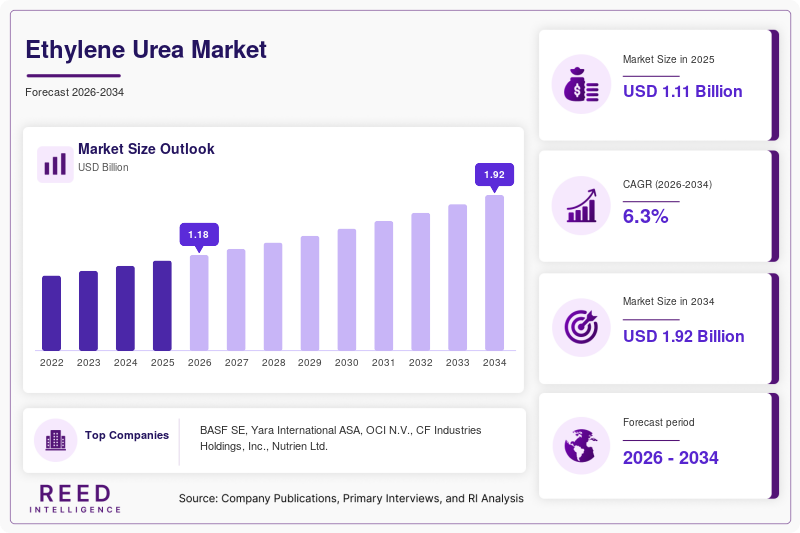
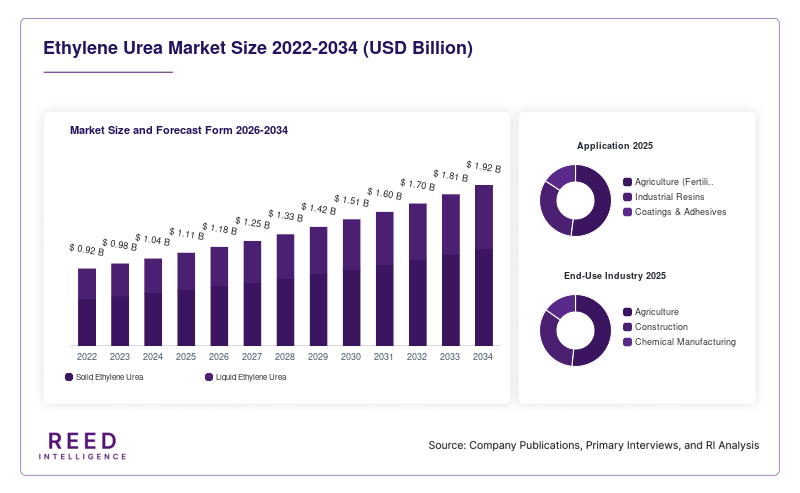
The global Ethylene Urea Market size was estimated at USD 1.18 billion in 2026 and is projected to reach approximately USD 1.92 billion by 2034, expanding at a CAGR of 6.3% during the forecast period (2026–2034). Ethylene urea, a nitrogen-rich compound widely used in agriculture, industrial resins, and specialty chemicals, continues to gain traction due to its functional versatility and controlled-release properties.
A key global factor supporting the growth of the Ethylene Urea Market is the increasing demand for high-efficiency fertilizers that enhance crop productivity while reducing environmental impact. Governments and agricultural bodies worldwide are encouraging the use of nitrogen stabilizers and slow-release fertilizers, which has directly boosted demand for ethylene urea-based formulations.
Key Highlights:
- Asia Pacific dominated the market with a 41.6% share in 2025 and will remain the fastest-growing region with a CAGR of 7.1%
- Agriculture application led with a 52.4% share, while industrial resins will grow at a CAGR of 6.8%
- Solid ethylene urea held the largest share at 63.2%, while liquid forms will grow at a CAGR of 6.6%
- China, the dominant country, recorded USD 312 million in 2024 and USD 335 million in 2025
Market Trends
Shift Toward Sustainable Fertilizer Solutions
The Ethylene Urea Market is witnessing a clear transition toward sustainable and environmentally efficient fertilizer solutions. Ethylene urea is increasingly used in slow-release fertilizers that minimize nitrogen loss through volatilization and leaching. This aligns with global sustainability goals and stricter agricultural regulations. Farmers are adopting these formulations to improve nutrient efficiency and crop yield, especially in regions facing soil degradation and water scarcity. This trend is expected to strengthen as climate-resilient farming practices become more mainstream.
Expansion in Specialty Chemical Applications
Another notable trend shaping the Ethylene Urea Market is the growing use of the compound in specialty chemical formulations. Ethylene urea is being incorporated into resins, coatings, and adhesives due to its thermal stability and cross-linking properties. Industrial sectors such as construction, automotive, and packaging are driving demand for these advanced materials. Manufacturers are investing in R&D to enhance product performance, which is accelerating innovation in high-value applications. This diversification beyond agriculture is broadening the market scope and improving profit margins for producers.
Market Drivers
Increasing Demand for High-Efficiency Fertilizers
The growing need to improve agricultural productivity is a major driver of the Ethylene Urea Market. With global population growth putting pressure on food supply chains, farmers are seeking fertilizers that offer better nutrient utilization. Ethylene urea provides controlled nitrogen release, reducing wastage and improving crop yields. This has made it a preferred choice in modern farming systems. Additionally, government incentives promoting efficient fertilizer use are further strengthening demand.
Growth of Industrial Resin and Adhesive Applications
The expansion of industrial sectors such as construction and automotive is driving the demand for ethylene urea in resin and adhesive formulations. Its chemical properties make it suitable for enhancing durability and performance in end products. Increasing infrastructure development and manufacturing activities are contributing to higher consumption. This industrial demand is complementing agricultural usage, thereby supporting overall market growth.
Market Restraint
Volatility in Raw Material Prices
One of the key challenges faced by the Ethylene Urea Market is the fluctuation in raw material prices. Ethylene and urea, the primary inputs, are subject to price volatility due to changes in crude oil markets and supply chain disruptions. This affects production costs and profit margins for manufacturers. Additionally, price instability can lead to inconsistent product pricing, impacting adoption rates among end users. Smaller manufacturers are particularly vulnerable to these fluctuations, which may limit market expansion in certain regions.
Market Opportunities
Rising Adoption in Emerging Agricultural Economies
Emerging economies in Asia, Africa, and Latin America present significant growth opportunities for the Ethylene Urea Market. Increasing awareness about advanced fertilizers and government support for agricultural modernization are driving adoption. These regions are experiencing rapid growth in crop production, creating strong demand for efficient nutrient solutions.
Innovation in Controlled-Release Formulations
Technological advancements in fertilizer formulation are creating new opportunities for market players. The development of advanced controlled-release and coated ethylene urea products is gaining attention. These innovations improve nutrient delivery efficiency and reduce environmental impact. Companies investing in product innovation are likely to gain a competitive edge and expand their market presence.
Segmental Analysis
By Form
The solid form segment dominated the Ethylene Urea Market with a 63.2% share in 2025. Its widespread use in agricultural applications, ease of storage, and longer shelf life contributed to its dominance. Solid ethylene urea is preferred for bulk fertilizer production and distribution.
The liquid form segment is expected to grow at a CAGR of 6.6% during the forecast period. Its increasing use in precision agriculture and fertigation systems will drive growth. Liquid formulations offer better absorption and uniform nutrient distribution, making them suitable for advanced farming techniques.
By Application
The agriculture segment held the largest share of 52.4% in 2025. The use of ethylene urea in fertilizers and soil conditioners drove its dominance. Farmers prefer it for its ability to enhance nitrogen efficiency and improve crop yields.
The industrial resins segment is projected to grow at a CAGR of 6.8%. The increasing demand for high-performance materials in construction and manufacturing will support growth. Ethylene urea’s role in improving resin properties is a key factor driving adoption.
By End-Use Industry
The agriculture industry dominated the Ethylene Urea Market in 2025, accounting for 48.7% of the share. The rising demand for food production and efficient fertilizers contributed to its leading position.
The construction industry is expected to grow at a CAGR of 6.7% during the forecast period. The use of ethylene urea in adhesives and coatings for construction applications will drive demand. Infrastructure development projects are supporting this growth.
By Distribution Channel
The direct sales segment held the largest share of 58.1% in 2025. Manufacturers prefer direct distribution to maintain pricing control and ensure consistent supply to large buyers such as agricultural cooperatives and industrial clients.
The online distribution segment is projected to grow at a CAGR of 7.0%. Increasing digitalization and the adoption of e-commerce platforms in the chemical industry will drive this growth. Online channels provide convenience and wider market reach.
Regional Analysis
North America
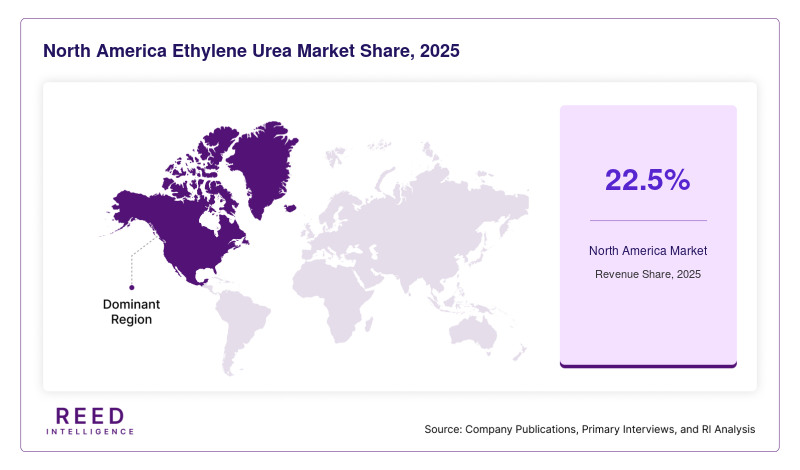
North America accounted for 22.5% of the Ethylene Urea Market share in 2025 and is expected to grow at a CAGR of 5.8% during the forecast period. The region’s growth will be driven by advanced agricultural practices and increasing adoption of precision farming technologies.
The United States dominated the regional market due to its strong focus on sustainable agriculture. Farmers are increasingly adopting slow-release fertilizers to optimize yields and reduce environmental impact. The presence of established chemical manufacturers also supports market expansion.
Europe
Europe held a 19.3% share of the Ethylene Urea Market in 2025 and is projected to grow at a CAGR of 5.6% through 2034. Strict environmental regulations and sustainability initiatives will drive the adoption of eco-friendly fertilizers in the region.
Germany led the market due to its strong industrial base and emphasis on green chemical solutions. The country’s focus on reducing nitrogen emissions is encouraging the use of controlled-release fertilizers, boosting demand for ethylene urea.
Asia Pacific
Asia Pacific dominated the Ethylene Urea Market with a 41.6% share in 2025 and is expected to grow at the fastest CAGR of 7.1% during the forecast period. Rapid agricultural expansion and population growth will drive demand for efficient fertilizers.
China emerged as the leading country, supported by large-scale agricultural production and government initiatives to improve fertilizer efficiency. The country’s expanding industrial sector also contributes to increased consumption of ethylene urea in chemical applications.
Middle East & Africa
The Middle East & Africa region accounted for 8.4% of the Ethylene Urea Market share in 2025 and is projected to grow at a CAGR of 6.2%. Increasing investments in agriculture and infrastructure development will support market growth.
Saudi Arabia dominated the region due to its strong petrochemical industry, which provides a steady supply of raw materials. The country is also investing in agricultural diversification, creating additional demand for fertilizers.
Latin America
Latin America held an 8.2% share of the Ethylene Urea Market in 2025 and is expected to grow at a CAGR of 6.5%. The region’s growth will be driven by expanding agricultural activities and increasing export-oriented crop production.
Brazil led the market due to its large agricultural sector and focus on improving crop yields. The adoption of advanced fertilizers is increasing as farmers seek to enhance productivity and meet global demand.
Competitive Landscape
The Ethylene Urea Market is moderately competitive, with several global and regional players focusing on product innovation and capacity expansion. Leading companies are investing in research and development to enhance product efficiency and expand application areas.
A key market leader is BASF SE, which continues to strengthen its position through advanced fertilizer solutions and specialty chemical innovations. The company recently expanded its production capabilities to meet growing demand in Asia Pacific.
Other major players are focusing on strategic partnerships and regional expansions to increase their market share. The competitive environment is characterized by continuous innovation and efforts to improve product sustainability.
Key Players List
- BASF SE
- Yara International ASA
- OCI N.V.
- CF Industries Holdings, Inc.
- Nutrien Ltd.
- SABIC
- Koch Industries, Inc.
- EuroChem Group
- Uralchem Group
- IFFCO
- Coromandel International Limited
- Haifa Group
- Sinofert Holdings Limited
- Gujarat State Fertilizers & Chemicals Ltd.
- Qatar Fertiliser Company
Recent Developments
- 2025: BASF SE expanded its fertilizer additive production capacity in Asia
- 2024: Yara International introduced a new controlled-release fertilizer formulation
- 2025: Nutrien Ltd. invested in digital agriculture platforms to support product adoption
- 2024: SABIC launched advanced resin solutions incorporating ethylene urea
- 2025: OCI N.V. strengthened its distribution network in emerging markets
Ethylene Urea Market Segments
Form
- Solid Ethylene Urea
- Liquid Ethylene Urea
Application
- Agriculture (Fertilizers & Soil Conditioners)
- Industrial Resins
- Coatings & Adhesives
End-Use Industry
- Agriculture
- Construction
- Chemical Manufacturing
Distribution Channel
- Direct Sales
- Distributors & Dealers
- Online Channels
By Region
- North America
- Europe
- APAC
- Middle East and Africa
- LATAM