Ethylenevinyl Acetate EVA Infusion Bag Market Size, Share Demand Report By Product Type (Single-Chamber Infusion Bags, Multi-Chamber Infusion Bags), By Application (Parenteral Nutrition, Chemotherapy), By End User (Hospitals, Ambulatory Surgical Centers), By Material Structure (Single-Layer EVA, Multilayer EVA, EVA Composite Films), By Distribution Channel (Direct Sales, Distributors), By Region & Segment Forecasts, 2026–2034
USD 3950
Market Overview
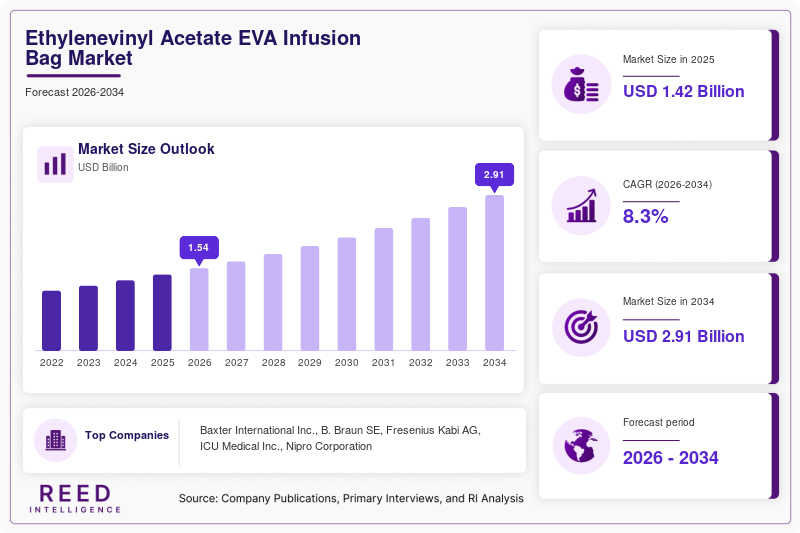
The Ethylenevinyl Acetate Eva Infusion Bag market was valued at approximately USD 1.42 billion in 2026 and is projected to reach nearly USD 2.68 billion by 2034, expanding at a CAGR of 8.3% during the forecast period from 2026 to 2034. The global Ethylenevinyl Acetate Eva Infusion Bag market continued to gain momentum due to the growing use of advanced medical infusion systems across hospitals, ambulatory surgical centers, and home healthcare environments. EVA infusion bags have become widely adopted because they provide high flexibility, chemical resistance, lightweight handling, and improved compatibility with sensitive pharmaceutical formulations.
One of the major global factors supporting the growth of the Ethylenevinyl Acetate Eva Infusion Bag market has been the continuous expansion of intravenous therapy procedures worldwide. The rising number of chronic disease patients requiring long-term drug administration, nutritional infusion, chemotherapy, and parenteral treatments has significantly increased demand for high-performance infusion packaging solutions. Healthcare providers have increasingly shifted toward non-PVC and latex-free infusion products due to environmental concerns and patient safety requirements. This transition has strengthened the adoption of EVA infusion bags across both developed and developing healthcare systems.
Key Highlights
- North America accounted for nearly 36.8% of the global Ethylenevinyl Acetate Eva Infusion Bag market share in 2025, while Asia Pacific is projected to register the fastest CAGR of 9.6% during the forecast period.
- By product type, single-chamber EVA infusion bags held the leading share of 48.4% in 2025, whereas multi-chamber infusion bags are anticipated to expand at a CAGR of 10.1% through 2034.
- By application, parenteral nutrition remained the dominant segment with 33.7% market share in 2025, while oncology drug infusion applications are expected to witness the fastest growth rate of 10.4%.
- By end user, hospitals accounted for 54.2% of the global market share in 2025, whereas home healthcare settings are forecast to grow at a CAGR of 11.2%.
- The United States represented the dominant country market with values of USD 352 million in 2024 and USD 381 million in 2025 due to extensive intravenous therapy adoption and strong pharmaceutical manufacturing infrastructure.
Market Trends
Growing Shift Toward Non-PVC Medical Packaging
The healthcare industry has increasingly adopted non-PVC medical packaging materials to reduce risks associated with plasticizer migration and chemical contamination. This trend has significantly supported the expansion of the Ethylenevinyl Acetate Eva Infusion Bag market. Hospitals and pharmaceutical manufacturers have shown rising preference for EVA-based infusion systems because these bags provide improved biocompatibility and reduced interaction with sensitive medications. Regulatory agencies in multiple countries have also encouraged the use of safer and recyclable medical packaging materials, which has accelerated the transition from traditional PVC infusion products to EVA-based alternatives.
Manufacturers are investing in sustainable production technologies and recyclable polymer innovations to align with environmental healthcare objectives. As a result, demand for eco-conscious infusion packaging solutions continues to rise among healthcare providers and pharmaceutical companies.
Increasing Demand for Multi-Chamber Infusion Systems
The adoption of multi-chamber infusion systems has emerged as another major trend shaping the Ethylenevinyl Acetate Eva Infusion Bag market. Multi-chamber bags enable separate storage of incompatible ingredients until administration, improving drug stability and reducing contamination risks. Healthcare facilities are increasingly utilizing these systems for parenteral nutrition, critical care therapy, and complex drug administration procedures.
Pharmaceutical manufacturers are also focusing on ready-to-use infusion formulations to reduce preparation time in hospitals and improve operational efficiency. The convenience offered by multi-chamber EVA infusion bags has strengthened their adoption in emergency care units, intensive care environments, and specialty clinics. Continuous product innovations in compartmentalized infusion systems are expected to further support market growth throughout the forecast period.
Market Drivers
Rising Prevalence of Chronic Diseases Requiring Intravenous Therapies
The increasing prevalence of chronic diseases such as cancer, diabetes, gastrointestinal disorders, and kidney diseases has substantially driven the Ethylenevinyl Acetate Eva Infusion Bag market. Patients suffering from these conditions often require long-term intravenous drug administration, parenteral nutrition, and fluid management therapies. This has generated sustained demand for reliable and sterile infusion packaging solutions.
Healthcare providers have increasingly prioritized infusion systems that offer reduced contamination risk and enhanced patient safety. EVA infusion bags provide superior flexibility and compatibility with multiple pharmaceutical compounds, making them suitable for advanced therapeutic procedures. The rising global burden of chronic illnesses is therefore expected to continue supporting market expansion.
Expansion of Biopharmaceutical Manufacturing Activities
The rapid growth of the biopharmaceutical industry has also emerged as a strong market driver. Pharmaceutical companies involved in biologics production require highly stable and chemically resistant infusion packaging systems to preserve product integrity. EVA infusion bags have become widely preferred because they offer low extractable levels and improved stability for temperature-sensitive formulations.
Increasing investments in vaccine manufacturing, injectable therapeutics, and specialty pharmaceutical products have contributed to greater demand for sterile infusion containers. In addition, contract manufacturing organizations have expanded production capacities for infusion-related pharmaceutical products, creating additional growth opportunities for EVA infusion bag manufacturers.
Market Restraint
High Manufacturing and Sterilization Costs
One of the major restraints affecting the Ethylenevinyl Acetate Eva Infusion Bag market is the relatively high manufacturing and sterilization cost associated with advanced medical-grade polymer materials. EVA infusion bags require specialized production environments, strict quality control systems, and sterilization technologies to comply with healthcare regulations. These factors increase operational expenses for manufacturers.
Small and regional manufacturers often face challenges in maintaining competitive pricing while meeting stringent regulatory standards. Additionally, fluctuations in raw material prices and supply chain disruptions may impact profit margins within the industry.
Market Opportunities
Increasing Adoption of Home Healthcare Services
The rapid expansion of home healthcare services presents significant opportunities for the Ethylenevinyl Acetate Eva Infusion Bag market. Patients increasingly prefer home-based intravenous therapy and nutritional support due to lower hospitalization costs and improved convenience. This trend has encouraged healthcare providers to adopt portable, lightweight, and easy-to-handle infusion systems.
Manufacturers are developing user-friendly EVA infusion bags with enhanced portability and simplified administration features to support home treatment programs. The rising aging population and increasing prevalence of chronic conditions are expected to further strengthen this opportunity.
Emerging Demand from Developing Healthcare Economies
Developing economies across Asia Pacific, Latin America, and parts of Africa are investing heavily in healthcare infrastructure modernization. This has created strong demand for advanced infusion systems and sterile medical consumables. Governments are expanding hospital capacities and improving access to intravenous treatment services, which is expected to increase the adoption of EVA infusion bags.
International pharmaceutical companies are also entering emerging markets through local manufacturing partnerships and distribution agreements. These developments are likely to create long-term growth opportunities for market participants.
Segmental Analysis
By Product Type
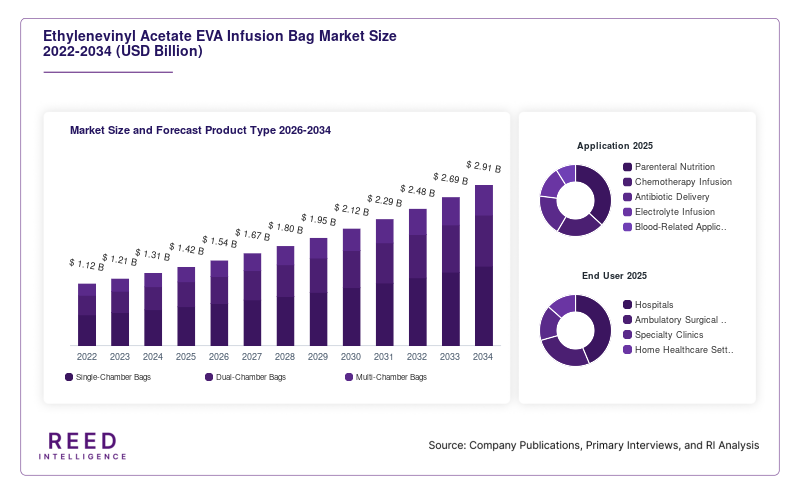
Based on product type, the Ethylenevinyl Acetate Eva Infusion Bag market is segmented into single-chamber bags, dual-chamber bags, and multi-chamber bags.
Single-chamber EVA infusion bags dominated the market with a share of 48.4% in 2025. Their widespread adoption in routine fluid administration and general intravenous therapies contributed significantly to segment growth. Hospitals preferred these bags because they offer lower handling complexity and cost-effective usage across high-volume healthcare settings.
Multi-chamber EVA infusion bags are expected to witness the fastest CAGR of 10.1% during the forecast period. The growing requirement for complex drug combinations and parenteral nutrition systems will support future growth. These bags provide enhanced storage flexibility and improved medication stability, making them suitable for advanced therapeutic applications.
By Application
Based on application, the market is categorized into parenteral nutrition, chemotherapy infusion, antibiotic delivery, electrolyte infusion, and blood-related applications.
Parenteral nutrition accounted for the largest market share of 33.7% in 2025 due to increasing use of intravenous nutritional support in intensive care and post-surgical recovery procedures. Healthcare providers increasingly relied on EVA infusion bags because they maintain nutrient stability and reduce contamination risks.
Chemotherapy infusion applications are projected to grow at the fastest CAGR of 10.4% through 2034. Rising cancer prevalence and expanding oncology treatment programs are expected to increase demand for safe and chemically resistant infusion systems. EVA infusion bags are increasingly preferred for oncology therapies because they provide compatibility with specialized drug formulations.
By End User
Based on end user, the Ethylenevinyl Acetate Eva Infusion Bag market is segmented into hospitals, ambulatory surgical centers, specialty clinics, and home healthcare settings.
Hospitals remained the dominant end-user segment with 54.2% market share in 2025. Large patient volumes, extensive intravenous therapy utilization, and increasing critical care admissions contributed to segment dominance. Hospitals also adopted advanced EVA infusion bags to improve treatment safety and operational efficiency.
Home healthcare settings are expected to register the fastest CAGR of 11.2% during the forecast period. The increasing preference for home-based infusion therapies and rising elderly population will support segment growth. Portable infusion systems and advancements in remote patient monitoring technologies are expected to further increase adoption rates.
By Capacity
Based on capacity, the market is segmented into below 250 ml, 250–500 ml, and above 500 ml.
The 250–500 ml segment held the largest share of 44.6% in 2025 because these bags are widely used across routine hydration therapies, antibiotic delivery, and nutritional applications. Their balanced storage capacity and operational convenience supported widespread healthcare adoption.
The above 500 ml segment is anticipated to grow at the fastest CAGR of 8.9% during the forecast period due to rising demand for long-duration infusion therapies and intensive care treatments. Increasing utilization in emergency medicine and nutritional support applications is expected to contribute to future segment growth.
Regional Analysis
North America
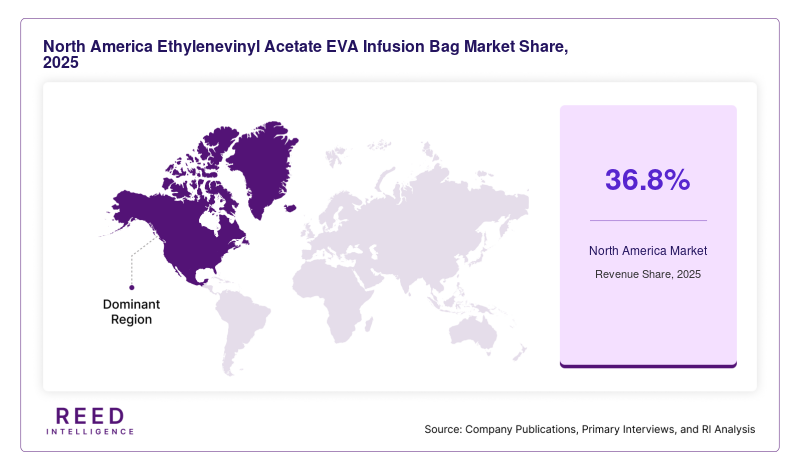
North America held approximately 36.8% of the global Ethylenevinyl Acetate Eva Infusion Bag market share in 2025. The region benefited from advanced healthcare infrastructure, high healthcare expenditure, and strong adoption of intravenous therapies. The United States remained the dominant country due to its extensive hospital network and increasing biologics manufacturing activities.
The region is expected to grow at a CAGR of 7.8% during the forecast period. The presence of major pharmaceutical manufacturers and rising adoption of specialized infusion therapies will continue supporting regional market expansion. Growing utilization of home infusion services in the United States is also expected to contribute to future demand.
Europe
Europe accounted for nearly 27.1% of the global Ethylenevinyl Acetate Eva Infusion Bag market share in 2025. Countries such as Germany, France, and the United Kingdom contributed significantly due to increasing healthcare modernization and rising demand for non-PVC medical products.
The regional market is projected to expand at a CAGR of 7.5% through 2034. Germany remained the dominant country market because of its strong medical device manufacturing ecosystem and increasing pharmaceutical packaging innovation. Rising emphasis on environmentally sustainable healthcare products is expected to support regional growth.
Asia Pacific
Asia Pacific represented around 23.4% of the global Ethylenevinyl Acetate Eva Infusion Bag market share in 2025. Rapid healthcare infrastructure expansion, increasing hospitalization rates, and growing pharmaceutical manufacturing capacities contributed to market growth across the region.
The region is forecast to witness the fastest CAGR of 9.6% during the forecast period. China remained the leading country market due to large-scale healthcare investments and expanding intravenous therapy utilization. Rising government support for domestic medical manufacturing and increasing chronic disease prevalence are expected to strengthen regional demand.
Middle East & Africa
The Middle East & Africa accounted for approximately 6.4% of the global market share in 2025. The regional market benefited from improving healthcare accessibility and growing investments in hospital infrastructure across Gulf countries.
The market in this region is anticipated to grow at a CAGR of 7.1% through 2034. Saudi Arabia emerged as the dominant country due to increasing healthcare digitization initiatives and rising specialty treatment facilities. Government-backed healthcare expansion projects are expected to support future adoption of EVA infusion bags.
Latin America
Latin America captured nearly 6.3% of the global Ethylenevinyl Acetate Eva Infusion Bag market share in 2025. Increasing public healthcare spending and expanding pharmaceutical distribution networks contributed to regional market development.
The market is projected to register a CAGR of 7.4% during the forecast period. Brazil remained the leading country market because of growing hospital admissions and rising demand for sterile infusion products. Expanding private healthcare investments are expected to further support market growth across the region.
Competitive Landscape
The competitive landscape of the Ethylenevinyl Acetate Eva Infusion Bag market remains moderately consolidated, with several global and regional manufacturers focusing on product innovation, sterile packaging technologies, and healthcare partnerships. Companies are investing in advanced polymer engineering and automated manufacturing systems to strengthen production efficiency and improve product quality.
Baxter International Inc. remained one of the leading market participants due to its broad infusion therapy portfolio and strong global distribution network. The company recently expanded its sterile IV solutions manufacturing capabilities to support increasing hospital demand for advanced infusion products.
Other major companies have focused on mergers, regional distribution expansion, and customized infusion system development to strengthen their market presence. Product differentiation through multilayer film technology and environmentally conscious manufacturing practices has become an important competitive strategy across the industry.
Key Players List
- Baxter International Inc.
- B. Braun SE
- Fresenius Kabi AG
- ICU Medical Inc.
- Renolit SE
- Technoflex
- Sippex IV Bag
- PolyCine GmbH
- Wipak Group
- Pfm Medical AG
- Otsuka Pharmaceutical Factory Inc.
- Shanghai Solve Care Co. Ltd.
- Angiplast Pvt. Ltd.
- Kraton Corporation
- Nipro Corporation
Recent Developments
- In 2025, Baxter International Inc. expanded IV solution manufacturing capacity to address rising hospital demand for sterile infusion products.
- In 2025, Fresenius Kabi AG introduced upgraded multilayer EVA infusion packaging systems designed for biologic drug compatibility.
- In 2024, B. Braun SE invested in sustainable medical packaging initiatives focused on recyclable infusion bag materials.
- In 2025, ICU Medical Inc. strengthened its infusion consumables distribution network across Asia Pacific healthcare markets.
- In 2024, Nipro Corporation launched advanced sterile infusion systems for specialty pharmaceutical applications.
Ethylenevinyl Acetate EVA Infusion Bag Market Segments
Product Type
- Single-Chamber Bags
- Dual-Chamber Bags
- Multi-Chamber Bags
Application
- Parenteral Nutrition
- Chemotherapy Infusion
- Antibiotic Delivery
- Electrolyte Infusion
- Blood-Related Applications
End User
- Hospitals
- Ambulatory Surgical Centers
- Specialty Clinics
- Home Healthcare Settings
Capacity
- Below 250 ml
- 250–500 ml
- Above 500 ml
By Region
- North America
- Europe
- APAC
- Middle East and Africa
- LATAM